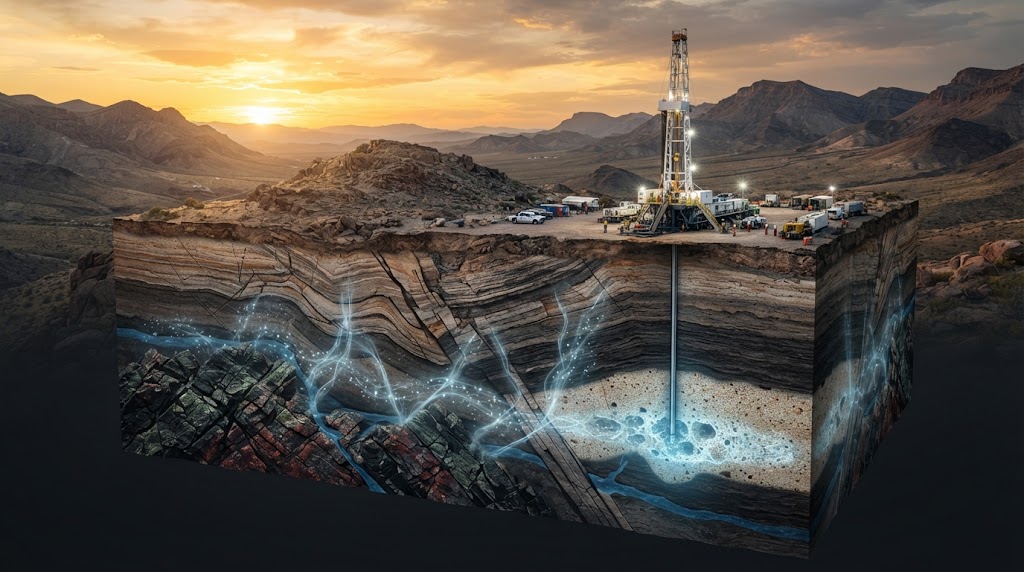
For decades, geologists assumed hydrogen was too reactive and too difficult to trap underground in useful quantities. Now prospectors in almost 30 countries are drilling for naturally occurring hydrogen—and a U.S. Geological Survey model suggests Earth's subsurface could contain an extraordinary amount of it. The unanswered question is whether any meaningful fraction can actually be produced economically.
Published: September 15, 2026
We Drilled for Oil for 150 Years—Were We Ignoring Hydrogen Under Our Feet?
Earth naturally manufactures hydrogen through reactions between water, iron-rich rock and radioactive minerals. Scientists once doubted enough could accumulate to matter. Now hundreds of millions of dollars are chasing a new possibility: what if some of tomorrow's low-carbon fuel can simply be drilled from underground?
By Climate, Energy & Science Desk | September 15, 2026
For more than a century, humans drilled deep into Earth looking for three things.
Oil.
Natural gas.
Coal.
We mapped sedimentary basins.
Built seismic surveys.
Drilled millions of wells.
And constructed a global energy economy around carbon-rich fuels buried underground.
But there may have been another energy resource beneath our feet that almost nobody was seriously trying to find.
Hydrogen.
Not hydrogen manufactured inside a chemical plant.
Not hydrogen made by splitting water with renewable electricity.
But molecular hydrogen created naturally inside Earth and accumulated underground.
The idea once sounded almost self-defeating.
Hydrogen is the smallest molecule.
It moves easily through tiny openings.
Microorganisms consume it.
It reacts with minerals.
For decades, many geologists assumed that even if Earth produced hydrogen naturally, the gas would escape or disappear before commercially useful reservoirs could develop.
That assumption is now being tested with drilling rigs.
A major Nature investigation published September 15 reports that companies and research groups are searching for geologic hydrogen in almost 30 countries, from Canada and Kansas to eastern Africa and South Australia.
Venture investors have put nearly $500 million into hydrogen exploration since 2023.
And behind the rush sits an extraordinary estimate.
A U.S. Geological Survey-led study calculated that Earth's subsurface could contain a most-probable in-place resource of about:
5.6 trillion tonnes of hydrogen.
That does not mean 5.6 trillion tonnes can be extracted.
Most almost certainly cannot.
But USGS researchers calculated that if even around 100 billion tonnes eventually proved recoverable, it could theoretically supply projected hydrogen demand associated with reaching net-zero emissions for roughly 200 years.
The numbers are enormous.
The uncertainty is even larger.
Which leads to the question at the centre of a new energy race:
Is natural hydrogen the beginning of another resource industry—or a geological curiosity surrounded by too much hype?
First: What Is Natural Hydrogen?
Natural hydrogen is simply H₂ gas that occurs naturally in Earth's subsurface.
Scientists also call it:
geologic hydrogen
or
geological hydrogen.
You may also see the terms:
white hydrogen
and
gold hydrogen.
Those colour names are informal industry labels rather than rigorous scientific classifications.
USGS generally uses geologic hydrogen.
The crucial difference is how the gas gets there.
Most hydrogen used by industry today has to be manufactured.
Natural hydrogen is produced by geological processes and can potentially accumulate underground in reservoirs in broadly the same sense that natural gas accumulates—although the geology may be very different.
If a commercial field exists, the basic idea becomes surprisingly familiar:
find the reservoir,
drill a well,
produce the gas,
separate impurities,
and transport the hydrogen to customers.
That sounds much more like the oil-and-gas industry than the giant electrolysers usually associated with the hydrogen economy.
Why Does Hydrogen Matter So Much?
Hydrogen already matters to industry.
It is used in:
oil refining,
ammonia and fertilizer production,
methanol,
chemical manufacturing,
and other industrial processes.
USGS says the world produced roughly 100 million tonnes of hydrogen in 2024, with less than 1% coming from low-carbon sources. Much conventional hydrogen is produced from methane or coal, generating substantial carbon dioxide emissions.
The climate challenge is therefore strange.
Hydrogen itself contains no carbon.
But making hydrogen can produce a lot of carbon.
That is why policymakers have invested heavily in alternatives.
Green hydrogen uses electricity—ideally renewable electricity—to split water through electrolysis.
Blue hydrogen typically starts with fossil gas but attempts to capture and store much of the resulting carbon dioxide.
Both require industrial processing.
Natural hydrogen raises a third possibility:
What if nature already did the manufacturing?
How Does Earth Make Hydrogen?
There is no single mechanism.
Two processes are particularly important.
1. Water meets iron-rich rock
This is often associated with serpentinization.
Certain rocks originating from Earth's mantle contain minerals rich in reduced iron.
When water interacts with these rocks under suitable conditions, iron is oxidized.
During the chemical reaction, water can be reduced and hydrogen gas can be released.
USGS identifies water-rock reactions involving iron-rich rocks as one of the principal mechanisms capable of producing natural hydrogen.
Think of the rock itself as participating in an enormous underground chemical reactor.
No wind turbine required.
No solar farm.
No electrolyser.
Just:
water,
reactive minerals,
heat,
pressure,
and geological time.
2. Natural Radioactivity Can Split Water
The second major mechanism is radiolysis.
Certain rocks contain radioactive elements such as:
uranium,
thorium,
and potassium.
As those elements decay naturally, radiation can interact with underground water.
That radiation can split water molecules and ultimately generate molecular hydrogen.
The process can operate over extraordinarily long periods.
In other words, part of Earth's hydrogen supply may be powered by the slow radioactive decay of ancient rocks.
That is a remarkable idea:
some underground hydrogen may effectively be the chemical product of geological time.
Making Hydrogen Is Only Half the Problem
Imagine Earth producing hydrogen deep underground.
That does not automatically make an energy resource.
The hydrogen has to survive.
A commercial geologic system needs several things.
A source that generates hydrogen.
A migration pathway allowing the gas to move.
A porous or fractured reservoir capable of storing it.
And ideally a low-permeability seal preventing it from escaping.
That framework looks familiar to petroleum geologists.
But hydrogen introduces new complications.
The molecule is extremely small.
It can diffuse through materials.
Microorganisms can consume it.
Hydrogen can react chemically with minerals or other substances.
And faults that help hydrogen travel upward can also become pathways that allow it to escape completely.
USGS says major uncertainties remain across virtually every stage of the natural-hydrogen system—from generation and migration to accumulation, preservation and recoverability.
Finding evidence that hydrogen exists underground is therefore much easier than proving that a profitable hydrogen field exists.
Mali Changed the Conversation
One of the most famous examples lies near Bourakébougou in Mali.
A water well drilled there in the 1980s unexpectedly encountered flammable gas.
Later investigation found that the shallow reservoir contained gas that was approximately:
98% hydrogen
with small amounts of nitrogen and methane.
Subsequent exploration identified hydrogen in numerous additional boreholes and several stacked reservoir intervals.
One well was used to generate electricity locally.
That mattered enormously to scientists.
It proved that natural hydrogen was not simply a trace gas occasionally detectable around rocks.
Under the right circumstances, it could:
accumulate,
remain trapped,
flow from a well,
and be used as an energy source.
Bourakébougou did not prove that giant commercial hydrogen fields exist everywhere.
But it demolished one of the field's most important assumptions.
Hydrogen really can accumulate underground.
Then Researchers Found an Extraordinary Hydrogen Flow in Albania
Another clue came from a chromite mine in Bulqizë, Albania.
Researchers reported in Science in 2024 that underground water pools and mine workings were releasing large quantities of hydrogen associated with deeply serpentinized rock.
Nature notes that researchers estimated the mine releases at least 200 tonnes of hydrogen per year, one of the largest measured natural hydrogen flows.
Again, that does not automatically make Bulqizë a commercial hydrogen field.
But it demonstrates something important:
Earth can generate and transport hydrogen at substantial rates in particular geological environments.
The question then becomes:
Where else is this happening without anybody noticing?
Why Didn't the Oil Industry Find It Decades Ago?
This might be the most intriguing question of all.
Humans have drilled millions of wells.
How could an entire potential energy resource remain largely overlooked?
Part of the answer is simple:
we were looking for something else.
Oil companies search for geological systems likely to contain petroleum.
Hydrogen can be generated in geological settings that are not conventional oil and gas targets.
USGS says historically, subsurface drilling often did not target hydrogen, companies did not always measure or preserve hydrogen data, and some of the most prospective geological environments differ from petroleum basins.
There is another technical problem.
Hydrogen can be difficult to sample accurately.
Drilling itself can produce or contaminate gas measurements.
Certain equipment may not have been designed to measure hydrogen.
Gas considered irrelevant to petroleum exploration might never receive much attention.
An oil explorer encountering hydrogen historically might therefore have thought:
wrong gas.
Today's hydrogen explorer may look at the same signal and think:
discovery.
The United States Is Now Mapping Where Hydrogen Might Hide
In 2025, the U.S. Geological Survey published its first publicly available geologic hydrogen prospectivity map for the contiguous United States.
Researchers combined information about:
potential hydrogen-generating rocks,
radiogenic rocks,
reservoirs,
seals,
faults,
and migration pathways.
Areas of interest include parts of:
Kansas,
Nebraska,
Oklahoma,
Texas,
Minnesota,
Michigan,
California,
and other regions with favourable geological features.
But a prospectivity map is not a reserve map.
It says:
this geology might work.
It does not say:
commercial hydrogen is definitely here.
That difference is now being tested by drilling.
And Drilling Is Already Producing Disappointing Results
This is where the story becomes much more credible—and much more interesting.
Exploration does not always work.
HyTerra has been drilling and testing for natural hydrogen and helium at its Nemaha Project in Kansas.
Its McCoy-1 well produced gas during testing this summer, but the recorded flow was too low to justify continued testing of that interval.
The company reported low gas saturation at the location and deferred testing of a second zone.
That is important evidence.
Natural hydrogen proponents often focus on spectacular theoretical resources.
Commercial energy projects live or die on something much less glamorous:
flow rate.
A reservoir might contain hydrogen.
But if the gas cannot flow rapidly enough through a well, the project may never make economic sense.
This is exactly what exploration drilling exists to discover.
Failure is data.
Other Companies Are Drilling Anyway
The disappointing result has not ended the Kansas race.
A separate partnership between H2Au and 45-8 Energy moved toward drilling two wells into structures associated with the Nemaha region, targeting hydrogen and helium resources and planning follow-up flow tests depending on initial results.
Elsewhere, companies are exploring in:
Canada,
Australia,
Africa,
Europe,
and other regions.
Nature reports that exploration is now under way or being pursued in almost 30 countries.
The next few years could therefore produce one of two very different stories.
Either drilling identifies several commercially productive hydrogen fields—
or the industry discovers that naturally occurring hydrogen is widespread but rarely concentrated enough to make money.
Both outcomes would teach geologists something important.
Is There Really 5.6 Trillion Tonnes Underground?
This number requires careful handling.
The USGS-led study did not discover 5.6 trillion tonnes.
Researchers built a probabilistic model based on hydrogen generation, loss and geological behaviour.
Their estimates covered an enormous uncertainty range.
The model's most probable value was approximately:
5.6 trillion tonnes.
But “in place” does not mean “recoverable.”
Oil provides an easy analogy.
A petroleum basin can contain huge quantities of hydrocarbons while only a fraction can be economically produced.
Hydrogen could be even more difficult.
Some may be:
too deep,
too dispersed,
too dilute,
too far from customers,
consumed by microbes,
lost through faults,
or trapped in formations where production rates are too low.
So the scientifically responsible interpretation is:
Earth might contain an enormous natural hydrogen endowment.
Not:
Humanity has discovered trillions of tonnes of cheap fuel.
We have not.
Is Natural Hydrogen Renewable?
Probably not in the way solar and wind are renewable.
This distinction is important.
Some early descriptions of natural hydrogen emphasized the possibility that underground systems continually recharge.
Certain reservoirs may indeed receive ongoing hydrogen input.
But a major 2025 Nature Reviews Earth & Environment analysis concluded that continental natural-hydrogen systems generally do not regenerate fast enough on human timescales to be treated as renewable energy resources.
New USGS-associated research published in 2026 reaches a similar caution.
Modelling of serpentinization systems suggests meaningful accumulations may require thousands to tens of thousands of years to develop.
Natural hydrogen may therefore be better thought of as:
a potentially low-carbon geological resource
rather than an endlessly renewing underground fuel fountain.
That makes it more analogous to a resource that nature created slowly and humans might extract comparatively quickly.
Would It Really Be “Clean”?
Potentially low-carbon?
Yes.
Automatically clean?
No.
Hydrogen contains no carbon, so using it in a fuel cell produces water rather than carbon dioxide.
But the full climate impact depends on:
drilling,
processing,
compression,
transport,
electricity use,
associated gases,
and leakage.
Hydrogen itself is not a direct greenhouse gas, but atmospheric hydrogen can indirectly increase warming by influencing methane, ozone and stratospheric water vapour.
The IEA therefore warns that hydrogen leakage should be minimized throughout production and transport infrastructure.
If a natural-hydrogen reservoir also contains significant methane or other gases, separating and managing those streams becomes important too.
The correct claim is therefore:
natural hydrogen could have a very low carbon footprint under favourable conditions.
Not:
natural hydrogen is automatically emissions-free.
Why Could Natural Hydrogen Be Cheaper Than Green Hydrogen?
Green hydrogen requires expensive infrastructure.
You need:
renewable electricity,
electrolysers,
water,
compression,
storage,
and transport.
Electricity alone can dominate production costs.
Natural hydrogen potentially avoids the electrolysis step altogether.
If a high-concentration reservoir sits at moderate depth and flows strongly near an industrial customer, production might look more like conventional gas extraction.
A 2026 techno-economic study using Mali's Bourakébougou field as an illustrative case found that under favourable scaled-production assumptions, natural-hydrogen costs could potentially approach around $1 per kilogram, although transport costs and geological performance strongly influence economics.
That is not a guaranteed future industry price.
It is a modelling result based partly on an unusually favourable known field.
Still, it explains the excitement.
Cheap hydrogen could be especially valuable for sectors that are difficult to electrify directly.
Where Would We Actually Use It?
Hydrogen is often discussed as if it should replace everything.
That is unlikely.
Using electricity directly is generally more efficient for many applications.
Battery-electric vehicles, for example, avoid the energy losses involved in:
making hydrogen,
compressing it,
transporting it,
and converting it back into electricity.
The strongest hydrogen opportunities are generally in sectors where direct electrification is much harder.
Examples include:
ammonia and fertilizer production,
some steelmaking,
certain chemical processes,
high-temperature industrial heat,
and potentially some forms of long-duration energy storage or transport fuels.
So even if natural hydrogen becomes commercially successful, your next family car may still be electric.
The bigger revolution could happen inside:
steel mills,
chemical plants,
fertilizer factories,
refineries,
and industrial ports.
The Hydrogen Industry Already Has Enormous Momentum
Natural hydrogen is arriving at a moment when the broader hydrogen economy is already receiving massive investment.
The Hydrogen Council reported this month that global committed investment in clean-hydrogen projects has exceeded $130 billion, covering more than 570 projects representing around 6.9 million tonnes of annual production capacity.
Yet hydrogen's central economic problem remains:
cost.
Many planned projects have struggled because buyers are unwilling to pay a large premium over conventional fossil-derived hydrogen or competing fuels.
That makes natural hydrogen potentially disruptive.
If drillers can produce low-carbon hydrogen at fossil-fuel-like prices without requiring enormous amounts of renewable electricity, the economics of the hydrogen transition could change dramatically.
The word doing most of the work in that sentence is:
if.
What Has to Be Proven Before This Becomes an Energy Revolution?
At least six questions.
1. Are large reservoirs common?
We know hydrogen exists.
We do not yet know whether commercially significant accumulations are rare exceptions or a widespread resource.
2. Can wells sustain high flow rates?
Hydrogen concentration alone is not enough.
A profitable well needs substantial, sustained production.
Recent Kansas results demonstrate why this matters.
3. Can hydrogen remain trapped?
Its small molecular size and chemical reactivity create unusual reservoir and sealing challenges.
4. How quickly is it regenerated?
Current research suggests many continental accumulations may build over geological rather than human timescales.
5. What will production actually cost?
Depth, pressure, purity, drilling difficulty, processing and distance to customers could make two apparently similar discoveries economically very different.
6. What is the real environmental footprint?
Low-carbon production requires controlling:
methane,
hydrogen leakage,
water use,
surface disturbance,
and energy consumption across the supply chain.
Until exploration answers these questions, natural hydrogen remains a promising resource class—not an established global industry.
This Could Become the Petroleum Geology of the 21st Century
There is an interesting historical parallel.
Early petroleum exploration was uncertain.
Geologists did not initially understand:
where oil formed,
how it migrated,
which rocks stored it,
or which structures trapped it.
Over decades, those questions became an entire science.
Petroleum geology emerged because people learned to recognize the elements of a working hydrocarbon system.
Natural hydrogen exploration is now trying to build a similar framework.
Where is the source?
How fast does hydrogen form?
Which faults carry it?
What reservoirs store it?
Which seals hold it?
What destroys it?
How can we detect it before drilling?
USGS scientists are already adapting tools from:
petroleum geology,
mineral exploration,
geophysics,
geochemistry,
remote sensing,
and reservoir modelling
to answer those questions.
We could be watching the earliest years of an entirely new branch of energy geology.
Or we could be watching geologists prove why it never becomes large.
Either would be scientifically remarkable.
The Most Important Number Is Not 5.6 Trillion Tonnes
It is tempting to end with the enormous resource estimate.
But that is not the number that will decide whether natural hydrogen matters.
The decisive numbers will come from wells.
How many kilograms per day?
At what pressure?
For how many years?
At what purity?
At what drilling cost?
How fast does production decline?
How much gas leaks?
And how close is the reservoir to somebody willing to buy hydrogen?
The oil industry learned this lesson long ago.
A giant resource underground has little value if it cannot be produced economically.
Natural hydrogen will face the same reality.
We May Have Been Looking Underground With the Wrong Question
For most of modern industrial history, drilling had a purpose.
Find oil.
Find natural gas.
Find water.
Find minerals.
Hydrogen was rarely the prize.
That is changing.
Scientists now know that Earth naturally creates hydrogen through multiple geological processes.
Mali has demonstrated that high-purity hydrogen can accumulate and be produced from a well.
Albania has demonstrated that some geological systems can release hydrogen at substantial rates.
USGS modelling suggests Earth's total hydrogen endowment could be enormous.
And nearly $500 million in venture investment is now betting that drillers can turn those scientific clues into commercial fields.
But geology has not yet delivered the answer investors want.
The first serious drilling campaigns are discovering exactly what frontier exploration is supposed to reveal:
some targets will fail.
Some will contain hydrogen but not enough flow.
Others may surprise everyone.
So the most important question is no longer:
Does natural hydrogen exist?
That question has been answered.
It does.
The new question is:
Does Earth hide hydrogen reservoirs large enough, concentrated enough and productive enough to become an industry?
Over the next few years, drilling rigs in Kansas, Canada, Australia, Africa and elsewhere may finally tell us.
For 150 years, humans drilled into Earth searching for carbon.
We may now be entering an era in which some of those rigs search for the simplest molecule in the universe instead.
And if even a small number of them strike the right geology, the energy transition could gain an option almost nobody seriously planned for:
fuel that Earth already made.
Frequently Asked Questions
What is natural hydrogen?
Natural or geologic hydrogen is molecular hydrogen that forms naturally underground through geological and geochemical processes rather than being manufactured industrially.
Is natural hydrogen the same as white hydrogen?
“White hydrogen” and “gold hydrogen” are informal terms often used for natural or geologic hydrogen. Scientific agencies such as USGS generally use the term geologic hydrogen.
How is hydrogen produced underground?
Two major mechanisms are reactions between water and iron-rich rocks, including serpentinization, and radiolysis, in which natural radioactive decay splits underground water molecules.
How much natural hydrogen could exist underground?
A USGS-led probabilistic model estimated a most-probable in-place global resource of approximately 5.6 trillion tonnes, but with enormous uncertainty. Most of that hydrogen is expected to be inaccessible or uneconomic.
Does that mean humanity has 5.6 trillion tonnes available to use?
No. In-place resource is very different from economically recoverable reserves. The commercially recoverable amount has not been established.
Could natural hydrogen really supply energy for 200 years?
USGS researchers estimated that around 100 billion tonnes of recoverable hydrogen could theoretically cover projected hydrogen requirements associated with net-zero scenarios for roughly 200 years. This is a modelling scenario, not a confirmed reserve.
Where has natural hydrogen actually been found?
Examples include Bourakébougou in Mali, the Bulqizë chromite mine in Albania and numerous other geological settings. Companies are now exploring in almost 30 countries.
What happened in Mali?
Exploration around Bourakébougou identified multiple hydrogen-bearing reservoirs. The shallow gas was reported at around 98% hydrogen, and one well has been used to generate local electricity.
How much hydrogen is coming from the Albanian mine?
Research published in Science estimated that the Bulqizë chromite mine releases at least about 200 tonnes per year of natural hydrogen.
Is natural hydrogen renewable?
Not necessarily. Current research suggests many continental hydrogen systems develop over thousands to millions of years and should not generally be treated as renewable on human timescales.
Is natural hydrogen completely clean?
No energy source is automatically impact-free. Natural hydrogen could potentially have a very low carbon footprint, but drilling, processing, transport, associated gases and hydrogen leakage all affect lifecycle emissions.
Does hydrogen leakage matter for climate?
Yes. Hydrogen is not a direct greenhouse gas, but atmospheric hydrogen can indirectly influence methane, ozone and stratospheric water vapour, creating a warming effect.
Why wasn't natural hydrogen discovered by the oil industry?
Some occurrences were detected, but hydrogen generally was not the exploration target, was not always measured appropriately, and favourable hydrogen geology can differ substantially from conventional petroleum geology.
Are companies already producing natural hydrogen commercially?
Not at large global scale. Mali provides an important small-scale proof of concept, but a large commercial natural-hydrogen industry has not yet been demonstrated.
Has natural-hydrogen drilling failed anywhere?
Yes. HyTerra's 2026 McCoy-1 production test in Kansas found gas flow below the level needed to justify additional testing of that interval, highlighting the difference between finding geological indications and proving commercial production.
Why are investors interested now?
Improved geological understanding, high clean-hydrogen costs, new exploration maps and discoveries in places such as Mali and Albania have made natural hydrogen a credible exploration target. Nature reports nearly $500 million in venture investment since 2023.
geologic hydrogen, white hydrogen, gold hydrogen, underground hydrogen, natural hydrogen drilling, hydrogen deposits, hydrogen exploration 2026, clean hydrogen energy
Natural Hydrogen, Geologic Hydrogen, White Hydrogen, Gold Hydrogen, Clean Energy, Hydrogen Economy, Energy Transition, Geology, Climate Technology, Future Energy