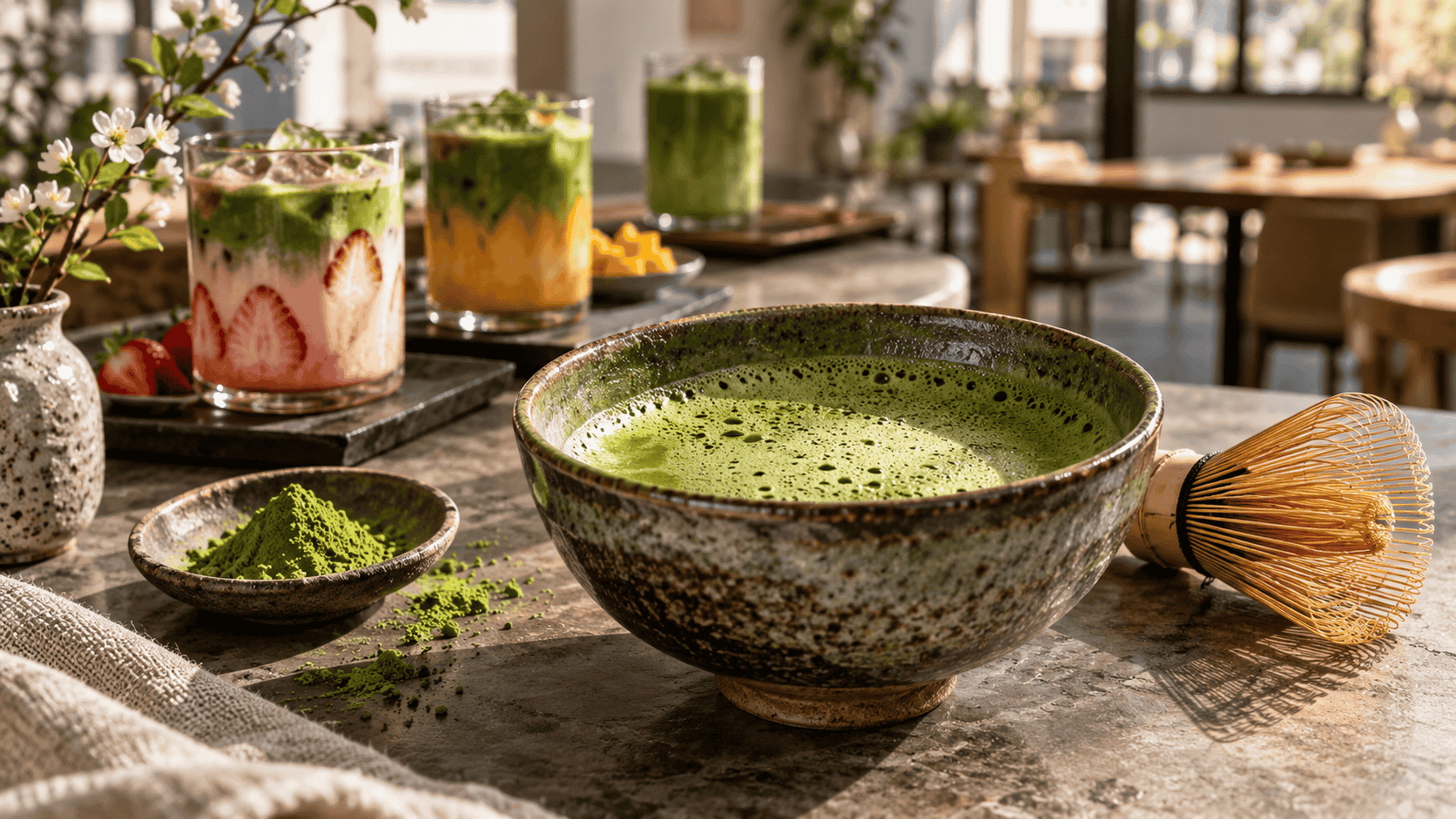
It started as a tea.
Then it became a latte.
Then strawberry matcha appeared.
Mango matcha.
Coconut matcha.
Matcha protein.
Matcha desserts.
Matcha skincare.
Matcha candles.
Even matcha-inspired fashion.
At some point, the powdered Japanese green tea stopped being merely a drink and became an aesthetic.
Google's September 2026 search data from India captures just how dramatic that transformation has become.
Searches for “how to make matcha” increased 1,300% over the previous year, while “matcha health” rose 1,000% and “matcha protein” climbed 2,500%.
Consumers are also searching heavily for questions such as “does matcha have caffeine?” and comparing matcha vs coffee.
So what is everyone actually drinking?
And is matcha genuinely healthier—or simply very good at looking beautiful on Instagram?
Matcha Is Green Tea, But You Consume It Differently
Matcha comes from the same species used to make other true teas:
Camellia sinensis.
The difference involves cultivation and processing.
Tea plants used for matcha are shaded before harvesting, influencing compounds such as chlorophyll and L-theanine.
The leaves are then processed and milled into a fine powder.
With ordinary brewed green tea, you steep leaves and discard them.
With matcha, you drink the suspended powdered leaf itself.
That helps explain its distinctive colour, texture, flavour and chemical profile.
A 2026 scientific review notes that matcha contains compounds including catechins, caffeine, L-theanine, chlorophyll and other polyphenols.
Yes, Matcha Contains Caffeine
One of the strangest social-media myths around matcha is the implication that it is somehow a caffeine-free alternative to coffee.
It isn't.
Matcha naturally contains caffeine.
The exact amount varies with the product and preparation.
So someone switching from coffee to matcha is not necessarily quitting caffeine.
They are changing the source and potentially the dose.
Matcha also contains L-theanine, an amino acid widely studied in tea.
The combination of caffeine and L-theanine is one reason matcha is often marketed as producing a different subjective experience from coffee.
But personal responses to caffeine vary enormously.
For one person, matcha may feel smooth and focused.
For another, caffeine is still caffeine—and drinking enough late in the day may interfere with sleep.
What About Antioxidants?
This is where wellness marketing loves impressive language.
Matcha contains catechins, including EGCG, along with other polyphenols.
These compounds have attracted substantial scientific interest.
But the existence of antioxidants in a food does not automatically mean consuming that food prevents every disease mentioned in an advertisement.
A major 2026 review concluded that matcha has promising biological properties, but also emphasized that the human evidence is still limited and heterogeneous for many specific outcomes and that better long-term clinical research is needed.
That is less exciting than:
“One cup changes your life.”
It is also more scientifically useful.
Can Matcha Help With Weight Loss?
This is another area where marketing can outrun evidence.
Green-tea compounds have been studied in metabolism and weight management.
Some studies suggest modest effects under certain circumstances.
But matcha is not a magic fat-burning beverage.
A sugary café drink containing matcha does not become a weight-loss treatment because the powder is green.
The overall drink still matters.
Milk.
Sugar.
Syrup.
Portion.
Total diet.
Context.
Wellness ingredients do not cancel arithmetic.
Then Why Do People Feel Better Drinking It?
Because health is not the only reason we drink things.
Ritual matters.
Taste matters.
Aesthetic pleasure matters.
Taking five minutes to whisk a drink can itself become a small break.
The same psychological value exists in preparing coffee or tea carefully.
Matcha fits beautifully into the modern desire for slow rituals inside fast lives.
It is visually striking.
It photographs well.
It can be prepared at home.
It feels both traditional and contemporary.
And it sits perfectly at the intersection of café culture and wellness culture.
That combination is marketing gold.
Matcha Has Become Part of the Functional Beverage Boom
Consumers increasingly want drinks to do something.
Energy.
Relaxation.
Protein.
Hydration.
Gut health.
Focus.
Beauty.
Sleep.
Traditional beverages are being rebuilt around functional promises.
Google's search data illustrates this directly: interest in “matcha protein” surged 2,500%, showing consumers are combining matcha with another major wellness category rather than treating it simply as tea.
That is why the next generation of cafés looks increasingly different from the old coffee shop.
The menu may contain:
matcha,
ube,
hōjicha,
protein drinks,
electrolyte drinks,
adaptogenic beverages,
and increasingly elaborate combinations.
Ube and Hōjicha Are Following Behind
Matcha may not remain the only star.
Google reports that search interest for ube, a purple yam popular in Filipino cuisine, and hōjicha, a roasted Japanese green tea, reached new highs during 2026.
That tells us something interesting about food culture.
Global flavours can now move incredibly quickly.
A drink associated with one region enters social media.
Cafés adopt it.
Creators remix it.
Consumers search for home recipes.
Retailers sell kits.
Within months, something unfamiliar becomes recognizable worldwide.
Taste is becoming global at algorithmic speed.
Is Matcha Better Than Coffee?
The internet wants a winner.
Reality doesn't.
Coffee and matcha are different beverages with different flavour profiles, preparation methods and chemical compositions.
Both can fit into a healthy diet for many people.
Both contain caffeine.
Both contain bioactive compounds.
Both can also be transformed into very sugary café desserts.
The better question is:
Which one works better for you?
Do you like the taste?
How much caffeine are you getting?
Does it affect your sleep?
What else is in the drink?
What are you actually expecting it to do?
Those questions matter more than declaring a universal beverage champion.
Quality Matters Too
Not every bright-green powder is identical.
Cultivation, harvest quality, storage and processing affect matcha's flavour, colour and chemical composition.
A 2026 review focused on matcha processing found that heat, formulation and the food matrix can alter the stability and availability of compounds such as catechins, caffeine, L-theanine and chlorophyll.
In other words:
matcha in a bowl of traditionally prepared tea is not chemically identical to matcha baked into a cookie.
That seems obvious once you hear it.
Marketing rarely mentions it.
The Best Reason to Drink Matcha May Be the Simplest
Drink matcha because you enjoy matcha.
If you like the flavour, ritual and caffeine profile, wonderful.
Its tea compounds are scientifically interesting.
Its popularity is culturally fascinating.
But it does not need to cure everything in order to deserve a place in your kitchen.
Sometimes a drink can be both:
healthy enough to enjoy and overhyped enough to question.
That may be the most sensible way to understand the matcha boom.
It is a traditional tea.
A modern wellness product.
A café phenomenon.
A social-media colour palette.
And increasingly, an entire consumer category.
Not bad for a bowl of powdered leaves.
matcha benefits, matcha tea, matcha vs coffee, matcha caffeine, how to make matcha, matcha health benefits, matcha protein, green tea, functional beverages, matcha trend 2026, L-theanine, EGCG
“How to make matcha” searches jumped 1,300% in India over the past year. “Matcha protein” climbed 2,500%.
A centuries-old tea has become one of the internet's most modern lifestyle products.
But what does matcha actually do—and how much of the hype survives contact with science?