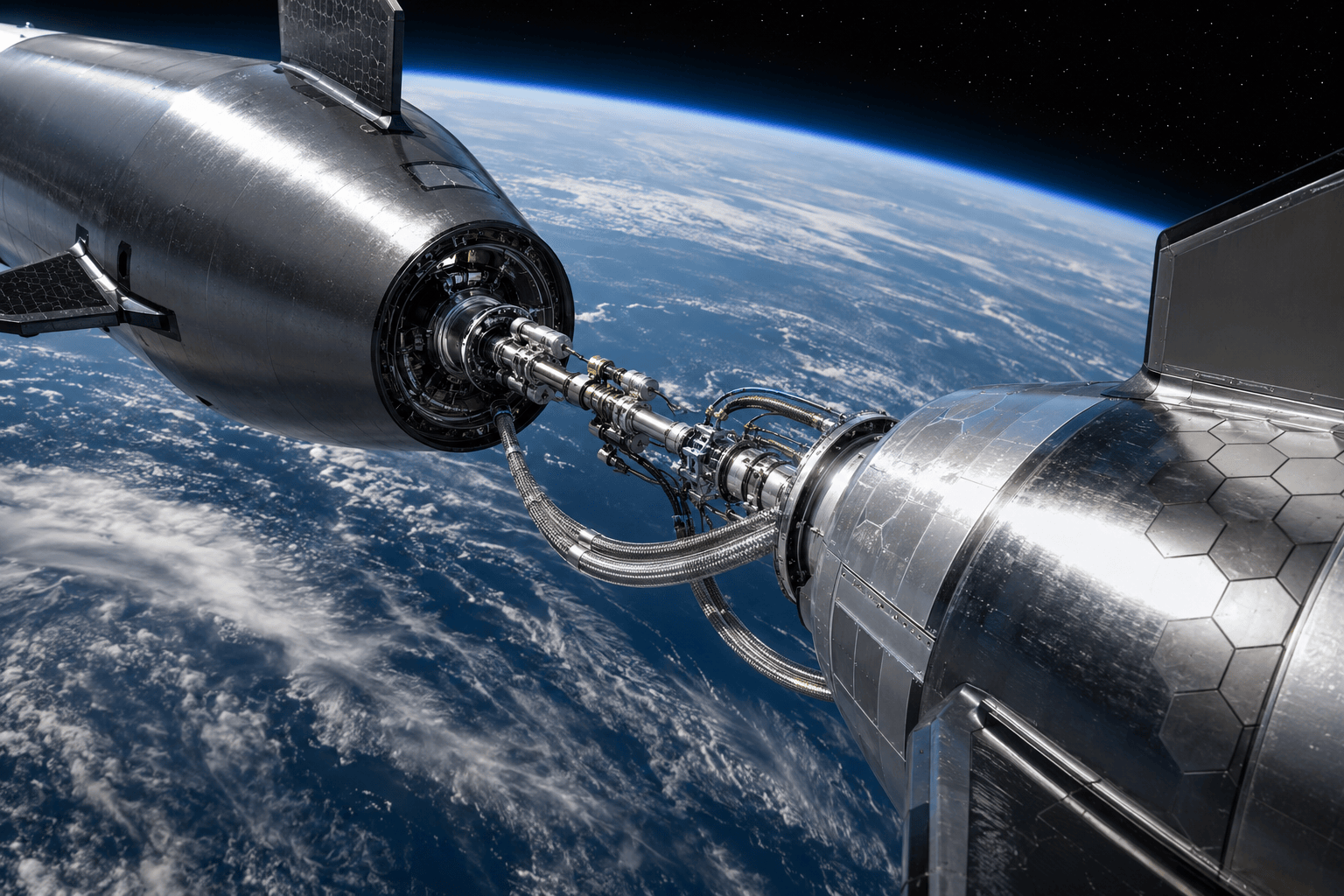
Starship's most important 2026 mission may not be about going farther. It may be about parking next to another Starship in Earth orbit and behaving like a flying fuel tanker.
By Space & Deep Tech Desk | Thursday, August 27, 2026
The most important Starship mission of 2026 may involve travelling only a few hundred kilometres above Earth.
No Mars.
No lunar landing.
No astronauts.
Instead, SpaceX plans to launch one Starship into orbit.
Then launch another.
The second spacecraft must find the first while both are moving around Earth at orbital velocity.
They must approach one another autonomously.
Align.
Dock.
Establish a cryogenic connection.
And transfer super-cold rocket propellant from one giant spacecraft into another.
If SpaceX can make that sequence work reliably, Starship becomes something much more powerful than an enormous launch vehicle.
It becomes a spacecraft that can leave Earth with one fuel load and receive another after reaching space.
That difference underpins SpaceX's lunar architecture.
It also matters for Mars.
And potentially for an entirely new orbital economy built around depots, reusable spacecraft and in-space logistics.
SpaceX says its next major Human Landing System flight milestones are a long-duration orbital test and a ship-to-ship propellant transfer demonstration, with both targeted for 2026.
But the company also gives an important qualification:
the timing depends on how the new Starship V3 architecture performs during upcoming flight tests.
As of August 27, Starship has not yet performed the vehicle-to-vehicle transfer.
And that makes the coming test one of the biggest engineering milestones still standing between Starship and operational lunar missions.
1. Why Starship Needs a Gas Station in Space
The underlying problem is basic rocket physics.
A spacecraft carrying fuel must also expend fuel to accelerate that fuel.
Add more propellant and the spacecraft becomes heavier.
A heavier spacecraft requires still more propellant.
Eventually, simply making the launch vehicle larger becomes an inefficient way to increase deep-space capability.
Starship approaches the problem differently.
Launch from Earth.
Reach orbit.
Then refuel.
That allows one Starship to function as the deep-space vehicle while other Starships operate primarily as tankers.
SpaceX's lunar architecture eventually adds another component:
the orbital propellant depot.
A sequence of tankers would launch from Earth and fill that depot.
The lunar Starship would then arrive, take on the propellant it needs and depart Earth orbit for the Moon.
NASA's Inspector General described SpaceX's current HLS architecture in March 2026 as involving three Starship configurations:
lander, tanker and storage depot.
For operational lunar missions, NASA OIG says SpaceX currently anticipates more than 10 tanker launches to aggregate enough propellant in the depot.
That makes orbital refueling not an optional enhancement.
It is part of the mission architecture.
2. But the 2026 Demonstration Is Simpler Than the Full Lunar Architecture
This distinction is important.
The upcoming demonstration is not expected to reproduce the entire future lunar refueling chain.
SpaceX's current description starts with a Starship launching from Starbase and remaining in orbit for an extended period.
During that time, engineers want to measure:
propulsion behavior,
thermal conditions,
long-duration propellant storage,
and boil-off.
Then a second Starship will launch.
It will rendezvous with the first vehicle.
Dock.
And attempt a ship-to-ship propellant transfer.
So the demonstration is better thought of as:
Target Starship + Transfer Starship
rather than assuming the first spacecraft must already be the final operational depot design.
NASA's earlier demonstration architecture similarly described the vehicles as a Target and a Chaser, with the target receiving propellant and the chaser supplying it.
The operational depot comes later.
3. SpaceX Has Already Transferred Cryogenic Propellant in Space—Just Not Between Two Starships
SpaceX is not starting from zero.
During Starship Flight 3 in March 2024, NASA and SpaceX performed an earlier cryogenic-fluid experiment.
That test moved propellant between tanks inside a single Starship.
SpaceX now says approximately five metric tons of cryogenic propellant were transferred during that experiment.
NASA's TechPort describes the earlier technology demonstration as involving more than three metric tons of liquid oxygen transferred between tanks aboard Starship.
That experiment provided data on:
fluid motion,
propellant settling,
tank pressure,
and transfer behavior in microgravity.
But moving liquid between two tanks in one vehicle is considerably easier than:
launching two independent spacecraft,
bringing them together,
docking them,
connecting their propellant systems,
and moving cryogenic liquids across the vehicle interface.
That is the technological leap SpaceX is now trying to make.
4. The Problem With Liquid Floating in Space
Fill a glass with water on Earth and gravity tells the water where to go.
Down.
Open a valve at the bottom and the liquid naturally sits over the outlet.
Orbit changes that.
Inside a spacecraft in microgravity, liquid propellant can float, spread along tank walls and break into complicated fluid structures.
That creates a problem.
A transfer system cannot simply assume the liquid is sitting neatly at the bottom of a tank.
Before propellant can be moved reliably, engineers may need to settle the liquid so it collects near the desired outlet.
Small accelerations produced by thrusters can help create an artificial “down” inside the tank.
NASA identifies propellant settling as one of the central engineering problems involved in large-scale cryogenic transfer.
Others include:
tank-pressure control,
receiving-tank chill-down,
transfer-line chill-down,
high fill fractions,
and differential-pressure transfer.
In other words, the challenge is much more complicated than connecting a hose.
5. How Could Starship Actually Push Fuel From One Ship Into Another?
On Earth, pumps can move fluids from one container to another.
Large-scale cryogenic propellant transfer in space can also exploit pressure differences.
Conceptually, engineers can maintain greater pressure in the supplying tank than in the receiving tank.
The pressure difference encourages liquid to move through the transfer system.
NASA specifically lists differential pressure-based transfer operations among the capabilities being studied for Starship.
But several conditions have to be controlled simultaneously.
The propellant must be settled.
The transfer line needs appropriate thermal conditioning.
The receiving tank cannot be allowed to develop problematic pressure.
Gas and liquid phases have to behave predictably.
And the spacecraft must remain stable while two huge vehicles are physically connected.
What looks like a plumbing problem is actually a combination of:
fluid dynamics,
thermal engineering,
spacecraft guidance,
pressurization,
structural dynamics,
and autonomous control.
6. The Fuel Is Extremely Cold
Starship uses two cryogenic propellants:
liquid oxygen
and
liquid methane.
Both must remain at very low temperatures.
Methane boils at roughly −162°C at atmospheric pressure.
Oxygen boils at roughly −183°C.
Space creates a strange thermal environment.
There is no atmosphere to conduct heat in the conventional way.
But sunlight still transfers energy through radiation.
A spacecraft can alternate between intense solar heating and darkness.
Heat leaking into a propellant tank causes some liquid to vaporize.
That is known as boil-off.
For a short mission, some boil-off may be manageable.
For an orbital depot that must accumulate propellant across multiple tanker launches, losses become much more important.
If fuel arrives faster than it can be used but then slowly evaporates away, the architecture begins losing efficiency.
That is why SpaceX plans to use the first vehicle in the upcoming demonstration to collect data on long-duration propellant storage and boil-off behavior before the second vehicle arrives.
7. Starship V3 Was Redesigned With Refueling in Mind
One major correction to the earlier draft is that the relevant hardware is now associated with Starship V3, rather than simply a modification introduced on the older Block 2 vehicle S33.
SpaceX's third-generation Starship includes extensive changes specifically aimed at long-duration flight and in-space propellant operations.
According to SpaceX, V3 adds:
more capable reaction control,
new high-pressure gas isolation valves,
100% vacuum jacketing coverage of the header feed system,
an electrically operated cryogenic recirculation system,
and a dedicated system for managing cryogenic interactions with the engines during long-duration coast periods.
These are not glamorous features.
They do not look as spectacular as a booster catch.
But they may be more important to the Moon architecture.
A rocket can reach orbit without them.
A reusable interplanetary transportation system cannot.
8. SpaceX Has Also Added Hardware for Starship-to-Starship Docking
Refueling requires two spacecraft to physically connect.
Starship V3 therefore includes new docking infrastructure.
SpaceX says V3 has four docking drogues on the leeward side of the vehicle.
Tanker-configured Starships can add docking probes.
The spacecraft also includes propellant connections designed for ship-to-ship transfer.
This raises an unusual visual possibility.
Two enormous stainless-steel Starships, each roughly the size of a building, connected side-by-side in orbit.
That is fundamentally different from docking a Crew Dragon with the International Space Station.
The vehicles are larger.
The propellant volumes are larger.
And the purpose of the docking is not simply exchanging people or cargo.
It is establishing an interface through which cryogenic rocket propellant can move.
9. Dragon Technology Is Helping Starship Find the Other Ship
One part of the operation is at least based on technology SpaceX already knows well.
Rendezvous.
SpaceX says the Starships will use DragonEye navigation sensors.
Dragon-derived relative navigation technology has extensive flight heritage from SpaceX's repeated spacecraft rendezvous and dockings with the International Space Station.
This is a good example of how Starship development does not begin entirely from scratch.
SpaceX can reuse knowledge from Dragon for:
relative navigation,
proximity operations,
docking logic,
sensor fusion,
and autonomous guidance.
But the final Starship docking hardware and vehicle dynamics are new.
A sensor with heritage does not make the complete maneuver routine.
10. Why the First Starship Has to Wait in Orbit
The delay between launches is not merely an inconvenience.
It is part of the test.
An operational depot cannot assume the tanker arrives five minutes later.
Future lunar missions require propellant to remain usable while multiple tanker launches occur over time.
NASA OIG says SpaceX's operational concept currently starts propellant aggregation more than 200 days before the crew launches, providing schedule margin for the tanker campaign.
The demonstration therefore needs to answer questions such as:
How does Starship behave after days in orbit?
How much propellant is lost?
Can pressure be controlled?
Can the vehicle maintain orientation?
Can its thermal systems protect the fuel?
Can it still dock normally?
Can the transfer hardware function after extended exposure to space?
Long-duration storage is therefore nearly as important as the transfer itself.
11. “Three to Four Weeks Between Ships” Is Not Yet a Safe Number to Publish as Fact
The original draft specifies that the second Starship will arrive three to four weeks later.
That may ultimately be close to the operational test design.
But SpaceX's current public description does not give a fixed interval.
It says the first Starship will spend an extended time on orbit, followed by the second vehicle.
The exact timing remains dependent on the flight program.
For a current article, that is the safer description.
This matters because Starship development changes very quickly.
A specific number can turn an otherwise accurate article stale overnight.
12. The Tanker Count Is More Than Ten—But It Is Not a Fixed Universal Number
Another popular Starship talking point says:
“It will take exactly 10 tankers to reach the Moon.”
NASA's March 2026 Inspector General report provides the more accurate current picture.
SpaceX's HLS concept involves launching the depot followed by more than 10 tanker Starships to build the required propellant inventory.
NASA OIG also reports that SpaceX is targeting a tanker launch roughly every six days during propellant aggregation.
The final number can depend on:
Starship's usable payload to orbit,
propellant remaining after launch,
depot losses,
vehicle mass,
mission requirements,
and the performance of later Starship versions.
So “ten tankers” is useful shorthand.
It should not be treated as a universal constant.
13. Launch Cadence Is Almost as Important as Fuel Transfer
Suppose the transfer hardware works perfectly.
SpaceX still has another problem.
It must launch tankers frequently.
NASA OIG identifies launch cadence as a significant program risk.
SpaceX's operational concept requires rapid tanker flights, but NASA notes the company has not yet demonstrated the 12-to-24-day launch-pad turnaround previously required by the HLS architecture, much less the eventual cadence needed for aggressive propellant aggregation.
This reveals something important about Starship.
The lunar architecture is not dependent on one breakthrough.
It depends on an ecosystem of breakthroughs working together:
reusable boosters,
reusable ships,
rapid pad turnaround,
orbital storage,
rendezvous,
docking,
propellant transfer,
low boil-off,
and high launch cadence.
Orbital refueling is the centerpiece.
But it does not operate alone.
14. The First Orbital Starship Flight Still Comes Before the Refueling Test
As of August 27, 2026, the immediate milestone is Flight 14.
Ship 41, a Starship V3 vehicle, recently completed both a single-engine and a six-engine static-fire campaign.
The single-engine test demonstrated the type of burn required for future deorbit operations.
Flight 14 is expected to become Starship's first attempt to enter a sustained Earth orbit.
This matters enormously.
Before SpaceX can demonstrate a long-duration orbital stay and rendezvous between two Starships, V3 first has to prove that its new architecture can reliably:
launch,
reach orbit,
operate there,
and deorbit.
SpaceX explicitly says the refueling demonstration's timing depends on how those V3 flights progress.
So a 2026 propellant-transfer test remains a target, not a guaranteed calendar event.
15. SpaceX Is Not Yet Catching Returning Starship Upper Stages
The original mission description also assumes the tanker will return to Starbase and be caught by the launch tower.
That would make a fantastic ending.
It is not something we should state as established for this demonstration.
SpaceX has successfully demonstrated tower catches of Super Heavy boosters.
But the company has not yet performed a tower catch of a returning Starship upper stage.
Indeed, the planned upper-stage catch associated with upcoming flights has been pushed back while SpaceX continues developing the return architecture.
NASA's earlier ship-to-ship transfer concept instead showed both demonstration vehicles eventually performing deorbit burns.
Until SpaceX publishes the final test profile, the safest position is simple:
do not assume the demonstration ends with a Starship tower catch.
16. Artemis III Is No Longer the Lunar Landing Mission
This is the biggest change from the original article.
Earlier versions of NASA's Artemis architecture planned the first Starship HLS crewed lunar landing for Artemis III.
That changed in 2026.
NASA now describes Artemis III in 2027 as a crewed demonstration mission in Earth orbit.
The mission is intended to test important rendezvous and docking operations involving Orion and commercial human-landing-system spacecraft.
NASA's current Artemis III launch page explicitly says its objectives will occur in low Earth orbit, with the capabilities supporting later lunar landing missions.
NASA now says astronauts are expected to return to the lunar surface during Artemis IV in 2028.
So orbital refueling remains fundamental to the Moon program.
But the story should no longer say this test directly unlocks an Artemis III lunar landing.
It unlocks the Starship HLS architecture needed for the later crewed Moon missions.
17. This Actually Gives SpaceX More Time to Prove Refueling
The Artemis restructuring changes the schedule pressure.
Previously, the vehicle-to-vehicle transfer, uncrewed lunar demonstration and crewed Artemis III landing were tightly packed.
NASA's March 2026 Inspector General report warned that the old schedule contained very little margin.
At the time, SpaceX's propellant-transfer milestone had already slipped substantially from its earlier target.
NASA's revised campaign now separates the 2027 orbital Artemis III demonstration from the first crewed lunar landing planned for 2028.
That does not make orbital refueling easy.
It does provide the program with additional time to:
test,
fail,
redesign,
and repeat.
For a technology this new, that margin could matter enormously.
18. The Uncrewed Lunar Starship Must Prove the Architecture Before Astronauts Use It
Before astronauts descend to the Moon aboard Starship, SpaceX must also demonstrate the HLS architecture without a crew.
The future uncrewed mission will require far more than merely landing.
The lunar Starship must:
launch,
receive propellant in Earth orbit,
depart Earth,
travel to lunar orbit,
perform mission operations,
descend,
land,
and demonstrate the systems NASA needs before approving crewed use.
NASA continues to describe an uncrewed lunar landing demonstration as an important prerequisite for future astronaut missions.
That means the 2026 ship-to-ship transfer is one rung on a much taller ladder.
But it is a critical rung.
Without refueling, the later lunar demonstration architecture does not close.
19. Why Not Just Launch the Lunar Starship Full?
This is one of the most intuitive questions.
Why build depots and launch a dozen tankers?
Why not fill the lander on Earth and launch it directly?
Because reaching orbit is extraordinarily expensive in energy.
Starship burns most of its launch propellant fighting:
Earth's gravity,
atmospheric drag,
and the need to accelerate to orbital velocity.
By the time a spacecraft arrives in low Earth orbit, much of the propellant initially loaded at the launch site has already been consumed.
A lunar Starship then needs substantial additional velocity to:
leave Earth orbit,
reach the Moon,
enter the required lunar trajectory,
descend,
and later ascend.
Refueling in orbit changes the equation.
The spacecraft reaches orbit nearly empty from the perspective of its deep-space mission.
Then other launches refill it.
Low Earth orbit becomes the starting point rather than merely the halfway point.
20. Orbit Could Become the Space Industry's First Fuel Economy
If SpaceX proves this works, the implications extend beyond Artemis.
An orbital depot is essentially infrastructure.
Today, most spacecraft leave Earth carrying all the propellant they will ever receive.
In-space refueling changes that assumption.
Future spacecraft could theoretically be:
launched partially fueled,
reused between destinations,
serviced in orbit,
refilled,
or dispatched on missions requiring much larger total propellant budgets.
That opens possibilities involving:
Moon logistics,
Mars missions,
large scientific spacecraft,
space tugs,
commercial stations,
and extremely heavy deep-space payloads.
NASA itself describes in-space cryogenic refueling as a potentially important capability for future exploration beyond the Moon.
The Starship test therefore matters even if one ignores SpaceX's Mars ambitions entirely.
21. Cryogenic Depots Could Become the Gas Stations of Space
NASA actually uses the analogy.
In a June 2026 update about cryogenic refueling technology, the agency described future orbital propellant depots as effectively serving as gas stations in space.
The comparison is useful.
But a space gas station behaves nothing like a terrestrial one.
A terrestrial petrol station does not:
orbit at kilometres per second,
experience microgravity,
have its fuel continuously trying to boil away,
require autonomous spacecraft rendezvous,
or need plumbing that operates reliably in vacuum.
This is why orbital propellant infrastructure has remained attractive on paper for decades but difficult in practice.
The economic case becomes compelling only when launch is frequent and sufficiently inexpensive.
That is exactly the problem Starship is attempting to solve simultaneously.
22. The Depot May Become More Important Than the Rocket
Launch vehicles receive the attention because launches are spectacular.
Infrastructure is less photogenic.
But consider commercial aviation.
The airplane matters.
So do:
airports,
fuel farms,
maintenance facilities,
air traffic control,
and logistics networks.
Reusable spacecraft may eventually develop a similar relationship with orbital infrastructure.
If a Starship can repeatedly visit a depot, refuel and leave for another destination, the depot starts functioning as part of a transportation network rather than a single mission.
That is a much bigger vision than “one Moon lander.”
It is the beginning of space logistics.
23. Why This Test Is Harder Than It Looks
To appreciate the 2026 demonstration, list what has to work correctly.
Launch One
A Starship V3 has to reach orbit.
Long-Duration Coast
The vehicle has to manage its propellant and thermal environment.
Launch Two
Another Starship has to reach the correct orbit.
Rendezvous
The second vehicle must locate and approach the first autonomously.
Proximity Operations
Two enormous spacecraft must maneuver safely close together.
Docking
Their interfaces must align and connect.
Fluid Connection
The propellant-transfer hardware must establish a reliable cryogenic path.
Settling
The liquid must be positioned so it can be transferred.
Pressure Management
Both vehicles must maintain appropriate tank conditions.
Transfer
Cryogenic liquid must cross from one Starship to the other.
Measurement
Engineers must determine how much was actually transferred and how much was lost.
Separation
The ships must safely undock.
Disposal or Recovery
Each spacecraft must complete its planned post-test mission.
Failure at almost any step can prevent completion of the primary objective.
That is why this seemingly simple “refueling test” is really a demonstration of multiple new Starship capabilities simultaneously.
24. Success Does Not Mean “Artemis Is Ready”
Suppose the first transfer demonstration works flawlessly.
That would be historic.
But it still would not prove the full lunar architecture.
NASA ultimately needs confidence in:
repeated docking,
repeated transfer,
rapid launch cadence,
propellant aggregation,
long-duration storage,
actual depot operations,
HLS refueling,
trans-lunar flight,
lunar orbit operations,
landing,
surface survival,
and ascent.
One successful transfer would establish feasibility.
Operational reliability requires repetition.
This is particularly important because a crewed lunar mission could depend on more than ten tanker launches interacting with the same depot.
A system involving that many launches needs far more than a spectacular prototype demonstration.
It needs routine operations.
25. SpaceX's Real Goal Is To Make Refueling Boring
The first docking of two Starships will be dramatic.
The tenth should not be.
By the hundredth, nobody should care.
That is how infrastructure matures.
Imagine an airline where every mid-air refueling operation became global breaking news.
That would not suggest confidence.
It would suggest novelty.
SpaceX's lunar architecture ultimately requires orbital refueling to become predictable:
launch,
rendezvous,
dock,
transfer,
leave,
repeat.
The technological victory is not merely doing it once.
It is making something unprecedented become routine.
The Mission That Changes What a Rocket Can Be
For most of spaceflight history, a launch vehicle has had one basic relationship with its propellant.
It leaves Earth with the fuel it needs.
Then it spends that fuel until the mission is over.
Orbital refueling changes the definition.
A Starship could arrive in orbit after consuming enormous amounts of methane and oxygen...
and then become full again.
That sounds simple.
It is not.
It requires another giant rocket.
And another.
A depot.
Autonomous rendezvous.
Docking.
Cryogenic plumbing.
Thermal management.
High launch cadence.
Reusable vehicles.
And perhaps most difficult of all, the ability to make those systems work together reliably enough that NASA is willing to put astronauts downstream of them.
As of August 27, 2026, SpaceX has already demonstrated one important precursor by transferring approximately five tonnes of cryogenic propellant between tanks aboard a single Starship.
Starship V3 now incorporates hardware specifically designed for:
long-duration operation,
docking,
and ship-to-ship refueling.
The next step is harder.
Two ships.
One orbit.
One connection.
Real propellant moving between them.
SpaceX still targets that demonstration for 2026, although the schedule depends on the progress of the V3 flight campaign.
If it succeeds, Starship will not suddenly be ready to land astronauts on the Moon.
But something fundamental will have changed.
A rocket will no longer have to carry its entire future inside its tanks when it leaves Earth.
It will be able to stop for fuel along the way.
And that may turn low Earth orbit from a destination into the first service station on the road to the Moon and Mars.
Frequently Asked Questions
When will SpaceX perform the Starship orbital refueling test?
SpaceX currently targets its long-duration Starship test and ship-to-ship propellant-transfer test for 2026, but says the exact timing depends on how upcoming Starship V3 flight tests progress. A fixed public launch date has not been confirmed.
Has SpaceX already transferred rocket fuel in space?
Yes, but only between tanks aboard the same Starship. During Flight 3, SpaceX performed an in-space cryogenic transfer experiment. SpaceX says approximately five metric tons of propellant were transferred. The upcoming demonstration will attempt the much harder task of transferring propellant between two separate Starships.
Will the first spacecraft be a full Starship depot?
Not necessarily. SpaceX's current public description says the first Starship will perform a long-duration orbital mission and receive propellant from a second Starship. The full operational lunar architecture later uses dedicated depot and tanker configurations.
How many Starships are required for the transfer demonstration?
Two: one Starship launches first and remains in orbit, while a second launches later, rendezvous and docks with it, and transfers propellant.
What fuel does Starship use?
Starship's Raptor engines use liquid methane and liquid oxygen, both cryogenic propellants.
How does Starship transfer fuel in zero gravity?
The process involves controlling fluid position, tank pressure, transfer-line temperature and other conditions. NASA identifies propellant settling and differential-pressure-based transfer as key elements being developed for large-scale in-space cryogenic transfer.
Why does fuel boil off in space?
Even in vacuum, sunlight and thermal radiation can transfer heat into spacecraft. Cryogenic methane and oxygen can then vaporize, raising tank pressure and potentially requiring management or venting.
What changes did SpaceX make to Starship V3 for orbital refueling?
SpaceX says V3 includes full vacuum jacketing of the header feed system, improved reaction control, cryogenic recirculation equipment, docking drogues and connections for ship-to-ship propellant transfer.
How will the two Starships find each other?
SpaceX says the vehicles will use DragonEye relative-navigation sensors derived from technology used during Dragon spacecraft dockings with the International Space Station.
How many tanker launches will a lunar Starship require?
NASA's March 2026 Inspector General report says SpaceX's current operational concept involves more than 10 tanker launches to build up sufficient propellant in a storage depot. The exact number can evolve with vehicle performance and mission requirements.
Will tanker Starships launch every six days?
NASA OIG reported that SpaceX is targeting approximately one tanker launch every six days during the operational propellant-aggregation campaign. That is an architectural target, not a launch cadence SpaceX has yet demonstrated operationally.
Is Artemis III still the mission that will land astronauts on the Moon?
No. NASA changed the Artemis architecture in 2026. Artemis III is now planned as a 2027 crewed demonstration mission in low Earth orbit. NASA currently plans the next crewed lunar landing for Artemis IV in 2028.
Why is orbital refueling still important if Artemis III no longer lands on the Moon?
Because SpaceX's Starship Human Landing System still depends on orbital propellant aggregation for the later lunar missions, including the planned crewed lunar landing architecture.
Will the tanker be caught by the Starbase tower after the test?
That has not been confirmed for the propellant-transfer mission. SpaceX has caught Super Heavy boosters, but has not yet demonstrated a returning Starship upper-stage tower catch. Current plans for upcoming Starship flights still include ocean recovery while upper-stage catch development continues.
What is the biggest risk in Starship orbital refueling?
There is no single risk. Major challenges include cryogenic boil-off, fluid behavior in microgravity, tank pressure management, docking, transfer hardware, long-duration storage and the rapid launch cadence required for repeated tanker missions. NASA considers large-scale cryogenic propellant transfer one of Starship HLS's most significant technical challenges.
Editorial Note: SpaceX's Starship schedule remains highly dynamic. As of August 27, 2026, SpaceX is targeting both a long-duration orbital flight and ship-to-ship propellant-transfer demonstration during 2026, but has not announced a firm date for the transfer mission. Artemis mission architecture has also changed during 2026; older sources describing Artemis III as the first crewed lunar landing are no longer current.
Starship propellant transfer demonstration, orbital refueling test, Starship tanker, Starship depot, cryogenic propellant transfer, Starship HLS, Artemis IV, lunar Starship, Starship V3
satellite launch services, space technology, aerospace engineering, cryogenic systems, orbital infrastructure, satellite communications, commercial space industry, space investment, aerospace manufacturing
SpaceX, Starship, Orbital Refueling, Artemis, NASA, Moon, Starship HLS, Cryogenic Propellant, Space Exploration, Aerospace
Starship can reach space. The harder challenge is proving that one giant spacecraft can find another in orbit, dock with it and transfer super-cold methane and oxygen without wasting the fuel. SpaceX is targeting that demonstration for 2026—and the architecture of future lunar Starships depends on it.