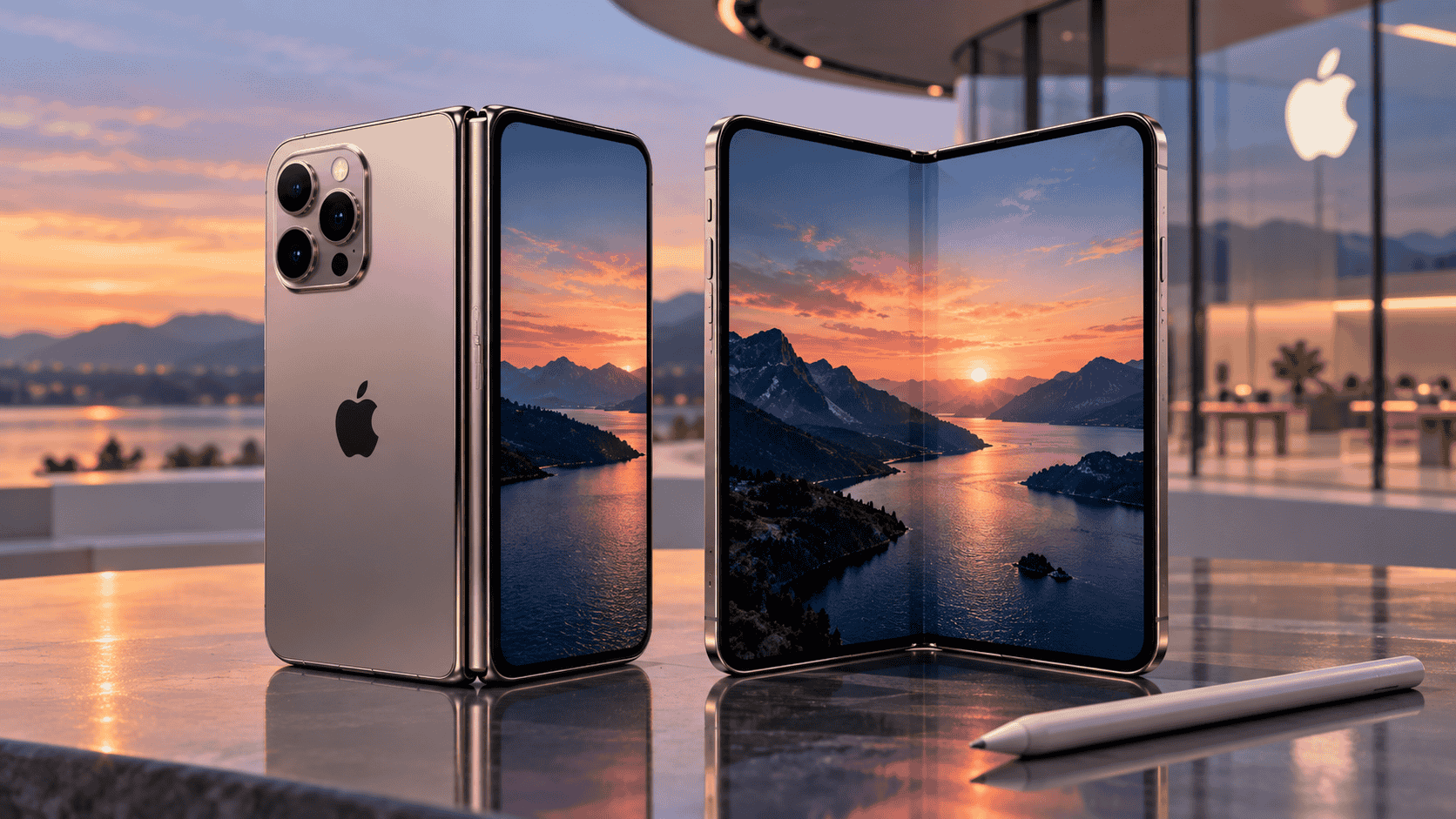
Apple waited years before entering the foldable-phone market. Its answer is the $1,999 iPhone Duo—a titanium, dual-screen iPhone with a 100-plus-part hinge, dual batteries and Apple’s largest iPhone display. But how much of that price is engineering, and how much is premium positioning?
Why Does Apple’s First Foldable iPhone Cost $1,999—and What Are You Actually Paying For?
Apple watched Samsung, Huawei and other manufacturers spend years learning how phones break when you fold them. Now it has entered the market with a $1,999 iPhone. The interesting question is not whether the screen bends. It is what Apple believes makes that bend worth almost two thousand dollars.
By Technology & Consumer Innovation Desk | Thursday, September 10, 2026
Apple spent years refusing to sell a foldable iPhone.
That became increasingly conspicuous.
Samsung launched its first Galaxy Fold in 2019. Huawei developed multiple generations of folding hardware. Other Android manufacturers experimented with book-style phones, compact clamshells and eventually even tri-fold designs.
Apple kept making rectangles.
Then on September 9, 2026, it changed course.
The company introduced the iPhone Duo, its first foldable iPhone, beginning at $1,999 and going on sale October 23 after pre-orders open October 16. Reuters notes that the starting price is around $100 higher than comparable base-storage foldables from Samsung and Google.
Open the Duo and a 7.6-inch inner screen appears.
Close it and a 5.4-inch outer display turns the device into something closer to an unusually compact conventional phone.
Apple calls it the biggest change to the iPhone since the original.
That is marketing language.
But mechanically, this really is one of the largest redesigns the iPhone has undergone.
The more useful question for buyers is simpler:
Why does it cost $1,999?
And more importantly:
What are you actually buying for that money?
First, $1,999 Is Not the “Cost of the Hinge”
There is no public Apple document telling us:
the hinge costs $140,
the folding display costs $310,
the titanium costs $80,
and Apple adds the rest as profit.
Apple does not publish that bill of materials.
So claims that the Duo “costs this much because of one expensive component” should be treated cautiously.
A retail price includes far more than raw component cost.
It has to absorb:
product development,
specialized manufacturing,
supplier tooling,
software engineering,
testing,
warranty risk,
distribution,
retail operations,
marketing,
support,
and Apple's profit margin.
Then there is another factor:
positioning.
Apple is not presenting the Duo as the default iPhone.
It is presenting it as a new ultra-premium category.
That means the price is partly an engineering story and partly a business decision.
Understanding both is essential.
What Do You Physically Get for $1,999?
The iPhone Duo opens to a 7.6-inch Super Retina XDR OLED display with a 2670-by-1878 resolution.
The outer screen measures 5.4 inches.
Both support ProMotion refresh rates up to 120Hz and up to 3,000 nits of peak outdoor brightness. Apple says the inner screen is 50% larger than the display on the iPhone 18 Pro Max.
When fully open, the phone is only 5.2 millimetres thick.
Fold it shut and that becomes 11.3 millimetres.
It weighs 254 grams.
Those numbers reveal the central engineering problem.
Apple essentially had to make two extremely thin halves of a high-performance smartphone, connect them with a durable mechanical joint, divide the battery between them, keep them cool, route signals across the folding structure and cover everything with a display that bends thousands of times without behaving like ordinary glass.
That complexity is where much of the Duo story begins.
The Most Expensive-Looking Part May Be the Part You Hardly See
A conventional smartphone has no major moving joint through its center.
The Duo does.
Apple says its hinge contains more than 100 components.
Its job is not simply to allow the phone to fold.
It must control the motion precisely enough that the device:
opens smoothly,
stays stable at intermediate angles,
closes securely,
and supports the center of the inner display when fully opened.
The frame and hinge cover use Grade 5 titanium, while Apple says the hinge cover itself is 3D printed.
That immediately creates a very different manufacturing challenge from a standard slab phone.
Think about a laptop hinge.
Now make it dramatically smaller.
Make it thin enough for a pocket.
Place an extremely delicate flexible display directly above it.
Then ask the user to open and close it perhaps dozens of times every day for several years.
A folding phone is partly a computer and partly a precision mechanical device.
The Display Has to Bend Without Behaving Like a Sheet of Glass
The inner screen may be the most difficult part of any book-style foldable.
Ordinary rigid smartphone glass does not like repeatedly bending through a tight radius.
Apple's answer is a multilayer structure.
The company says the inner display contains 10 ultrathin layers. Its newsroom description says high-strength glass is used above and below the folding panel, with specialized adhesives allowing layers to move slightly relative to one another as the phone bends. A titanium support plate reinforces the structure underneath.
The surface also uses a custom polymer cover layer and a scratch-resistant coating.
Apple says that polymer has up to 40% greater stiffness than other materials used in the industry. That is Apple's own comparison, not yet an independent long-term durability result.
And that distinction matters.
The Duo has been announced.
Consumers have not yet carried it for two years.
No one outside Apple's testing program can currently tell us how the inner screen will look after tens of thousands of real-world folds, pockets, drops, fingernails, dust and heat cycles.
For a first-generation $1,999 device, durability is not a footnote.
It is one of the biggest unanswered questions.
What About the Famous Foldable Crease?
Almost every book-style folding phone creates some visible deformation where the display repeatedly bends.
Apple claims it has reduced the problem using a combination of:
the supporting hinge,
special adhesives,
the display stack,
and a nano-texture finish that reduces reflections.
Its product material describes the inner display as smooth and says the design minimizes the visibility of the crease.
Notice the wording.
Minimizes is not the same as eliminates.
That is another question buyers should wait for independent reviews to answer.
A crease that is barely visible indoors might behave differently:
under direct sunlight,
when viewed from the side,
or after months of folding.
Apple may have solved the problem better than rivals.
We do not yet know that it has solved it completely.
Then Apple Put Two Batteries Inside
A foldable phone has another awkward problem.
You cannot simply place one giant battery across the hinge.
So Apple uses its first dual-battery architecture in an iPhone, distributing battery capacity through the two halves.
The company also removed the physical SIM tray worldwide and made the Duo eSIM-only, saying the freed internal volume helps maximize battery space.
Apple rates the phone for up to:
24 hours of typical use,
31 hours of video playback using the inner display,
and
44 hours using the outer display.
It also supports wired fast charging to around 50% in approximately 20 minutes with a suitable 60W-or-higher adapter.
Again, those are Apple's controlled test figures.
Real battery life will depend heavily on how buyers use the device.
Someone spending most of the day on the smaller outer screen may see very different endurance from someone gaming or multitasking continuously on 7.6 inches of OLED.
A Folding Phone Also Creates a Cooling Problem
Thin electronics and high-performance chips generate heat.
A foldable makes the thermal problem stranger because the internal volume is divided between two halves.
Apple uses a custom vapor chamber alongside the A20 Pro processor.
The A20 Pro has a six-core CPU, seven-core GPU and dual 16-core Neural Engine. Apple says the CPU can be up to 20% faster than the A19 Pro, while memory bandwidth increases by as much as 50%.
Reuters reports that the chip is manufactured on a 2-nanometre process and is paired with Apple's new C2 modem.
Why does any of this matter to the price?
Because Apple is not putting a tablet-sized screen around a midrange phone processor.
It is trying to deliver flagship iPhone performance inside a chassis only 5.2mm thick when open.
Performance is relatively easy when you have room for:
a large heatsink,
a large battery,
and substantial airflow.
Phones have none of those luxuries.
Foldables have even less.
Apple Is Also Selling You a Small Tablet
This is arguably the strongest reason the Duo exists.
The value proposition is not:
a normal iPhone that folds because folding looks cool.
It is:
a small phone that can become a larger workspace.
Apple redesigned parts of iOS 27 for that purpose.
The open display supports side-by-side apps.
Controls relocate according to orientation.
The phone can sit partially folded on a desk for video, calls or workouts.
It can stand independently for FaceTime.
Netflix, Zoom and Slack are among the third-party apps Apple says are already adapting to the format.
This is the feature that will determine whether the Duo becomes useful rather than merely impressive.
A 7.6-inch display costs you nothing if every app behaves like a stretched phone application.
Foldable hardware only becomes valuable when software understands the new shape.
Samsung spent years learning that lesson.
Apple's advantage is that it controls:
the phone,
the operating system,
the developer tools,
and many of the most important built-in apps.
Apple Pencil Support Quietly Changes the Product
Later this year, the Duo will support Apple Pencil (USB-C) on its displays.
That pushes the device closer to a miniature productivity tablet.
Imagine:
marking up a PDF on the train,
signing a document,
taking handwritten notes,
sketching,
or reviewing a presentation
without carrying an iPad.
For most iPhone buyers, Pencil support probably will not justify an extra thousand dollars.
For certain professionals, it could materially change how they use a phone.
This is one reason the $1,999 question does not have one universal answer.
A feature's value depends on whether it replaces another device or simply duplicates one.
The Cameras Reveal Where Apple Compromised
This is where the comparison with the iPhone 18 Pro becomes interesting.
The Duo uses two 48MP rear cameras:
a 48MP Fusion Main,
and a 48MP Fusion Ultra Wide.
The main camera also provides a 2x optical-quality crop.
The iPhone 18 Pro line, however, includes a dedicated 48MP telephoto camera in addition to its main and ultrawide cameras.
In other words:
the most expensive iPhone does not automatically contain Apple's most extensive camera system.
Why?
Space.
Every cubic millimetre inside a foldable is contested by:
hinges,
batteries,
display electronics,
antennas,
cooling,
and cameras.
That is the important lesson.
At $1,999, you are not buying “the maximum specification of every iPhone feature.”
You are paying primarily for the folding architecture.
The Fold Does Create Camera Tricks a Normal iPhone Cannot Do
The Duo's second display becomes useful during photography.
Someone being photographed can see themselves on the outer screen.
You can use the higher-quality rear cameras for a selfie while using the outer screen as a viewfinder.
The phone can support itself while partially folded.
Apple also introduced camera features that use both screens, including Duo Preview and Duo FaceTime.
These are not reasons everyone should spend $1,999.
They are examples of the right way to design a foldable:
use the fold to do something a rigid phone cannot.
Why Touch ID Instead of Face ID?
The Duo uses Touch ID integrated into the side button rather than Apple's familiar Face ID system.
That may surprise iPhone users.
But a foldable exists in many physical states:
closed,
open,
horizontal,
vertical,
partially folded,
or sitting on a table.
A side-mounted fingerprint sensor remains accessible across most of those configurations.
It may also require less internal display hardware than a conventional Face ID array.
Whether customers see this as elegant engineering or a downgrade from Face ID will depend on personal preference.
But it is another reminder that foldable design requires trade-offs.
$1,999 Is Expensive—But Apple Didn't Invent the Expensive Foldable
Apple is entering an already premium segment.
Reuters notes that the Duo starts around $100 above comparable base-storage folding models from Samsung and Google.
That is an important comparison.
Apple has not entered foldables with a radically cheaper device.
It has deliberately entered near the top.
And the timing is fascinating.
The broader smartphone business is struggling.
IDC's August forecast expects worldwide smartphone shipments to fall 16.7% in 2026, while average selling prices rise sharply.
Yet foldables are one of the few areas still expected to grow: IDC forecasts roughly 22.9 million foldable phones in 2026, up 12.6% year over year.
So Apple is entering the market where manufacturers can still plausibly convince consumers to pay more for genuinely different hardware.
Apple May Not Need the Duo to Become “Normal”
This is the business angle many launch stories miss.
Apple does not necessarily need hundreds of millions of people to buy its foldable immediately.
IDC expects Apple to capture around 40% of the foldable market by the end of 2027, helped by the existing iPhone customer base and Apple's entry into the category.
Even a relatively small number of $2,000-plus phones can become a very large business.
More importantly, the Duo creates a new pricing ceiling.
Once a $1,999 iPhone exists, a $1,199 Pro model psychologically occupies a different position.
Premium-product ladders work partly through comparison.
The most expensive model does not only generate its own sales.
It can change how consumers perceive the prices below it.
So Is the Extra Money Mostly the “Apple Tax”?
That phrase is too simple.
Part of the price clearly reflects Apple's premium brand and ability to charge what its customers will tolerate.
That has always been part of the company's business model.
But a book-style folding smartphone genuinely contains engineering challenges that a conventional phone avoids.
The Duo requires:
a precision mechanical hinge,
two displays,
an ultrathin folding display stack,
two battery cells,
specialized thermal engineering,
structural reinforcement,
new software behaviors,
and manufacturing processes designed around moving parts.
Those are real differences.
What we cannot responsibly say is exactly how many dollars each difference adds to Apple's manufacturing cost.
Until independent teardown firms analyze production devices, anyone claiming to know the precise cost of the Duo's components is mostly guessing.
And even a teardown cannot tell us the full cost of years of research and manufacturing development.
The Bigger Question: Why Did Apple Wait Seven Years?
Samsung's original Galaxy Fold arrived in 2019.
Its early history was difficult.
Review units suffered display failures.
Protective layers confused users.
Hinge durability became a major issue.
Later generations gradually improved:
hinges,
water resistance,
screen materials,
software,
cameras,
and thickness.
Huawei and other manufacturers pushed the form factor further.
Apple watched all of it.
That is characteristic of the company.
Apple is often not first to a category.
Its preferred strategy is to enter when technology has matured enough that it believes it can control the whole experience.
That does not guarantee the Duo is superior.
It does mean Apple had years of competitors' successes and failures to study.
And now it is attempting to solve the industry's long-running problems simultaneously:
crease,
thickness,
durability,
battery life,
software adaptation,
and mainstream usability.
But Apple Has Not Yet Proven the Most Important Thing
This phone costs $1,999.
And almost nobody has lived with it.
That matters.
Product launches show:
controlled demonstrations,
perfectly clean devices,
carefully selected lighting,
and brand-new hinges.
Real ownership means:
keys,
dust,
hot cars,
cold mornings,
drops,
airport security trays,
children,
backpacks,
sand,
thousands of folds,
and accidental pressure.
Apple gives the Duo an IP68 water- and dust-resistance rating and uses Ceramic Shield materials on the exterior.
Those are encouraging specifications.
They are not substitutes for long-term experience.
A first-generation device should be judged after people have actually used it.
Who Should Seriously Consider the iPhone Duo?
The Duo makes the most sense for someone who can genuinely use its second identity.
A person who already carries an iPhone and iPad mini-like device may find value in combining the two roles.
It may appeal strongly to:
frequent travelers,
business users,
heavy document readers,
mobile gamers,
multitaskers,
creators,
and people who regularly use video conferencing or productivity apps on the move.
For someone who mostly:
messages,
uses social media,
takes photos,
streams music,
and occasionally watches video,
a conventional iPhone will almost certainly provide far better value.
That is the central buying question:
Will you use the unfolded screen often enough to justify carrying and paying for it?
If the answer is no, the Duo becomes an extremely expensive party trick.
What Are You Really Paying For?
Not a faster iPhone alone.
The iPhone 18 Pro already has the A20 Pro.
Not the best possible iPhone camera system.
The Pro models have an additional dedicated telephoto camera.
Not simply more storage.
The Duo does offer capacities from 256GB through 2TB, but storage alone does not explain the price.
You are primarily paying for one idea:
a pocketable iPhone that can transform into a significantly larger computing surface.
Everything expensive about the design exists to make that transformation practical.
The hinge makes it fold.
The titanium helps support it.
The specialized screen survives the bend.
The dual batteries fit around the hinge.
The vapor chamber manages performance in a thin body.
iOS changes shape with the hardware.
The outer display prevents you from needing to unfold it for every interaction.
That integration is the product.
Is It Worth $1,999?
For most people?
Probably not.
And it does not need to be.
A $1,999 smartphone is inherently a luxury technology purchase.
But “too expensive for most people” and “bad product” are not the same statement.
The more interesting judgment will come after October 23.
If the Duo:
feels significantly less awkward than existing foldables,
keeps the crease unobtrusive,
survives real daily use,
offers excellent battery life,
and gives developers compelling reasons to redesign applications,
then Apple may have created the first foldable that a large number of existing iPhone users seriously consider.
If the inner screen scratches easily, the hinge develops problems, applications waste the larger display or users rarely unfold it, then $1,999 will look much harder to defend.
Apple Is Really Betting on the Future of the Smartphone
The iPhone Duo matters beyond one expensive device.
The smartphone industry has spent nearly two decades refining essentially the same object:
a glass rectangle.
Better cameras.
Faster processors.
Brighter screens.
Longer battery life.
But physically, phones have changed remarkably little.
Foldables ask whether the next improvement should be shape rather than specification.
IDC now expects foldables to remain one of the few growing portions of an otherwise contracting 2026 smartphone market.
Apple entering the category adds something Samsung and Huawei could not provide by themselves:
hundreds of millions of iPhone customers suddenly being asked to consider folding as part of the normal smartphone conversation.
That may be the Duo's most important contribution.
Not the hinge.
Not the titanium.
Not even the 7.6-inch screen.
Legitimacy.
When Apple waited, foldables remained an Android experiment.
Now they are an iPhone option.
The $1,999 Question Has Two Answers
Why does the iPhone Duo cost $1,999?
The first answer is engineering.
Folding a high-performance computer in half without destroying its display creates costs and compromises conventional phones do not face.
The second answer is economics.
Apple believes enough customers will pay $1,999 for the privilege.
Both can be true at the same time.
There is sophisticated technology inside the Duo.
There is also premium pricing.
Consumers should not confuse one for proof of the other.
The device does not have to cost $1,999 merely because the hinge contains more than 100 parts.
Apple chose the final price.
What buyers now decide is whether the experience justifies it.
And that may ultimately determine something much bigger than whether Apple's first foldable succeeds.
It may tell us whether the smartphone itself is finally ready to change shape.
Frequently Asked Questions
How much does the iPhone Duo cost?
Apple's first foldable iPhone starts at $1,999 in the United States. Pre-orders begin October 16, 2026, and general availability begins October 23.
What size is the iPhone Duo screen?
It has a 7.6-inch folding inner display and a 5.4-inch outer display. Both are Super Retina XDR OLED panels with ProMotion up to 120Hz.
How thin is the iPhone Duo?
Apple lists the Duo at 5.2mm thick when open and 11.3mm when closed. It weighs 254 grams.
How many parts are in the iPhone Duo hinge?
Apple says the precision hinge is engineered from more than 100 components and supports the center of the display when opened.
Does the iPhone Duo have a visible crease?
Apple says its hinge, display stack, adhesives and nano-texture treatment minimize crease visibility. Independent long-term testing is not yet available because the phone has not reached consumers.
Is the iPhone Duo waterproof?
Apple rates it IP68 for splash, water and dust resistance, including laboratory testing at up to six metres of water for 30 minutes under the relevant IEC standard. Water resistance can decline with normal wear.
Does iPhone Duo have Face ID?
No. It uses Touch ID in the side button.
Does iPhone Duo support Apple Pencil?
Yes. Apple says support for the USB-C Apple Pencil will arrive later in 2026.
What processor does the iPhone Duo use?
It uses Apple's A20 Pro, with a six-core CPU, seven-core GPU and dual 16-core Neural Engine.
How long does its battery last?
Apple rates it for up to 24 hours of typical use, 31 hours of video playback on the inner display or 44 hours on the outer display. Actual battery life will vary.
What storage options are available?
The Duo comes in 256GB, 512GB, 1TB and 2TB capacities.
Does it have better cameras than iPhone 18 Pro?
Not in every respect. Duo has 48MP main and 48MP ultrawide rear cameras, while the iPhone 18 Pro line also includes a dedicated 48MP telephoto camera.
Is iPhone Duo more expensive than Samsung's foldable?
Reuters reports that the $1,999 starting price is about $100 higher than Samsung's Galaxy Z Fold8 and Google's Pixel 11 Pro Fold at comparable base-storage configurations.
Is this Apple's first foldable phone?
Yes. The iPhone Duo is Apple's first commercially announced foldable iPhone.
Will foldable phones become mainstream?
They remain a relatively small portion of the overall smartphone market, but IDC forecasts foldable shipments to grow 12.6% in 2026 to around 22.9 million units, helped substantially by Apple's entry.
Should I buy iPhone Duo or iPhone 18 Pro?
Choose Duo primarily if you value the folding screen, multitasking and tablet-like workspace enough to justify the additional cost and first-generation hardware risk. Buyers prioritizing cameras, conventional durability or value may be better served by the standard Pro line.
Editorial Note: iPhone Duo was announced on September 9, 2026 but does not reach consumers until October 23. Statements about durability, battery life, display stiffness and crease reduction currently rely on Apple's published specifications and laboratory claims. UrduPure should update this article after independent production-device testing becomes available.
Apple foldable iPhone 2026, iPhone Duo specs, why iPhone Duo costs $1,999, Apple foldable phone, iPhone Duo vs Samsung Fold, first foldable iPhone
iPhone Duo price, buy foldable iPhone, best foldable phone 2026, premium smartphone, foldable phone comparison, iPhone upgrade, Apple Pencil iPhone
iPhone Duo, Apple, Foldable Phones, iPhone 2026, Smartphones, A20 Pro, Mobile Technology, Samsung Fold, Apple Intelligence, Consumer Technology