There is one number used-car buyers have been trained to fear.
100,000 miles.
See six digits on the odometer and many people immediately imagine:
expensive repairs,
worn suspension,
engine problems,
a tired transmission,
and a car approaching the end of its useful life.
For decades, mileage has been one of the quickest ways to judge a second-hand vehicle.
But electric cars may require us to rethink that instinct.
A huge new analysis published on September 22, 2026 examined 47.4 million British MOT roadworthiness tests.
The result was surprising.
Among cars aged three to eight years with 90,000 to 120,000 miles, 16.5% of battery-electric vehicles failed their MOT compared with 22.1% of equivalent petrol cars.
Above 120,000 miles, the difference grew further:
16.0% of EVs failed compared with 23.5% of petrol cars.
In other words, the high-mileage electric cars in this dataset were substantially less likely to fail their statutory roadworthiness test than petrol cars of similar age and mileage. (bvrla.co.uk)
That sounds like fantastic news for used-EV buyers.
And it is encouraging.
But there is one enormous catch.
An MOT does not test the most expensive component in an electric car: the traction battery.
So perhaps the old used-car rule is not disappearing.
Perhaps the number buyers need to care about is changing.
The Old 60,000-Mile Rule Came From Petrol Cars
For generations, mileage acted as shorthand for mechanical wear.
That made sense.
A conventional petrol or diesel vehicle contains a complicated mechanical system.
Engine.
Transmission.
Exhaust.
Fuel system.
Cooling components.
Belts.
Pumps.
Lubrication.
Clutches in some cars.
Thousands of components experience heat, friction and vibration over time.
As mileage increases, the probability that some of those components will eventually require attention tends to rise.
So buyers developed simple rules.
30,000 miles?
Still young.
60,000?
Start checking carefully.
100,000?
Proceed with caution.
Those rules became cultural knowledge.
But electric cars work differently.
A battery-electric drivetrain eliminates many of the mechanical systems associated with an internal-combustion engine.
There is no petrol engine producing thousands of controlled explosions every minute.
No engine oil to circulate.
No conventional exhaust system.
No spark plugs.
And most EV drivetrains use far simpler gearing than conventional multi-speed transmissions.
That does not mean electric cars have nothing to wear out.
They absolutely do.
But the parts ageing with mileage are different.
What 47.4 Million MOT Tests Found
The new study was commissioned by the British Vehicle Rental and Leasing Association and carried out by transport research organization New AutoMotive using official DVSA MOT records.
At lower mileage, EVs and petrol cars looked remarkably similar.
Between 20,000 and 40,000 miles:
12.0% of electric cars failed;
11.7% of petrol cars failed.
Essentially no meaningful advantage.
But from around 60,000 miles, the curves began to separate.
The EV failure rate levelled at approximately 16%.
Petrol and diesel failure rates continued rising.
By 90,000–120,000 miles, the EVs were around 25% less likely to fail their MOT than comparable petrol vehicles. (bvrla.co.uk)
That challenges one of the strongest assumptions in the second-hand market:
high mileage automatically means a worn-out car.
For electric vehicles, mileage alone appears to provide a much less complete picture.
But Be Careful With the Word “Reliable”
This distinction is critical.
An MOT is Britain's statutory roadworthiness test.
It checks things such as:
brakes,
tyres,
lights,
steering,
suspension,
visibility,
and other safety-related components.
It does not comprehensively measure whether a car has suffered:
software failures,
charging problems,
infotainment faults,
unscheduled breakdowns,
warranty repairs,
or battery degradation.
Most importantly, the BVRLA study explicitly notes that the MOT dataset does not measure battery state of health. (bvrla.co.uk)
So the correct conclusion is not:
“Every high-mileage EV is more reliable than every petrol car.”
The evidence supports something narrower—and still important:
High-mileage EVs in this enormous dataset held up remarkably well on roadworthiness measures.
That should make buyers reconsider mileage.
It should not make them stop inspecting the car.
Electric Cars Had One Notable Weakness: Tyres
EVs did not outperform petrol vehicles everywhere.
Tyres stood out.
The same 47.4-million-test dataset showed electric cars recording substantially more serious tyre defects than petrol vehicles.
A detailed analysis of the findings reported roughly 1.8 times as many tyre defects among EVs in the compared mileage bands. (tyrenews.co.uk)
Why?
Several factors can contribute.
Electric cars are often heavier because of their battery packs.
Electric motors can also deliver strong torque immediately.
Vehicle weight, wheel alignment, driving style, tyre specification and suspension geometry can all affect tyre wear.
This is therefore one place where a used EV buyer should look extremely carefully.
A cheap used electric car needing four premium tyres immediately may not be quite as cheap as it looked in the advertisement.
Surprisingly, Suspension Was Not Worse
Another common assumption is that heavy batteries must destroy suspension components.
The new analysis did not find evidence that electric vehicles suffered greater suspension failure simply because of their extra weight.
In fact, the BVRLA says the data does not support the idea that heavier EVs automatically experience worse suspension problems. (bvrla.co.uk)
That is useful because weight has become one of the most frequently repeated objections to long-term EV durability.
The tyre concern is real.
The simplistic assumption that additional weight destroys everything underneath the vehicle is not supported by this dataset.
Then We Reach the Battery
This is where the used-EV conversation changes completely.
In a petrol car, buyers may obsess over:
engine compression,
gearbox condition,
oil leaks,
timing belts,
turbochargers,
and exhaust systems.
With a used EV, one of the most important questions becomes:
How much useful battery capacity remains?
Every lithium-ion battery gradually loses some capacity.
That means a car that could travel a particular distance when new may eventually travel less on a full charge.
The technical term buyers increasingly encounter is:
State of Health, or SoH.
If a battery has an SoH of 90%, it roughly indicates that its available capacity has declined compared with when it was new, although calculation methods vary among manufacturers.
And this is where the odometer becomes less useful.
Two Cars With the Same Mileage Can Have Different Batteries
Battery-diagnostics company AVILOO released a large dataset earlier this month based on more than 500,000 independent battery tests across 20 popular EV models performed between 2022 and 2026.
Its central finding was not that all batteries age identically.
Quite the opposite.
AVILOO says substantial differences can exist between individual cars of the same model and similar mileage, which is why it argues that actual battery condition should be measured rather than inferred from the odometer. (aviloo.com)
Data from that study indicated that many of the tested models still retained roughly around 90% or more of their original battery capacity at 150,000 kilometres—about 93,000 miles—although results varied by model and individual vehicle. (mynrma.com.au)
That is encouraging.
But it contains the most important lesson for used buyers:
Don't buy the average battery.
You are buying that battery in that car.
Mileage May Be Becoming the Wrong Number
Imagine two identical EVs.
Same year.
Same model.
Both have driven 80,000 miles.
Car A has spent most of its life in a mild climate, usually charged sensibly and has a healthy battery.
Car B has experienced different temperature conditions and charging patterns and now has noticeably less usable capacity.
Their odometers look identical.
Their future usefulness may not be.
This suggests the used-car market could slowly shift from asking:
“How many miles has it done?”
toward:
“What condition is the battery in?”
In other words, battery health could become the EV-era equivalent of checking an engine and gearbox.
The Used-EV Market Is Getting Much Bigger
This is not a niche problem anymore.
The International Energy Agency estimates that sales of used electric cars exceeded 3 million vehicles in 2025 across China, five major European markets and the United States—about 35% more than in 2024. (iea.org)
Millions of first-generation EV owners are now trading their cars.
Leasing fleets are returning vehicles.
Company cars are entering auctions.
And rapidly falling prices of some used EVs are making electric cars available to buyers who could never justify purchasing one new.
That creates an enormous second-hand market.
But it also creates a new consumer-education problem.
Buyers know how to inspect a petrol car.
Many still do not know what to ask about an EV.
What Should You Check Before Buying a Used EV?
A high odometer reading should not automatically frighten you away.
But neither should this new research make you careless.
A serious used-EV inspection should look beyond mileage.
1. Ask for battery state of health
Where reliable testing is available, obtain an actual battery-health assessment.
Do not assume:
80,000 miles = healthy battery.
Or:
120,000 miles = bad battery.
The data increasingly suggests the relationship is not that simple.
2. Check the remaining battery warranty
Battery warranty terms differ significantly among manufacturers and markets.
Check:
the time limit,
mileage limit,
minimum-capacity guarantee,
whether the warranty transfers to a second owner,
and what circumstances can invalidate coverage.
Do not rely on a salesperson saying:
“The battery is still under warranty.”
Read what the warranty actually promises.
3. Inspect the tyres closely
The latest MOT research makes this particularly important.
Check:
tread depth,
uneven wear,
correct tyre specification,
sidewall damage,
and whether all four tyres are appropriate for the vehicle.
Uneven wear can also hint at alignment or suspension issues.
4. Check the brakes
EV regenerative braking can reduce use of conventional friction brakes.
That can extend pad life.
But components used less frequently can still deteriorate through corrosion or lack of use.
A proper inspection remains important.
5. Test both AC and DC charging
A car can drive perfectly and still have a charging-related problem.
Where practical, confirm:
home/AC charging,
rapid/DC charging,
charging-port condition,
and supplied cables.
6. Check the underbody
The large traction battery usually sits beneath the passenger compartment.
Evidence of serious underside impact deserves attention.
Damage involving a battery enclosure should be evaluated professionally.
7. Look at real-world range
Do not compare the car only with its original advertised range.
Ask:
What range does this particular vehicle realistically achieve now?
Weather, speed, heating, air conditioning, tyre choice, battery health and driving style all affect the answer.
8. Check software and recall history
Modern EVs are computers as much as vehicles.
Make sure important manufacturer updates and recall work have been completed.
9. Inspect climate-control systems
Heating and cooling can strongly affect both comfort and range.
A failed heat pump or air-conditioning component can also be expensive.
10. Treat accident history seriously
This applies to every vehicle.
But on an EV, accident damage near the battery pack or high-voltage components deserves specialist inspection.
A Cheap Used EV Can Be Very Cheap for a Reason
Used electric-car prices have fallen sharply in several major markets.
IEA data shows EV resale values weakened considerably in many markets during 2025, partly because new-EV price cuts and changing incentives affected second-hand values. (iea.org)
For buyers, depreciation can be wonderful.
A car that was expensive new may become surprisingly affordable after several years.
But low purchase price is only one number.
A smart buyer should calculate:
purchase price,
insurance,
financing,
tyres,
home-charging installation,
public-charging costs,
remaining warranty,
expected range,
and potential repairs.
An EV that saves money on fuel but costs dramatically more to insure may change the calculation.
Another with inexpensive home charging and a healthy battery could look extremely attractive.
There is no universal answer.
What About Battery Replacement?
This is one of the fears that scares people away from used EVs.
Someone sees an electric car advertised cheaply and thinks:
“What happens if I suddenly need a completely new battery?”
A full replacement battery can indeed be very expensive.
But battery problems are not always equivalent to total-pack failure.
Diagnosis can involve:
individual modules,
battery-management systems,
cooling systems,
electrical components,
or other related faults depending on vehicle design.
The important point is not to assume either extreme.
Don't assume the battery will certainly fail.
And don't assume it cannot.
Measure its condition before buying.
Could High-Mileage EVs Become Bargains?
This is where the new research becomes especially interesting.
The used-car market heavily discounts mileage because decades of experience have taught buyers that mechanical risk rises as the odometer climbs.
But what happens if consumers continue applying petrol-era depreciation assumptions to cars whose roadworthiness does not deteriorate in the same way?
You could end up with an unusual situation:
the market discounts some high-mileage EVs more aggressively than their actual condition justifies.
That would make carefully inspected examples attractive to knowledgeable buyers.
Not every 100,000-mile EV will be a bargain.
But the number itself may no longer deserve the automatic fear it once carried.
The Odometer Isn't Dead
Mileage still tells us something.
A car that has travelled 120,000 miles has experienced more road use than one that has travelled 20,000.
Seats wear.
Doors open.
Bearings rotate.
Suspension moves.
Tyres are replaced.
Components age.
Mileage remains useful evidence.
The mistake is treating it as a complete diagnosis.
The new data suggests that for electric cars, the relationship between mileage and roadworthiness can look very different from what generations of petrol-car buyers learned to expect. (bvrla.co.uk)
The Used-Car Rule Is Changing
For a petrol car, one of the first questions has traditionally been:
How many miles?
For a used electric car, the smarter conversation may increasingly become:
How many miles?
And what is the battery state of health?
What range does it actually deliver?
What warranty remains?
How are the tyres?
Does it charge properly?
Has the battery enclosure ever been damaged?
That is more work than simply rejecting anything with six digits on the odometer.
It is also better buying.
The most interesting thing about the 47.4 million MOT tests isn't that electric cars suddenly became indestructible.
They didn't.
It is that one of our oldest shortcuts for judging a used car may no longer work the way we thought.
A 100,000-mile petrol car and a 100,000-mile electric car can reach that number through very different mechanical journeys.
So perhaps the question is no longer:
“Would you buy an electric car with 100,000 miles?”
The better question is:
“Why would I decide before checking what condition it's actually in?”
used electric car, used EV, used EV reliability, electric car battery health, high mileage EV, EV battery life, 100000 mile electric car, used electric vehicle buying guide, EV state of health, electric car reliability, second hand EV, used EV battery test, EV tyre wear, electric vehicle maintenance, used cars 2026
used electric cars for sale, EV financing, electric car insurance, EV battery warranty, battery health test, EV warranty, used car loan, home EV charger, electric car tyres, used EV inspection, vehicle history check, electric car servicing
Pakistan’s Most-Searched Used Cars and What Buyers Should Check
Latest Automotive Technology
How Electric Vehicles Are Changing Transportation
Money Guides for Major Purchases
Sustainability & Global Risks
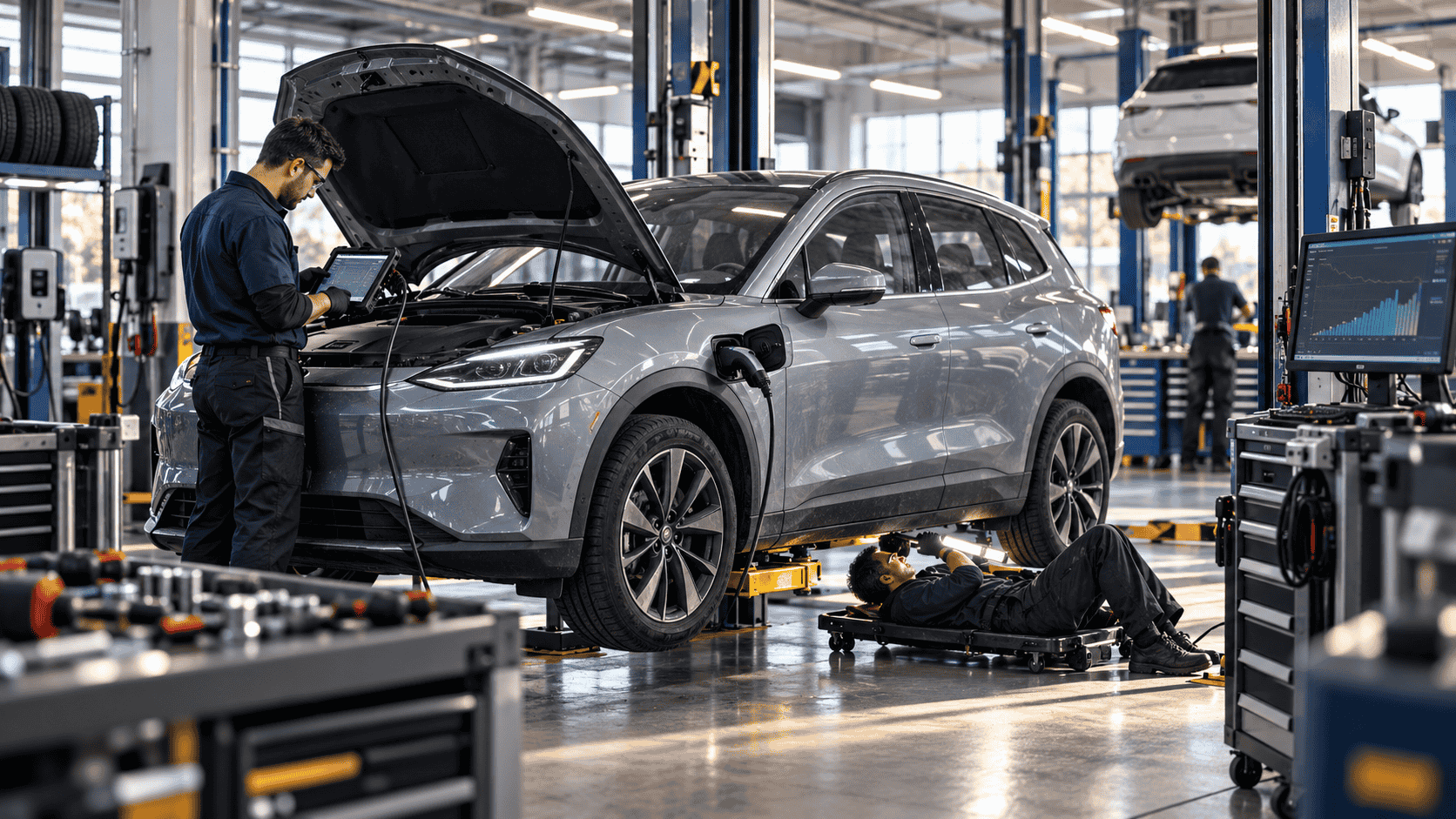
A high-mileage used electric car parked at a dealership inspection bay at dusk while a potential buyer and technician examine battery-health information on a tablet. The vehicle should appear clean but realistically used, with subtle tyre and charging-port details visible. Premium consumer automotive photography, credible rather than promotional, 16:9, photorealistic 8K, no text or logos.
Would you buy an electric car with 100,000 miles on it?
A new analysis of 47.4 million MOT tests found EVs with 90,000–120,000 miles were around 25% less likely to fail than petrol cars of the same age and mileage.
Above 120,000 miles:
EV failure rate: 16.0%
Petrol: 23.5%
But there is one huge catch.
An MOT doesn't tell you the health of the battery. (bvrla.co.uk)
The old used-car rule may not be dead.
The number we need to look at may simply be changing.
Reader Question
Would a verified 90% battery-health report make you more comfortable buying a 100,000-mile EV than a petrol car with the same mileage?
Research Notes
The primary September 22, 2026 study was commissioned by the BVRLA and conducted by New AutoMotive using 47.4 million official DVSA MOT tests. Comparisons controlled for vehicle age and mileage, excluded implausible odometer readings and counted Major and Dangerous defects that cause an MOT failure. Between 90,000 and 120,000 miles, 16.5% of EVs failed versus 22.1% of petrol cars; beyond 120,000 miles, failure rates were 16.0% and 23.5% respectively. (bvrla.co.uk)
The study does not measure traction-battery state of health, software reliability, charging speed or unscheduled repair history, so MOT performance should not be interpreted as a complete measure of vehicle reliability. (bvrla.co.uk)
Separately, AVILOO says its September 2026 report draws on more than 500,000 battery tests across 20 EV models and demonstrates substantial variation between individual used batteries, reinforcing the importance of testing the specific vehicle rather than predicting battery condition from mileage alone. (aviloo.com)