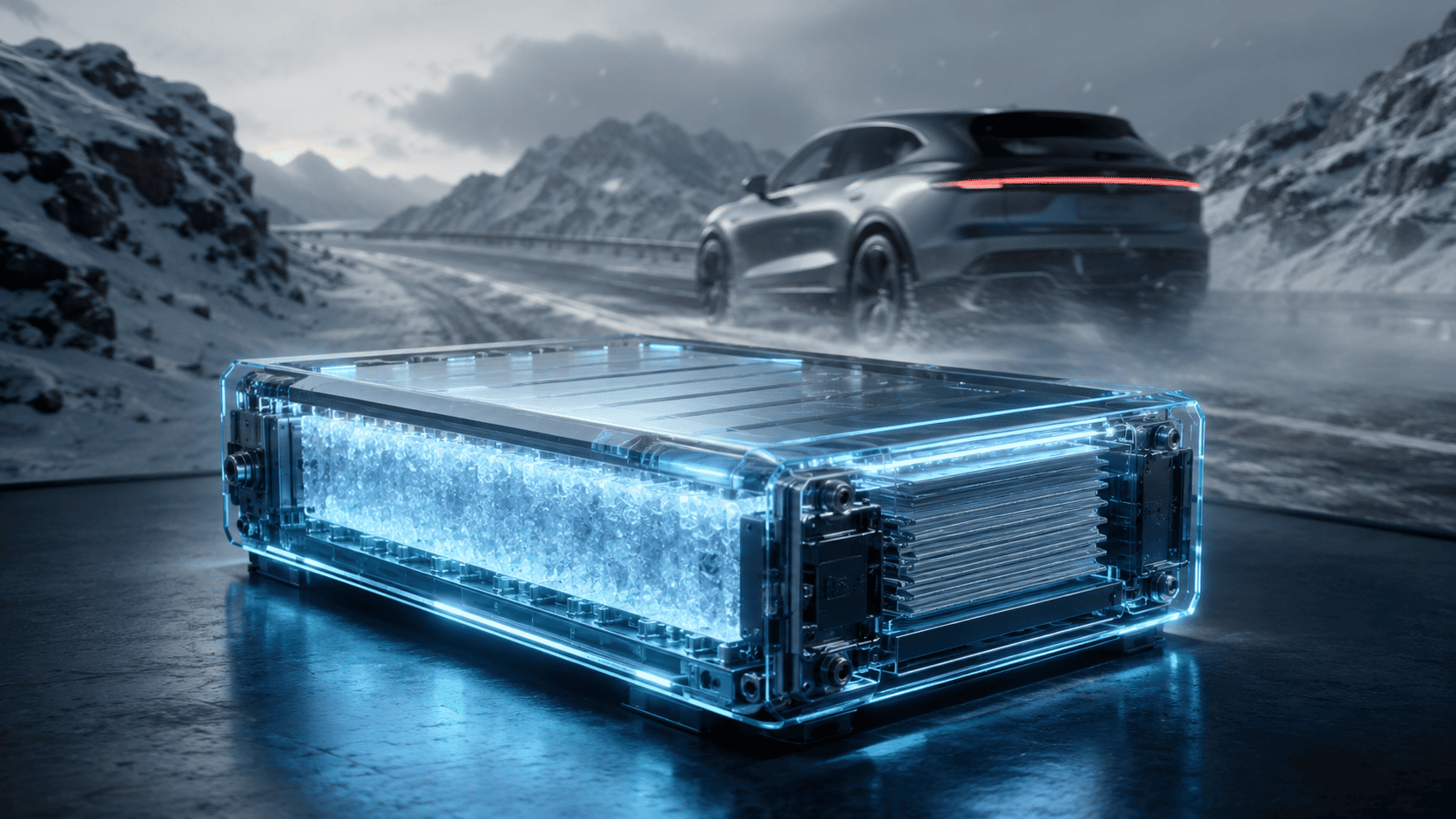
For decades, the electric vehicle market has battled range anxiety, battery fires, and terrible cold-weather performance. In the second half of 2026, a massive shift in battery chemistry is solving all three problems simultaneously.
By Automotive & Sustainability Desk | Tuesday, August 12, 2026
The traditional lithium-ion battery has officially reached its technological ceiling. While it pioneered the modern electric vehicle (EV) revolution, its reliance on heavy, flammable liquid electrolytes has always been a fundamental flaw.
As we move through August 2026, the automotive and aerospace industries are undergoing a massive disruption. Solid-state battery technology is no longer a laboratory experiment; it is scaling for mass commercial production. By replacing the liquid core with a solid conductive material, manufacturers are unlocking absurd energy densities and unparalleled safety metrics.
Here is why the cars and drones of late 2026 are suddenly traveling further, charging faster, and practically eliminating the risk of thermal runaway.
1. The 1,000-Kilometer Benchmark
The biggest news shaking legacy automakers this year is the leap in raw energy density. Today's standard lithium-ion batteries max out around 250–300 Wh/kg.
However, automakers like Dongfeng have confirmed mass production of their solid-state batteries for the second half of 2026.
- Extreme Energy Density: Utilizing an oxide-polymer composite, these new batteries are hitting 350 Wh/kg.
- Ending Range Anxiety: This leap allows passenger vehicles to comfortably exceed a 1,000-kilometer (620-mile) driving range on a single charge.
- Defeating the Cold: A historical weak point for EVs has been freezing weather. During extreme cold tests in Mohe, China, solid-state battery packs retained over 74% of their charge at temperatures plunging to -30°C, maintaining their 1,000 km range.
2. Zero-Percent Fire Risk
Beyond range, the most significant consumer upgrade is safety. Traditional batteries use a flammable liquid electrolyte (a lithium salt dissolved in an organic solvent). If punctured or overheated, this liquid can ignite, causing violent thermal runaway.
Solid-state technology completely removes this liquid, resulting in a virtually 0% fire risk. In rigorous 2026 safety trials, Dongfeng's solid-state packs survived brutal compression tests where the battery was deformed by 50% without failing. Even when exposed directly to heat at 170°C, the batteries showed absolutely no signs of smoke or combustion.
3. Semi-Solid Batteries Fueling the eVTOL Boom
While the automotive sector gears up for fully solid-state mass production, the commercial aerospace sector is already flying on the technology.
Semi-solid-state batteries have achieved commercial maturity in 2026 and have become the dominant power solution for industrial drones and electric Vertical Take-Off and Landing (eVTOL) air taxis.
- Aviation Requirements: Passenger drones require incredibly high energy output to maintain lift.
- The Commercial Optimum: Semi-solid batteries offer 260–420 Wh/kg and reduced thermal runaway risk, making them the current commercial optimum for high-demand UAV applications like long-endurance inspections and regional air mobility.
4. The 2026 Capital Race
The financial markets are violently reacting to this shift. 2026 is acting as a critical inflection point where the industry moves from technical verification to engineering-scale commercialization.
We are witnessing a fierce capital race among the top players. For example, WeLion New Energy just officially launched its Pre-IPO round in late 2025 (targeting a massive ¥20 billion pre-money valuation), aiming for a 2027 listing as they scale their solid-state production lines. Companies that fail to secure this next-generation battery supply chain risk instant obsolescence in the 2027 market.
FAQ
Q: What is a solid-state battery?
A: A solid-state battery replaces the flammable liquid electrolyte found in traditional lithium-ion batteries with a solid material, such as a polymer, oxide, or sulfide. This drastic change improves energy density, charging speed, and overall safety by preventing thermal runaway.
Q: Will solid-state batteries be available in 2026?
A: Yes. 2026 marks the commercial transition for this technology. Automakers like Dongfeng have confirmed mass production of their solid-state batteries for the second half of 2026, boasting a range of over 1,000 kilometers.
Q: Are solid-state batteries safer than lithium-ion?
A: Yes, they are significantly safer. Because they do not contain highly flammable liquid electrolytes, they pose virtually zero fire risk even during extreme collisions or when exposed to high heat (such as 170°C).