You press the button.
The garage door rises every morning.
You drive out.
It closes behind you.
At night, the same thing happens in reverse.
Day after day.
Year after year.
Most homeowners barely think about it.
Until one morning there is a loud:
BANG.
You press the remote.
The motor starts.
The door moves perhaps an inch.
Then nothing.
Suddenly the object you have ignored for ten years has trapped your car inside the garage.
And one of the first thoughts is:
“Did the garage-door opener die?”
Maybe.
But surprisingly, the motor hanging from the ceiling is not doing most of the heavy lifting.
The springs are.
A garage door is one of the largest moving objects in a home, and the system moving it contains:
springs under enormous tension,
steel cables,
rollers,
tracks,
hinges,
sensors,
an electric operator,
and safety systems designed to prevent something very heavy from closing on a person or object.
UL Solutions specifically describes the garage door as the largest moving object in the home, which is precisely why correct installation, safety protection and maintenance matter.
And the commercial market surrounding these failures is enormous.
Current 2026 search datasets estimate:
“garage door repair” — roughly 246,000–301,000 U.S. searches per month
with advertiser CPC estimates ranging roughly from $47 to $56 depending on the dataset.
“Garage door opener repair” is estimated around 60,500 to 165,000 searches, while spring-repair terms can attract CPCs above $40.
Why do businesses pay so much for one click?
Because someone whose garage door just stopped opening is no longer browsing.
They need help.
But before you assume the entire system needs replacement, it helps to understand what is actually moving that door.
The Motor Is Not Supposed to Lift the Entire Door by Itself
This surprises a lot of homeowners.
The box mounted to the ceiling is commonly called the garage-door opener.
That name makes it sound as though the motor lifts the entire weight of the door.
It should not.
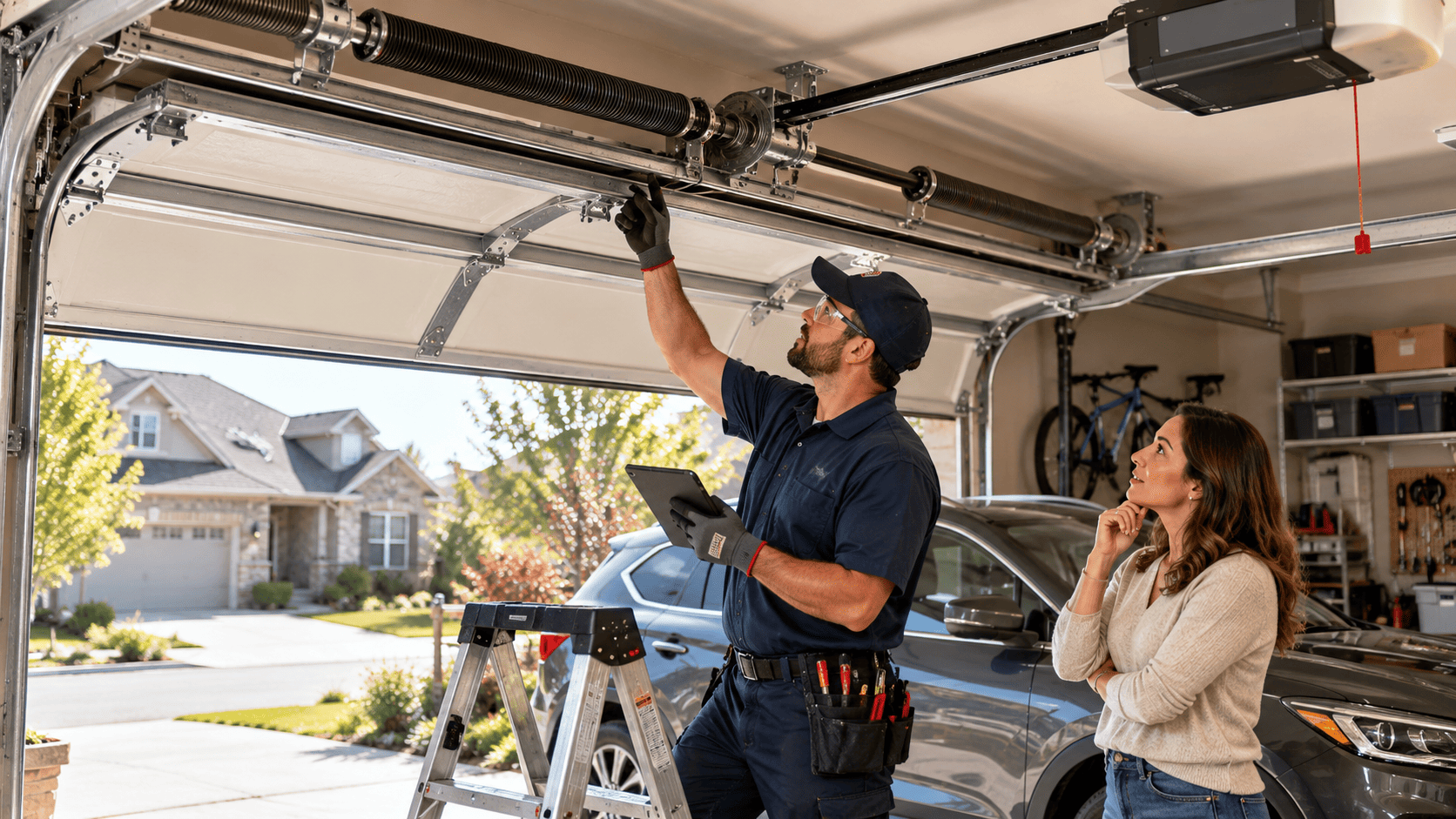
The spring system counterbalances the door's weight.
Clopay explains that the springs store and release energy to balance the door while cables transfer that force as the door travels through the tracks.
When properly balanced, the door should require relatively little effort to move and the opener motor should not have to fight the full weight of the door.
That means:
Door = heavy
Springs = counterbalance the weight
Opener = controls movement
This distinction explains one of the most common garage-door mysteries.
The motor can still make noise even though the door barely moves.
The motor may not be the failed component at all.
What Usually Fails First?
There is no single component that always fails first.
How frequently the door is used matters.
So do:
door weight,
installation,
spring specification,
climate,
maintenance,
hardware quality,
and accidental damage.
But one component deserves particular attention because it is intentionally designed around a finite number of operating cycles:
the spring.
A garage-door cycle means:
one opening + one closing.
Clopay says many standard residential garage-door springs are designed for approximately 10,000 cycles.
Commercial manufacturers likewise commonly specify 10,000-cycle standard springs, with higher-cycle options available for heavier-use applications.
That number becomes surprisingly meaningful when translated into normal household life.
If your door completes:
2 cycles a day, 10,000 cycles represents roughly 13.7 years.
At:
4 cycles a day, roughly 6.8 years.
At:
6 cycles every day, only about 4.6 years.
That does not mean every 10,000-cycle spring breaks exactly at cycle 10,001.
It means the way your household uses the garage can affect spring life dramatically.
A family using the garage door as the main entrance to the house can accumulate cycles much faster than someone who opens it twice a week.
The Loud Bang Is Often the Clue
A torsion spring stores a substantial amount of mechanical energy.
When one breaks, homeowners often describe hearing a loud bang from the garage.
Later they may notice:
the door will not open,
the opener struggles,
the door feels extremely heavy manually,
or a visible gap has appeared in the spring above the door.
If you suspect a broken spring:
do not keep repeatedly pressing the opener button.
A poorly balanced door puts extra load on the opener, and manufacturers warn that broken springs and improperly balanced doors should be handled by trained door-system technicians.
This is one of those home repairs where DIY confidence can become dangerous.
Garage-Door Springs Are Not a Normal DIY Repair
There are plenty of household jobs a capable homeowner can reasonably attempt.
Painting.
Changing filters.
Replacing weather stripping.
Lubricating suitable moving hardware according to manufacturer instructions.
A torsion-spring repair belongs in another category.
Garage-door springs store significant mechanical energy.
Cables, drums and brackets can also remain under spring tension.
An Overhead Door homeowner manual explicitly warns owners not to repair, adjust or remove torsion springs, counterbalance cables, drums, pulleys, shafts or related brackets themselves.
Clopay gives similar guidance, warning that spring repair is not a DIY project because of the tension involved.
So if you see a broken spring:
Do not start loosening bolts.
Do not unwind anything.
Do not copy a ten-minute internet video using improvised tools.
Call someone trained to work on the system.
There are situations where paying for professional labor is buying convenience.
This is one where you are also buying risk control.
The Second Important Failure Point: Cables
The springs create force.
The cables help transfer it to the door.
If a cable:
frays,
slips,
breaks,
or comes off its drum,
the door may become crooked or jam in the tracks.
That can produce one of the most alarming garage-door symptoms:
one side moves while the other does not.
The Overhead Door manual warns that if a lift cable breaks or slips from the torsion drum, the door can become cocked or wedged in its tracks and should not continue to be operated.
Again:
this is not the moment to force the remote.
A crooked door is giving you information.
Listen to it.
If the Door Is Crooked, Stop
Imagine the left side rises six inches.
The right side rises two.
The automatic response is:
Press the button again.
Maybe it will straighten itself out.
That can turn a manageable repair into:
damaged panels,
bent tracks,
damaged rollers,
or a door leaving its intended path.
If a large sectional door is visibly misaligned:
stop operating it until the reason is understood.
The system is designed to move evenly.
A door trying to move diagonally is not behaving normally.
Rollers and Tracks Have a Different Job
The springs counterbalance the weight.
The rollers guide the door.
The tracks determine where those rollers travel.
Problems here tend to create different symptoms.
You may hear:
grinding,
scraping,
rattling,
or unusual vibration.
The door may:
hesitate,
shake,
bind,
or become noticeably louder.
Overhead Door advises homeowners that a door should operate relatively quietly; new or unusual noises can indicate maintenance or repair needs.
Not every squeak means catastrophe.
But a new mechanical noise deserves attention precisely because these systems usually repeat the same movement thousands of times.
A sudden change means something changed.
Lubrication Helps—But Do Not Lubricate Everything
“Just spray WD-40 everywhere” is not garage-door maintenance.
Different components have different maintenance requirements.
Manufacturer instructions should guide lubrication.
Clopay, for example, recommends suitable garage-door or synthetic lubricant on specified moving parts such as:
spring coils,
roller bearings,
hinges,
and certain hardware points.
The objective is controlled lubrication of appropriate moving surfaces.
Not soaking:
tracks,
sensors,
belts,
electronics,
and everything else nearby in generic spray.
More lubricant is not automatically better maintenance.
Then There Is the Opener
Sometimes the opener really is the problem.
The operator includes components such as:
motor,
drive mechanism,
electronics,
limit controls,
remote receiver,
and safety logic.
Symptoms can include:
motor operating but trolley not moving,
door stopping unexpectedly,
intermittent remote operation,
incorrect opening or closing limits,
or complete failure.
But before replacing the opener, first establish whether the door itself is mechanically sound and balanced.
Why?
Because an opener attached to a badly balanced door can appear weak when it is actually being asked to do a job the spring system should be doing.
The Halfway Test Tells You Something Important
There is a basic balance test manufacturers recommend for appropriate doors.
With the door closed and the automatic opener safely disengaged according to the manufacturer's instructions, the door can be manually raised approximately halfway.
A properly balanced door should remain near that position.
If it moves sharply upward or downward, the spring balance may be incorrect.
Overhead Door explains that improper balance places unnecessary pressure on the automatic opener and can create a safety hazard. Spring adjustment should be performed by a trained professional.
One major caution:
do not perform this test on a door you already believe has a broken spring, cable problem or unsafe mechanical condition.
The balance test is a maintenance check for a functioning system—not permission to manually experiment with a visibly broken one.
Sometimes Nothing Mechanical Is Broken at All
You press Close.
The door begins to descend.
Then suddenly reverses.
You press again.
Same thing.
Now the first thought becomes:
Motor problem.
Maybe not.
Look near the bottom of the door opening.
Modern automatic garage-door systems use entrapment-protection devices, commonly photoelectric sensors, to detect an obstruction in the closing path.
A bicycle tyre.
A cardboard box.
Dust.
A spider web.
A sensor knocked out of alignment.
Even one sensor no longer seeing the other correctly can prevent normal closing.
That can look like a malfunction.
In reality, the safety system may be doing exactly what it was designed to do.
Those Little Sensors Are Not Optional Decoration
Garage doors can injure people if they close onto an obstruction.
That is why automatic residential garage-door openers in the United States became subject to federal entrapment-protection requirements.
UL explains that federal U.S. law requires residential garage-door operators to comply with the relevant entrapment-protection provisions of UL 325.
CPSC's rules requiring enhanced reversing protection took effect in the early 1990s after serious child-entrapment incidents involving older automatic garage doors.
That historical context is grim.
But it explains why a door refusing to close when its sensor beam is blocked is not an annoyance to defeat.
It is a safety feature to preserve.
There Are Usually Two Reversal Protections to Think About
A modern residential system can include:
photoelectric obstruction detection
and
contact reversal.
The photoelectric sensors should stop or reverse the closing door when an obstruction interrupts the beam.
The contact-reversal system should reverse the door when it physically contacts an appropriate test object.
CPSC guidance recommends placing a 2×4 board flat on the floor in the door's path to test the automatic reversing function, following manufacturer instructions.
If the door does not reverse properly, CPSC advises disengaging the opener until it is adjusted, repaired or replaced appropriately.
Manufacturers likewise commonly recommend this test monthly.
That is one of the simplest garage safety checks a household can perform.
And almost nobody remembers to do it.
Do Not “Fix” a Sensor by Defeating It
This deserves its own warning.
If the garage door refuses to close because of a sensor problem, do not solve the inconvenience by:
disconnecting the sensor,
taping something over a control,
rewiring the system,
or permanently bypassing the safety protection.
Fix the reason the protection is not functioning normally.
The safety system is there precisely because nobody can guarantee that the closing path will remain empty every time the door moves.
Children.
Pets.
Bicycles.
Tools.
Boxes.
Vehicles.
Anything can end up underneath.
Convenience is not worth removing entrapment protection.
What If the Remote Doesn't Work but the Wall Button Does?
That often points toward a control problem rather than a mechanical door problem.
Possible causes include:
remote battery,
lost programming,
radio interference,
remote failure,
or related electronics.
If the wall control operates the door normally and the door itself moves smoothly, the spring-and-track system is less likely to be the immediate problem.
This is where diagnosis saves money.
A $10 battery problem should not become a new garage-door opener.
What If the Motor Hums but the Door Does Not Rise?
This symptom deserves more caution.
Potential possibilities include:
broken spring,
severely unbalanced door,
drive-system problem,
disconnected trolley,
or another mechanical obstruction.
Do not repeatedly operate the opener trying to force movement.
First determine whether the counterbalance system is intact.
Remember:
the opener is not supposed to muscle a dead-weight door upward.
If a spring has failed, forcing the operator can damage additional components.
What If the Door Opens a Foot and Stops?
Possible explanations vary.
The opener may be:
detecting excessive resistance,
struggling against an unbalanced door,
encountering track or roller problems,
experiencing operator issues,
or responding to improperly set limits.
A professional diagnosis should distinguish between:
door problem
and
opener problem.
That distinction determines whether you need a relatively simple repair or replacement of a larger component.
The Door Itself Can Fail Too
We spend so much time talking about springs and openers that it is easy to forget the actual door panels.
Depending on material and environment, a door can develop:
dents,
rust,
cracked sections,
delamination,
warping,
damaged hinges,
or weather-seal deterioration.
One damaged panel does not automatically require replacing the entire door.
Some doors allow sectional replacement.
But the decision becomes more complicated when:
the door is old,
matching panels are unavailable,
multiple sections are damaged,
hardware is also worn,
or insulation performance is poor.
At some point, replacement becomes more sensible than rebuilding an ageing system one component at a time.
Repair or Replace?
There is no universal age at which a garage door must be replaced.
Ask instead:
What actually failed?
A broken spring on an otherwise excellent door is normally a repair discussion.
A failed opener attached to a healthy door is an opener discussion.
One damaged panel may be a panel discussion.
But an ageing door with:
multiple damaged sections,
worn hardware,
corrosion,
repeated failures,
poor sealing,
and an obsolete opener
can become a replacement discussion.
The key is not to let a contractor turn every failure into:
“You need everything new.”
Ask for diagnosis first.
Ask the Technician to Show You the Failure
This is one of the best consumer habits in home repair.
If the recommendation is:
new spring,
ask to see the broken spring.
Cable replacement?
Show the damaged cable.
Roller replacement?
Show the wear.
New opener?
Explain what failed in the existing one.
Complete replacement?
Explain why repair is unreasonable.
A reputable diagnosis should survive explanation.
Garage-Door Repair Is a Very Expensive Search Market
This is why consumer knowledge matters.
Current 2026 keyword datasets vary on exact numbers but agree that garage-door repair is a high-value home-services market.
One June 2026 dataset estimates:
Garage door repair — 301,000 monthly searches / $56.40 CPC
Garage door repair near me — 90,500 / $59.03
Garage door installation — 40,500 / $33.63.
Another April 2026 dataset estimates:
Garage door repair — 246,000 searches / $47.53 CPC
Garage door opener repair — 165,000 / $39.83
Garage spring repair — 27,100 / $42.33
Emergency garage-door repair — 12,100 / $95.46.
Search tools use different databases and methodologies, so these figures should be treated as directional rather than exact.
But there is no ambiguity about the larger conclusion:
A homeowner with a broken garage door is commercially valuable.
Urgency increases that value.
Urgency Can Also Make You Easier to Overcharge
Your vehicle is trapped.
You need to get to work.
Someone can come today.
They inspect the door and immediately say:
Everything needs replacing.
Maybe they are correct.
But emergency conditions reduce your willingness to compare.
The Federal Trade Commission advises homeowners to:
verify contractor licensing and insurance where required,
obtain multiple written estimates,
understand what work is being proposed,
avoid contractors demanding full payment upfront,
and resist pressure to make an immediate decision.
Obviously, a broken garage door can sometimes require immediate action.
But immediate action and unquestioned spending are not the same thing.
Be Particularly Careful With Door-to-Door Repairs
A technician you deliberately called after researching a company is different from a stranger appearing and claiming:
“We were working nearby and noticed your garage door needs repair.”
The FTC specifically identifies unsolicited doorstep approaches, pressure to act immediately and requests for full upfront payment as common warning signs in home-improvement scams.
If somebody discovers an expensive emergency you did not know existed five minutes earlier:
get another opinion.
Maintenance Does Not Need to Be Complicated
A garage door does not require obsessive attention.
But a few regular checks can reveal developing problems.
Listen.
Has the sound changed?
Watch.
Does it travel evenly?
Look.
Are cables visibly frayed?
Are rollers and hinges behaving normally?
Check the bottom weather seal.
Test the safety sensors.
Test contact reversal according to manufacturer instructions.
Have balance checked appropriately.
Follow the specific lubrication instructions for your door.
Overhead Door's maintenance guidance includes observing door travel, testing balance, inspecting safety systems and responding to unusual noises.
The goal is not to prevent every eventual failure.
Mechanical components wear.
The goal is to recognize change before the door stops working at the worst possible moment.
Springs Are Measured in Cycles, Not Birthdays
This is perhaps the most useful concept in the entire article.
People ask:
“How long does a garage-door spring last?”
The better question is:
“How many times has the door moved?”
Consider two identical homes.
House A
Garage opens once in the morning.
Closes.
Opens when the driver returns.
Closes.
Approximately four movements forming two full daily cycles.
House B
Family members enter through the garage repeatedly.
Children come and go.
Deliveries.
Second car.
Weekend errands.
The door may cycle many more times every day.
The doors can be the same age.
Their spring systems have lived very different mechanical lives.
This is why cycle rating is more meaningful than simply saying:
“The spring is seven years old.”
High-Cycle Springs Exist
If your garage door functions as the main household entrance and operates constantly, ask about spring cycle ratings when replacement becomes necessary.
Manufacturers offer higher-cycle systems for high-use applications.
Commercial spring specifications, for example, may offer options ranging from a standard 10,000 cycles to 25,000, 50,000, 75,000 or even 100,000 cycles, depending on system design.
That does not mean every residential door should automatically receive the highest-cycle spring available.
The spring must be properly matched to:
door weight,
height,
track geometry,
and system requirements.
But households with unusually heavy use should know that cycle life is a real specification worth discussing.
An Unbalanced Door Can Quietly Damage the Opener
This is one reason preventative inspection matters.
If spring tension no longer properly counterbalances the door, the opener may compensate.
At first, everything still works.
The homeowner notices nothing.
But the motor is doing more work than intended.
Overhead Door notes that an unbalanced door places unnecessary pressure on the opener and can become a safety issue.
So:
“It still opens”
does not always mean:
“Everything is healthy.”
A slow change in balance can be easy to miss because people adapt to gradual changes.
Smart Garage Doors Add Convenience—Not Mechanical Immortality
Modern openers can provide:
smartphone control,
remote status,
delivery access,
alerts,
camera integration,
battery backup,
and home-automation connectivity.
Useful.
But none of those features changes the fundamental mechanics.
The door still depends on:
springs,
cables,
rollers,
tracks,
hinges,
and correct balance.
A smart notification can tell you the garage door did not close.
It cannot repair the broken spring that prevented it from closing.
The most technologically advanced opener in the world still depends on old-fashioned mechanical physics.
Battery Backup Solves One Specific Problem
Some modern openers include battery backup.
That can help operate the door during an electrical outage.
But battery backup does not solve:
broken springs,
damaged tracks,
failed cables,
or an unsafe door.
This is another good example of understanding what each component actually does.
The battery powers the operator.
The spring still balances the door.
The Safest Garage Door Is One You Understand
You do not need to know how to wind a torsion spring.
In fact, you should not attempt to.
But every homeowner can benefit from understanding the basic system.
Spring — balances the weight.
Cable — transfers lifting force.
Rollers and tracks — guide movement.
Opener — controls powered movement.
Sensors and reversal system — help prevent entrapment.
Once you understand those roles, common symptoms become much easier to interpret.
A Quick Symptom Guide
Loud bang + door suddenly extremely heavy:
Possible spring failure. Stop operating and arrange professional inspection.
Door rises crooked:
Possible cable, drum, roller or track problem. Stop forcing it.
Door closes partway then reverses:
Check for obstruction and sensor alignment before assuming motor failure.
Remote fails but wall control works:
Consider remote/control issues.
New grinding or scraping noise:
Inspect for roller, hinge, track or hardware issues.
Motor runs but door barely moves:
Could involve spring/balance or opener-drive problems.
Door moves normally but reverses on contact incorrectly:
Safety reversal system requires attention.
Door repeatedly fails safety tests:
Do not ignore or bypass the protection.
These are diagnostic clues—not a substitute for professional inspection where tensioned hardware, electrical work or serious mechanical problems are involved.
The One Monthly Test Almost Nobody Does
If you remember only one maintenance task from this article, make it this:
test the automatic reversal system.
CPSC recommends regular testing of garage-door opener reversing protection, and manufacturer instructions commonly call for a monthly test.
The simple contact-reversal test uses a 2×4 laid flat in the closing path according to the opener manufacturer's instructions.
The door should reverse after contacting it.
If it does not:
do not simply continue using the system as though nothing happened.
The test takes minutes.
The safety system exists for years.
What Fails First?
For many households, the spring eventually becomes one of the first major mechanical wear items because its life is measured in operating cycles.
For another house, it may be:
an opener component,
sensor alignment,
cable,
roller,
or damaged section.
But the broader lesson is more useful than identifying one universal winner.
Your garage door is a system.
And each symptom points toward a different part of that system.
A door that suddenly becomes heavy is telling you something.
A door that becomes crooked is telling you something.
A door that reverses because the sensor beam is blocked is telling you something.
A motor straining against an unbalanced door is telling you something.
The mistake is repeatedly pressing the remote and hoping the message goes away.
The Machine You Ignore Until It Traps the Car
There are machines in a home that receive far more attention.
The refrigerator.
Air conditioner.
Washing machine.
Television.
Yet the garage door can move several times every single day while homeowners barely acknowledge that it contains a heavily loaded mechanical counterbalance system.
Until:
BANG.
Then everyone notices.
The best time to understand how it works is therefore not when your car is trapped behind it at 7:30 in the morning.
Know what the springs do.
Watch for balance changes.
Listen for new sounds.
Inspect visible cables without touching tensioned hardware.
Test the safety reversal system.
And when someone recommends a major repair, ask them to show you exactly what failed.
Because sometimes the most expensive part of a broken garage door is not the component.
It is the urgency.
garage door repair, garage door repair near me, garage door spring repair, garage door opener repair, broken garage door spring, garage door not opening, garage door cable repair, garage door sensor problem, garage door maintenance, garage door opener, garage door replacement, garage door installation, garage door safety, garage door spring replacement, garage door repair 2026
garage door repair service, emergency garage door repair, garage door opener repair, garage spring repair, garage door installation, garage door company, garage door replacement cost, garage door technician, torsion spring replacement, garage door cable repair, garage door off track repair, automatic garage door opener
That motor on your garage ceiling is not supposed to lift the full weight of the door.
The springs do much of the heavy work.
And many standard garage-door springs are designed around roughly 10,000 operating cycles.
So a family opening and closing the garage several times a day can wear through those cycles far sooner than somebody who barely uses the door.
Then one morning:
BANG.
The motor still runs.
The door won't move.
And suddenly the biggest moving object in the house becomes impossible to ignore.
Reader Question
How many times did your garage door open and close yesterday?
Multiply that routine across ten years and the number may surprise you.
Research Notes
UL Solutions describes the garage door as the largest moving object in the home and emphasizes the importance of correct installation and entrapment protection. In the United States, residential automatic operators are subject to federal requirements incorporating UL 325 safety protections.
Garage-door springs act as the counterbalance system rather than leaving the electric opener to lift the full door weight. Manufacturer guidance says improper spring balance can strain the opener and create a safety concern.
Many standard spring systems are designed around approximately 10,000 cycles, though actual life varies and higher-cycle spring systems exist. Spring selection must match the door's weight and system geometry.
CPSC and manufacturer guidance recommend regular testing of automatic reversal protection. CPSC describes a contact-reversal test using a 2×4 laid flat beneath the closing door; a system that fails to reverse should be adjusted or repaired rather than simply continued in service.
Safety note: Garage-door torsion springs, counterbalance cables, drums and related hardware can remain under dangerous tension. Repairs or adjustment of these components should be performed by appropriately trained professionals.