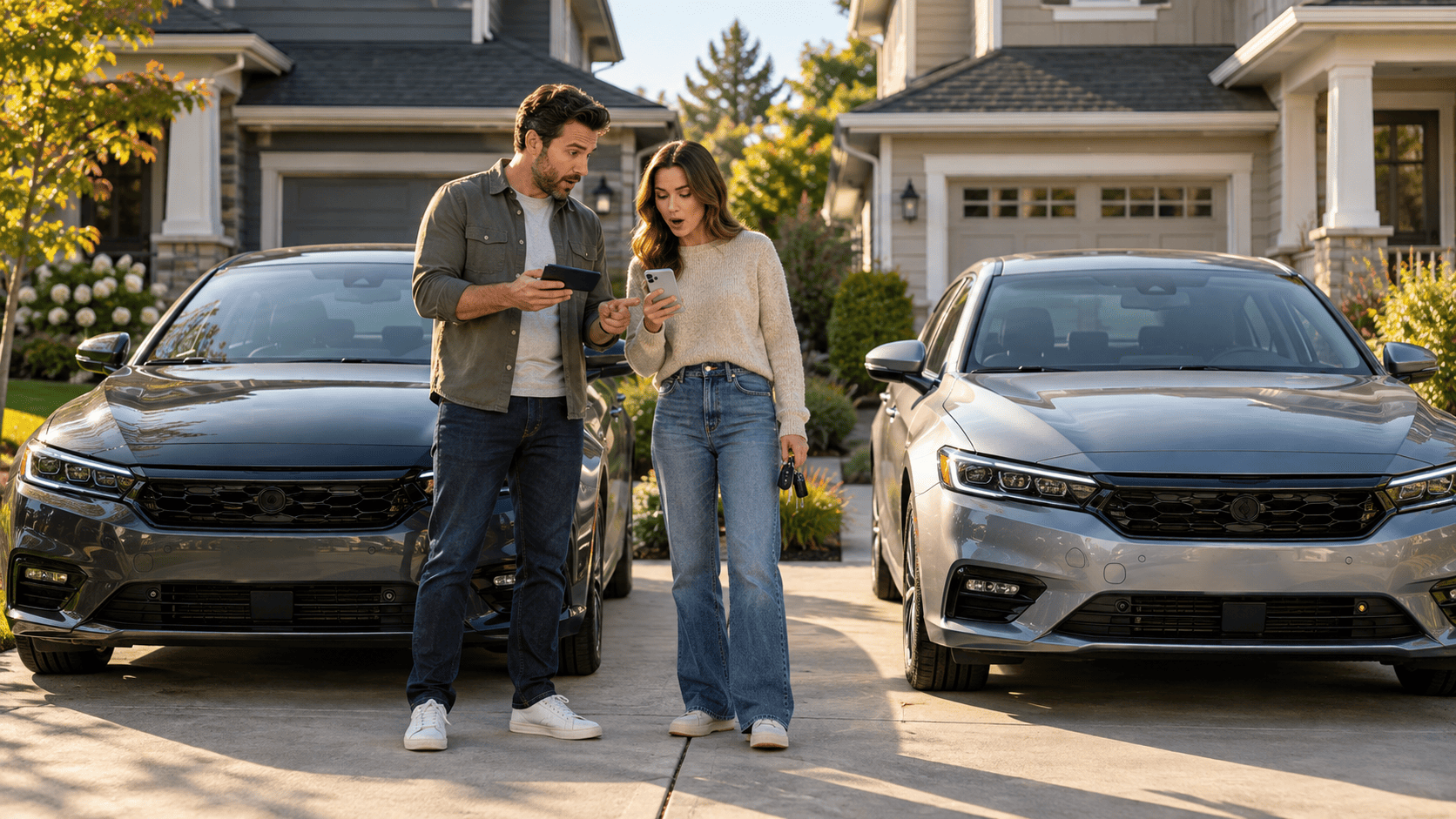
Two neighbors own nearly identical cars.
Same model.
Same year.
Same neighborhood.
They commute similar distances.
Neither considers themselves a dangerous driver.
One receives an insurance quote for one amount.
The other receives a quote hundreds—or sometimes thousands—of dollars higher.
Naturally, the second driver asks:
“How can that possibly be fair?”
It feels as though car insurance should work like gasoline.
Same product.
Same location.
Roughly the same price.
But auto insurance does not work that way.
You are not simply buying protection for the car.
The insurer is pricing a prediction.
How likely is this driver, vehicle and coverage combination to generate a claim—and how expensive could that claim become?
That prediction can involve:
where you live,
what you drive,
how much you drive,
your driving history,
previous claims,
coverage limits,
deductible,
insurance history,
and, where legally permitted, factors derived from credit history.
Different insurance companies can also weigh those variables differently.
That is how two apparently similar drivers can receive remarkably different prices.
And Americans are increasingly discovering those differences for themselves.
LexisNexis reported in August 2026 that 47.2% of U.S. auto insurance policies in force had been shopped at least once during the previous 12 months, only fractionally below the highest rate the company has recorded.
Meanwhile, the advertising economics surrounding those searches are extraordinary.
A September 2026 analysis of Google Keyword Planner data found the average CPC across 993 insurance keywords was $31.22.
The volume-weighted average was even higher at $36.45.
And one of the most valuable phrases in the entire dataset—
“car insurance quotes”
—was estimated at approximately 673,000 monthly searches and $156.95 per advertiser click.
Why would an insurer potentially pay that much just for a click?
Because the person clicking may be preparing to move thousands of dollars of future premium payments to another company.
Insurance Is Really a Prediction Business
When you buy auto insurance, the insurer does not know whether you will crash next Tuesday.
Nobody does.
So it estimates risk.
The National Association of Insurance Commissioners explains auto-insurance pricing as two connected processes:
underwriting and rating.
Underwriting evaluates the risk associated with an applicant.
Rating assigns a price based on the insurer's expected cost of accepting that risk.
This is why insurance pricing can feel strangely personal.
A shop sells a television based mostly on the television's price.
An insurer sells you a policy partly based on what it believes may happen after you buy it.
That makes every customer a statistical question.
Your Driving Record Is One of the Obvious Factors
Speeding tickets.
At-fault crashes.
Serious traffic violations.
Previous claims.
These are among the easiest factors for consumers to understand.
NAIC lists driving history and claims history among the major considerations used in auto-insurance pricing.
The logic is straightforward.
Past behavior cannot perfectly predict future behavior.
But insurers use historical patterns to estimate future claim probability.
A clean record can therefore have financial value.
A serious violation can have a cost that extends well beyond the ticket itself.
But Your Own Claims Are Not the Whole Story
This is where insurance becomes more interesting.
NAIC notes that one of the biggest influences on rating is claim frequency within groups of similar risks, not merely the number of claims you personally have filed.
That means insurers are asking broader questions.
How frequently do similar vehicles generate claims?
How severe are claims in this location?
How expensive are repairs for this model?
How frequently are drivers with similar characteristics involved in losses?
Insurance is built around pooling risk.
So part of your price can reflect the experience of people statistically grouped with you.
Your Address Can Change the Price
Where you live matters.
Insurers can consider geographic territory because claim patterns differ by location.
An urban environment may have:
more traffic,
more collisions,
greater theft exposure,
more vandalism,
higher repair costs,
or different legal and medical claim patterns
than another area.
Even within a metropolitan region, loss experience can differ.
So moving homes without changing cars can potentially change an insurance quote.
The vehicle did not become more dangerous overnight.
The statistical environment around it changed.
The Car Matters for More Reasons Than Its Purchase Price
A $70,000 car may cost more to insure than a $25,000 car because replacing it costs more.
Obvious.
But vehicle pricing is more complicated than sticker price.
Insurers may consider:
repair cost,
parts availability,
theft patterns,
performance,
safety equipment,
claim history,
and the severity of losses associated with particular vehicles.
NAIC specifically identifies vehicle type as an important pricing factor.
And modern technology has made this increasingly interesting.
A Small Crash Is Not Always a Small Repair Anymore
Twenty years ago, a bumper might have been mostly a bumper.
Today it may sit beside or contain:
radar sensors,
parking sensors,
cameras,
wiring,
driver-assistance components,
and equipment requiring calibration after repair.
The Insurance Institute for Highway Safety noted in August 2026 that vehicle repair prices have increased more than 40% since 2020, according to U.S. Bureau of Labor Statistics data. Advanced crash-avoidance technology can increase the cost of individual repairs even while preventing crashes overall.
CCC Intelligent Solutions reported another striking statistic in its 2026 Crash Course analysis:
28.3% of repairable estimates now include calibrations, reflecting the increasing complexity of technology inside modern vehicles.
So when somebody asks:
“Why does insurance care which version of the car I bought?”
this is part of the answer.
A seemingly minor accident can involve expensive technology.
The Safest Technology Can Also Be Expensive to Fix
This creates an interesting paradox.
Automatic emergency braking may reduce crashes.
Blind-spot detection may prevent another.
Lane-support technology may reduce risk.
That is good for insurers and drivers.
But if an accident does occur, replacing and recalibrating those systems can increase the repair bill.
IIHS describes exactly this tension: modern crash-avoidance systems can simultaneously reduce crash frequency while increasing repair severity when damage occurs.
So technology can push insurance economics in both directions.
Fewer crashes.
More complicated repairs.
Electric Cars Add Another Layer
EV insurance has generated a great deal of debate because battery-electric vehicles historically produced more expensive collision claims than comparable internal-combustion vehicles.
The difference appears to be narrowing.
Mitchell's Q2 2026 collision analysis found average repairable-claim severity in the United States of:
$5,684 for battery EVs
versus
$4,955 for internal-combustion vehicles.
That $729 difference was the smallest gap Mitchell had recorded, although EV repairs remained more expensive on average.
This reinforces an important principle.
Insurance pricing does not ask merely:
Is this technology good?
It asks:
What does a claim involving this technology tend to cost?
Mileage Matters Because Exposure Matters
Imagine two identical drivers.
One drives:
4,000 miles per year.
The other:
30,000.
All else equal, the second driver simply spends much more time exposed to road risk.
NAIC therefore lists annual mileage and vehicle use among standard rating considerations.
That is why insurers may ask whether the vehicle is used for:
commuting,
business,
pleasure,
delivery work,
or another purpose.
More road exposure can mean greater opportunity for a claim.
Working From Home Can Potentially Matter
If someone's commute disappears and annual mileage drops substantially, that information may be worth updating with the insurer.
Do not assume the insurer knows automatically.
The same applies when:
a commute changes,
a child leaves for university,
a vehicle becomes rarely used,
or another vehicle becomes the primary car.
Accurate insurance information matters because pricing is based partly on how the vehicle is actually used.
Your Deductible Is Essentially Risk You Keep Yourself
Suppose your collision deductible is $500.
You are agreeing to absorb the first $500 of an eligible covered loss before the insurer's portion applies according to the policy.
Increase that deductible and the insurer retains less of the smaller-loss risk.
As a result, premiums may fall.
NAIC explicitly notes that policyholders can often lower premiums by accepting more risk themselves—for example by increasing deductibles or removing optional coverage.
But this creates a trap.
A $2,000 deductible is not a bargain if you could not produce $2,000 after an accident.
Lower premium does not mean lower financial exposure.
It means the exposure has moved.
Coverage Limits Matter Too
Two drivers saying:
“I have full coverage”
may have dramatically different policies.
“Full coverage” is not a precise universal insurance product.
One person may carry much higher liability limits.
Another may choose lower limits.
One may include:
collision,
comprehensive,
rental reimbursement,
roadside assistance,
uninsured-motorist protection,
or other options.
Another may not.
NAIC describes auto coverage as a collection of different protections and notes that premium depends partly on the amount and types of coverage purchased.
So comparing premiums without comparing coverage can be meaningless.
The Cheapest Quote May Simply Contain Less Insurance
Imagine:
Company A: $1,600
Company B: $1,250
Company B looks clearly cheaper.
But suppose Company A includes:
$500 collision deductible,
higher liability limits,
rental reimbursement,
and broader uninsured-motorist protection.
Company B has:
$1,500 deductible,
lower limits,
and no rental coverage.
You are not comparing two prices for the same product.
You are comparing two products.
Before switching, align the coverage as closely as possible.
Then We Reach the Controversial Factor: Credit
Many consumers are shocked to learn that auto insurance pricing may consider information connected with credit history.
A credit-based insurance score is not the same thing as the credit score a bank uses to decide whether you will repay a loan.
NAIC says insurers use credit-based insurance scores to estimate the likelihood of an insurance claim. FICO estimates that roughly 95% of auto insurers use them in states where the practice is permitted.
The rules vary by jurisdiction.
Some states restrict or prohibit particular uses of credit information.
That is why blanket statements such as:
“Your credit score always determines your car insurance”
are inaccurate.
But where permitted, credit-related information can materially affect pricing.
Why Would Credit History Have Anything to Do With Driving?
This is where many people object.
A credit card has nothing to do with steering a vehicle.
That criticism is understandable.
Insurers argue that historical data shows statistical relationships between credit-based insurance scores and claims.
Critics question fairness, equity and whether consumers should be priced for auto coverage based on financial characteristics that are not driving behavior.
The regulatory treatment differs precisely because this remains a significant policy debate.
From a consumer perspective, the practical lesson is simpler:
Know whether credit-related information is allowed to influence your policy where you live.
And check your credit reports for errors where applicable.
Age and Driving Experience Can Matter
Insurance companies also consider experience and age in many jurisdictions, subject to local law.
A newly licensed driver presents less historical evidence and can belong to groups with higher claim frequency.
Older and more experienced drivers may initially benefit from greater experience, although risk can change again later in life.
NAIC includes age and driving experience among common rating factors.
Again, regulation varies.
Not every factor is legal everywhere.
Gender and Marital Status Can Be Used in Some Markets
These factors often surprise consumers as well.
NAIC lists gender and marital status among rating factors used by insurers, while emphasizing that insurance regulation is state-specific.
Some jurisdictions prohibit or restrict their use.
The key principle is that insurers price populations using statistical loss experience within whatever legal framework applies.
That framework can therefore change the premium almost as much as the individual driver.
Your Insurance History Can Follow You
Previous insurance coverage matters too.
A lapse can be important.
Suppose someone cancels insurance because they temporarily stop driving.
Later they return to the market.
Depending on the circumstances and jurisdiction, the gap in continuous coverage can affect pricing.
NAIC includes prior insurance coverage among the main factors insurers may consider.
That is why cancelling a policy should be a deliberate decision rather than simply allowing it to expire because the car is not being used.
Then There Is Telematics
Insurance is becoming more personalized through usage-based insurance, or UBI.
Instead of estimating risk primarily from traditional characteristics, telematics attempts to measure aspects of how the vehicle is actually driven.
Depending on the program, data may include:
mileage,
time of day,
hard braking,
rapid acceleration,
cornering,
speed,
and other driving patterns.
NAIC describes these systems as a way for insurers to align pricing more closely with observed vehicle use.
And adoption is no longer tiny.
JD Power's 2026 Insurance Shopping Study reported that 20% of auto-insurance customers were using usage-based insurance programs.
The Trade-Off Is Obvious: Price for Data
Telematics may reward safer or lower-mileage drivers.
But the discount is not free in the philosophical sense.
You are sharing driving information.
So before enrolling, ask:
What information is collected?
How long is it retained?
Does location get recorded?
Can your rate increase as well as decrease?
Is the program temporary or continuous?
What happens to the data if you leave?
Can information be used for claims?
Those questions matter because insurance pricing is increasingly becoming a data relationship.
Your Smartphone May Become Part of Your Insurance Profile
Telematics no longer necessarily requires a separate box installed in a vehicle.
Programs can operate through:
phone apps,
connected vehicles,
or other digital systems.
This creates a future in which insurance pricing may depend increasingly on observable behavior rather than broad demographic proxies.
That could be beneficial for genuinely careful drivers.
But it also creates new questions involving:
privacy,
accuracy,
context,
and algorithmic interpretation.
A hard braking event may indicate aggressive driving.
Or it may indicate that you successfully avoided a child running into the road.
Data records behavior.
It does not always understand the story.
Why Do Different Insurers Give Different Quotes?
This is the part consumers should use to their advantage.
NAIC notes that insurance companies develop their own rating systems, even though they operate within regulatory requirements.
One insurer may price your vehicle type attractively.
Another may have had poor claims experience with it.
One may aggressively want customers in your demographic.
Another may not.
One may value your bundling potential.
Another may price your location more heavily.
One may offer a strong discount for telematics.
Another may barely move the premium.
That means an expensive quote does not necessarily mean:
“You are expensive to insure everywhere.”
It may mean:
“You are expensive according to this insurer's current model.”
That is a very different statement.
This Is Why Shopping Can Actually Work
The latest market data is remarkable.
LexisNexis says that by the end of Q2 2026, 47.2% of U.S. auto insurance policies had been shopped at least once during the previous twelve months.
JD Power's separate 2026 Insurance Shopping Study found 53% of customers had shopped for auto insurance, down from 57% the previous year but still historically elevated.
Those shoppers were requesting 3.5 quotes on average, the highest level JD Power reported.
People are not merely accepting the renewal notice anymore.
They are testing the market.
Nearly Half of New Policies Are Now Bought Digitally
Insurance used to mean:
call an agent,
visit an office,
discuss options,
sign paperwork.
That model is changing rapidly.
JD Power found 48% of new auto policies were purchased digitally in 2026, compared with 36% just five years earlier.
This helps explain the extraordinary bidding war around insurance search terms.
The person typing:
“car insurance quotes”
may move from search engine to completed policy without ever entering an insurance office.
That click can be the beginning of a long-term customer relationship.
AI Has Entered the Insurance Shopping Process Too
This is a particularly interesting 2026 development.
JD Power says roughly one-third of auto-insurance shoppers are now using AI tools while comparing coverage, and AI users are more likely to switch insurers.
That sounds useful.
Insurance contracts are complicated.
AI can help explain:
deductibles,
liability limits,
collision,
comprehensive,
and other terminology.
But there is a danger.
JD Power also found only 58% of customers said they fully understood their auto-policy coverage.
That means millions may be shopping for something they do not completely understand.
AI can assist.
It should not replace verification against the actual policy.
The Renewal Notice Is Not a Loyalty Reward
Many consumers stay with the same insurer for years.
That can be perfectly reasonable.
Bundling benefits may be good.
Service may be excellent.
The price may remain competitive.
But loyalty alone should not be assumed to produce the lowest market price.
Insurance models change.
Your circumstances change.
Competitors change.
Insurers change their appetite for different types of customers.
The price that was best three years ago may no longer be best today.
Periodic comparison creates information.
You can still decide to stay.
But Do Not Switch for $50 Without Looking at Everything Else
Price matters.
Claims service matters too.
So do:
financial strength,
coverage,
deductibles,
digital tools,
repair processes,
customer service,
rental handling,
and policy exclusions.
The absolute cheapest insurer may not be the best choice if a serious claim becomes difficult to resolve.
The objective is not:
lowest premium at any cost.
It is:
appropriate coverage at a competitive total price from a provider you are comfortable relying on after a loss.
Bundling Can Help—But Compare the Total
Insurers frequently discount customers who combine:
auto,
home,
renters,
or umbrella insurance.
That can produce worthwhile savings.
But evaluate the entire package.
Suppose:
Insurer A saves $300 on auto through bundling but charges $600 more for home insurance.
That is not a saving.
The household-level number matters.
JD Power's 2026 shopping data found 45% of active auto shoppers also had homeowners coverage, yet only 20% received a home quote while shopping for auto coverage.
That suggests many people compare only part of their insurance picture.
Raising the Deductible Can Lower the Premium—But Build the Cash First
A higher deductible can be a sensible way to reduce recurring premiums if you have enough emergency savings to absorb it.
For example:
Old deductible: $500
New deductible: $1,500
Potential premium: lower.
But if an accident happens next week, you need the additional $1,000.
The saving becomes rational only when you can actually retain the extra risk.
Insurance should protect against financial shocks.
It should not create one.
Do Not Automatically File Every Tiny Claim
This does not mean hiding accidents that your policy or law requires you to report.
But for optional damage claims, consumers should understand the relationship between:
repair amount,
deductible,
claim history,
and future insurability.
If the repair costs $650 and your deductible is $500, the maximum immediate benefit may be small.
Whether a claim should be filed depends on the circumstances and policy obligations.
The important point is to understand the economics before assuming insurance should be used for every minor loss.
Check Discounts Individually
NAIC lists several common discount categories, although availability varies by insurer and state.
These can include:
multiple vehicles,
driver education,
good student,
safety devices,
anti-theft equipment,
low mileage,
good-driver status,
and combining home and auto coverage.
Do not assume every eligible discount was applied automatically.
Ask.
Especially after life changes.
Update the Insurer When Your Life Changes
Insurance applications can quietly become outdated.
Perhaps you:
stopped commuting,
changed jobs,
moved,
began working remotely,
added a teenage driver,
removed a driver,
sold a vehicle,
changed annual mileage,
installed anti-theft equipment,
or began keeping the vehicle at another location.
Those changes can affect risk and therefore pricing or coverage.
Keeping the policy accurate is part of managing insurance.
Why Are Premiums Still Expensive Even as Some Rate Increases Cool?
The 2026 market is becoming more interesting.
LexisNexis reported that Q2 rate revisions were fairly balanced:
36% were decreases
38% were increases
27% were effectively neutral.
Average decreases were about 4.5%, while increases averaged about 5.1%.
JD Power likewise reported that fewer customers were seeing insurer-initiated premium increases than previously.
So the era of across-the-board sharp increases may be cooling.
But underlying claim costs remain high.
Vehicle repairs are expensive.
Medical claims are expensive.
Modern vehicles are complex.
And severe claims have become more costly.
Bodily Injury Is Becoming More Expensive
Car insurance is not simply about fixing bumpers.
Serious crashes injure people.
CCC's 2026 Crash Course report found average paid bodily-injury claim severity rose 10.3% year over year and 32% over four years.
LexisNexis separately reported that bodily-injury claims accounted for more than 26% of total claims dollars in 2025, compared with 20% in 2022.
That matters because insurance premiums ultimately need to fund claims.
Even if crashes become less frequent, more expensive severe claims can continue putting pressure on prices.
Your Premium Is Not a Score of Your Character
This is worth remembering.
An expensive insurance quote does not mean an insurer has decided:
“You are a bad person.”
Insurance pricing is statistical.
Sometimes very personal variables are involved.
But the output is ultimately an actuarial estimate of expected cost under a particular model and legal framework.
That explains why another insurer can reach a different answer.
How to Compare Quotes Properly
When shopping, hold as much constant as possible.
Compare the same:
liability limits;
collision coverage;
comprehensive coverage;
deductibles;
uninsured/underinsured motorist coverage;
medical-related coverage where applicable;
rental coverage;
roadside benefits;
drivers;
vehicles;
annual mileage.
Then compare the premium.
Otherwise, the cheapest quote may merely contain less protection.
The Declaration Page Is Your Starting Point
NAIC recommends understanding the policy's declarations page, which summarizes key information including insured vehicles, policy period and coverage limits.
When shopping, use your existing declaration page as a reference.
It makes apples-to-apples comparison much easier.
Instead of asking:
“Give me cheap insurance.”
you can ask:
“Quote this level of protection.”
The Five-Minute Renewal Habit
When your renewal arrives, do not simply hit autopay.
Check:
Did the premium change?
Did any coverage change?
Did the deductible change?
Are all drivers and vehicles correct?
Is annual mileage still accurate?
Are available discounts applied?
Would comparable coverage cost less elsewhere?
You do not have to switch every six months.
You do need to know what you are paying for.
The Biggest Insurance Mistake Is Comparing Only the Price
Imagine saving $300 a year.
Excellent.
Then an accident occurs.
You discover the cheaper policy has a much higher deductible and lower limits than the old policy.
You did not actually find the same insurance for $300 less.
You bought less insurance.
That may still have been a legitimate choice.
But it should have been intentional.
Why Two Drivers Can Pay So Differently
Return to our two neighbors.
Same car.
Same city.
Yet one pays considerably more.
Maybe one drives 25,000 miles annually.
Maybe one has a recent speeding violation.
Maybe their coverage limits differ.
Maybe one chose a $250 deductible and the other $1,000.
Maybe one has continuous insurance history.
Maybe the vehicles have different trim levels.
Maybe one participates in telematics.
Maybe credit-based insurance scores are legally permitted and differ.
Or maybe one insurer simply prices that driver's risk profile more aggressively than another.
Usually there is no single answer.
Insurance pricing is the result of many small variables interacting.
That Is Exactly Why Shopping Matters
If every insurer used the exact same formula, comparing quotes would be mostly pointless.
They do not.
That variation creates opportunity.
A driver considered expensive by one insurer can be perfectly attractive to another.
This is why nearly half of U.S. policies have now been shopped within a year.
And why advertisers are willing to bid astonishing amounts for quote searches.
The consumer who understands this has an advantage.
Do not ask only:
“Why did my insurance company charge me this?”
Ask:
“What would another insurer charge for the same protection?”
That question takes perhaps twenty minutes online.
In a market where the same risk can receive very different prices, those twenty minutes can be among the best-paid minutes in your household budget.
car insurance, auto insurance, car insurance rates, car insurance quotes, auto insurance quotes, cheap car insurance, why car insurance is expensive, compare car insurance, auto insurance rates, car insurance deductible, insurance premiums, vehicle insurance, telematics insurance, usage based insurance, car insurance credit score, car insurance 2026
car insurance quotes, auto insurance quotes, compare car insurance, affordable car insurance, auto insurance companies, car insurance companies, online car insurance quote, full coverage car insurance, bundle auto and home insurance, usage based insurance, vehicle insurance quote, insurance broker
Would You Buy an EV With 100,000 Miles?
Personal Loan APR vs Interest Rate
Why Home Insurance Costs Are Rising So Fast
Travel Insurance Explained
Automotive
Money Guides
Two people can drive almost the same car, live in the same city and receive completely different insurance quotes.
And consumers are noticing.
LexisNexis says 47.2% of U.S. auto policies were shopped at least once over the past year, close to a record.
There is a reason shopping matters:
Insurance companies do not all calculate your risk the same way.
The quote you receive is not necessarily the price of insuring you.
It is one insurer's price for insuring you.
Those are very different things.
Reader Question
If another insurer offered identical coverage for $500 less per year, how much loyalty would you feel toward your current insurance company?
Research Notes
The National Association of Insurance Commissioners identifies location, age and driving experience, driving record, claims history, credit information where permitted, prior insurance coverage, vehicle type and use, annual mileage, coverage choices and deductibles among factors that may affect auto-insurance rates. Each insurer develops its own rating approach within applicable regulatory rules, which helps explain why quotations can differ materially.
Credit-based insurance scoring deserves special qualification. NAIC says such scores use information from credit history to help estimate claim risk and reports that FICO estimates approximately 95% of auto insurers use them where legally allowed. State restrictions differ, so this should not be treated as universal U.S. practice.
The latest LexisNexis Insurance Demand Meter reports that 47.2% of U.S. policies in force were shopped during the prior 12 months. Its analysis is based on consumer shopping transactions representing nearly 90% of the U.S. insurance-shopping universe.
JD Power's 2026 Insurance Shopping Study separately reports that shoppers sought 3.5 quotes on average, nearly half of newly purchased auto policies were acquired digitally, and approximately 20% of customers were using usage-based insurance.
Vehicle repair economics are also changing. IIHS reports vehicle-repair prices have risen more than 40% since 2020, while CCC's 2026 claims analysis found 28.3% of repairable estimates now involve calibrations associated with increasingly sophisticated vehicle technology.
Insurance note: Auto-insurance rating factors, permitted data, minimum coverage, liability rules and consumer protections differ substantially by jurisdiction. This article provides general consumer information rather than individualized insurance, financial or legal advice.