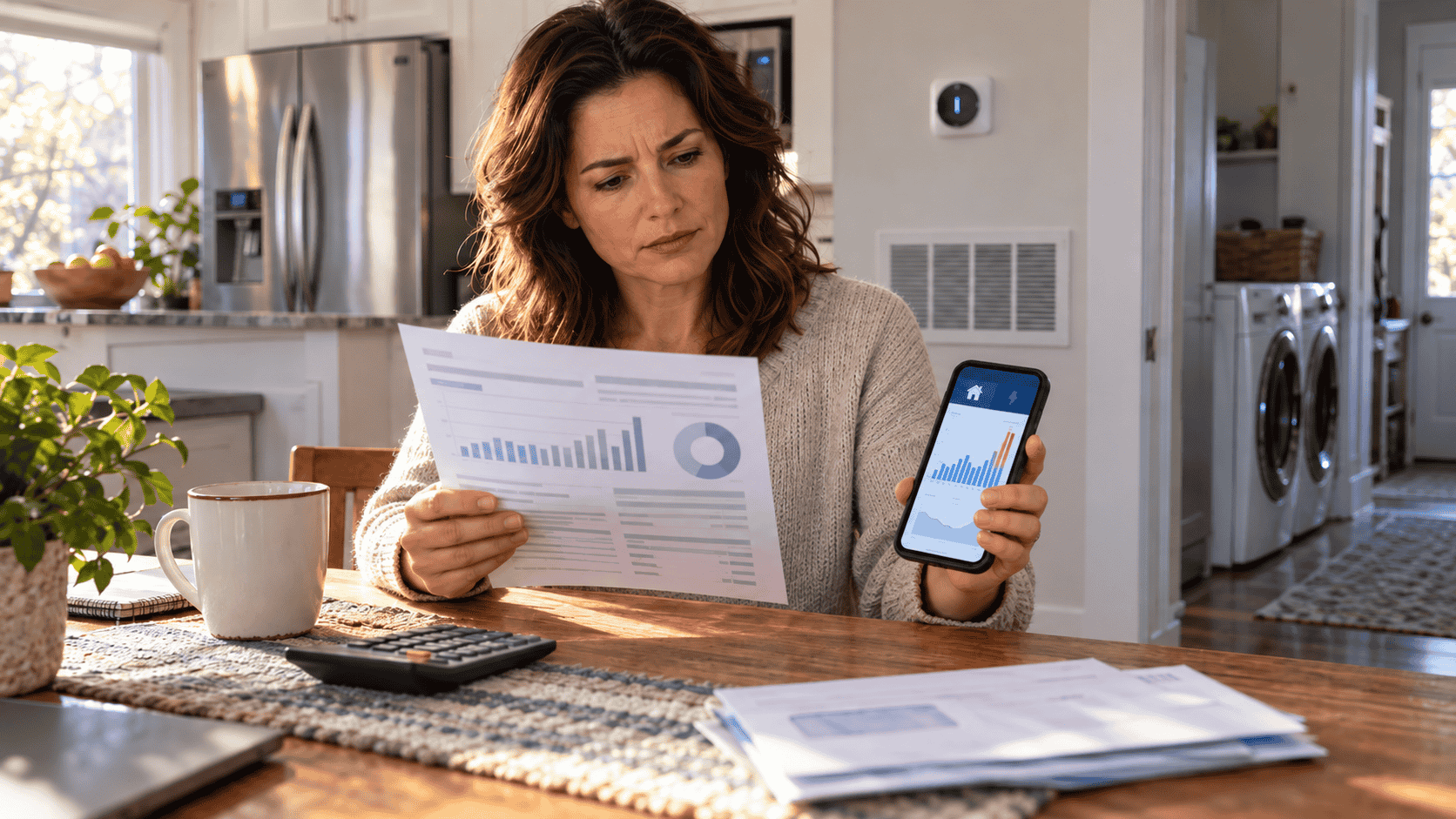
You open the electric bill expecting roughly the usual amount and suddenly it is $70, $100 or even more above normal. Nothing obvious changed. You did not buy an electric car, install a hot tub or leave every light on all month. Before assuming your utility made a mistake, compare two numbers first: how many kilowatt-hours you used and how much each of those kilowatt-hours effectively cost you.
Start With kWh, Not the Dollar Total
The total amount due is the number that gets your attention.
It is not the best number for diagnosing the problem.
Find the electricity consumption on the bill, usually shown in kilowatt-hours, or kWh.
Then compare it with:
last month;
the same month last year;
and, ideally, several similar months.
There are two fundamentally different ways for a bill to rise.
You used more electricity.
Or electricity became more expensive.
Sometimes both happened at once.
Until you separate those two, everything else is guessing.
If Your kWh Stayed Almost the Same, Look at the Price
Suppose you used 900 kWh last October.
This October you used 910 kWh.
Usage barely changed.
But the bill is significantly higher.
That points away from household behavior and toward the price structure.
The U.S. Energy Information Administration says the average residential revenue collected per kilowatt-hour nationwide reached 18.31 cents in July 2026, 4.9% higher than a year earlier.
That is a national average, not the rate on your particular bill.
Your state, utility, supplier and rate plan can behave very differently.
But it illustrates an important point:
a household can consume nearly the same amount of electricity and still pay more because the price changed.
Your “Electricity Rate” May Be More Than One Line
Many people look for one number labeled electricity rate.
The bill may be more complicated.
Depending on where you live, you may be paying separately for things such as:
electricity generation;
transmission;
distribution;
customer charges;
taxes;
fees;
fuel adjustments;
renewable-energy programs;
or other regulated charges.
EIA explains that the effective retail price consumers pay reflects the cost of delivered electricity, including generation, transmission, distribution, taxes and fees.
That means the generation price can stay relatively stable while another part of the bill changes.
Read the bill line by line before concluding that the utility simply raised “the electricity price.”
A Fixed Customer Charge Can Raise the Bill Even When Usage Falls
Some utilities charge a fixed monthly amount just for having electric service.
That charge does not disappear because you used fewer kilowatt-hours.
Imagine your energy consumption falls by $15 worth of electricity but the fixed customer charge rises by $10.
Your conservation effort still helped.
It just becomes harder to see in the total.
When comparing bills, separate:
fixed charges;
usage-based charges;
and taxes or adjustments.
That gives you a much clearer picture.
Check the Number of Days in the Billing Period
This sounds minor.
It can matter more than people expect.
One bill may cover 28 days.
The next may cover 33.
Even if your daily electricity use stayed identical, the 33-day bill would naturally be higher.
Instead of comparing only monthly kWh, calculate roughly:
kWh ÷ billing days.
That gives you average daily electricity use.
Example:
900 kWh over 30 days = 30 kWh per day.
990 kWh over 33 days = also 30 kWh per day.
The second bill looks 10% worse.
Your daily behavior did not change at all.
The billing period did.
Weather Can Change Electricity Use Without You Feeling Like You Changed Anything
You may honestly believe your household routine is identical.
The weather may disagree.
Heating and cooling are the largest residential electricity uses nationally.
EIA says residential electricity demand shows strong seasonal variation because temperature and humidity affect cooling and heating needs.
Your thermostat can remain at exactly the same setting while the HVAC system runs much longer because the outdoor temperature changed.
That means:
same thermostat setting
does not equal
same electricity use.
A Few Degrees Outside Can Mean Hours More HVAC Runtime
Suppose your thermostat is always set to 72°F.
Last week the outdoor temperature was 78°F.
This week it is 94°F.
You did not touch the thermostat.
But the air conditioner now has a much larger heat load to overcome.
The same thing happens with electrically heated homes in winter.
If outside temperatures plunge, a heat pump or electric furnace may need to run far longer to maintain the same indoor temperature.
EIA says residential electricity use typically rises significantly during summer cooling periods and can also rise during winter in homes that use electric heating.
Your behavior may look unchanged.
The building’s workload is not.
Heat Pumps Can Produce a Particularly Surprising Winter Bill
A heat pump normally heats a home efficiently by moving heat rather than creating all of it through electric resistance.
But some systems also contain electric resistance backup heat.
Depending on the system, thermostat and outdoor conditions, that auxiliary or emergency heat can operate during very cold weather or during certain recovery periods.
Resistance heating can use substantially more electricity than normal heat-pump operation.
So if a winter bill suddenly jumps, check whether your thermostat or HVAC system has been showing:
AUX HEAT;
EM HEAT;
or another backup-heat indication.
Do not assume the heat pump itself suddenly became inefficient.
Find out what heating mode actually operated.
A Thermostat Schedule Can Change Without You Realizing It
Smart thermostats add convenience.
They also add another variable.
A software update, schedule change, occupancy setting or manually overridden temperature can alter how long the HVAC equipment runs.
Check:
the target temperature;
weekly schedule;
away mode;
eco mode;
heating and cooling history;
and any utility demand-response settings you enrolled in.
ENERGY STAR says heating and cooling account for almost half of the average American household’s annual energy bill.
That makes even small HVAC schedule changes potentially more important than dozens of lights.
Do Not Start by Unplugging the Phone Charger
Tiny loads are easy to see.
Big loads are where the money usually lives.
If your electric bill jumped dramatically, investigate major energy users first.
Depending on the home, those may include:
central air conditioning;
electric heat;
heat pumps;
water heaters;
clothes dryers;
electric ovens;
pool pumps;
dehumidifiers;
space heaters;
EV charging;
and large refrigeration equipment.
A phone charger left plugged in is unlikely to explain a $120 monthly surprise.
Find the elephants before chasing the mice.
An Electric Space Heater Can Be a Much Bigger Deal Than It Looks
A small portable heater looks harmless.
Many draw around 1,500 watts on their highest setting.
Run one for eight hours and it can consume roughly 12 kWh in a day.
Do that repeatedly through a cold month and the electricity use adds up quickly.
Two space heaters running regularly can become a major load.
This is why a household can say:
“We didn’t change anything”
while forgetting that somebody started using a heater under the desk every workday.
Lifestyle changes do not have to involve new appliances.
Sometimes they involve old appliances running much longer.
A Dehumidifier Can Quietly Run for Hours Too
Basements and humid climates often require dehumidification.
A dehumidifier can run for many hours when moisture levels are high.
If drainage, humidity settings or basement conditions change, runtime can increase substantially.
The device may be out of sight.
Its electricity consumption is not.
If your bill rises during a humid period, check whether the dehumidifier seems to be operating almost continuously.
The Water Heater Is Another Hidden Load
Electric water heating can consume substantial energy.
Changes in hot-water use may not feel like changes in electricity use.
Maybe:
more people are staying in the house;
showers became longer;
the incoming water is colder;
laundry habits changed;
or the water heater developed a problem.
An older electric heater with sediment buildup, a thermostat issue or another malfunction may perform differently from normal.
If electricity consumption increased and nothing obvious changed elsewhere, water heating belongs on the checklist.
A Hot-Water Leak Can Become an Electricity Leak
Imagine a hot-water faucet dripping.
Or a plumbing leak somewhere constantly drawing heated water.
The problem is not only the water going down the drain.
The water heater has to replace and reheat that water.
A significant hot-water leak can therefore increase both:
the water bill;
and the energy bill.
If both bills rose around the same time, look for a connection.
Your Refrigerator Runs 24 Hours a Day
A refrigerator normally cycles on and off.
If something makes it run much longer, electricity consumption can increase.
Possible causes include:
dirty condenser coils;
poor airflow;
a failing door seal;
a door that is not closing fully;
very warm room conditions;
or mechanical problems.
One refrigerator is unlikely to explain every enormous utility increase.
But an appliance running continuously when it normally cycles deserves attention.
Listen.
Feel whether the compressor seems to operate almost all the time.
Check the door seals.
A Second Refrigerator or Freezer Can Be Easy to Forget
Garage refrigerators are famous for becoming invisible to the household budget.
They sit in the background keeping:
drinks;
extra groceries;
frozen food;
or holiday supplies cold.
Older refrigerators and freezers can consume substantially more power than newer efficient models.
Garage temperatures can also make some equipment work harder.
When auditing a high electricity bill, count every refrigerator and freezer—not just the one in the kitchen.
The Clothes Dryer Is Another Large Intermittent Load
One dryer cycle does not seem dramatic.
Multiply it.
A household that suddenly does more laundry because:
children returned home;
sports season started;
guests arrived;
weather became wetter;
or bedding is being washed more frequently
can increase electricity use without anyone consciously thinking:
“We are consuming more power.”
Behavior matters most when it affects high-wattage equipment.
Someone Working From Home Usually Is Not Just Using a Laptop
Remote work adds more than one computer.
It can also mean:
more heating or cooling during the daytime;
more lights;
more cooking;
more coffee;
more monitors;
more electronics;
and greater hot-water use.
The laptop itself may not be the biggest issue.
Keeping the entire house comfortable for an additional eight hours can be.
This is why comparing household behavior requires looking beyond individual devices.
EV Charging Can Change the Bill Dramatically
If an electric vehicle is new to the household, the explanation may be obvious.
But changes in EV use can also matter.
Longer commutes.
More weekend travel.
Colder weather.
More frequent home charging.
A vehicle can shift energy spending away from gasoline and onto the electric bill.
That does not necessarily mean total transportation spending increased.
It means the cost moved.
Compare the electricity increase with what you are no longer paying at the gas station.
Solar Homes Can See a Surprise When Production Falls
If you have rooftop solar, the electric bill depends on both:
how much electricity the home consumes;
and how much the solar system produces.
A cloudy month, shading, snow cover, inverter issue or other production problem can increase grid purchases even when household usage remains similar.
Check the solar monitoring app.
If home consumption looks normal but solar production suddenly fell, the utility bill may simply be filling the gap.
The problem may be generation rather than consumption.
Do Not Assume an Energy Monitor Is Showing the Same Number as the Utility Meter
Home energy monitors and smart-home dashboards are useful.
They are not necessarily the billing system of record.
Your utility calculates the bill using its own metering and tariff rules.
Use home-monitoring data to identify patterns.
Use the utility meter and bill for the official billing data.
If the numbers differ substantially, investigate why rather than assuming one must be fraudulent.
Was the Meter Reading Estimated?
Utilities sometimes use estimated readings when an actual meter reading is unavailable, depending on the utility and meter system.
That can create unusual-looking bills.
An estimate may be:
too high;
too low;
or later corrected.
If an earlier bill underestimated consumption, a later actual reading can create a catch-up bill.
Look on the statement for language such as:
actual;
estimated;
meter read;
or adjustment.
If the bill was based on an estimate and the amount looks unreasonable, contact the utility and ask how the reading was calculated.
A “Catch-Up” Bill Can Feel Like Your Usage Suddenly Exploded
Imagine your utility underestimates electricity use for two months.
The bills look pleasantly low.
Then the meter is actually read.
The utility discovers you consumed more than previously billed.
The next statement includes the difference.
From your perspective:
“My electricity bill doubled this month.”
From the utility’s perspective:
“We finally billed electricity that was used earlier.”
That distinction matters.
Review several months, not only the current bill.
Rate Plans Can Make the Time of Day Matter
Some customers are on time-of-use or other time-based electricity rates.
Under these plans, electricity can cost different amounts depending on when it is consumed.
EIA notes that some utility tariffs use time-of-use, real-time, variable-peak or critical-peak pricing.
That means shifting usage from one part of the day to another can change the bill even if total kWh stays similar.
Running:
the dishwasher;
dryer;
EV charger;
or other flexible loads
during expensive peak periods can cost more than running them later.
Check which rate plan you actually have.
You Might Have Been Switched to a Different Rate Plan
Some utilities offer multiple plans.
You may have enrolled voluntarily.
A promotional rate may have ended.
A seasonal tariff may have changed.
Or your account may simply be on a structure you never examined closely.
Compare this month’s rate code with previous bills.
If it changed, ask the utility why.
Do not compare electricity bills without confirming they were calculated under the same pricing plan.
Third-Party Electricity Suppliers Can Complicate the Bill
In some U.S. states, customers can choose a competitive electricity supplier while the local utility continues delivering the power.
The supply price and delivery price may therefore come from different companies or appear as separate portions of the bill.
EIA notes that several states allow competitive retail suppliers that charge market-based electricity prices.
If you enrolled in a supplier plan with an introductory or variable rate, the supply cost can change even though the local wires and utility remain identical.
Check the supplier name and price.
Do not assume every line on the statement comes from the same company.
Read Any “Rate Adjustment” or “Fuel Adjustment” Line
Utilities can have charges that move over time because of approved cost adjustments, fuel costs or other tariff components.
The names vary by state and utility.
If usage is stable but the total jumped, compare every per-kWh and adjustment line with the previous bill.
The reason may be sitting there in small print.
You do not need to understand the entire electricity market.
You do need to know which line became more expensive.
Your Utility’s Average Price and Your Rate Are Not the Same Thing
EIA publishes average residential electricity prices by state and utility.
But EIA explains that these averages are calculated by dividing total electricity revenue by total electricity sold.
They are useful for comparing broad trends.
They are not necessarily the tariff applied to your individual account.
Your actual bill may depend on:
rate tier;
time of use;
fixed charges;
taxes;
location;
supplier;
and usage.
Use EIA for context.
Use your utility bill for your price.
Residential Electricity Prices Are Up Nationally in 2026
The latest available EIA monthly data provide useful context.
For July 2026, EIA calculated average residential revenue of 18.31 cents per kWh nationally, up 4.9% from July 2025.
That does not mean every American household saw a 4.9% increase.
Some states rose much more.
Some changed little.
Some even declined.
But it means households should not automatically assume higher bills are entirely the result of using more electricity.
Price matters too.
Compare the Same Month Last Year, Not Just Last Month
September to October can be misleading.
July to August can be misleading.
Seasonal weather changes rapidly.
A more useful comparison is often:
October 2026 versus October 2025.
Then check:
kWh;
billing days;
average daily use;
effective price;
and major fixed charges.
That comparison controls for season much better than comparing two completely different weather months.
Even Year-to-Year Weather Can Be Very Different
Same month does not guarantee same weather.
One October can be mild.
Another can have an early cold snap.
One July can be moderate.
Another can experience a heat wave.
EIA says weather is a major driver of residential electricity demand.
So if consumption changed, check temperatures during the billing periods too.
Your memory of the weather is not always reliable.
The HVAC runtime is.
Check Your Utility’s Online Usage Graph
Many modern utility portals show:
daily electricity use;
hourly use;
peak demand;
or comparisons with weather.
Use it.
A monthly total tells you that something happened.
Daily data can help show when.
Did usage jump on one exact day?
Was it consistently higher for the entire month?
Did nighttime consumption rise?
Did a heat wave coincide with the increase?
That pattern can narrow the search quickly.
A Sudden 24-Hour Increase Is More Suspicious Than a Gradual Seasonal Rise
Suppose daily use normally runs around 25 kWh.
Then it suddenly becomes 55 kWh and stays there.
Something likely changed.
Possibilities could include:
HVAC equipment running continuously;
a space heater;
pool equipment;
water-heater problems;
EV charging;
an additional occupant;
or malfunctioning equipment.
A gradual rise that closely follows outdoor temperature points more toward seasonal heating or cooling.
Patterns are evidence.
Check Whether Your HVAC Is Running Constantly
Stand near the thermostat.
Listen to the system.
Does it seem to run almost nonstop?
That can result from:
extreme weather;
dirty filters;
poor airflow;
equipment problems;
duct leakage;
insulation problems;
or an incorrectly set thermostat.
ENERGY STAR says heating and cooling are major household energy expenses, and leaky duct systems can waste significant conditioned air.
A high utility bill combined with rooms that remain uncomfortable is especially important.
Your HVAC may be working harder without actually solving the comfort problem.
Leaky Ducts Can Send Paid-for Air Into the Attic
ENERGY STAR estimates that in a typical home, roughly 20% to 30% of the air moving through ductwork can be lost through leaks, holes and poor connections.
That means your furnace or air conditioner may run longer because part of the conditioned air never reaches the room.
The thermostat only knows the house is not comfortable yet.
So it keeps asking for more heating or cooling.
The utility meter keeps counting.
If high bills appear alongside weak airflow or uncomfortable rooms, inspect the ducts rather than assuming the HVAC appliance itself must be replaced.
Air Leaks Can Make the Whole House More Expensive to Condition
The building itself matters too.
Drafts around:
windows;
doors;
attic penetrations;
plumbing openings;
and other gaps
allow conditioned indoor air to escape and outdoor air to enter.
DOE recommends energy assessments as a way to identify air leakage, insulation problems and inefficient mechanical systems.
Sometimes the most effective way to reduce an electric bill is not buying a more efficient appliance.
It is stopping the house from throwing away the heating or cooling the appliance already produced.
This Is Where a Home Energy Assessment Can Help
If the electric bill has been persistently high and no single appliance explains it, consider a home energy assessment.
ENERGY STAR says a professional home-performance assessment can include:
historical bill review;
inspection of the building envelope;
mechanical-system evaluation;
diagnostic testing;
and identification of air leaks or other efficiency problems.
That approach is much more useful than replacing random equipment because a neighbor said it saved them money.
Your house has its own problems.
Find them.
Do Not Buy a $15,000 HVAC System to Solve a $20 Filter Problem
High energy bills create urgency.
Urgency creates bad buying decisions.
Before approving a major replacement, verify:
the filter;
thermostat;
airflow;
duct condition;
equipment maintenance;
actual runtime;
and building insulation.
An old HVAC system can absolutely be inefficient.
It can also be blamed for problems caused somewhere else.
Diagnosis first.
Equipment quote second.
Compare Cost per kWh Yourself
A rough calculation can reveal whether your effective electricity price changed.
Take the electricity-related bill amount and divide it by kWh used.
Because bills can contain fixed fees and taxes, this will not always equal the official tariff.
But comparing the same calculation from month to month can still be useful.
Example:
Last year:
$150 ÷ 900 kWh = about 16.7 cents per kWh.
This year:
$180 ÷ 900 kWh = 20 cents per kWh.
Same usage.
Very different cost.
Now you know where to investigate.
Budget Billing Can Hide the Timing
Some utilities offer level-payment or budget-billing plans.
Instead of paying the exact cost of each month's usage, you pay a smoothed monthly amount based on expected annual consumption.
That can make bills easier to budget.
But eventually the utility may:
recalculate;
true up;
or adjust the monthly amount.
A sudden increase may therefore reflect accumulated usage over many months rather than electricity consumed only this month.
If you are on budget billing, check how and when the plan reconciles actual charges.
A Large Balance Adjustment Deserves an Explanation
If the bill contains:
prior-period adjustment;
corrected meter read;
balance adjustment;
reconciliation;
or another unusual line,
do not guess.
Contact the utility.
Ask:
what period does this adjustment cover?
what reading changed?
why was it corrected?
how was the new amount calculated?
A legitimate correction should be explainable.
What If the kWh Number Looks Impossible?
Suppose your household usually consumes 700 to 1,000 kWh.
This month's bill suddenly shows 6,000.
That deserves investigation.
First check:
billing period length;
meter number;
actual versus estimated reading;
and whether an adjustment covers earlier months.
Then contact the utility.
Do not immediately pay someone who calls claiming they can “fix” the meter.
Use the customer-service number printed on your real utility statement or the verified company website.
Be Careful When a Huge Bill Is Followed by a Threatening Phone Call
High utility bills create a perfect environment for scammers.
The FTC warns that utility impersonators may call, text, email or appear at the door claiming your power will be disconnected unless you pay immediately.
That is a scam warning sign.
The FTC says legitimate utilities do not demand immediate payment through:
gift cards;
cryptocurrency;
wire transfers;
payment apps;
or similar hard-to-reverse methods.
If someone contacts you unexpectedly, hang up and contact the real utility using information on your bill.
Do not use the number the caller provides.
A Real Utility Bill Problem Should Be Solved Through the Real Utility
If the amount seems wrong:
log into the official account;
compare prior bills;
check meter information;
then call the utility directly.
Do not search for a random “customer service” number and automatically click the first sponsored result.
The FTC has specifically warned that scammers and deceptive services can appear in paid search results.
Your paper statement or official utility app is safer.
What If You Really Cannot Afford the Bill?
Do not ignore it.
Contact the utility before the account becomes severely delinquent.
Ask about:
payment plans;
budget billing;
hardship programs;
energy assistance;
or local support.
Availability differs by location and household circumstances.
Government and utility assistance programs may also exist for qualifying customers.
A high bill is much easier to deal with before it becomes a shutoff emergency.
The Fastest Way to Diagnose a High Electric Bill
Start with the latest bill and last year's comparable bill.
Compare:
total kWh;
billing days;
kWh per day;
electricity price;
fixed charges;
rate plan;
meter-read status;
and adjustments.
If kWh increased, find out when.
Check daily or hourly usage if available.
Then investigate the major loads:
HVAC;
water heating;
space heaters;
dryer;
dehumidifier;
pool equipment;
EV charging;
refrigerators;
and other high-energy devices.
If kWh stayed almost the same, concentrate on:
rates;
fees;
supplier charges;
billing-period length;
and adjustments.
Do not mix the two investigations.
So Why Did Your Electric Bill Jump?
There is usually a mathematical answer.
Either:
more electricity was consumed;
the effective price increased;
the billing period was longer;
a previous estimate was corrected;
a new fee or rate applied;
or some combination of those occurred.
The latest national EIA data show residential electricity prices continuing to rise overall in 2026, so price changes are a legitimate part of the story.
But weather and HVAC demand remain enormous drivers of household consumption.
The best question is therefore not:
“Why is my bill so high?”
It is:
“Did my kWh rise—or did the price of each kWh rise?”
That one comparison splits a confusing problem in half.
And once you know which half changed, the bill becomes much easier to explain.
Reader Question
Have you ever received an electricity bill that seemed impossible until you discovered what actually caused it?
Research Notes
EIA’s latest Electricity Monthly Update, released September 24, 2026 with July data, reports average U.S. residential revenue of 18.31 cents per kWh, 4.9% higher than July 2025. EIA uses revenue divided by retail electricity sales as a proxy for average retail electricity prices; an individual customer’s tariff may differ substantially.
EIA says retail electricity costs can include generation, transmission, distribution, taxes and fees. Actual utility rate structures can also include time-of-use and other time-based pricing.
EIA identifies heating and cooling as the largest residential electricity uses and says residential electricity demand varies significantly with weather and season.
ENERGY STAR says heating and cooling account for almost half of the average American household’s annual energy bill. It also says roughly 20% to 30% of conditioned air moving through a typical home’s duct system can be lost through leaks, holes and poor connections.
DOE recommends home energy assessments to identify air leakage, inadequate insulation and inefficient heating and cooling systems when household energy use remains persistently high.
The FTC warns that utility impersonation scammers commonly threaten immediate shutoff and demand unusual payment methods. Consumers who receive an unexpected threat should contact their utility through a verified number from the bill or official website rather than using contact information supplied by the caller.
Consumer Note
Electricity tariffs, fixed charges, time-of-use periods, meter-reading practices, budget-billing programs and assistance options differ by utility and state. Use your current utility statement and tariff for account-specific calculations.
----------------------------------------------------------------------
electric bill suddenly higher, why is my electric bill so high, high electricity bill, electric bill doubled, electricity rate increase, kWh electricity bill, high utility bill, electricity rates 2026, HVAC electricity use, time of use electricity rates, estimated meter reading, electricity bill adjustment, reduce electric bill, home energy usage
Your Furnace Still Works. So When Does Replacing It Actually Save Money?
Do You Really Need Air-Duct Cleaning? What the Evidence Says
Your AC Is Running but the House Is Still Hot
A Heat Pump Is Basically an Air Conditioner That Runs Backwards
Your Water Heater Is Making That Noise for a Reason. Repair It—or Replace It?
Your Bank Balance Was Positive. So Why Did You Get an Overdraft Fee?
Home & Garden
Money
Homeowner comparing an unexpectedly high electricity bill with a utility usage chart on a smartphone at a kitchen table.
Why Did My Electric Bill Suddenly Increase?
Your Electric Bill Jumped—but You Didn’t Use More Power. What Changed?
A higher electric bill does not always mean you used much more electricity. Rates, billing days, weather, meter adjustments and hidden household loads can all change the total.
Your Electric Bill Jumped. But Did You Actually Use More Power?
Your electric bill is $90 higher.
You swear nothing changed.
Before blaming the air conditioner—or the utility—find two numbers:
this month’s kWh
and the price you effectively paid for each one.
If the kWh barely changed, the problem may not be inside your house at all.
And if usage did jump, the utility’s daily graph may tell you exactly when it happened.
why is my electric bill so high, high electricity bill, electricity rate increase, electric bill doubled, kWh usage, utility bill high, time of use electricity rates, estimated meter reading, HVAC electricity usage, home energy bill
Electricity Bill, Utility Bills, Home Energy, Energy Costs, HVAC, Personal Finance, Electricity Rates, Home Maintenance, Energy Efficiency, Everyday Problems
Your Electric Bill Jumped—But You Didn’t Use More Power. What Changed?