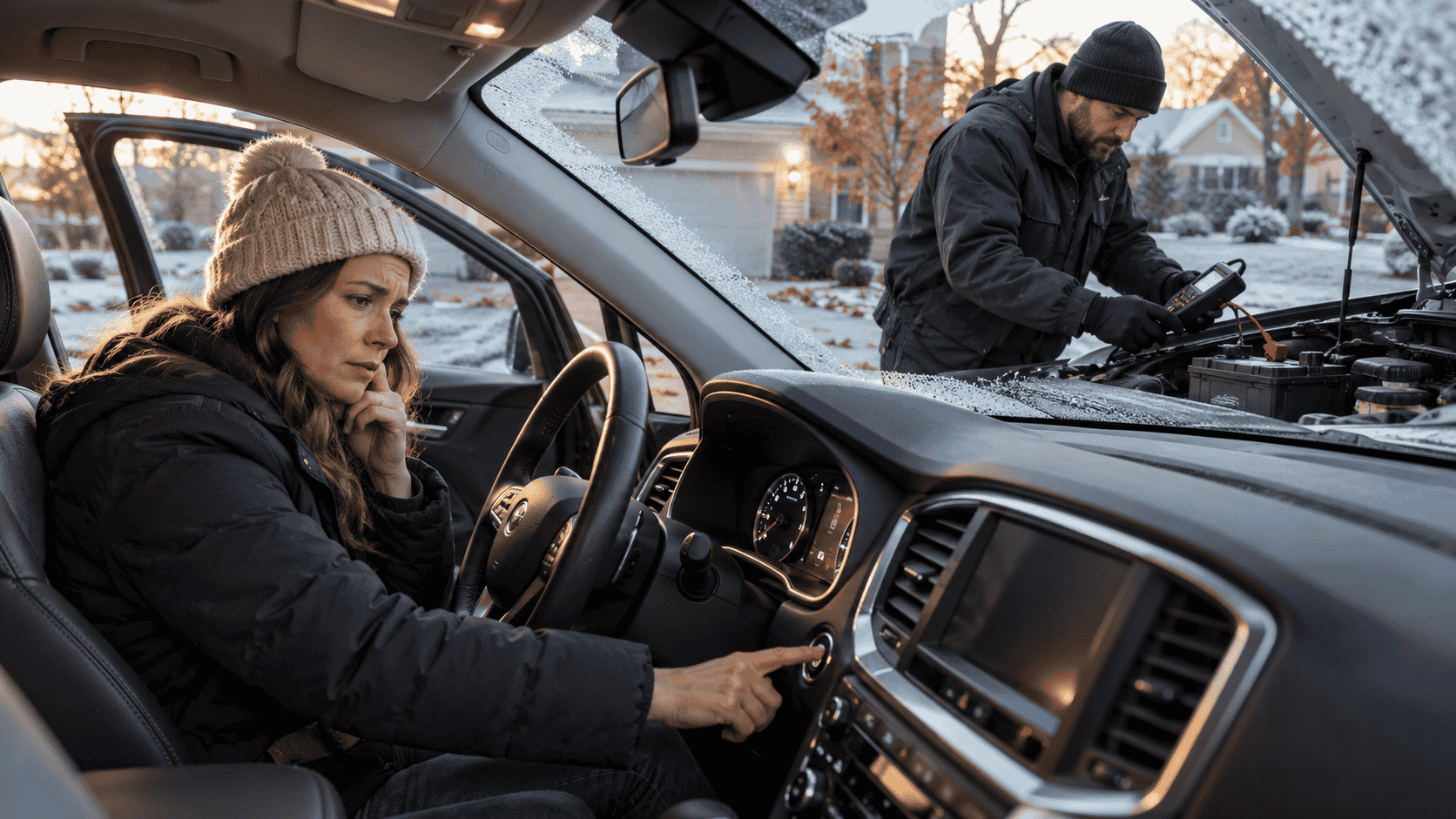
Yesterday the car started normally. Overnight the temperature drops, you turn the key or press the start button—and suddenly the engine turns slowly, clicks once or does nothing at all. It feels as though the cold killed a perfectly good battery overnight, but what often happened is more interesting: the cold revealed a battery that was already becoming weak.
Cold Weather Makes Starting Much Harder
A conventional car battery creates electricity through a chemical reaction.
As temperatures fall, that chemical reaction slows.
At the same time, a cold gasoline or diesel engine requires more electrical power to crank and start.
NHTSA puts the situation simply: as outside temperature drops, battery power falls, while gasoline and diesel engines require more battery power to start.
That combination explains why an older battery can appear perfectly acceptable one afternoon and fail the following cold morning.
The battery did not necessarily go from healthy to dead in eight hours.
Cold weather may simply have removed the margin it had left.
A Battery Can Lose a Surprising Amount of Starting Power
AAA reports that at 32°F, a typical car battery can lose roughly 35% of its strength.
At 0°F, the loss can approach 60%.
Meanwhile, the engine itself becomes more difficult to turn.
Oil thickens.
Mechanical resistance increases.
The starter has to work harder.
So the exact moment when the battery has less power available is also the moment the car asks more from it.
A healthy battery can usually handle that.
A marginal one may not.
But Winter May Not Be What Damaged the Battery
This is the counterintuitive part.
Cold weather is famous for dead batteries.
Heat can be even more damaging to battery life.
AAA’s September 2026 winter-preparation guidance says summer heat often causes much of the underlying battery deterioration, while cold weather exposes the weakness by slowing the battery’s chemical reaction and increasing starting demand.
So the first freezing morning may get blamed for a failure that has actually been developing for months.
Think of cold weather as a stress test.
A strong battery passes.
A weak battery finally reveals itself.
The Sound the Car Makes Gives You a Clue
Do not repeatedly press the start button without paying attention.
Listen.
Different symptoms suggest different possibilities.
A slow, labored engine crank commonly points toward a weak battery.
A rapid clicking sound can also indicate insufficient battery power or a poor electrical connection.
One solid click with no engine movement can involve the starter as well.
AAA says slow cranking, difficulty starting and clicking sounds are common signs of battery trouble, although a clicking no-start can also result from a faulty starter.
The sound is a clue.
It is not a complete diagnosis.
If Absolutely Nothing Happens, Check the Simple Things First
You press Start.
Silence.
No crank.
Before assuming the battery is destroyed, look at what else is happening.
Do the dashboard lights come on?
Are the headlights bright?
Does the interior light work?
Does the car recognize the key?
Is the transmission fully in Park or Neutral?
A completely dead electrical system strongly suggests a battery or connection problem.
But modern vehicles can also refuse to start because of:
key-fob recognition;
security-system issues;
starter problems;
electrical faults;
or other conditions.
Do not replace an expensive battery simply because the car failed to start once.
Dim Lights Strengthen the Battery Theory
If the dashboard becomes unusually dim when you try to start the engine, that is useful evidence.
The battery is being asked to supply a large current to the starter.
If voltage collapses under that load, lights and electronics may dim or reset.
AAA lists dim headlights and other electrical problems among common signs of a weak battery.
You may also notice:
the clock resetting;
the infotainment system rebooting;
interior lights fading;
or several warning lights flashing briefly during the unsuccessful start.
Again, these symptoms point toward low electrical voltage.
They do not prove which component caused it.
A Slow Crank Is One Warning You Should Not Ignore
Sometimes the car does start.
It just sounds different.
Instead of:
crank-crank-start,
you hear:
crank... crank... crank...
and then the engine finally fires.
That can be an early warning.
AAA’s current 2026 battery guidance identifies slow engine cranking as one of the clearest signs that a battery may be approaching failure.
If this happens repeatedly—especially on cold mornings—have the battery and charging system tested before the car chooses the worst possible place to stop cooperating.
How Old Is the Battery?
This may be the quickest reality check.
AAA says conventional car batteries commonly last around three to five years, though climate, driving habits, heat, vibration and vehicle conditions can shorten or extend that life.
That does not mean every three-year-old battery needs replacement.
It does mean a four- or five-year-old battery that suddenly begins cranking slowly deserves much more suspicion than a new battery.
Look for the installation date.
Some batteries have a date label or code.
If you do not know how old yours is, a battery test can answer a much more useful question:
How strong is it now?
Do Not Replace a Battery Just Because It Is Four Years Old
Age is a risk factor.
It is not a diagnosis.
A battery test can measure whether the battery is still capable of supplying sufficient starting power.
A good technician can also test the charging system.
That matters because replacing a battery without checking why it became discharged can leave you with the same problem tomorrow.
AAA recommends checking the battery, alternator and related charging components when starting problems occur.
The goal is not simply to get the engine running once.
It is to understand why it stopped starting.
A Dead Battery and a Bad Alternator Can Look Similar
The battery starts the engine.
Once the engine is running, the alternator powers the vehicle’s electrical system and replenishes the battery.
If the alternator is not charging correctly, even a good battery can gradually become discharged.
This creates a familiar sequence:
the car needs a jump;
it runs afterward;
you assume the battery is fixed;
then it will not start again later.
AAA notes that repeated jump-starts can point either to a failing battery or to another electrical-system problem such as the alternator.
Repeatedly jumping the car is therefore not a long-term repair strategy.
The Battery Warning Light Is Not Simply a “Bad Battery” Light
This is an important dashboard misconception.
If the red battery-shaped warning light appears while the engine is running, it commonly indicates a charging-system problem.
That system includes more than the battery.
The alternator, wiring, connections and other charging components may be involved.
AAA’s current guidance specifically says the battery or charging-system warning should be taken seriously rather than interpreted as proof that the battery alone needs replacement.
If the charging warning appears while driving, have the vehicle inspected promptly.
The car may be operating only on the electrical energy remaining in the battery.
Once that is exhausted, the engine can stop.
Short Trips Can Quietly Create Battery Problems
Suppose your normal routine is:
start the car;
drive five minutes;
stop;
start again;
drive another few minutes;
park overnight.
Starting the engine requires substantial electrical energy.
The alternator then needs time to restore that charge.
AAA’s 2026 maintenance guidance identifies frequent short trips as one factor that can weaken battery condition over time because the battery may not receive enough charging time between starts.
Cold weather can make this pattern even harder on the battery.
The engine needs more starting power while the battery is less efficient.
Leaving the Car Parked for Days Can Matter Too
Modern vehicles still consume small amounts of electricity when switched off.
Security systems.
Computers.
Keyless-entry modules.
Telematics.
Clocks.
Other electronic systems.
A healthy battery can support normal standby loads.
But a weak battery—or a vehicle with an abnormal parasitic draw—may become too discharged to start after sitting.
AAA lists extended inactivity and electrical drain among factors that can contribute to premature battery failure.
If your car starts normally when driven every day but repeatedly dies after sitting for two or three days, mention that pattern to the technician.
It may be diagnostically useful.
Yes, Something Could Be Draining the Battery Overnight
Sometimes the problem really does happen overnight.
A light may remain on.
A module may fail to sleep.
An accessory may continue drawing power.
A dash camera may be wired incorrectly.
A charger may remain active.
Or another electrical fault can produce a parasitic drain.
The battery then gets blamed because it is empty in the morning.
But the battery may simply be the victim.
If a recently tested battery repeatedly becomes discharged while the parked vehicle sits, ask for an electrical draw test rather than automatically installing another battery.
Your Key Fob Can Even Matter in Some Vehicles
Modern proximity-key systems can communicate with the vehicle while the key is nearby.
AAA notes that storing a key fob too close to some vehicles can contribute to electrical drain because vehicle systems may remain more active than expected.
This does not mean every key fob sitting by the front door is killing every car battery.
Vehicle designs differ.
But if a car repeatedly loses charge while parked and the cause is unclear, follow the manufacturer’s key-storage guidance and mention the pattern during diagnosis.
Corroded Battery Terminals Can Mimic a Weak Battery
The battery can contain plenty of energy and still struggle to deliver it if the electrical connection is poor.
Look at the battery terminals if they are safely visible.
Heavy white, blue or greenish corrosion can interfere with the connection.
Loose terminals can create similar problems.
AAA lists corrosion and poor battery connections among things worth checking when diagnosing starting trouble.
If you are unfamiliar with battery service, have a professional handle cleaning and tightening.
Car batteries contain corrosive electrolyte and can release flammable gases.
A Bulging or Cracked Battery Is Different
Do not treat physical battery damage as a routine jump-start problem.
AAA warns against jump-starting a battery with a swollen or cracked case.
A rotten-egg odor can also indicate a dangerous battery condition involving sulfur compounds and possible leakage.
If the battery appears:
swollen;
cracked;
leaking;
or physically damaged,
stop experimenting.
Keep sparks and flames away and obtain professional assistance.
A Frozen Battery Can Be Dangerous to Jump
This becomes particularly important in severe cold.
AAA advises never attempting to jump-start or charge a battery that may be frozen.
Warning signs can include cracks, bulging, frost, ice or other visible abnormalities around the battery.
A frozen or damaged battery can rupture or explode.
If you are uncertain, roadside assistance is much safer than trial and error.
Can You Just Jump-Start It?
Often, yes—if the problem is simply a discharged but otherwise sound 12-volt starting battery.
But there is an important condition:
follow the instructions for your specific vehicle.
Modern vehicles contain sensitive electronics.
Battery locations vary.
Some cars provide dedicated jump terminals.
Hybrid and electric vehicles can have completely different procedures.
AAA advises checking the owner’s manual before attempting a jump and specifically cautions against assuming every vehicle should be used as a donor car.
The correct procedure for a 2008 sedan is not automatically correct for a 2026 hybrid.
Do Not Guess Which Terminal Goes Where
Incorrect jumper-cable connections can damage vehicle electronics and create serious safety hazards.
Use the exact sequence specified by the vehicle manufacturer.
If you are not confident:
use roadside assistance;
a qualified technician;
or another trained person.
There is very little financial upside to saving a service call if the alternative is damaging thousands of dollars of vehicle electronics.
A Portable Jump Pack Can Be Useful
Modern lithium jump packs can be convenient emergency tools.
They do not require another vehicle to be present.
That can make them especially useful in:
office parking lots;
airport parking;
cold driveways;
or isolated locations.
But they still need to be:
properly charged;
correctly rated for the vehicle;
and used according to both the jump-pack and vehicle instructions.
A dead emergency jump pack sitting in the trunk is simply another battery that failed to help.
Check it periodically.
If the Car Starts After a Jump, the Problem Is Not Necessarily Solved
This is one of the most important lessons.
The jump proved that additional electrical power helped start the engine.
It did not prove why the battery lacked that power.
Possible explanations still include:
an aging battery;
a battery discharged by leaving something on;
an alternator or charging-system problem;
a parasitic electrical drain;
poor battery connections;
or extended inactivity.
Get the battery and charging system tested.
Otherwise tomorrow morning may be a repeat.
A Five-Minute Drive May Not Fully Recharge a Dead Battery
Starting the vehicle after a jump does not instantly restore the battery.
AAA notes that cold weather reduces both the battery’s ability to deliver energy and its ability to accept recharge efficiently.
A severely discharged battery may require a much longer drive or proper battery charging equipment to recover.
That is why:
“Drive around the block and it will be fine”
is not reliable advice for every situation.
If the battery has become deeply discharged, have its state of charge and health checked.
Do Not Let the Engine Idle in a Closed Garage
This should be obvious, but cold-weather starting problems often happen inside garages.
A gasoline vehicle produces carbon monoxide.
Never run it in a closed garage simply to “warm it up” or charge the battery.
NHTSA warns drivers about carbon-monoxide risk during winter conditions and advises keeping vehicle exhaust clear when a vehicle is running.
Move the vehicle into open air as appropriate and follow safe operating procedures.
Carbon monoxide has no smell or color.
What If the Car Cranks Normally but Will Not Start?
That changes the diagnosis.
If the starter spins the engine at normal speed but the engine never fires, the battery may not be the main issue.
Other possibilities include:
fuel delivery;
ignition;
engine sensors;
security systems;
or other mechanical or electronic faults.
AAA’s no-start guidance notes that a vehicle can fail to start for many reasons beyond the battery, including starter, alternator and fuel-related problems.
A strong, normal crank with no ignition deserves a different troubleshooting path from a slow, weak crank.
What If You Hear One Click?
A click is not a diagnosis either.
A weak battery may create clicking.
So can poor battery connections.
A starter or starter-solenoid problem may also be involved.
AAA specifically notes that clicking can be associated with either battery or starter trouble.
If a jump makes no difference and the battery tests well, the starter becomes more suspicious.
That is why parts should be tested before replacement.
What If You Hear Rapid Clicking?
Rapid repetitive clicking is commonly associated with voltage dropping too low when the starter tries to engage.
The electrical system attempts to engage the starter.
Voltage collapses.
The circuit releases.
Voltage recovers slightly.
Then the cycle repeats.
That pattern strongly points toward insufficient electrical power or a poor connection.
Check the battery and connections first.
But again, testing beats guessing.
What If Everything Goes Dark When You Turn the Key?
A severe voltage drop can make the dashboard and lights shut off when the starter load is applied.
This can happen with:
a weak battery;
a failed internal battery connection;
or poor terminal contact.
Stop repeatedly cranking the engine.
Inspect and test the electrical system.
Repeated attempts are unlikely to strengthen a weak battery.
Warm Weather Can Hide the Problem Again
Suppose the car fails to start during a cold morning.
Later that afternoon, the temperature rises.
Now it starts normally.
Problem solved?
Not necessarily.
The warmer battery may simply be capable of producing enough current again.
If the battery is approaching failure, the next cold snap may leave you stranded.
A battery that repeatedly shows temperature-dependent starting trouble deserves testing even if it behaves normally once the day warms.
This Is Why Fall Is the Best Time to Test an Older Battery
Waiting until the first snowstorm creates an unnecessary emergency.
If the battery is already:
three to five years old;
cranking slowly;
needing jump-starts;
or showing signs of weakness,
testing it during autumn gives you choices.
AAA’s September 2026 winter guidance specifically recommends checking the battery before winter adds additional strain.
You can compare replacement options.
Schedule service conveniently.
And avoid buying whatever battery happens to be available from the only shop open during a freezing morning.
Repeated Jump-Starts Are a Warning, Not a Lifestyle
If you keep jumper cables permanently attached to your routine because the car needs help every few days, something is wrong.
AAA lists frequent jump-starting among warning signs that the battery or charging system needs attention.
A reliable vehicle should not require a rescue every Monday morning.
Find the underlying cause.
Should You Buy the Cheapest Replacement Battery?
Not automatically.
Replacement batteries differ in:
size;
terminal configuration;
cold-cranking capability;
reserve capacity;
battery technology;
warranty;
and compatibility with start-stop systems.
Use a battery that meets the vehicle manufacturer’s requirements.
Modern cars equipped with AGM batteries or sophisticated charging systems may require a specific battery type.
Some vehicles also require battery registration or electronic adaptation after replacement.
Check the owner’s manual or use a qualified technician.
The battery is part of the vehicle’s electrical system, not simply a box that happens to fit in the tray.
Cold-Cranking Amps Matter in Cold Weather
Battery labels often include a Cold Cranking Amps rating, or CCA.
This describes the battery’s ability to provide starting current under cold test conditions.
Higher does not mean you should install any enormous battery that physically fits.
Use the specification appropriate for the vehicle.
The useful question is:
Does this battery meet or exceed the manufacturer’s required rating while remaining the correct physical and electrical type?
A correct battery installed properly is better than chasing the largest number on the shelf.
Start-Stop Vehicles Can Be More Demanding
Vehicles that shut the engine off automatically at traffic lights repeatedly restart the engine during normal use.
Many use enhanced flooded batteries or AGM batteries designed for frequent cycling.
Replacing such a battery with an inappropriate conventional unit may create performance or lifespan problems.
If your car has automatic start-stop, confirm the required battery technology before replacement.
This is another reason model-specific guidance matters.
What About Hybrid Cars?
Hybrid vehicles usually still contain a smaller low-voltage battery in addition to the large high-voltage traction battery.
That 12-volt system can sometimes create its own no-start symptoms.
But hybrid designs vary greatly.
Do not assume conventional jump-start procedures apply.
Use the manufacturer’s instructions.
AAA specifically cautions that hybrids and EVs contain complex electrical systems and should not casually be treated as ordinary donor vehicles for jump-starting another car.
Electric Vehicles Can Have a “Dead Battery” Problem Too—Just Not the Same One
An EV does not have a gasoline engine to crank.
But it still typically uses a low-voltage electrical system to power controls and enable the high-voltage traction system.
Cold weather also affects the large traction battery’s efficiency and driving range.
NHTSA says temperature management consumes battery energy in electric vehicles and that cold temperatures can reduce available range.
AAA’s 2026 testing likewise found that extreme temperatures can reduce EV and hybrid efficiency.
So an EV owner saying:
“the battery is low”
may be talking about a completely different system from the lead-acid starting battery in a gasoline car.
Do Not Diagnose an EV From Gas-Car Advice
High-voltage electric-vehicle systems require specialized procedures.
If an EV will not power on, check the vehicle manufacturer’s instructions or obtain appropriate roadside assistance.
Do not start probing orange high-voltage cables or traction-battery components.
The everyday consumer troubleshooting boundary should stop well before high-voltage electrical work begins.
Can Parking in a Garage Help?
Yes, mainly because shelter can reduce exposure to very low ambient temperatures.
AAA recommends parking under cover or in a garage where practical during extreme cold.
A garage does not restore an old battery to new condition.
It simply gives the battery a less hostile environment.
If your car starts only when parked indoors but repeatedly fails after a cold night outside, that is useful evidence that battery capacity may be marginal.
Do Battery Blankets Help?
In very cold climates, battery warmers or insulating products can be useful when they are appropriate for the vehicle and used correctly.
But do not improvise with materials that could interfere with moving components, electrical terminals or engine heat.
Use equipment designed for automotive use and follow manufacturer instructions.
A battery heater can help a healthy system cope with severe weather.
It cannot repair a failing internal battery cell.
What Is the Best Prevention?
You do not need an elaborate winter battery ritual.
Know the battery’s age.
Pay attention to slow starting.
Have an older or suspicious battery tested.
Keep the charging system maintained.
Avoid leaving electrical accessories running unnecessarily.
Address corrosion and loose connections.
Drive enough for the charging system to replenish normal starting losses.
And do not ignore repeated jump-starts.
NHTSA recommends having the battery and charging system checked as part of winter vehicle preparation.
That is much easier than troubleshooting in a freezing parking lot.
The Five-Minute Cold-Morning Diagnosis
If the car refuses to start, stop and observe before doing anything.
Are the dashboard lights bright or weak?
Does the engine crank normally, slowly or not at all?
Do you hear rapid clicking, one click or silence?
Is the battery visibly damaged?
How old is it?
Did the car sit for several days?
Were lights or accessories left on?
Has it been starting more slowly recently?
Has the battery or charging-system warning appeared while driving?
Those answers can help a technician diagnose the problem far more quickly.
When Should You Call Roadside Assistance Instead of Trying Again?
Get professional help if:
the battery is cracked, swollen, leaking or possibly frozen;
you smell a strong rotten-egg odor;
you are uncertain about the vehicle’s jump-start procedure;
the vehicle is a hybrid or EV and you do not know the correct low-voltage procedure;
a jump-start does not work;
the vehicle repeatedly dies after starting;
or you are in an unsafe location.
A no-start is inconvenient.
Turning it into a battery explosion, electrical-system failure or roadside injury is much worse.
So Did the Cold Kill Your Battery Overnight?
Maybe—but usually the story started earlier.
Cold temperatures reduce the battery’s available starting power at exactly the same time the engine requires more power to start.
That is why the first real cold morning can expose a battery that seemed fine throughout warmer weather.
If the battery is several years old, cranks slowly or needs repeated jumps, have it tested.
If a healthy battery repeatedly discharges overnight, investigate the charging system or an electrical drain.
If the engine cranks strongly but will not start, look beyond the battery.
And if the battery is frozen, bulging, cracked or leaking, do not jump it.
The biggest mistake is thinking that getting the car started once means the problem is solved.
A jump can get you to work.
A diagnosis can keep you from needing another jump tomorrow.
------------------------------------------------------------
car won’t start in cold weather, car battery dead in cold weather, car won’t start cold morning, dead car battery, weak car battery symptoms, car clicks but won’t start, slow engine crank, cold weather car battery, car battery lifespan, battery or alternator, jump start car, battery warning light, car battery dies overnight, winter car battery
Why Did Your Tire Pressure Light Come On Overnight? Don’t Ignore It Even If It Goes Away
Your Car Insurance Renewal Went Up Even Without an Accident
Why Is That Credit Card Charge Still Pending? And Why Is the Amount Wrong?
Your Furnace Still Works. So When Does Replacing It Actually Save Money?
A Pipe Bursts at 2 A.M. What Should You Do Before the Plumber Arrives?
Automotive
Lifestyle
Driver trying to start a car on a cold autumn morning while noticing signs of a weak battery.
Why Won’t My Car Start in Cold Weather?
Your Car Won’t Start on the First Cold Morning. Is the Battery Dead?
Cold weather can expose a weak battery overnight—but a dead battery is not the only reason a car won’t start. Here’s how to tell what may be happening.
Your Car Started Yesterday. Why Is It Dead This Cold Morning?
Yesterday, the car started perfectly.
This morning, the temperature dropped—and all you hear is clicking.
Did the cold destroy the battery overnight?
Usually, the story started earlier.
Summer heat may have weakened the battery months ago. Cold weather simply removes the last bit of starting power it had left—at the exact moment your engine needs more.
And if the car starts after a jump, that does not mean the problem is fixed.
Reader Question
Has your car battery ever failed on the first really cold morning of the season?
Research Notes
NHTSA says battery power decreases as temperature drops, while gasoline and diesel engines require more battery power to start in cold weather. It recommends having the battery, charging system, belts and related components checked as part of winter vehicle preparation.
AAA reported in September 2026 that summer heat often causes underlying battery deterioration while colder weather exposes the resulting weakness. AAA says conventional batteries commonly last approximately three to five years, although climate, driving patterns and other factors affect lifespan.
AAA says slow engine cranking, repeated jump-starts, dim lights, clicking noises, charging-system warnings and visible corrosion can indicate battery or charging-system problems. Similar symptoms can also involve components such as the starter or alternator, so testing is preferable to replacing parts by guesswork.
AAA warns drivers not to jump-start batteries that are frozen, cracked, swollen or otherwise physically damaged because damaged batteries can rupture or explode. Vehicle-specific jump-start instructions should be followed, especially for hybrid and electric vehicles.
NHTSA says extreme temperatures affect EV battery performance and that thermal management can consume traction-battery energy, reducing range during cold conditions.
Safety Note
Vehicle batteries contain corrosive chemicals and can produce flammable gases. Never jump-start a battery that appears frozen, cracked, swollen or leaking. Follow the vehicle manufacturer’s jump-start instructions, keep sparks and flames away from batteries, and use qualified roadside or repair assistance when the procedure or diagnosis is uncertain. Hybrid and electric vehicles require vehicle-specific procedures around their electrical systems.
car battery dead in cold weather, car won’t start cold morning, dead car battery, weak car battery symptoms, car clicks but won’t start, cold weather car battery, jump start car, battery or alternator, car battery lifespan, slow engine crank
Car Battery, Cold Weather, Dead Battery, Car Maintenance, Winter Driving, Jump Start, Alternator, Automotive, Roadside Assistance, Everyday Problems