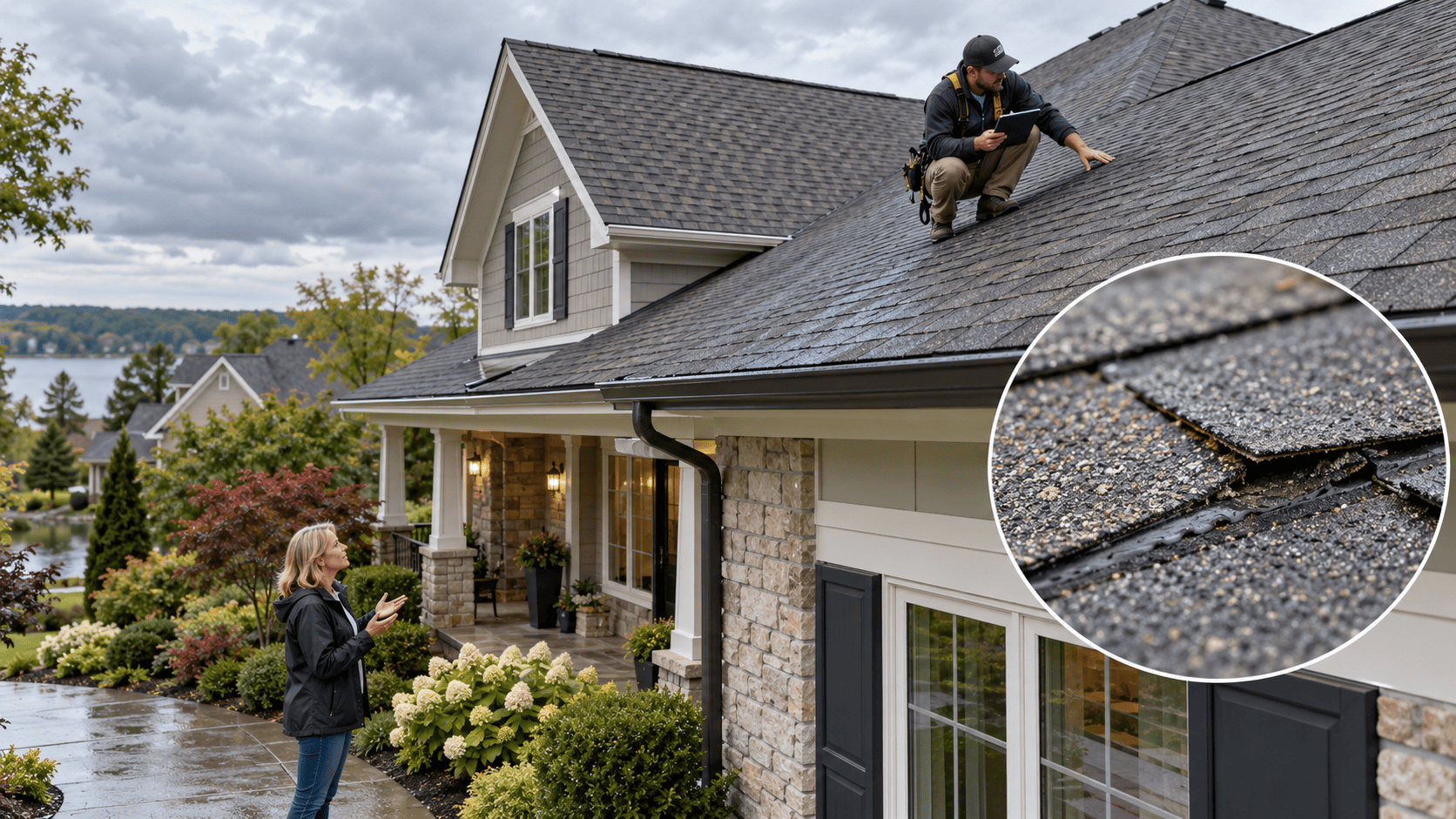
Most homeowners wait for one unmistakable sign before thinking seriously about the roof.
Water dripping from the ceiling.
By then, the roof has already won the argument.
There is a bucket on the floor.
A stain spreading across the plaster.
Someone is searching:
“roof repair near me.”
And a contractor suddenly has to be found quickly.
But roofs rarely go from perfectly healthy to catastrophic overnight.
They age quietly.
Sunlight.
Heat.
Cold.
Wind.
Rain.
Expansion.
Contraction.
Thousands of ordinary days gradually change the material protecting everything underneath it.
And fresh 2026 research has uncovered something homeowners should know:
Two roofs that looked very similar when new can perform dramatically differently after ten years outside.
The Insurance Institute for Business & Home Safety, or IBHS, spent a decade naturally ageing asphalt shingles in multiple U.S. climates and then tested how they resisted wind.
The results, released in September 2026, showed major differences between products.
Many shingles actually strengthened during their first few years after installation as their adhesive seals fully developed.
But between roughly years five and ten, most began losing wind resistance.
Some declined much more severely than others.
The single biggest warning sign was surprisingly simple:
the shingles had started to unseal.
That means the question:
“How old is my roof?”
may no longer be enough.
A better question is:
“What condition is my roof actually in?”
A Roof Can Age Without Looking Old
Think about how people inspect roofs.
Usually from the ground.
Maybe from across the street.
If all the shingles are still there, the roof looks fine.
No giant hole.
No obvious missing section.
No tree through it.
Everything seems normal.
But a roofing system depends on details that are difficult to see from twenty metres away.
Are the shingles still properly sealed?
Has flashing loosened?
Are nails lifting?
Are edges curling?
Has the underlayment been exposed somewhere?
Are repeated temperature cycles making materials brittle?
Is water getting underneath a seemingly intact surface?
The roof's job is not to look good.
Its job is to remain attached and keep water outside during conditions much harsher than an ordinary afternoon.
Ten Years of Weather Changed Roofs Differently
IBHS began its Roof Materials Aging Farm research program in 2013.
Researchers installed roofing products in multiple climate zones and allowed them to experience real sunlight, rain, temperature cycles and weather rather than trying to reproduce an entire decade inside a laboratory.
The latest study examined asphalt shingles naturally weathered for ten years at locations including South Carolina, Wisconsin and Ohio.
Researchers then measured wind resistance.
One of the most important findings was variability.
Products that began life meeting the same high wind-classification standards did not necessarily perform equally after a decade.
Climate mattered.
Roof orientation mattered.
Product design mattered.
And whether the shingles remained properly sealed mattered enormously.
That challenges a common assumption:
A warranty length is not the same thing as guaranteed real-world performance.
The Weak Point Was the Seal Between Shingles
Modern asphalt shingles are designed so adjacent pieces bond together after installation.
That seal helps the roof behave as a connected surface when wind tries to lift it.
Imagine one shingle beginning to lift.
Wind can get underneath.
Once air gets beneath the edge, the force trying to pull the shingle upward increases.
That can expose the next section.
And the next.
The latest IBHS research found that unsealing was the strongest driver of wind vulnerability.
Products most prone to losing that bond repeatedly showed the greatest probability of wind-related failure.
This helps explain why a roof may appear visually complete while becoming more vulnerable.
The shingles are still there.
But the system holding them tightly together may be weakening.
Why Age Alone Can Mislead You
Suppose two neighbours replace their roofs in the same year.
Ten years later, both say:
“My roof is ten years old.”
That tells you surprisingly little.
One roof faces stronger afternoon sun.
Another receives more shade.
One experiences repeated freeze-thaw cycles.
Another lives through intense heat.
One uses a product whose seal remains strong.
Another uses material whose wind resistance has declined considerably.
IBHS researchers found that solar radiation, temperature cycles, latitude, orientation and product differences influenced how shingles aged.
So there is no magical birthday when every roof becomes “old.”
Condition matters.
Then Why Do People Talk About 20-Year or 30-Year Roofs?
Because roofing materials are often sold with long manufacturer warranties or estimated service lives.
But consumers frequently interpret those numbers too literally.
A 30-year product warranty does not necessarily mean:
“Nothing significant can happen to this roof for 30 years.”
Warranty coverage can depend on:
material defect,
installation,
age,
transferability,
maintenance,
proration,
and numerous exclusions.
Weather damage may be treated differently.
Labor may not be included.
The amount covered later in the warranty may differ significantly from the early years.
IBHS has explicitly warned that consumer expectations about asphalt-shingle lifespan, often reinforced by long product warranties, do not always match real-world performance.
That makes the warranty worth reading before installation rather than after a failure.
The Roof Is One of the Most Expensive Things You Rarely See
People interact with their kitchens every day.
Bathrooms every day.
Flooring every day.
A new kitchen countertop is visible constantly.
A roof?
Most homeowners barely look at it.
Yet replacing it can become one of the largest maintenance expenses associated with owning a house.
A September 2026 survey of 1,000 U.S. homeowners found nearly 59% of those who completed a full roof replacement spent $10,000 or more.
Weather or disaster-related damage was the most commonly cited reason respondents had replaced the full roof.
That turns roof maintenance into something more than home improvement.
It becomes financial planning.
Search Behaviour Shows How Valuable a Roof Problem Is
Roofing is also one of the most commercially competitive areas in home services.
Current U.S. search-ad estimates using Google keyword data put:
“roof repair” — about 74,000 monthly searches, ~$40 CPC
“roof leak repair” — about 33,100 searches, ~$34 CPC
“roofing companies near me” — about 165,000 searches, ~$32 CPC
“roof replacement” — about 33,100 searches, ~$32 CPC.
The precise numbers vary by keyword tool, geography and month.
But the economic signal is unmistakable.
A homeowner searching for a roofer can represent a project worth thousands or tens of thousands of dollars.
That is why advertisers fight so aggressively for those searches.
And it is also why homeowners should resist making the decision under panic.
Repair or Replace?
This is the question homeowners actually care about.
A leak does not automatically mean the entire roof needs replacement.
A relatively young roof may have a localized issue involving:
damaged flashing,
a small number of shingles,
a roof penetration,
a vent,
a chimney,
or storm damage confined to one section.
Repair can be entirely reasonable.
But continually repairing an extensively deteriorated roof can become false economy.
You fix one section.
Another problem appears.
Then another.
Eventually you have spent thousands maintaining a system approaching the end of useful service.
The difficult part is determining which situation you have.
One Leak Can Come From Somewhere Completely Different
Water is deceptive.
The stain appearing above the dining room does not necessarily mean the leak began directly above it.
Water can enter higher on the roof.
Travel along:
rafters,
decking,
pipes,
insulation,
or structural components,
and finally drip somewhere else.
That is why diagnosing roof leaks by simply looking upward from the wet ceiling can fail.
The visible symptom and actual entry point may be separated by a considerable distance.
Watch the Flashing
Some of the most vulnerable roof locations are not in the middle of an enormous field of shingles.
They occur where the roof changes direction or meets something else.
Around:
chimneys,
vents,
skylights,
walls,
valleys,
and roof penetrations.
These areas use flashing to redirect water.
A roof covering can remain in decent condition while damaged or poorly installed flashing allows leakage.
So when someone says:
“Your roof is leaking; you need an entirely new roof,”
the correct response is often:
“Show me exactly where it is failing.”
Missing Shingles Are Obvious. Loose Ones May Not Be.
A missing shingle after a storm is easy to spot.
A partially unsealed shingle is more difficult.
That distinction matters because the newest IBHS findings suggest loss of the adhesive bond can dramatically affect wind performance before wholesale roof failure occurs.
A professional inspection can therefore be valuable even when every shingle appears to be present.
Especially on an ageing roof in a wind-prone location.
Granules in the Gutter: Should You Panic?
Asphalt shingles contain mineral granules on their upper surface.
Some granule loss can occur naturally.
New roofs may release loose manufacturing granules initially.
Older roofs can lose increasing amounts as surfaces weather.
A few granules therefore do not automatically mean:
Replace the roof tomorrow.
But extensive or uneven granule loss combined with:
bare areas,
cracking,
curling,
or other deterioration
deserves attention.
The roof should be evaluated as a system rather than diagnosed from a single symptom.
Curling and Cracking Are Different Messages
Shingles that no longer lie flat may indicate ageing, installation problems, moisture issues or other deterioration.
Cracks can create potential routes for water and may signal material ageing.
But once again, the important question is scale.
One damaged area after a fallen branch?
Possibly repairable.
Widespread deterioration across multiple slopes?
A broader replacement conversation becomes more reasonable.
Your Attic May Tell You Before Your Ceiling Does
One of the most useful places to inspect is underneath the roof.
During daylight, an attic may reveal:
unexpected light penetration,
water staining,
darkened wood,
moist insulation,
mold,
or signs of previous leakage.
After rain, moisture can sometimes appear there before it reaches the finished ceiling below.
Homeowners should not climb into unsafe attic areas or walk on structural surfaces not designed for access.
But where safe access exists, the underside of the roof can contain valuable clues.
Do Not Wait for Water to Enter the Living Room
A leaking roof can damage far more than roofing material.
Water can affect:
insulation,
ceilings,
walls,
electrical systems,
wood framing,
paint,
flooring,
and personal possessions.
Persistent moisture can also create conditions suitable for mold growth.
A small exterior defect therefore has the potential to become a much larger interior repair.
The cheapest leak is usually the one identified before it produces visible indoor damage.
Storm Damage Needs a Different Kind of Inspection
After strong wind, hail or severe weather, homeowners understandably look for missing shingles.
But storm damage can be subtle.
Hail can damage material without punching a giant hole.
Wind can weaken attachment.
Edges can lift and reseal imperfectly.
IBHS has spent years studying this issue because asphalt-shingle failures are repeatedly observed during severe storms, sometimes at wind speeds below what homeowners might expect from product ratings.
After a meaningful storm, inspection can make sense even if the roof appears intact from the driveway.
Never Climb Onto a Dangerous Roof Yourself
There is no roof repair worth falling for.
Steep surfaces, wet materials, loose shingles, fragile areas and edges make roofs dangerous.
A homeowner can perform useful observations from:
the ground,
upper windows,
binoculars,
safe attic areas,
or through a qualified professional.
There is little value in saving the price of an inspection if the alternative involves a serious injury.
Contractor Selection Matters as Much as Material Selection
Roofing is unusual because an excellent product can still perform badly when installed poorly.
Details such as:
nailing pattern,
underlayment,
flashing,
ventilation,
deck preparation,
edge protection,
and manufacturer installation requirements
can influence performance.
The 2026 Roofing Contractor homeowner survey found that consumers valued:
reputation,
licensing,
warranties,
material quality,
and transparent pricing.
About 65% said transparent pricing on a contractor's website would make them more likely to contact that business, while unexpected costs and poor communication were among the leading homeowner complaints.
Price matters.
But contractor quality can determine whether the price was actually cheap.
Get Multiple Written Quotes
A roofing quote should be detailed enough that another contractor could understand what is being proposed.
Before agreeing to a major replacement, compare at least several credible estimates where practical.
Look for details such as:
exact roofing material and product line;
removal or overlay of existing material;
underlayment;
flashing replacement;
decking repair allowances;
ventilation work;
edge and valley treatment;
disposal;
labor and material warranties;
start and completion expectations;
payment schedule;
licensing and insurance where applicable.
If one quote is dramatically cheaper, ask why.
Perhaps the contractor is simply more competitive.
Or perhaps something important is missing.
The Cheapest Roof Can Become the Most Expensive
Imagine two quotes.
One is $11,000.
The other is $15,000.
The first looks obviously better.
But suppose it excludes deteriorated decking.
Uses a lower-performing material.
Reuses flashing.
Includes a weaker workmanship warranty.
And produces expensive change orders halfway through the project.
The $11,000 roof was never actually an $11,000 roof.
This is one reason pricing transparency matters so much to homeowners.
They are not merely afraid of high cost.
They are afraid of unknown cost.
Asphalt Is Still the Dominant Choice
The September 2026 homeowner survey found asphalt shingles were used by 47% of homeowners who replaced their roofs, making them the most common material in the survey.
Metal followed at 13%, with concrete tile at 10%.
Asphalt remains popular because it generally combines:
lower upfront cost,
wide availability,
many styles,
and familiar installation.
But the latest ageing research suggests consumers should look beyond an initial wind rating.
Two products carrying high classifications when new may age differently over the years.
Long-term performance matters.
What About Metal Roofs?
Metal roofing costs more upfront in many markets.
But durability is one of its major selling points.
Consumer Reports notes that quality metal roofing can potentially last 40 to 50 years or longer, depending on material, environment and installation.
That does not mean metal always wins financially.
A homeowner planning to move within five years may evaluate the investment differently from someone expecting to remain in the home for decades.
Local climate also matters.
So do:
noise control,
corrosion resistance,
installation skill,
appearance,
building structure,
and insurance considerations.
The correct roof is partly a lifetime-cost decision.
Roof Colour Is Not Purely Cosmetic
Dark roofing surfaces absorb more solar energy.
Lighter or specially designed reflective roofing can reduce roof-surface temperatures and cooling loads under appropriate conditions.
But the best choice depends heavily on climate.
In an extremely hot region, reducing solar heat gain can be valuable.
In a heating-dominated climate, the annual benefit changes.
Roof design should therefore consider not only appearance but the thermal demands of the house.
Ventilation Matters More Than Most People Realize
The roof covering sits on top of a larger building system.
Attic ventilation and insulation influence:
temperature,
moisture,
comfort,
and roof-deck conditions.
Poor ventilation can contribute to excessive heat or moisture problems depending on climate and building design.
That is why simply replacing shingles without examining the larger roof and attic system may miss underlying problems.
Solar Panels Change the Roof Decision
If you intend to install rooftop solar, roof age becomes especially important.
Panels may remain in service for decades.
Installing an expensive solar array over roofing likely to require replacement soon can create unnecessary removal and reinstallation costs.
A homeowner considering both projects should therefore coordinate them.
Sometimes replacing an ageing roof immediately before solar installation makes more sense than treating them as completely separate upgrades.
Photograph the Roof Before There Is a Problem
This is a surprisingly useful habit.
Keep records showing:
installation date,
material brand and product,
contractor,
warranty,
invoices,
previous repairs,
inspection reports,
and photographs.
After a major storm, earlier images can make it easier to identify new damage.
And years later, knowing the actual product installed may become increasingly valuable.
That matters because the new IBHS research specifically found meaningful product-level differences in how asphalt shingles aged.
“What kind of shingles are these?”
should not have to be answered with:
“Brown ones.”
Your Roof Needs a Maintenance File
Homeowners keep:
mortgage records,
insurance records,
appliance manuals,
and renovation invoices.
The roof deserves the same treatment.
Record:
when it was installed,
what material was used,
who installed it,
warranty terms,
storm events,
repairs,
inspection findings,
and future recommendations.
When the time finally comes to decide between another repair and replacement, those records turn guesswork into evidence.
So When Should You Replace Instead of Repair?
There is no universal age or leak count.
Replacement becomes more reasonable when several factors begin appearing together:
widespread deterioration,
repeated leaks,
large areas of unsealed or damaged material,
extensive storm damage,
persistent repair costs,
structural decking problems,
or a roof nearing the end of realistic service life for its material and climate.
A professional inspection should identify why replacement is being recommended.
“It's old” is information.
It is not a complete diagnosis.
The Most Expensive Roof Repair Is the One Made in Panic
A severe leak creates urgency.
Urgency weakens comparison shopping.
You do not want to spend three days researching contractors while rain continues entering the house.
That is why the best time to understand your roof is before it becomes an emergency.
Know:
its age,
its material,
its history,
its condition,
and who you would call if something failed.
A roof inspection performed at the right time can provide something far more valuable than a repair estimate:
time to make a rational decision.
The New Research Changes One Important Assumption
For years, homeowners have been told to think of roofs primarily in terms of age.
Ten years.
Twenty years.
Thirty years.
But the 2026 IBHS results show why that shortcut is incomplete.
Some products retained substantially stronger wind performance after ten years than others.
Climate and orientation influenced ageing.
And whether the shingles remained sealed played an enormous role in their ability to resist wind.
So your roof does not suddenly become bad because it reaches a particular birthday.
Nor is it automatically healthy because the warranty still has twenty years written on the paperwork.
Condition matters more than the calendar alone.
The roof above you tonight may look exactly like it did five years ago.
The important question is not whether it still looks like a roof.
It is whether it can still behave like one during the next serious storm.
And finding out before the rain reaches your ceiling is usually much cheaper than discovering the answer afterwards.
roof replacement, roof repair, roof replacement cost, roof repair near me, roofing contractor, roof leak repair, roof inspection, asphalt shingles, roof lifespan, roof damage signs, when to replace roof, roof maintenance, metal roof, storm damage roof, roofing 2026
roofing companies near me, roof repair near me, roof replacement estimate, roofing contractor near me, emergency roof repair, roof inspection service, roof financing, metal roof installation, shingle replacement, storm damage roofing, roof warranty, roofing quotes
Why Home Insurance Costs Are Rising So Fast
Heat Pump vs Air Conditioner: Which Costs Less?
Home & Garden Guides
Sustainability & Global Risks
Money Guides for Homeowners
Your roof can still look completely normal while becoming much weaker in a storm.
A newly released 10-year real-world roofing study found that asphalt shingles meeting similar high wind standards when new could perform very differently after years outdoors.
The biggest weakness?
Shingles losing the seal that keeps wind from getting underneath them.
And roof problems are expensive: a September 2026 homeowner survey found nearly 59% of full roof replacements cost $10,000 or more.
Maybe the best time to inspect a roof is not when water begins dripping through the ceiling.
Reader Question
Do you know how old your roof is—and the exact roofing product installed on it?
Research & Demand Notes
The central evidence comes from the Insurance Institute for Business & Home Safety's long-running Roof Materials Aging Farm. Researchers naturally weathered asphalt shingles for ten years in multiple climates, then measured their wind performance. Most products showed some decline between years five and ten, but the size of that deterioration differed substantially. Loss of the seal between shingles was the strongest predictor of wind vulnerability.
Home-maintenance note: Roof condition, material, building design and local weather vary substantially. Major roof work and inspections involving height should be handled by appropriately qualified professionals.