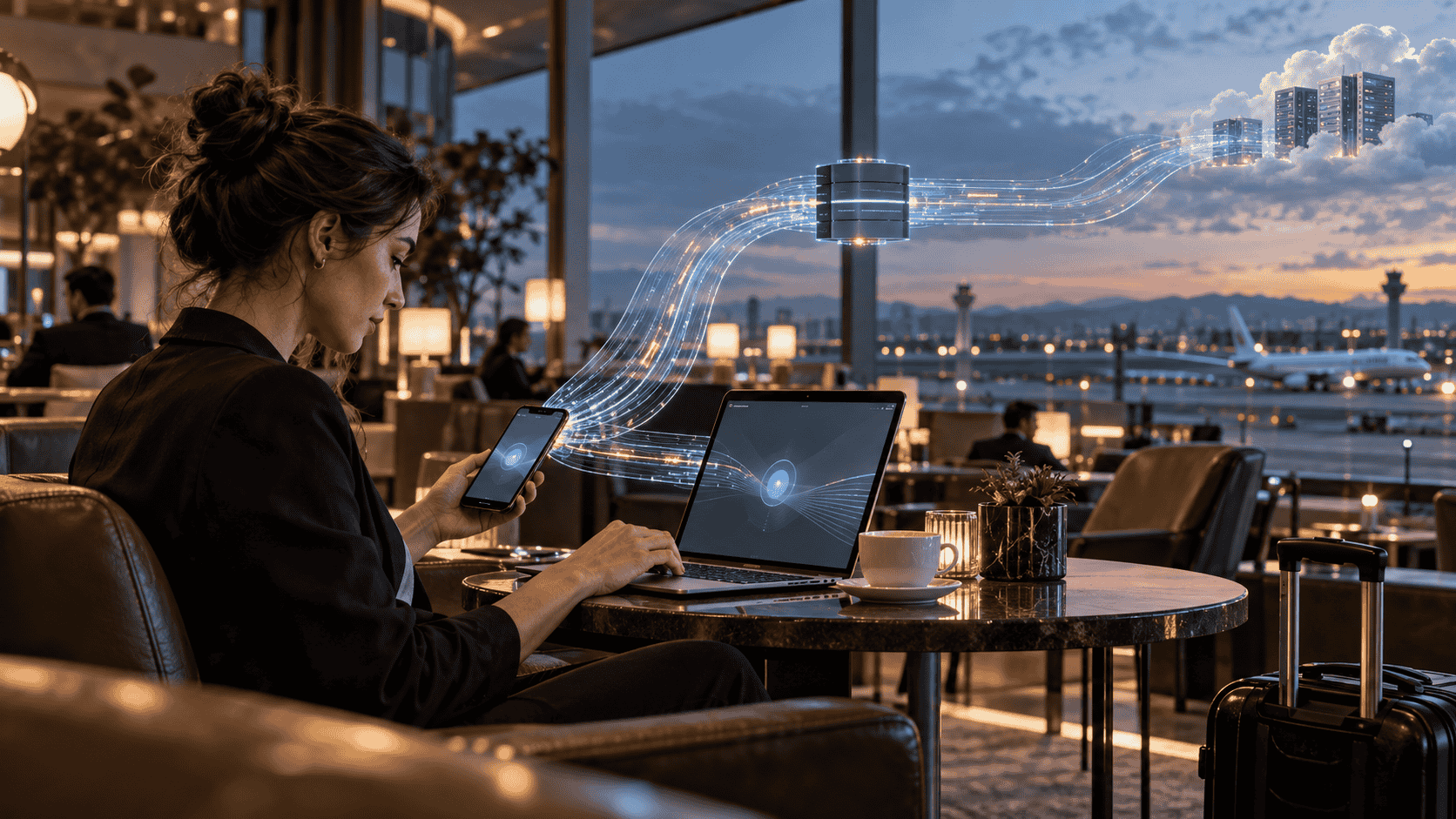
There is something almost irresistible about an app with two promises:
More privacy.
Free.
Install it.
Tap Connect.
A small key or VPN symbol appears at the top of your phone.
Suddenly it feels as if you have put an invisible shield around your entire digital life.
Your internet provider cannot see what you are doing.
Websites cannot track you.
Hackers disappear.
You become anonymous.
At least, that is what many people imagine.
And VPN use is booming again.
A 2026 survey of 1,008 U.S. adults found 42% said they now use a VPN for personal or work purposes, up from 32% in 2025.
More strikingly, 43% of VPN users said they relied on a free service, up sharply from 28% one year earlier. Privacy and security remained the two leading reasons people said they used one.
But 2026 also produced one of the largest technical examinations yet of mobile VPN apps.
Researchers from the University of Michigan, University of New Mexico and IIT Delhi audited 281 popular Android VPN applications.
They found:
61 apps transmitting some data without encryption.
29 leaking user traffic—including DNS traffic—outside the VPN tunnel.
76 transmitting Android advertising identifiers.
And 107 failing to follow recommended security practices in their VPN configuration files.
There is a strange irony here.
People install VPNs because they want to trust the internet less.
But using one requires placing enormous trust in somebody new.
What Does a VPN Actually Do?
VPN stands for Virtual Private Network.
NIST describes a VPN as a virtual network built on top of existing networks that can provide a secure communication mechanism between network points, often through encryption and tunneling.
For an ordinary consumer, the easiest way to picture it is this:
Without a VPN:
Your device → Internet provider/network → Website
With a VPN:
Your device → Encrypted VPN tunnel → VPN server → Website
The website generally sees the VPN server's public IP address rather than your ordinary public IP address.
Your local network or internet provider sees your connection to the VPN service, while a correctly functioning encrypted tunnel can prevent it from easily reading the traffic being carried inside.
That can be useful.
Especially when you want to:
reduce exposure of your IP address,
protect traffic on an untrusted network,
connect securely to a company network,
reduce some forms of ISP visibility,
or appear to websites as if you are connecting through the VPN server's location.
But one crucial thing happened when you pressed Connect.
You changed whom you trust.
A VPN Does Not Remove Trust. It Moves It.
This is perhaps the single most important thing to understand about consumer VPNs.
Researchers behind the 2026 MVPNalyzer study describe VPN use as a “transfer of trust.”
Your internet traffic no longer travels directly through the normal route.
Instead, the VPN provider sits in a highly privileged position because traffic passes through infrastructure it controls.
That is perfectly reasonable when the provider is trustworthy and the technology is correctly implemented.
But imagine choosing a VPN by doing this:
Open app store.
Search free VPN.
Download whichever result has an attractive logo.
Allow it to route your phone's network traffic.
Tap Connect.
You have effectively said:
“I trust this company enough to put it between me and much of the internet.”
Do you know who that company is?
Where it is incorporated?
How it makes money?
What it logs?
Whether its software has been independently audited?
Who owns it?
What happens to your data?
For many people, the answer is no.
The 2026 Study Found Problems at a Very Basic Level
The MVPNalyzer research was presented at the Network and Distributed System Security Symposium, one of the major academic cybersecurity conferences.
The researchers created an automated framework capable of examining mobile VPN behavior across several network layers.
They then used it to audit 281 popular Android VPN applications.
Some findings were particularly worrying.
29 apps leaked traffic outside the VPN tunnel
This included DNS traffic.
DNS is the system that helps convert a website name into the network address needed to reach it.
A VPN marketed around privacy should ideally prevent sensitive network information from escaping outside the protected route.
Yet the researchers found applications where traffic leaked.
61 transmitted unencrypted data
Five applications were found sending sensitive VPN configuration files in clear text.
The researchers warned that this could potentially allow an attacker positioned on the network to interfere with the VPN connection.
76 transmitted advertising IDs
Android advertising identifiers are designed to help advertising and analytics systems distinguish devices or users for advertising purposes.
Finding such identifiers being transmitted by VPN apps does not automatically prove that browsing histories were sold.
But it raises an obvious question:
Why does privacy software need advertising-oriented tracking infrastructure in the first place?
Free Does Not Automatically Mean Dangerous
This is where the story needs some restraint.
There are reputable companies that offer free VPN tiers.
Their business model can be straightforward:
Free users receive fewer locations, slower speeds, smaller data allowances or fewer features.
Some eventually upgrade to a paid service.
That is a perfectly understandable commercial model.
So the useful lesson is not:
Never use a free VPN.
It is:
Never assume an app is trustworthy simply because it calls itself a VPN.
Price alone is not a security audit.
A bad paid VPN can still be bad.
A well-run free tier from a transparent provider can be preferable to an obscure paid app.
The important variable is trustworthiness.
If the VPN Is Free, Ask How the Company Gets Paid
Running VPN infrastructure costs money.
Servers cost money.
Bandwidth costs money.
Software engineers cost money.
Security audits cost money.
Customer support costs money.
App-store distribution and marketing cost money.
So when a company gives unlimited VPN service away indefinitely, one useful question is:
What funds the service?
Possible answers include:
advertising,
a limited free tier that converts users to paid plans,
bundling with another product,
enterprise customers subsidizing consumer access,
investor funding,
or data-related monetization.
Some models are far more privacy-friendly than others.
The important thing is whether the business model is understandable.
If you cannot figure out how a service survives financially, that uncertainty itself deserves attention.
“No Logs” Is One of the Most Powerful Words in VPN Marketing
Open almost any VPN website and you are likely to see:
No logs.
It sounds wonderfully simple.
Nobody records anything.
But logging is more complicated than one phrase.
A provider might potentially distinguish between:
browsing activity,
connection timestamps,
bandwidth usage,
device information,
account identifiers,
payment information,
server diagnostics,
and security logs.
A privacy policy should explain what is and is not collected.
Security.org's 2026 VPN survey found 62% of respondents considered it very or extremely important that their VPN keep no activity logs.
The same research also found misunderstandings about how much VPN providers themselves may technically be able to observe.
So do not stop reading at:
NO LOGS!
Ask:
No logs of what?
For how long?
Can the claim be independently verified?
Has an outside audit examined it?
A VPN Does Not Make You Anonymous
This is one of the biggest misconceptions.
Suppose you connect to a VPN.
Then open Google.
Log into your Google account.
Open Facebook.
Log into Facebook.
Visit Amazon while signed in.
Your IP address may now be different.
But those services still know who you are because you told them.
Cookies can persist.
Accounts remain accounts.
Browser characteristics may still help sites distinguish devices.
Advertising systems can use many signals other than an IP address.
A VPN therefore improves certain forms of network privacy.
It does not turn you into a ghost.
A VPN Does Not Stop Phishing
Imagine receiving an email saying:
Your bank account has been locked. Click here immediately.
You connect to the world's best VPN.
Then click the fraudulent link.
Enter your password.
Enter your card details.
The VPN cannot save you from voluntarily giving information to a criminal.
Likewise, a VPN does not automatically stop:
phishing,
malicious attachments,
fake websites,
social engineering,
password reuse,
fraudulent investment schemes,
or somebody convincing you to send money.
Security.org's 2026 report explicitly notes that VPNs have limits and do not replace other security protections.
This is important because cybersecurity products are often marketed as complete protection.
There is no complete protection.
Security works in layers.
A VPN Is Not Antivirus
This seems obvious.
Yet the two are often bundled so aggressively that the distinction becomes blurry.
A VPN primarily changes and protects the network connection path.
Antimalware software attempts to detect or prevent malicious software.
A password manager helps create and store credentials.
Multifactor authentication protects accounts even when passwords are stolen.
Operating-system updates patch known vulnerabilities.
Backups protect against data loss.
Each solves a different problem.
Installing a VPN while using the same password everywhere is like installing an expensive lock on your front door and leaving every window open.
Public Wi-Fi Is More Nuanced Than the Advertising Suggests
VPN advertising loves airports.
A mysterious person is supposedly sitting three tables away in a café stealing your banking information because you connected to public Wi-Fi.
There are legitimate risks on hostile or poorly configured networks, and NIST describes VPNs as useful for protecting communications carried over public networks.
CISA guidance for government mobile work likewise recommends authorized VPN or secure-access technologies when connecting from public networks, while emphasizing that a VPN is only one part of device security.
But today's internet is not identical to the web of 15 years ago.
Many modern websites and applications already use encrypted HTTPS connections.
That means public Wi-Fi does not automatically expose every password or message to everybody nearby.
A VPN adds another protection layer and can hide more of the network path from the local network.
But the idea that “public Wi-Fi without VPN = everything instantly stolen” is an oversimplification.
Why Are So Many People Using VPNs in 2026?
Privacy remains the main motivation.
Security.org's survey found:
56% cited general privacy.
51% cited security.
27% cited reducing tracking.
Another 27% mentioned accessing international or non-local media.
But something broader has happened.
The internet is becoming increasingly fragmented by:
location,
subscription rules,
content licensing,
age verification,
network restrictions,
and country-specific regulation.
VPNs therefore occupy a strange position.
They are simultaneously:
security software,
privacy software,
remote-work infrastructure,
streaming tools,
and technologies used to alter apparent network location.
That broad usefulness helps explain why consumer interest is so valuable commercially.
Current U.S. keyword estimates put “vpn best” near 90,500 monthly searches with an estimated CPC around $24.80, while “vpn free” is around 110,000 monthly searches.
Few consumer software categories combine that level of intent with such high-value advertising.
Why Free VPN Use Jumped Back Up
Security.org's annual survey found free VPN use followed an interesting pattern:
2023: 43%
2025: 28%
2026: 43%
The rebound is substantial.
The obvious explanation is price.
A consumer who only occasionally wants:
extra privacy,
temporary location switching,
a secure connection while travelling,
or access to a restricted service
may find it difficult to justify another monthly subscription.
Modern life already contains:
streaming subscriptions,
cloud storage,
music,
AI subscriptions,
fitness services,
news subscriptions,
and software.
People are suffering subscription fatigue.
“Free” becomes very attractive.
But privacy software is an unusual place to choose solely on price.
The App Store Rating Is Not Enough
An app might have:
4.7 stars.
Ten million installs.
Thousands of reviews.
That tells you people installed it.
It does not prove its encryption is correctly implemented.
It does not prove there are no DNS leaks.
It does not prove the privacy policy matches actual behavior.
And it does not prove ownership is transparent.
The 2026 MVPNalyzer work is valuable precisely because researchers examined what applications were technically doing rather than simply what their store pages claimed.
Cybersecurity is one of those areas where popularity and quality are not synonymous.
What Should You Check Before Installing a VPN?
You do not need to become a network engineer.
But there are several useful questions.
Who owns it?
Can you identify the company operating the service?
Does it provide a real corporate identity and jurisdiction?
How does it make money?
A transparent free-tier model is easier to understand than a mysterious unlimited service with no visible revenue source.
What does the privacy policy actually say?
Look specifically for:
activity logs,
connection logs,
device identifiers,
advertising,
analytics,
and third-party sharing.
Has it undergone a meaningful independent audit?
An outside technical audit is not a permanent guarantee.
But it is stronger evidence than a company simply declaring itself secure.
Which VPN protocol does it use?
Modern services generally rely on established VPN protocols rather than unexplained proprietary technologies with no meaningful technical documentation.
Is the app asking for strange permissions?
A VPN needs extensive networking access.
It does not automatically need your:
contacts,
camera,
microphone,
or unrelated device information.
Unexpected permissions deserve scrutiny.
Does it include leak protection?
DNS and traffic leakage can undermine the privacy purpose of the VPN.
Is there a kill switch?
A kill switch can block internet connectivity if the VPN unexpectedly disconnects, reducing the chance that traffic silently reverts to the ordinary network.
Does the company publish security information?
Transparency is a useful signal.
A provider that talks openly about:
security architecture,
audits,
incidents,
ownership,
and privacy practices
gives consumers more evidence to evaluate.
Should You Use a VPN All the Time?
Not necessarily.
It depends on why you need one.
A remote employee connecting to a company's internal network may require a corporate VPN continuously during work.
A traveller may want additional privacy on unfamiliar networks.
Someone concerned about ISP visibility may keep a consumer VPN active most of the time.
Another person may have no strong everyday need.
VPNs can also create trade-offs.
They may:
reduce speed,
increase latency,
trigger anti-fraud systems,
interfere with banking sites,
change search results,
cause streaming problems,
or break services that depend on location.
More security software is not automatically better.
The tool should solve an actual problem.
What About Apple's Private Relay?
People sometimes confuse Apple's iCloud Private Relay with a conventional VPN.
They are related privacy technologies but are not identical.
Apple says Private Relay uses two separate internet relays so no single party sees both the user's IP address and the requested destination information.
Apple explicitly distinguishes this architecture from a traditional VPN and notes that Private Relay does not let a user simply choose another country as their apparent location.
So if somebody says:
“My iPhone already has a VPN.”
the technically accurate answer depends on what feature they mean.
The VPN Paradox
A VPN exists because you do not want every network between you and the internet to know too much.
So you deliberately place another network in the middle.
That can dramatically improve privacy.
Or it can simply move the problem.
The difference is trust.
And that is why the free-VPN boom deserves more attention than another list of “Top 10 VPNs.”
The important question is not:
Which VPN has the coolest app?
Or:
Which one costs nothing?
It is:
Who am I allowing to carry my internet traffic—and what evidence do I have that they deserve that position?
That question matters especially in 2026.
Millions more people are turning to VPNs.
Free use has surged back.
Search demand is enormous.
And security researchers have just demonstrated that some mobile VPN applications still fail at tasks users reasonably assume a VPN will perform.
A free VPN may genuinely protect your privacy.
Another may offer weak engineering.
Another may contain extensive tracking infrastructure.
The word VPN on an app icon does not tell you which one you installed.
So before tapping Connect, take another thirty seconds.
Find out who sits at the other end of the tunnel.
Because privacy software asks for something more valuable than your subscription fee.
It asks for your trust.
free VPN, best VPN, VPN security, are free VPNs safe, VPN privacy, VPN app, virtual private network, free VPN app, Android VPN, VPN tracking, VPN data leak, VPN for privacy, VPN for public Wi-Fi, no logs VPN, VPN security 2026, online privacy
VPN service, best VPN service, cybersecurity software, internet security software, password manager, antivirus software, online privacy tools, secure browsing, business VPN, remote access VPN, identity protection, data protection services
AI Agent Cyberattacks Are Changing Cybersecurity
Personal Finance Apps Are Changing How We Manage Money
How AI Is Changing Online Shopping and Travel
Latest Computers & Technology Stories
Windows and Online Privacy Guides
43% of VPN users surveyed in 2026 said they use a free VPN.
At the same time, cybersecurity researchers audited 281 popular Android VPN apps and found:
61 transmitted unencrypted data.
29 leaked traffic outside the VPN tunnel.
76 transmitted advertising IDs.
A VPN does not eliminate trust.
It transfers trust from your network provider to the company operating the tunnel.
So perhaps the most important question is not:
“Is this VPN free?”
It is:
“Who am I trusting with my connection?”
Reader Question
Would you install a free VPN with 10 million downloads if you could not identify the company behind it or explain how the service makes money?
Research Notes
The 2026 MVPNalyzer research was presented at the Network and Distributed System Security Symposium by researchers from the University of Michigan, University of New Mexico and IIT Delhi. It systematically audited 281 popular Android VPN applications and identified traffic leaks, unencrypted transmissions, advertising-ID transmission and poor configuration practices. The results apply to the apps tested and should not be interpreted as evidence that all VPN applications—or all free VPNs—have those flaws.
A separate August 2026 survey of 1,008 U.S. adults found VPN adoption at 42%, compared with 32% in 2025, while the share of VPN users relying on a free product rose from 28% to 43%. The survey was self-reported and unweighted, with a stated maximum margin of error of approximately ±3.1 percentage points for full-sample questions.
NIST defines a VPN as a virtual network layered on existing physical networks that can provide secure communications using technologies such as encryption and tunneling. VPN protection should therefore be understood as one security layer rather than anonymity or protection from every form of online attack.