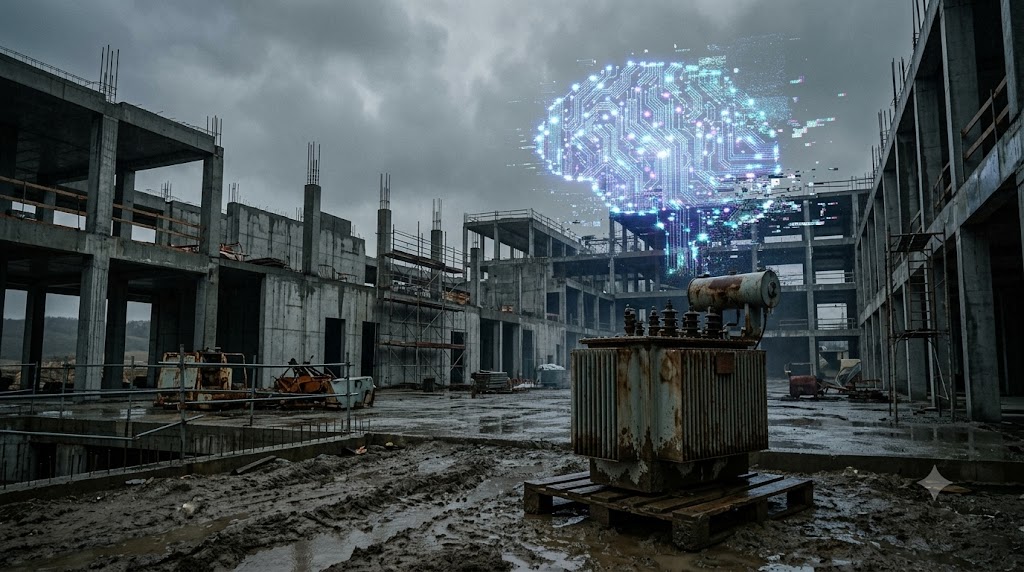
The world's largest technology companies are pouring unprecedented capital into AI data centers. But the physical world is fighting back with grid bottlenecks, supply chain breakdowns, and fierce community opposition.
By Technology & Business Desk | Wednesday, August 5, 2026
The artificial intelligence industry has hit a physical wall. For years, the bottleneck for AI advancement was the software—creating the algorithms and training the models. Today, the bottleneck is entirely made of concrete, copper, and electricity.
Four technology giants—Alphabet, Amazon, Meta, and Microsoft—are expected to spend more than $650 billion on new AI infrastructure in 2026 alone. Stacked in hundred-dollar bills, that sum would reach 710 kilometers past the International Space Station.
But despite having nearly infinite capital, tech giants are discovering a brutal reality: the money isn't enough. From power grid shortages to a collapse in critical hardware supply chains, the industry's biggest expansion in history is beginning to crack.
1. The Grand Illusion of Progress
At first glance, the data center boom has been the primary engine of recent economic growth. In 2024, an estimated 92% of U.S. GDP growth came from data center construction; without those server racks and cranes, the broader American economy expanded by a mere 0.1%.
However, the foundation holding up this massive economic pillar is highly fragile. Of the roughly 140 data center projects slated to open in the United States in 2026, nearly half have been delayed or canceled outright. These facilities were supposed to represent 12 gigawatts of computing capacity—enough to power nine million homes. Yet, analysts note that only about one-third of these massive sites are actually currently under construction.
2. The Supply Chain and The Grid Say "No"
The absolute slowest part of the AI equation is not constructing the building; it is the electrical infrastructure required to feed it.
Equipment Shortages: The build-out is heavily stymied by limited supplies of transformers, switchgear, and batteries.
Crippling Delays: U.S. production cannot keep pace with the surging demand. Transformer delivery times, which previously took about two years, have now stretched to as long as five years.
Geopolitical Friction: To plug these gaps, companies are forced to rely on imports. China remains a key supplier for batteries and certain electrical components. However, tariffs and geopolitical friction now make that critical pipeline unreliable.
3. The Local Backlash
The external costs of this massive build-out have transformed from corporate boardroom discussions into kitchen-table issues across America.
Exhaust and Noise: In Virginia's Loudoun County, famously known as the epicenter of "data center alley," residents are now breathing the exhaust from an estimated 10,000 diesel backup generators used to power these facilities.
Soaring Utility Rates: In Georgia, a major utility raised electricity rates six times between 2023 and 2025. This resulted in a 24% cumulative jump in costs, with the utility explicitly citing data center demand as the reason.
4. What Happens Next?
The core structural flaw in this $650 billion gamble is that the investment presupposes exponential and indefinite AI demand growth, but the returns remain speculative. Analysts warn that unless supply chain issues are resolved, these massive investments may fail to translate into operational capacity, potentially undermining U.S. competitiveness in the global AI race.
To bypass these gridlocks, developers are exploring radical alternatives. One emerging path is subsea data centers. China has successfully deployed underwater capsules that use cold seawater for passive cooling; as a result, 99% of electricity goes to actual computing, compared to traditional air-cooled facilities where roughly 50% of the energy is spent on cooling systems.
Unless the industry can rapidly innovate its way out of these physical limits, the trillion-dollar bet on AI infrastructure may stall before it ever turns a genuine profit.
FAQ
Q: How much are tech companies spending on AI data centers in 2026?
A: Tech giants including Google, Amazon, Meta, and Microsoft are expected to spend more than $650 billion on AI infrastructure in 2026.
Q: Why are US data center projects being delayed in 2026?
A: Nearly half of the 140 U.S. data center projects scheduled to open in 2026 are delayed or canceled due to power grid bottlenecks and shortages of critical electrical equipment like transformers, switchgear, and batteries.
Q: How long does it take to get a power transformer for a data center?
A: Due to surging demand and supply chain breakdowns, transformer delivery times have stretched from about two years to as long as five years.