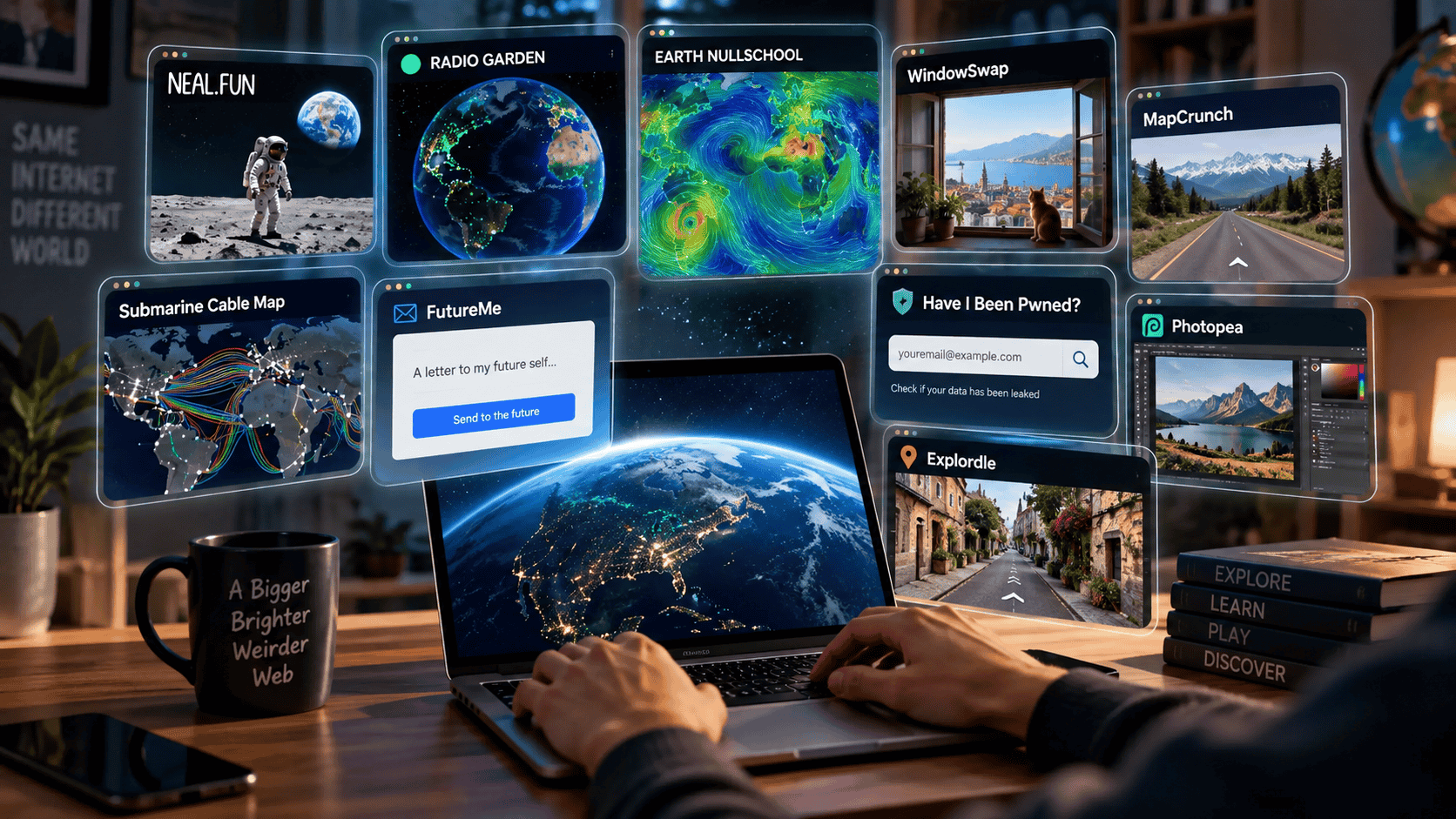
The internet feels repetitive because most of us visit the same handful of apps every day. But the web is still full of wonderfully strange places—from a globe made of live radio stations to a map of the cables carrying the internet beneath the oceans.
10 Crazy Websites You’ll Wish You Knew About Earlier
The internet is much bigger than Google, YouTube, TikTok and social media. These ten websites prove that the weird, creative and genuinely useful web is still alive in 2026.
By Internet & Technology Desk | Tuesday, September 8, 2026
Think about how you use the internet every day.
You probably open the same websites again and again.
Search.
Email.
YouTube.
Social media.
Maybe a news site.
Then back to social media.
It can make the internet feel strangely small.
But underneath the giant platforms is another web.
A place where someone has built a globe you can spin to listen to radio stations thousands of kilometres away.
Another website lets you watch the wind move around the entire planet in real time.
One lets you look out of a stranger's window in Italy, Japan or Brazil.
Another shows the physical cables lying at the bottom of the ocean that are carrying much of the internet you're using right now.
And one will tell you whether your email address has appeared in a known data breach.
These are not ten random “useless websites” selected only because they look strange.
Every one of them either:
teaches you something,
solves a problem,
shows you the world differently,
or is simply much more fun than scrolling another feed.
Here are 10 crazy websites worth knowing in 2026.
1. Neal.fun — The Internet Playground You Didn't Know You Needed
Best for: Losing 45 minutes while convincing yourself you're learning something.
Neal.fun is difficult to describe because it isn't really one thing.
Creator Neal Agarwal describes it simply as a place for his “games and stuff on the web.”
That undersells it considerably.
The site is filled with interactive experiments that turn ordinary subjects into things you can play with.
Instead of reading an article about scale, money, history or probability, you may find yourself clicking, scrolling or manipulating an interactive visualization.
Some pages are educational.
Some are absurd.
Some are both.
The magic is that Neal.fun remembers something much of the modern web has forgotten:
a website can be an experience rather than a content container.
There is no feed demanding that you keep scrolling forever.
No influencer shouting at you.
No productivity promise.
You arrive, play with something clever and leave knowing a little more—or at least smiling.
Why it's crazy
Because one person has managed to make the browser itself feel like a toy again.
Why it's useful
It is a brilliant example of how interactive storytelling can explain ideas better than another wall of text.
2. Radio Garden — Spin the Planet and Listen to Wherever You Land
Best for: Discovering what people are listening to right now in another country.
Radio Garden turns the Earth into a radio dial.
Open the site and you see a globe covered with points.
Spin toward Africa.
Europe.
Latin America.
The Middle East.
A remote island.
Click one of the dots and a local radio station starts playing.
As of September 2026, Radio Garden's own search interface lists stations across 223 countries.
That means you can move from a talk show in Niger to music in Romania, then to a station in the Falkland Islands, New Caledonia or Vanuatu without leaving your chair.
There is something unexpectedly human about it.
The internet usually tries to personalize everything.
Radio Garden does the opposite.
It asks:
What if you listened to something that had absolutely nothing to do with your algorithm?
Why it's crazy
The whole planet becomes one giant tuning knob.
Why it's useful
Language learners can hear real speech. Music fans can discover regional sounds. Travelers can get a feeling for a destination before visiting.
And sometimes it is just fascinating to hear what is playing somewhere 8,000 kilometres away at this exact moment.
3. Earth Nullschool — Watch the Planet Breathe
Best for: Weather nerds, travelers and anyone who enjoys seeing invisible forces become visible.
Most weather apps give you a number.
28°C.
40% chance of rain.
Wind: 15 km/h.
Earth Nullschool gives you the atmosphere.
The site displays a continuously animated globe showing conditions including:
wind,
temperature,
humidity,
ocean currents,
waves,
atmospheric chemistry,
particulates,
and even space-weather information.
The current surface-wind view uses forecast data from sources including the U.S. National Weather Service's GFS system.
The first time you see global wind flowing around hurricanes, mountain ranges and oceans, ordinary weather maps suddenly feel primitive.
You can rotate the globe.
Change altitude.
Switch from atmosphere to ocean.
Examine temperature.
Look at wind-power density.
Watch jet streams curl across continents.
Why it's crazy
You are effectively watching an animated visualization of the Earth's atmosphere from your browser.
Why it's useful
It is excellent for understanding large weather systems rather than just today's temperature.
It can also teach something important:
the weather above your city is connected to systems moving across an entire planet.
4. WindowSwap — Look Out Someone Else's Window
Best for: Five minutes of calm when the internet becomes too loud.
This website has one of the simplest ideas on the list.
People record the view from their windows.
You watch it.
That's basically it.
But it works.
Open a window and you might see:
a rainy apartment balcony,
Italian rooftops,
a quiet garden,
cars moving through a city,
snow falling somewhere cold,
birds outside a kitchen,
or the ocean beyond somebody's home.
WindowSwap currently lets users open windows submitted from around the world and has built paid features around saved windows, playlists and access to its wider archive.
There is no objective.
No score.
Nothing to win.
That makes it strangely refreshing.
Why it's crazy
You can sit at your desk in Karachi and spend a few minutes effectively looking through somebody else's window in another country.
Why it's useful
Use it as background ambience while working, studying or taking a mental break.
It feels closer to travel than a photograph because the scene continues moving even when nothing important happens.
5. MapCrunch — Let the Internet Teleport You Somewhere Random
Best for: Virtual travel and geography rabbit holes.
Press Go.
That's the game.
MapCrunch drops you into a random Google Street View location.
You might land on:
a quiet road in Peru,
a town in Iceland,
a street in Japan,
a remote American highway,
or somewhere you cannot immediately identify at all.
MapCrunch says it draws from Street View imagery across about 50 countries and lets users restrict random locations by continent, country or map area.
There are also modes such as:
Urban,
Indoor,
Stealth,
Tour,
and Auto.
You can turn it into a game:
How quickly can you determine the country?
Look at:
road markings,
architecture,
cars,
signs,
vegetation,
mountains,
weather,
and language.
Why it's crazy
One click can put you on a road you've never heard of on the opposite side of Earth.
Why it's useful
It teaches geographic observation surprisingly well.
It is also a dangerous website if you intended to work for the next hour.
6. Submarine Cable Map — See the Physical Internet Under the Ocean
Best for: Finally understanding that “the cloud” is not floating in the sky.
Explore the Submarine Cable Map
This may be my favorite website on the entire list.
Open it and you'll see coloured lines running across the oceans.
Those lines represent submarine fibre-optic cable systems.
They are among the physical connections carrying international internet traffic between countries and continents.
TeleGeography maintains the map as a free, regularly updated resource; its current edition was updated in August 2026.
Suddenly the internet stops looking abstract.
You can click a cable.
See where it lands.
See its length.
Find its owners.
Search by country.
Look at cables being built for future years.
For Pakistani readers, this is especially interesting.
The map currently lists Pakistan as connected through systems including:
2Africa, AAE-1, IMEWE, PEACE Cable, SeaMeWe-4, SeaMeWe-5 and Transworld-1, with additional systems such as Africa-1 and SeaMeWe-6 shown for future service.
The PEACE Cable alone runs approximately 25,000 km and lands at Karachi alongside locations across Europe, Africa, the Middle East and Asia.
Why it's crazy
The website visually reveals the enormous physical infrastructure underneath something we casually call “wireless.”
Why it's useful
The next time a submarine cable outage slows internet service, you can actually see the infrastructure people are talking about.
It is also fantastic for students interested in:
telecommunications,
geopolitics,
cloud infrastructure,
and cybersecurity.
7. FutureMe — Send an Email to Yourself in 2036
Best for: Creating a message that becomes more valuable simply because you forgot about it.
Write to your future self on FutureMe
What would you tell yourself ten years from now?
FutureMe lets you write a letter today and schedule its delivery for:
six months,
one year,
three years,
five years,
ten years,
or a custom date.
The website says users have sent more than 20 million letters over its 20-year history.
You can write about:
where you live,
your ambitions,
your worries,
your relationships,
your job,
the technology you're using,
your goals,
or what you think the world will look like.
Then forget about it.
Years later, the message arrives.
That is the strange part.
Ordinary email is designed to move information across distance.
FutureMe uses email to move information across time.
Why it's crazy
You can receive a genuine message from a version of yourself who may no longer think anything like you do.
Why it's useful
Write down measurable predictions:
Where will I be working?
What will I have accomplished?
What am I worried about today?
What do I think AI will look like in 2030?
Reading your own answers years later can be surprisingly powerful.
8. Have I Been Pwned — Find Out Whether Your Email Has Been Leaked
Best for: A cybersecurity check everyone should probably perform.
This one is less playful.
It may also be the most important website here.
Have I Been Pwned—usually shortened to HIBP—lets you check whether an email address appears in known data breaches.
Its current database contains information from more than 1,000 breaches involving approximately 17.8 billion compromised addresses.
Enter your email address.
If it appears in a known breach, HIBP can show which services were compromised and what types of information were exposed.
Maybe:
email addresses,
password hashes,
phone numbers,
dates of birth,
usernames,
or other account information.
Seeing an old website you forgot you ever joined appear in a breach list is an excellent reminder that your digital history does not always disappear when you stop using a service.
Why it's crazy
Your email address may have been circulating inside a stolen database without you knowing.
Why it's useful
If an account appears in a breach:
change any reused passwords,
enable multi-factor authentication,
and never reuse the compromised password elsewhere.
Important: HIBP asks for an email address to perform this check. Do not type your actual account password into random breach-checking websites.
9. Photopea — Photoshop in a Browser Tab
Best for: The moment somebody sends you a PSD file and you don't have Photoshop installed.
Photopea is one of those websites that makes you question why more people don't know about it.
Open a browser.
Go to Photopea.
You get a serious image editor with:
layers,
masks,
blending,
cropping,
resizing,
advanced editing tools,
and full PSD support.
No giant desktop installation is required.
Even better, Photopea says files are processed locally on your device rather than uploaded to its servers.
You can drag a file from your computer directly into the browser, and Photopea supports numerous image and editing resource formats.
This is particularly useful when:
you are borrowing another computer,
you only need to make one quick edit,
a designer sent you a PSD,
or you don't want to install heavy software.
Why it's crazy
A professional-looking image editor is sitting inside an ordinary webpage.
Why it's useful
Of all ten sites here, this is probably the one most likely to save you money or rescue you during an actual work emergency.
Bookmark it.
10. Explordle — Guess the Country From a Moving Video
Best for: Anyone who thinks they are excellent at geography until the video starts.
You see a short first-person video recorded somewhere in the world.
Now figure out where you are.
Not from a famous landmark.
Often from ordinary clues.
Architecture.
Shop signs.
Driving direction.
Street furniture.
Language.
Weather.
Clothing.
Mountains.
Cars.
The Daily Adventure version asks players to narrow the location from continent to country and then city. The site's current homepage continues to offer its Daily Adventure format in 2026.
Unlike MapCrunch, which lets you roam Street View freely, Explordle feels more like a travel puzzle.
You're watching an actual moving scene and trying to notice the tiny clues humans normally ignore.
Why it's crazy
A rubbish bin or road sign can suddenly become the most important object in the video.
Why it's useful
It trains geographic observation while feeling like a game.
Play it with friends and the arguments over whether the scene is “obviously Eastern Europe” can become half the entertainment.
Which of These Websites Should You Bookmark?
If you only want three, choose them according to what you want from the internet.
For pure discovery:
Radio Garden
For practical usefulness:
Photopea
For security:
Have I Been Pwned
For science:
Earth Nullschool
For travel:
MapCrunch or Explordle
For calming down:
WindowSwap
For understanding how the internet really works:
Submarine Cable Map
For questioning your entire life five years from now:
FutureMe
And for pure browser creativity:
Neal.fun
Why Websites Like These Still Matter
The modern internet increasingly tries to turn everything into a platform.
Log in.
Create a profile.
Follow people.
Build an audience.
Watch advertisements.
Buy premium access.
Keep scrolling.
Some of these ten sites have accounts or paid features too, but their core attraction comes from something older.
An idea.
What if you could tune the entire Earth like a radio?
What if the global atmosphere became an animation?
What if random windows became a way to travel?
What if the ocean floor showed you the internet?
What if an email could travel ten years instead of ten kilometres?
Those ideas remind us what made the web exciting in the first place.
Anyone could invent a strange experience and publish it for the entire planet.
No app store approval required.
No social-media algorithm needed.
Just:
a domain,
a browser,
and a sufficiently interesting idea.
The Internet Is Still Weird—You Just Have to Leave the Feed
We sometimes say the old internet disappeared.
It didn't.
We simply spend less time exploring it.
Recommendation algorithms are extraordinarily good at showing us more of what we already like.
That can gradually reduce discovery.
You watch one video.
The platform gives you twenty similar ones.
Search for one product.
Advertisements follow you for a week.
Listen to one genre.
The algorithm decides that must be what you want forever.
The websites on this list work differently.
Radio Garden can send you somewhere culturally unfamiliar.
MapCrunch may drop you onto a road you've never seen.
WindowSwap gives you a view that wasn't selected because it matches your interests.
Neal.fun gives you something you did not know you wanted to interact with.
That randomness is valuable.
Sometimes the most interesting thing on the internet is not what an algorithm predicts you will click.
It is the thing you would never have thought to search for.
So bookmark a few of these.
Send the list to somebody.
Open one when you're bored.
And the next time someone says:
“The internet has become boring,”
send them spinning around the Earth listening to a radio station in a country they've never visited.
The weird web is still here.
You just have to go looking for it.
Frequently Asked Questions
What are some crazy websites worth visiting in 2026?
Good examples include Neal.fun, Radio Garden, Earth Nullschool, WindowSwap, MapCrunch, Submarine Cable Map, FutureMe, Have I Been Pwned, Photopea and Explordle.
What is the most useful website on this list?
Photopea is probably the most immediately practical because it provides advanced image editing directly in a browser. Have I Been Pwned is particularly useful for checking exposure to known data breaches.
What website lets me listen to radio stations around the world?
Radio Garden lets users navigate a globe and play live radio stations from cities and countries around the world. Its current directory spans 223 countries.
What website shows live wind around the Earth?
Earth Nullschool provides an interactive animated globe showing wind and numerous other atmospheric and ocean conditions.
Is there a website that shows views from people's windows?
Yes. WindowSwap lets users watch window views submitted from locations around the world.
What website takes me somewhere random on Google Street View?
MapCrunch randomly places users into Google Street View locations and allows geographic filters by region or country.
Can I see the cables carrying the internet?
Yes. TeleGeography's Submarine Cable Map shows submarine cable systems, landing points, operators and planned cables around the world.
Is FutureMe really able to send an email years later?
FutureMe allows users to schedule letters to themselves for future delivery, including options extending several years ahead. The service says more than 20 million letters have been sent over 20 years.
How can I check whether my email appeared in a data breach?
Have I Been Pwned allows you to search an email address against known breach data. Its database currently includes about 17.8 billion breached addresses.
Is Photopea really free?
Photopea provides a free browser-based editor with advanced features and PSD support. It also says editing occurs locally on the user's device.
What is Explordle?
Explordle is a geography game built around videos of locations. Players use visual clues to determine where the footage was recorded.
Are all these websites safe?
These are legitimate websites as of this article's publication, but normal internet precautions still apply. Avoid entering sensitive passwords into unfamiliar sites, keep your browser updated and review privacy policies before uploading sensitive personal information.
Editorial Note: Website features and pricing can change. This article reflects services available and publicly described as of September 8, 2026. UrduPure has no affiliation with the websites listed.
useful websites 2026, cool websites, interesting websites, hidden websites, websites to bookmark, best internet tools, fun websites, unusual websites
Websites, Internet, Useful Tools, Productivity, Online Tools, Cybersecurity, Travel, Maps, Technology, Fun Websites