SpaceX Rocket Stage Crashes Into the Moon, Leaving a New Human-Made Crater
Author: Javaid Ahmed Solangi
Publication date: August 7, 2026
A piece of a SpaceX rocket has slammed into the Moon
A discarded upper stage from a SpaceX Falcon 9 rocket has crashed into the Moon, creating a new crater and providing scientists with a rare opportunity to study what happens when human-made space debris strikes another world.
The roughly four-tonne rocket stage was expected to hit the lunar surface near the Einstein and Bell craters at approximately 06:35 UTC on August 5, 2026.
It was travelling at around 2.4 kilometres per second, equivalent to approximately 8,700 kilometres per hour, when it struck the Moon. Researchers had calculated the trajectory several weeks before the collision.
Unlike many dramatic rocket accidents, this was not a failed launch or an explosion involving astronauts.
The Falcon 9 stage had completed its primary task more than a year earlier. It had been left in space after delivering commercial lunar spacecraft and eventually followed an unstable path toward the Moon.
No one captured a clear video of the crash
Scientists, space agencies and observatories had prepared to monitor the event, but the actual moment of impact proved extremely difficult to record.
The rocket struck sunlit terrain near the Moon’s edge as seen from Earth. That lighting and viewing geometry made a brief impact flash difficult to distinguish from the bright lunar surface.
No clear photograph or video of the collision had been publicly confirmed immediately after the event. However, a telescope in Chile reportedly detected spectral evidence associated with the impact plume, including signals from sodium and lithium.
The sodium may have originated from lunar soil blasted above the surface, while lithium may have come from material in the rocket stage.
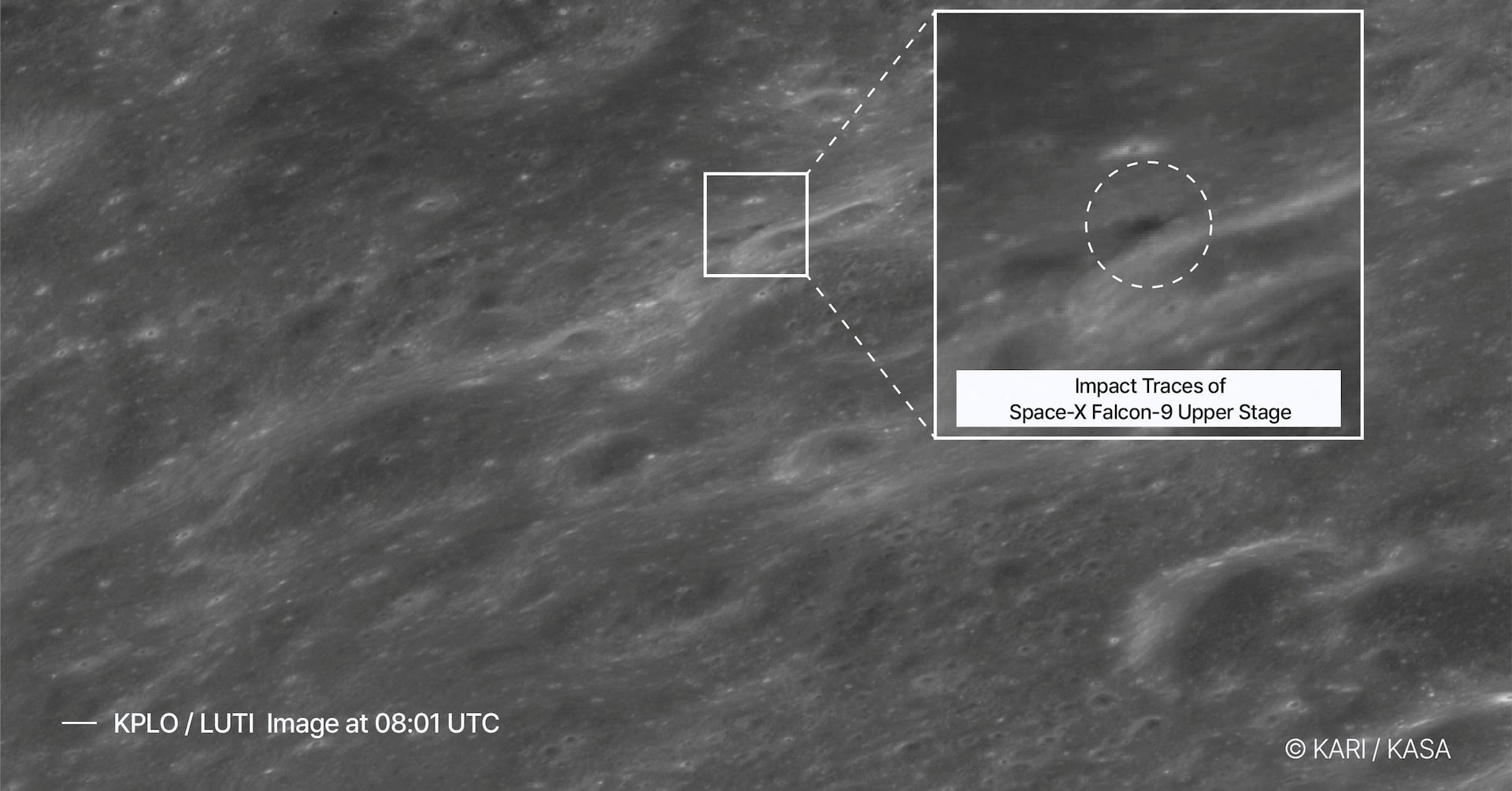
NASA’s Lunar Reconnaissance Orbiter and South Korea’s Danuri lunar orbiter are expected to examine the area. Images taken before and after the impact could reveal the exact location, crater size and distribution of debris.
Readers should be cautious about dramatic videos circulating on social media. With no verified close-up recording released immediately after the collision, some clips claiming to show the crash may be simulations, unrelated footage or AI-generated content.
How large is the new crater?
Before the impact, NASA estimated that the rocket stage could produce a crater approximately 60 feet—or 18 metres—wide and 12 feet deep.
A separate scientific analysis estimated that the resulting crater could potentially be larger, possibly approaching 40 metres, depending on the impact angle, surface material and the stage’s remaining structure.
The real dimensions will remain uncertain until spacecraft photograph and measure the site.
The crash was powerful by human standards, but it was not a major event for the Moon.
NASA noted that meteoroids carrying a similar amount of energy hit the lunar surface roughly every six days. The Moon has no substantial atmosphere to slow or destroy incoming objects, so impacts are a normal part of its geological environment.
What makes this event unusual is that the object was created and launched by humans.
Where did the rocket stage come from?
The object was the upper stage of a Falcon 9 launched on January 15, 2025.
That mission, known as Ghost Riders in the Sky, carried two commercial lunar landers:
Firefly Aerospace’s Blue Ghost Mission 1
Japan-based ispace’s Resilience lander
Blue Ghost successfully reached the lunar surface and carried NASA science instruments under the agency’s Commercial Lunar Payload Services programme.
After deploying the spacecraft, the Falcon 9 upper stage did not have enough remaining fuel to return safely toward Earth or enter a controlled disposal orbit.
It continued travelling through the Earth–Moon system.
Independent astronomers later tracked the object using publicly available observations. NASA subsequently confirmed that it had a 100% probability of striking the Moon.
Why did it crash more than a year later?
The upper stage did not travel directly from its 2025 mission into the lunar surface.
Instead, it remained in a complicated and changing orbit influenced by:
Earth’s gravity
The Moon’s gravity
Pressure from sunlight
Solar activity
The stage’s rotation
Small uncertainties in its trajectory
Over time, those forces changed its path until a collision became unavoidable.
Scientists classified and studied the object as 2025-010D. Researchers used its brightness, colour, movement and orbital history to link it to the Falcon 9 mission.
Observations suggested that the long, empty rocket stage was rotating approximately once every seven minutes, although its rotation rate changed unexpectedly during the tracking period.
Was anyone in danger?
No.
NASA said the impact presented no danger to Earth. It also occurred far from any astronaut or active surface mission.
The collision did not alter the Moon’s orbit, create a dangerous explosion visible from Earth or threaten people watching the Moon.
The scientific importance lies in what the crash may reveal about impact physics and how humanity manages equipment travelling beyond Earth orbit.
What scientists can learn from the collision
Because astronomers knew the object’s approximate mass, material and speed, the impact provides a useful natural experiment.
Researchers can compare their predictions with the actual crater and debris field.
The results may improve understanding of:
How craters form in lunar soil
How high lunar dust travels after an impact
How long impact plumes remain detectable
How human-made materials behave during high-speed collisions
How accurately objects can be tracked in the Earth–Moon region
What risks uncontrolled objects may pose to future lunar infrastructure
Before the crash, modelling suggested that some material could be thrown tens of kilometres above the lunar surface. The central part of the ejecta plume was predicted to rise even higher for a short period.
Scientists may also search for chemical signatures from the rocket itself, helping them separate human-made material from ordinary lunar dust.
Is this the first human-made object to hit the Moon?
No.
Humanity has intentionally and unintentionally crashed numerous objects into the Moon.
The Soviet Luna 2 spacecraft became the first human-made object to reach the Moon in 1959. Components from Apollo missions later struck the surface, sometimes deliberately, so instruments could study the resulting vibrations.
NASA’s LCROSS mission intentionally sent part of a rocket into a permanently shadowed lunar crater in 2009 to search for evidence of water.
Other discarded rocket stages have also reached the Moon, including an unidentified object that created an unusual double crater in 2022.
What is changing is the number of governments and companies sending spacecraft into lunar space.
The Moon is developing a space-junk problem
Earth’s orbit already contains large numbers of inactive satellites, spent rocket stages and smaller fragments.
Now, similar concerns are emerging around the Moon.
The region between Earth and the Moon—known as cislunar space—is becoming more crowded as governments and private companies launch orbiters, landers, navigation systems and communications spacecraft.
Many objects are difficult to track because they are distant, faint and influenced by the gravity of both Earth and the Moon.
Researchers studying the Falcon 9 stage warned that the final destination of many upper stages and failed lunar spacecraft remains poorly documented. That problem will become more serious as countries build permanent equipment and eventually establish crewed facilities on the lunar surface.
A discarded rocket striking an empty area of the Moon currently presents little practical danger.
In the future, however, an uncontrolled object could threaten:
Scientific instruments
Lunar communications systems
Navigation satellites
Robotic landers
Resource-exploration sites
Human bases
Astronaut operations
Who is responsible for lunar debris?
International space law was largely written before private companies began launching frequent commercial missions beyond Earth orbit.
The Outer Space Treaty establishes broad responsibilities for countries and objects launched under their authority. However, detailed international rules for disposing of equipment around the Moon remain limited.
Future missions may need stricter requirements covering:
End-of-mission disposal plans
Fuel reserves for controlled manoeuvres
Tracking beacons
Public orbital information
Collision-risk assessments
Protected zones around lunar infrastructure
Responsibility for accidental damage
The Falcon 9 collision caused no known harm, but it provides a warning while lunar activity is still at an early stage.
Did the rocket damage the Moon?
The impact created a new mark on the lunar surface, but it did not cause significant damage to the Moon as a planetary body.
The Moon is covered with craters formed by billions of years of natural collisions.
The more important question is not whether one rocket stage harmed the Moon. It is whether repeated missions will leave behind enough abandoned hardware to interfere with science, historic sites and future exploration.
Each individual object may appear insignificant. Thousands of unmanaged objects would be a different matter.
What happens next?
Scientists are now waiting for orbital photographs of the impact area.
A confirmed before-and-after image could establish:
The precise impact coordinates
The crater’s width and depth
Whether it formed one crater or multiple depressions
How far debris travelled
Whether pieces of the rocket survived
How accurately scientists predicted the collision
The event began as the final uncontrolled journey of an abandoned rocket stage.
It may end as one of the clearest warnings yet that humanity is exporting its space-junk problem beyond Earth.
The Falcon 9 stage completed its mission in 2025.
In 2026, it completed one final journey—at more than 8,000 kilometres per hour, directly into the Moon.
SpaceX, Falcon 9, Moon, Lunar Crater, Space Junk, NASA, Space Debris, Lunar Exploration, Science News