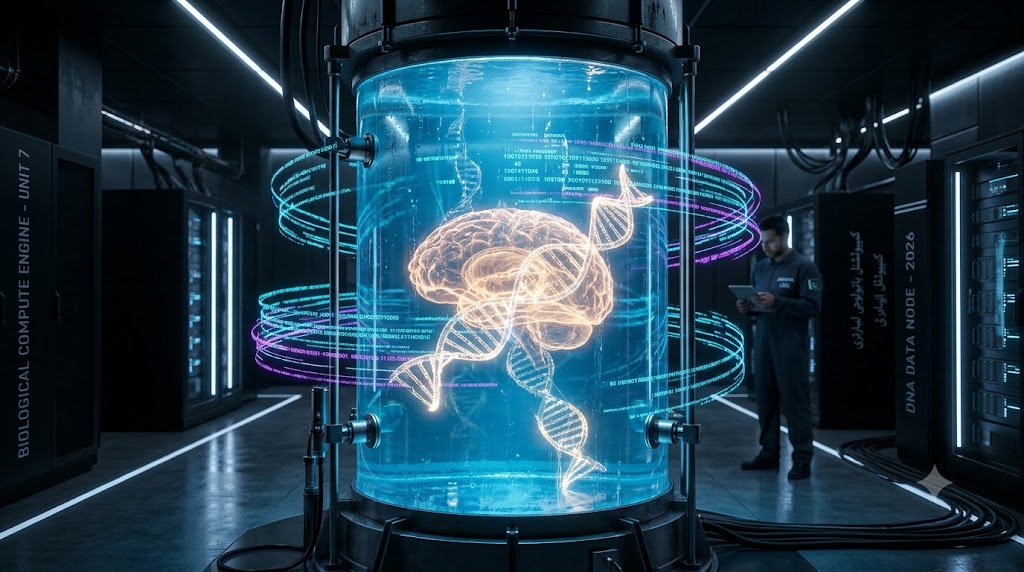
As the computational burden of generative AI threatens to break traditional power grids, the tech industry is looking past silicon. The ultimate full-stack environment of the future isn't a metal server rack—it is a living, biological computer.
By Deep Tech & Architecture Desk | Friday, August 7, 2026
For engineers accustomed to deploying reverse-proxies, managing full-stack web environments, and fine-tuning Nginx or Cloudflare configurations, the foundation of the internet has always been static: silicon chips, copper wires, and immense amounts of electricity. But as the relentless scaling of generative AI utilities pushes traditional data centers to their absolute thermal and energetic limits, a radical shift is occurring in deep tech.
The future of infrastructure is going biological. In 2026, two massive breakthroughs—DNA Data Storage and Organoid Intelligence (OI)—are moving from theoretical whitepapers to industrial reality, promising to solve the tech industry's insatiable demand for computing power.
1. Storage: The Transition to DNA Data Archives
Humanity is generating data at a pace that silicon storage can no longer sustain. The solution lies in the most efficient information storage medium ever created: DNA.
The momentum behind this technology crystalized recently at the Storage and Computing with DNA 2026 (SCDNA) conference held in Rome. Co-organized by the European Innovation Council and the DNA Data Storage Alliance, the event marked a critical transition point for the industry—moving DNA storage out of the research phase and into discussions of commercial scalability and industrial readiness.
Instead of magnetic tape or solid-state drives, future archives will encode digital information into the A, C, T, and G nucleotide sequences of synthetic DNA. The advantages are staggering: DNA offers millions of times the storage density of traditional hard drives and can remain stable for thousands of years without requiring constant energy for cooling.
2. Processing: The Rise of Organoid Intelligence (OI)
If DNA solves the storage crisis, Organoid Intelligence (OI) aims to solve the processing bottleneck. OI is an emerging multidisciplinary field that utilizes stem cell-derived brain organoids to create novel biocomputing models.
While traditional AI relies on brute-forcing massive datasets through silicon, biological learning is fundamentally different. Human brains—and by extension, these lab-grown organoids—massively outperform machines when processing complex information and making decisions on highly heterogeneous and incomplete datasets.
The "computational burden" of modern deep learning has become technically and environmentally unsustainable. To combat this, researchers are cultivating organoids that can learn and process information by minimizing unpredictability—using the free-energy principle to adapt to feedback. These living neural networks represent a pathway to biocomputers that could eventually be faster and vastly more energy-efficient than traditional silicon infrastructure.
3. The Future Full-Stack Environment
The integration of these biological systems will fundamentally redefine what a "server" looks like. We are moving toward a reality where sophisticated blood flow substitution systems will be required to maintain these biocomputers, scaling up the number of cells to replicate complex synaptic interactions.
For the modern tech stack, this means that the next major leap in hosting environments won't just require knowledge of Linux shells and local database connections; it will require an understanding of bio-security, cellular diversity, and living memory storage. The ultimate computational machine has already been invented by nature—we are just finally learning how to plug it in.
FAQ
Q: What is Organoid Intelligence (OI)?
A: Organoid Intelligence is an emerging field that uses stem cell-derived brain organoids to create novel biocomputing models. These biological systems aim to replicate cellular learning and memory to perform complex processing tasks more efficiently than silicon.
Q: Why is DNA being used for data storage in 2026?
A: DNA offers unparalleled storage density and longevity compared to traditional digital media. As highlighted at the SCDNA 2026 conference in Rome, the tech industry is actively working on scaling DNA storage for industrial and commercial applications to manage the world's exploding data output.
Q: How does biological learning differ from machine learning?
A: While machines may process simple numeric data faster, biological brains massively outperform machines in processing complex information and making decisions using incomplete datasets. Biocomputing aims to harness this efficiency to overcome the unsustainable energy demands of modern deep learning.