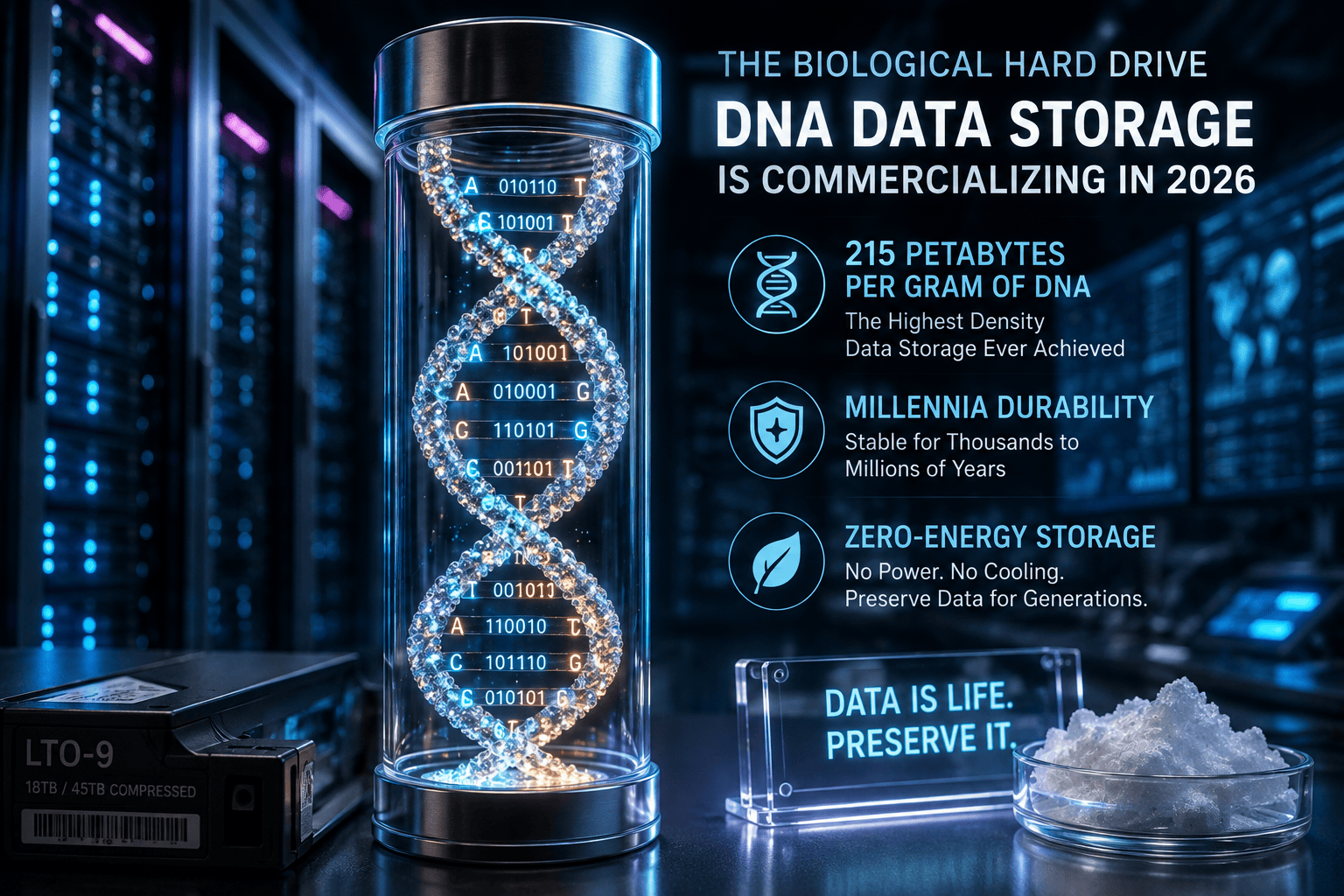
DNA can preserve enormous amounts of information in microscopic volumes without continuously powering a storage array. In 2026, that extraordinary idea is beginning to move from laboratory demonstrations toward enterprise data-center infrastructure.
The Biological Hard Drive: How DNA Data Storage Is Moving Into Data Centers in 2026
The ultimate archival medium may not look like a hard drive at all. It may look like a tiny container filled with synthetic molecules carrying files as sequences of A, C, G and T.
By Deep Tech & Biology Desk | Sunday, August 23, 2026
Imagine walking into a data center 20 years from now.
There are still flash arrays.
Still hard drives.
Probably still magnetic tape.
But somewhere inside one rack is something completely different.
No spinning platter.
No magnetic reel.
No NAND flash cells holding electrical charge.
Instead, a machine takes digital files and translates them into sequences built from the same four chemical letters nature has used to store biological information for billions of years:
A, C, G and T.
The data is written into synthetic DNA.
The molecules are stored.
Years later—perhaps decades later—the DNA is sequenced, software reconstructs the original binary information, and the file returns.
This has been demonstrated in laboratories for years.
What makes 2026 different is that companies are now trying to turn DNA storage into something an IT department could actually integrate into a data center.
Biomemory, one of the companies pushing hardest toward commercialization, says it is developing DNA storage as a new enterprise storage tier rather than a replacement for conventional electronic media. Its architecture is designed around data-center integration, modular storage appliances and standard object-storage interfaces.
And in June 2026, storage software company Scality announced a strategic partnership with Biomemory aimed at integrating DNA-based cold archives into modern enterprise storage environments.
The biological hard drive is still early.
But it is no longer merely science fiction.
The Real Data Problem Is Not Tomorrow's Files
When people talk about the world's exploding data volumes, the discussion usually focuses on capacity.
More AI.
More video.
More sensors.
More scientific data.
More business records.
More backups.
But capacity is only one part of the problem.
The harder question is:
What happens to information that must survive for decades?
A company may need to retain regulatory records for years.
A government may need to preserve historical archives.
A pharmaceutical company may need long-term scientific datasets.
A space agency may want raw mission data preserved long after the original hardware has been retired.
An AI company may accumulate enormous training corpora that are rarely accessed but too valuable to delete.
These files are usually considered cold data.
They do not need SSD-like speed.
They need reliability.
Low long-term cost.
Integrity.
Security.
And confidence that someone will still be able to read them in the future.
This is precisely where DNA storage hopes to compete.
1. DNA's Most Extraordinary Feature Is Density
The headline number associated with DNA storage almost sounds fictional.
In a landmark 2017 Science paper, researchers Yaniv Erlich and Dina Zielinski demonstrated a DNA encoding architecture capable of successfully retrieving data at a density equivalent to approximately 215 petabytes per gram of DNA.
That is:
215 million gigabytes.
In one gram.
It is important to understand what that figure means.
It was a demonstrated information-density result from a particular experimental encoding architecture—not evidence that a commercial 215-petabyte DNA drive is sitting in a server rack today.
In fact, more recent theoretical work places DNA's possible molecular information density even higher. A 2026 biotechnology review cites a theoretical capacity of roughly 455 exabytes per gram, while emphasizing that real-world DNA storage still faces major barriers including synthesis cost, error rates and biochemical constraints.
So the astonishing density is real.
The challenge is turning molecular density into usable storage-system density.
A working system also needs:
synthesis equipment,
containers,
indexing,
automation,
sequencing,
error correction,
retrieval systems,
and data-center interfaces.
That engineering overhead matters.
But even after accounting for it, DNA's physical density remains one of the most compelling reasons the storage industry continues investing in the technology.
2. Digital Files Become Biological Code
DNA data storage begins with a translation problem.
Computers use bits:
0 and 1.
DNA uses four nucleotide bases:
Adenine — A
Cytosine — C
Guanine — G
Thymine — T
Specialized encoding software converts digital information into sequences that can be represented using those four bases.
That sounds straightforward.
It is not.
You cannot simply map every two bits to one nucleotide and assume everything will work perfectly.
Certain DNA sequences are harder to manufacture or read reliably.
Long runs of identical bases can create problems.
Extreme GC content can complicate synthesis and sequencing.
DNA synthesis introduces errors.
Sequencing introduces errors.
Some molecules may disappear from the pool entirely.
So a practical DNA storage system uses sophisticated encoding and error-correction schemes to make sure the original file can still be reconstructed even when the biological process is imperfect.
This is one of the most elegant aspects of the field.
DNA is a noisy physical medium.
Computer science makes it reliable.
3. Why the Famous 215-Petabyte Experiment Mattered
The 2017 DNA Fountain experiment remains important because the researchers did not merely calculate a theoretical number.
They stored real files.
The dataset included a computer operating system, a movie and other digital material.
They then reconstructed the data successfully from synthesized DNA.
The architecture achieved the equivalent of 215 PB per gram, close to the information limit the researchers were targeting, while using error-resilient coding to recover the original information.
That experiment helped prove something crucial:
DNA does not merely store biological information exceptionally well.
It can store arbitrary digital information.
A spreadsheet does not care whether its bits are represented by transistors, magnetic domains or nucleotides.
As long as the encoding can be reconstructed perfectly, the medium is irrelevant to the software.
That is the conceptual leap behind molecular storage.
4. The Biggest Bottleneck Has Always Been Writing the DNA
Reading DNA has become dramatically cheaper and faster over the genomics era.
Writing custom DNA remains harder.
The standard industrial method, known as phosphoramidite synthesis, has been used for decades.
It works.
But it also comes with limitations in length, throughput, cost and chemical waste.
That is why enzymatic DNA synthesis has attracted so much attention.
Instead of relying entirely on traditional chemical synthesis, researchers are developing systems that use biological enzymes to assemble DNA.
The promise is significant:
less hazardous chemistry,
potentially higher parallelism,
different manufacturing architectures,
and eventually lower cost.
But this is one area where the original article was too optimistic.
A Nature Biotechnology editorial published on August 19, 2026 describes DNA writing as entering a period of rapid innovation, with enzymatic and cellular methods challenging established chemistry—but explicitly notes that none of the new approaches yet delivers long, accurate DNA at the scale the field ultimately requires.
That is the actual 2026 breakthrough story.
Enzymatic synthesis is advancing rapidly.
It has not completely solved DNA writing.
5. Why Enzymes Could Still Change the Economics
Even with those limitations, enzymatic synthesis is strategically important.
A 2025 review of enzyme-based DNA storage methods highlighted potential advantages including reduced hazardous waste, lower-cost synthesis pathways and improvements across writing, retrieval and reading workflows.
Research published in 2026 similarly describes enzymatic methods as one of the major advances helping reduce cost and increase throughput in DNA-storage systems.
This matters because the current economics of DNA storage are brutally simple:
storing molecules is cheap; creating the right molecules is expensive.
Once DNA has been written and placed into stable storage, it can sit without a powered hard-drive motor or continuously refreshed flash cell.
The costly operation is converting terabytes—or eventually petabytes—of digital information into DNA quickly enough and cheaply enough to compete with magnetic archival media.
That makes synthesis throughput one of the key commercial battles in molecular computing.
6. “Zero-Energy Storage” Needs a More Careful Definition
DNA storage is often described as requiring zero electricity.
That is partly true.
It can also be misleading.
A DNA molecule does not need electricity to remember its sequence.
Once encoded DNA has been placed into an appropriate storage environment, there is no electronic bit cell that needs refreshing and no spinning disk that must remain powered.
That gives molecular storage an extraordinary energy-at-rest advantage.
But an enterprise DNA storage system as a whole is not energy-free.
Energy is required to:
write the DNA,
operate robotics,
control storage environments where necessary,
retrieve samples,
sequence the molecules,
decode the data,
and run the surrounding IT infrastructure.
Biomemory therefore uses the more defensible phrase ultra-low energy at rest, positioning DNA as an archival tier with lower long-term infrastructure requirements rather than a magically energy-free computer.
That is the better way to understand the technology.
DNA saves energy because dormant information can remain physically encoded without continuous electronic maintenance.
7. The Million-Year Archive Is More Myth Than Commercial Requirement
Another popular claim says DNA can preserve files for a million years.
Under highly specific theoretical or environmental assumptions, extraordinary longevity is conceivable.
Ancient DNA research itself shows that genetic material can survive for remarkable periods under favorable conditions.
But no serious enterprise IT department needs a vendor to promise a million years.
It needs a predictable service-life guarantee.
Biomemory currently talks about enterprise retention periods up to approximately 150 years, and says very long preservation is possible under specialized cold and hermetic conditions.
That is already transformative.
Consider what 150 years means in computing.
A modern hard drive may be technologically irrelevant long before the end of that period.
Entire interface standards will disappear.
Software companies will vanish.
Operating systems will be forgotten.
Data centers will be rebuilt multiple times.
The interesting DNA-storage promise is therefore not immortality.
It is reducing the frequency with which archival data must be migrated simply because the underlying storage medium ages or becomes obsolete.
8. DNA Does Not Need to Replace Silicon
This is the most important correction to the original headline.
DNA is not replacing silicon.
And it does not need to.
Silicon is extraordinary at active computation.
DRAM is extraordinarily fast.
SSDs provide rapid random access.
Hard drives offer economical online capacity.
Tape remains extremely effective for deep archives.
DNA has a completely different job.
Biomemory itself describes the future as a multi-tier architecture in which molecular storage complements electronic storage rather than replacing it.
Think of it like a hierarchy.
Hot Data
RAM and extremely fast flash.
Warm Data
SSDs and hard-drive systems.
Cold Data
Object stores and archival tiers.
Deep Cold Data
Tape today—and potentially DNA tomorrow.
DNA does not need to beat an SSD at opening a database.
It needs to beat existing archive technologies at storing information that might not be requested for 10, 30 or 100 years.
That is a much more realistic commercial target.
9. Random Access Is Turning DNA From a Medium Into a Storage System
There is another major technical problem.
Suppose a tube contains DNA encoding 10 million files.
You need one photograph.
How do you retrieve it without sequencing everything?
That is the random-access problem.
It is becoming an increasingly important research area.
A July 2026 review in Trends in Biotechnology argues that random access is what transforms DNA from a passive storage medium into an actual storage system.
Researchers are developing techniques based on molecular addressing, partitioning and selective retrieval so that specific data can be located without decoding an entire molecular library.
This may ultimately be one of the most important advances in DNA storage.
Density alone does not make a useful archive.
You also need a catalogue.
10. Error Correction Is the Invisible Technology Making DNA Storage Possible
Electronic storage has trained us to expect perfection.
Save a PDF.
Open it tomorrow.
Every bit should be exactly where it belongs.
Biology does not naturally behave like that.
DNA molecules can be:
written incorrectly,
damaged,
copied unevenly,
lost,
or read incorrectly during sequencing.
So DNA storage systems deliberately add redundancy.
Modern architectures use error-correction approaches including Reed-Solomon coding, Fountain codes and newer DNA-specific techniques to reconstruct files despite missing or corrupted sequences. A 2026 review identifies error resilience as one of the central engineering requirements for scalable DNA storage.
This creates a beautiful inversion.
The molecules do not have to be perfect.
The system has to be capable of recognizing imperfection and recovering from it.
That is very similar to modern communications networks.
Packets disappear.
Noise exists.
Errors happen.
Good coding hides the mess from the user.
11. 2026 Is When Commercial DNA Storage Became Much More Serious
The most important commercial development this year is happening around Biomemory.
In March 2026, the company acquired the assets of U.S.-based Catalog Technologies, combining Biomemory's data-storage architecture with Catalog's work in large-scale DNA information processing.
The company said it intended to launch its first commercial end-to-end DNA storage solution in the second half of 2026.
That is an important distinction.
Previous DNA storage products have demonstrated that consumers can physically own DNA-encoded data.
The emerging enterprise effort is different.
The goal is a system that data-center operators can integrate with existing infrastructure.
Not a scientific demonstration.
Not a novelty DNA card.
A storage tier.
12. The Scality Partnership Makes the Data-Center Story Much More Credible
One reason the June 2026 Scality partnership matters is that DNA storage cannot become an enterprise technology by remaining isolated from normal IT management.
A bank does not want its archive team to learn molecular biology just to save an object.
The user should be able to interact with DNA storage through familiar storage policies and interfaces.
Scality and Biomemory say their partnership is aimed at bringing DNA storage into modern object-storage architectures where the molecular tier can coexist with flash, disk and tape.
Biomemory says its own architecture is being designed around interoperable APIs and an S3-compatible object-storage interface.
This might sound like an obscure IT detail.
It is actually essential.
The future DNA archive becomes commercially interesting only when a normal application can effectively say:
STORE THIS OBJECT
without caring whether the final bits reside on:
disk,
tape,
or DNA.
The molecular complexity must disappear behind software.
13. Biomemory Is Not Promising “Millions of Years” to Enterprises
The company's current positioning is revealing.
Biomemory talks about retention and readability of up to roughly 150 years, enterprise-grade resilience and a roadmap toward lower total cost of ownership for long-term storage.
It is also targeting use cases such as:
long-term archives,
regulated datasets,
AI training datasets,
compliance records,
and critical backups.
That tells us where commercialization will start.
Not with family photographs.
Not with a DNA SSD inside a laptop.
With organizations that attach unusually high value to preserving information for decades.
That is exactly how an expensive new storage technology should enter the market.
Begin where failure is most costly.
14. What Would Actually Be Worth Putting Into DNA?
Imagine a hospital.
There are records that need rapid access every day.
DNA would make no sense.
Then there are research datasets or regulatory records that might need to survive for many decades but are rarely retrieved.
That is much more interesting.
Other examples could include:
National Archives
Historical government records that should survive multiple generations of storage hardware.
Scientific Research
Raw datasets from experiments that can never be recreated.
Space Missions
Telemetry and scientific observations from missions costing billions of dollars.
Pharmaceutical Research
Long-lived research data, clinical archives and regulatory evidence.
Film and Media Archives
Master-quality cultural works intended for preservation far beyond ordinary commercial distribution cycles.
Enterprise Compliance
Records that must remain trustworthy for extremely long retention periods.
AI Training Archives
Large historical datasets that may become useful again when future models or research techniques change.
These are not everyday files.
They are files for which deletion would be economically, scientifically or culturally unacceptable.
15. DNA Storage Could Become an Interesting Cybersecurity Layer
There is another advantage to DNA that has little to do with density.
A DNA archive can be physically offline.
That matters in the age of ransomware.
Modern attackers increasingly target both primary systems and backups.
An archive that is physically separated from normal electronic infrastructure can add another level of isolation.
Biomemory describes its DNA media as biosecure and air-gapped by design, targeting high-security archival environments.
That does not make DNA immune to cybersecurity problems.
Access-control systems can still be compromised.
Metadata can be stolen.
Encoding pipelines can be attacked.
The surrounding software remains software.
But an offline molecular copy introduces an unusual physical barrier between an attacker and the archived bits.
For some enterprises, that could become as valuable as the density.
16. The Environmental Argument Is Strong—but Not Yet Settled
DNA storage is frequently promoted as greener than traditional archives.
The argument makes intuitive sense.
Very high density requires less physical space.
Dormant DNA does not need continuous electronic power.
Long media life could reduce manufacturing and replacement cycles.
But the environmental accounting must include the entire lifecycle.
DNA synthesis consumes materials and energy.
Sequencing consumes energy.
Storage containers have manufacturing footprints.
Automation equipment needs hardware.
Facilities still exist.
This is why claims about enormous sustainability advantages should eventually be evaluated through independent lifecycle assessments rather than assumed from molecular density alone.
DNA storage may prove dramatically more efficient for deep archives.
Commercial-scale deployments still need to demonstrate that advantage in real operational environments.
17. DNA Storage Still Has Four Major Problems
The technology is fascinating.
It is not ready to replace conventional archival infrastructure tomorrow.
Four barriers remain especially important.
Cost
DNA writing remains far too expensive for ordinary mass storage.
Throughput
Enterprise archives operate at enormous data rates.
DNA synthesis must become dramatically faster.
Latency
Retrieving and sequencing molecular data takes much longer than reading a disk.
Automation
A commercial archive must operate reliably without teams of molecular biologists manually handling every sample.
The DNA Data Storage Alliance continues to identify write/read speed, capacity, equipment complexity and cost as core barriers to commercialization.
This is why 2026 should be described as the beginning of industrialization.
Not the conclusion.
18. Enzymatic Synthesis May Decide Whether DNA Storage Wins
Among all those problems, cost-per-written-byte may be the decisive one.
Magnetic tape is cheap.
Extremely cheap.
DNA must become competitive enough that its advantages in density, longevity and energy usage compensate for the cost of synthesis.
This is where enzymatic writing could become transformative.
Biomemory's post-Catalog architecture combines enzymatic DNA-block assembly with high-speed printing and high-throughput reading technologies as part of its commercialization strategy.
The winner in DNA storage may not be the company with the most impressive theoretical density.
It may be the company that discovers how to manufacture molecular bits cheaply enough.
19. DNA Might Ultimately Do More Than Store Data
The story becomes even stranger when DNA storage meets molecular computing.
DNA is not merely a passive material.
Molecules can interact.
They can be amplified.
Selected.
Separated.
Combined.
Researchers are exploring whether some forms of searching and computation could happen directly within molecular datasets rather than requiring every piece of information to be converted back into conventional electronics first.
Biomemory's longer-term roadmap explicitly discusses future molecular-scale search and compute capabilities alongside storage.
That could transform the idea completely.
Instead of:
DNA as an incredibly dense tape replacement,
the future might become:
DNA as a programmable information medium.
Storage would only be the beginning.
20. Why This Matters in the Age of AI
Artificial intelligence makes the storage problem more urgent for a simple reason.
AI creates data.
Models have checkpoints.
Training pipelines have datasets.
Agents generate logs.
Companies collect evaluation records.
Synthetic media multiplies.
Video and multimodal systems consume enormous amounts of storage.
Most of this does not need to stay on an expensive SSD forever.
Some of it may need to survive for decades.
That produces a natural lifecycle:
hot while actively used,
warm while still relevant,
cold after activity falls,
deep cold when retained mainly because it is too valuable to destroy.
DNA potentially occupies that final layer.
The more digital civilization creates, the more valuable extreme archival density becomes.
21. But Do Not Throw Away the Tape Library
Magnetic tape deserves more respect than futuristic storage articles usually give it.
Tape is mature.
Cheap.
Reliable.
Well understood.
Highly automated.
Extremely effective for cold archives.
And already deployed at enormous scale.
DNA therefore faces a difficult competitor.
The question is not:
Is DNA scientifically cooler than tape?
Obviously.
The question is:
Can DNA eventually deliver enough operational advantage per dollar to justify replacing or complementing tape for selected workloads?
Scality's own 2026 positioning reflects this reality.
Its partnership with Biomemory explicitly describes DNA storage as a technology intended to complement flash, disk and tape, not immediately eliminate them.
That is probably what the first decade of commercial molecular storage will look like.
Hybrid.
22. The Biological Hard Drive Will Probably Be Invisible
The strangest thing about successful DNA storage may eventually be how ordinary it feels.
The user will not type DNA sequences.
They will not operate a sequencer.
They may never see the physical molecules.
An IT administrator may simply create an archival policy:
Move objects older than 10 years to molecular archive.
Software handles everything else.
The object disappears from conventional storage.
Somewhere inside an automated appliance, bits become DNA.
Decades later:
GET archive/object-2047
The system retrieves the molecular sample.
Sequences it.
Corrects errors.
Decodes the data.
Returns the file.
If DNA storage succeeds, all the biotechnology will eventually become boring infrastructure.
That is often the final stage of technological maturity.
The miracle disappears behind an API.
The Future of Storage Is Not Silicon or DNA
It is easy to frame emerging technologies as battles.
DNA versus hard drives.
DNA versus tape.
Biology versus silicon.
The real future will almost certainly be more layered.
CPUs will compute.
RAM will hold immediate working data.
SSDs will serve performance-sensitive storage.
Hard drives will continue providing huge inexpensive pools.
Tape will remain valuable for archives.
And DNA may become a new layer underneath them all:
the place where civilization puts information it wants to preserve after everyone has stopped actively using it.
That is what makes 2026 important.
Not because the world suddenly abandoned magnetic storage.
Not because a gram of DNA will arrive next month carrying 215 petabytes of customer files.
And not because enzymatic synthesis has completely solved molecular writing.
The important change is that DNA storage is being redesigned as an IT product rather than a biotechnology experiment.
Biomemory is working toward enterprise deployment.
Scality is exploring how molecular storage fits into existing object-storage environments.
Research is improving synthesis, retrieval, random access and error correction.
Standards bodies are beginning to think about data-center manageability.
The pieces are starting to connect.
Nature spent billions of years refining DNA as an information-storage molecule.
Computing spent less than a century learning how to store information electronically.
Now those histories are beginning to converge.
The biological hard drive is not replacing the data center.
It is beginning to become part of it.
Frequently Asked Questions
What is DNA data storage?
DNA data storage encodes ordinary digital information into sequences using DNA's four nucleotide bases—A, C, G and T. Synthetic DNA is manufactured with those sequences, stored physically, then later sequenced and decoded back into the original digital file.
Is DNA data storage commercially available in 2026?
Commercialization is beginning, but DNA storage is not yet a mainstream enterprise storage tier. Biomemory has said it plans its first end-to-end commercial DNA data-storage solution in the second half of 2026 and is developing systems intended for data-center integration.
How much information can one gram of DNA hold?
A famous 2017 Science experiment demonstrated successful retrieval at approximately 215 petabytes per gram using the DNA Fountain architecture. Newer reviews cite substantially higher theoretical molecular limits, but those theoretical figures should not be confused with the usable capacity of a commercial storage appliance.
Is 215 petabytes per gram a theoretical number?
No. The 215 PB/gram figure came from a demonstrated experimental architecture published in Science. However, the files used in the demonstration were far smaller; the density figure represented how efficiently the DNA encoding scheme could theoretically scale based on the molecules used.
Does DNA storage use electricity?
DNA molecules do not require continuous electrical power to preserve their encoded sequence. However, synthesis, automation, sequencing, decoding and supporting data-center infrastructure all consume energy. Commercial vendors therefore more accurately describe DNA as having very low energy requirements at rest.
Can DNA really preserve data for a million years?
Claims about extremely long DNA survival depend heavily on storage conditions. Current enterprise commercialization is more conservatively targeting retention measured in decades to roughly 150 years. Under specialized cold and hermetic conditions, DNA can potentially remain readable far longer.
What is enzymatic DNA synthesis?
Enzymatic DNA synthesis uses biological enzymes rather than relying solely on conventional phosphoramidite chemistry to construct custom DNA sequences. It is being explored as a potentially cleaner and more scalable way to write DNA, but it remains an active area of development.
Has enzymatic DNA synthesis solved DNA storage costs?
No. Enzymatic approaches are advancing rapidly but DNA writing remains a major bottleneck. Nature Biotechnology noted in August 2026 that newer synthesis approaches still do not yet deliver long, accurate DNA at the ultimate scale required.
Is DNA replacing magnetic tape?
No. The emerging enterprise model positions DNA as an additional cold-storage tier that may complement tape, disk and flash. Scality and Biomemory explicitly describe their approach this way.
Why use DNA instead of tape?
DNA potentially offers extraordinary physical density, very low energy use while dormant and extremely long retention without frequent media refresh. Whether those benefits outweigh synthesis and retrieval costs will determine where it becomes commercially competitive.
What data is best suited to DNA storage?
The most plausible early applications are high-value data that needs to remain intact for decades but is rarely accessed: scientific datasets, compliance records, cultural archives, critical backups, long-lived AI datasets and other deep-cold information.
How do you retrieve one file from DNA?
Researchers are developing random-access techniques using molecular addressing, partitioning and selective retrieval. Random access is considered essential for transforming DNA from a passive molecular medium into a practical storage system.
Is DNA storage secure from ransomware?
Offline DNA archives can potentially provide a strong air-gap against ordinary electronic attacks. However, the surrounding encoding, indexing, access-control and retrieval systems still require normal cybersecurity protections.
What is Biomemory?
Biomemory is a DNA data-storage company developing molecular storage systems for data-center environments. In 2026 it acquired Catalog Technologies' assets and partnered with Scality to advance enterprise integration.
Will DNA storage work with normal cloud or object-storage software?
That is the commercial goal. Biomemory says its systems are designed around interoperable APIs and the widely used S3 object-storage interface, allowing DNA to operate as another tier behind conventional storage software.
What prevents DNA data storage from becoming mainstream today?
The biggest challenges remain DNA synthesis cost, writing speed, reading latency, capacity, automated handling, random access, equipment complexity and integration with existing data-center systems.
Editorial Note: DNA data storage is entering an early commercialization phase, not replacing conventional storage in 2026. Density figures often cited for DNA may represent experimental or theoretical molecular capacity rather than the usable capacity of shipping enterprise hardware. Vendor retention, cost and performance claims should be distinguished from independently demonstrated production deployments.
synthetic DNA storage, molecular data storage, DNA cold storage, enzymatic DNA synthesis, Biomemory DNA storage, DNA archive technology, 215 petabytes per gram, enterprise cold storage
enterprise data storage, archival storage, object storage, data center infrastructure, cloud backup, cyber-resilient storage, immutable backup, cold storage solutions, data protection, S3 object storage, enterprise backup
DNA Data Storage, Molecular Storage, Data Centers, Enterprise Storage, Synthetic Biology, Cold Storage, Data Protection, Biotechnology, Archiving, Future Computing