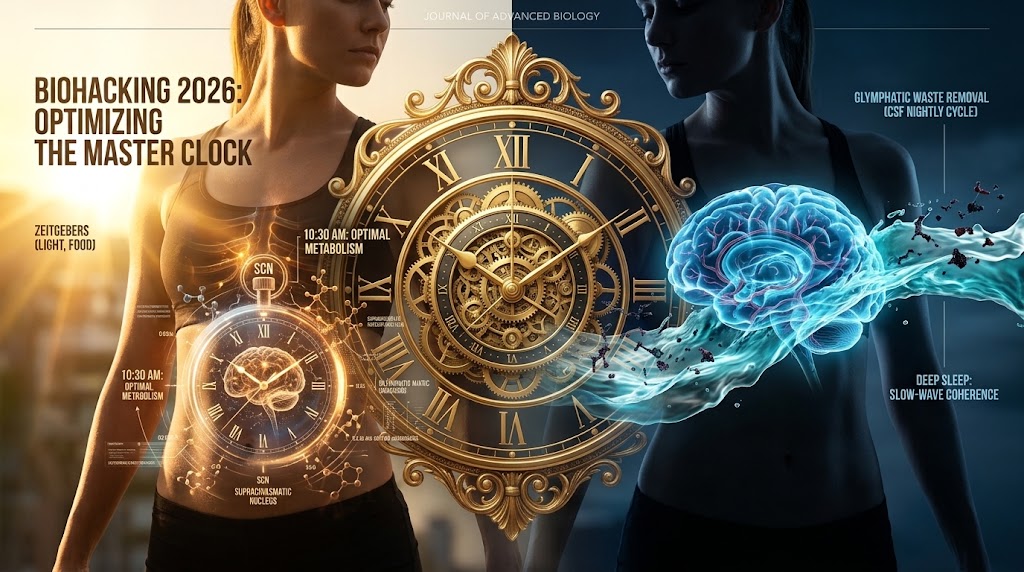
The Circadian Reboot: Why Timing Is Becoming the Missing Dimension of Health
Health advice has traditionally focused on what we eat and how long we sleep. In 2026, chronobiology is adding another question: when? New research suggests that timing can influence glucose metabolism, sleep physiology and the synchronization of the body's internal clocks—but the science is more nuanced than the wellness industry often suggests.
Your body does not experience 8 a.m. and midnight as biologically identical. In 2026, scientists are getting much better at understanding what that means for eating, sleeping and the clocks hidden inside our organs.
By Science & Wellness Desk | Monday, August 24, 2026
For decades, modern wellness has been obsessed with quantities.
How many calories?
How many grams of protein?
How many steps?
How many hours of sleep?
How many minutes of exercise?
How much vitamin D?
Those numbers still matter.
But a growing branch of biology is asking us to add another variable:
When?
What happens if exactly the same meal is eaten earlier rather than late at night?
What happens when the brain expects darkness but receives bright artificial light?
What happens when sleep occurs at irregular times even if the total number of hours sometimes looks adequate?
And what happens inside the sleeping brain while we are unconscious?
These questions sit inside chronobiology, the science of biological rhythms.
One part of that field—chrononutrition—studies the relationship between food timing and the body's internal clocks.
Another increasingly fascinating area examines the glymphatic system, a fluid-transport pathway involved in clearing metabolic waste from the brain.
Together, they are producing a more sophisticated view of human health.
Not:
timing matters more than everything.
But:
the body cares about timing as well as quantity and quality.
That may sound like a small distinction.
Biologically, it is enormous.
1. There Is More Than One Clock Inside You
We casually talk about “the body clock” as though humans contain one internal stopwatch.
The reality is more interesting.
A central circadian pacemaker sits in the brain's suprachiasmatic nucleus, or SCN, in the hypothalamus.
Its strongest environmental timing signal is light.
Morning and daytime light help synchronize this master clock with Earth's roughly 24-hour light-dark cycle.
But circadian rhythms also exist throughout the body.
The liver has clocks.
The pancreas has clocks.
The intestine has clocks.
Fat tissue has clocks.
Muscle has clocks.
These peripheral clocks help organize physiology so that the body can anticipate recurring events such as waking, activity, eating and fasting.
Modern research describes light as a powerful signal for the central clock while nutrient and metabolic signals can influence clocks in tissues outside the SCN.
This means your body is not simply reacting to what happens.
It is continuously predicting when things should happen.
2. Your Metabolism Has a Schedule
Imagine eating an identical meal twice.
Same calories.
Same carbohydrate.
Same protein.
Same fat.
One is eaten earlier in the day.
The other much later.
Would the body respond identically?
Evidence increasingly suggests: not necessarily.
A July 2026 systematic review and meta-analysis examined 44 human intervention studies comparing earlier and later food intake.
In shorter studies, earlier meals were associated with substantially lower post-meal glucose responses. Researchers found reductions in both two-hour postprandial glucose and peak glucose compared with later eating.
But there is an important limitation.
Most included trials lasted one week or less, and the studies differed considerably in design.
The authors therefore concluded that the evidence is physiologically compelling but not yet sufficient for definitive clinical recommendations.
That nuance matters.
Chrononutrition is becoming serious science.
It is not yet a universal prescription telling everyone to eat dinner at exactly 5:43 p.m.
3. So Is “A Calorie Is a Calorie” Dead?
No.
This is where wellness headlines often outrun physiology.
Energy balance still matters.
Food quality matters.
Protein matters.
Fibre matters.
Micronutrients matter.
How much a person eats matters.
Chrononutrition adds another layer:
the body's response to that energy may vary according to biological timing.
A delayed eating study in healthy young men found higher average 24-hour glucose when identical meals were shifted later in the day.
Older controlled experiments have likewise found poorer glucose handling when food is consumed later in the biological evening.
But that does not mean someone can consume unlimited food before noon without consequence.
Nor does it mean every late eater will gain weight.
The useful idea is simpler:
metabolism is rhythmic.
Calories remain relevant.
Timing may influence what happens after those calories arrive.
4. Chrononutrition Is Not Just Intermittent Fasting
The two terms are often confused.
Intermittent fasting is a broad category involving periods of eating and fasting.
Time-restricted eating, or TRE, usually limits daily food intake to a recurring window.
Chrononutrition is broader still.
It asks questions such as:
When is breakfast eaten?
How late is dinner?
How much energy is consumed earlier versus later?
How regular are meals?
How does meal timing relate to a person's sleep-wake rhythm?
Does an individual's chronotype matter?
A 2026 review in the Journal of Advanced Research argues that future precision nutrition may increasingly consider chronotype—the biological tendency toward earlier or later sleep and activity—rather than assuming everyone should follow exactly the same clock schedule.
That makes sense.
Humans are rhythmic.
But humans are not identical.
5. The 8-Hour Eating Window Is Not a Magic Number
You may have seen claims that everyone should eat within:
six hours,
eight hours,
ten hours,
or another perfectly defined window.
The evidence is much less rigid.
A major 2026 review of time-restricted eating describes promising effects across metabolic regulation, glucose control, appetite and circadian alignment, while also highlighting wide variation among study designs and fasting protocols.
This means there is no scientifically established universal eating window that is ideal for every healthy adult.
Lifestyle matters.
Age matters.
Medication matters.
Chronotype matters.
Exercise matters.
Work schedules matter.
Shift workers represent an especially complicated case because their behavioral schedules may conflict with environmental light-dark rhythms.
So the interesting 2026 conversation is shifting away from:
“What is the perfect fasting window?”
toward:
“How can food timing fit an individual's circadian and metabolic context?”
6. Light Is Still the Most Important Clock Setter
This is where the German word zeitgeber becomes useful.
It means roughly:
time giver.
A zeitgeber is an environmental cue capable of helping synchronize biological rhythms.
Humans receive many timing cues.
Light.
Darkness.
Meals.
Physical activity.
Social schedules.
Temperature.
But these signals are not equally powerful.
For the central circadian clock, light is the dominant cue.
Food timing appears to have particularly strong effects on metabolic and peripheral rhythms, while direct evidence for food functioning as a complete circadian zeitgeber in humans is more limited than popular wellness descriptions sometimes imply.
This is why circadian health cannot simply be reduced to fasting.
The body is listening to the whole day.
7. Modern Life Sends Conflicting Time Signals
Consider a common modern evening.
It is 11:30 p.m.
Outside, it is dark.
Inside:
bright ceiling lights,
a glowing television,
a phone six inches from the face,
a takeaway meal,
work email,
social media,
and perhaps caffeine consumed hours earlier.
The environmental message is contradictory.
The astronomical world says:
night.
Behavior says:
daytime activity continues.
Food says:
metabolic work is arriving.
This mismatch is one reason shift work and circadian disruption have become such important research areas.
The problem is not that a human body suddenly “breaks” after one late dinner.
It is that biological systems evolved around repeated cycles of light, activity, food and rest—and modern life can repeatedly move those signals apart.
8. Then Comes Sleep—and an Extraordinary Brain-Cleaning System
Chronobiology becomes even more fascinating when the lights go out.
For decades, scientists knew that the brain lacked the same conventional lymphatic organization found throughout much of the rest of the body.
Then researchers characterized a fluid-transport pathway now known as the glymphatic system.
The system involves movement of cerebrospinal fluid through pathways associated with blood vessels and astrocytes, helping move metabolites and proteins away from brain tissue.
One major reason it attracted worldwide attention is its relationship with sleep.
A comprehensive Molecular Psychiatry review published in July 2026 describes glymphatic activity as strongly sleep-dependent and discusses its potential role in clearing compounds including amyloid-beta from the brain's extracellular environment.
For the first time, sleep was not merely looking like “rest.”
It was beginning to look like a distinct physiological maintenance state.
9. In 2026, Researchers Got Stronger Human Evidence
Much of the early glymphatic research came from animal studies.
That created a crucial question:
Does the same waste-clearance process meaningfully operate in living humans?
A 2026 Nature Communications study provided important evidence.
In a randomized crossover experiment involving 39 participants, researchers compared normal sleep with sleep deprivation and measured biomarkers associated with glymphatic clearance.
After normal sleep, morning blood levels of amyloid-beta and tau reflected increased movement of these proteins from brain toward the bloodstream compared with sleep deprivation.
The researchers concluded that the findings provide evidence that the human glymphatic system contributes to clearance of amyloid-beta and tau.
That is significant.
It moves the field beyond assuming that observations in rodents automatically translate to humans.
10. Is Your Brain Literally Being “Washed” at Night?
This phrase is useful.
It is also oversimplified.
Cerebrospinal fluid does move through and around brain tissue.
Sleep is associated with enhanced clearance mechanisms.
But the brain does not switch on a miniature pressure washer when you enter deep sleep.
Scientists are still debating important details of glymphatic physiology.
A 2026 review in Neurobiology of Disease highlights unresolved questions involving fluid transport mechanisms, differences between species and the limitations of existing methods for measuring glymphatic activity in humans.
So “brain washing itself” works beautifully as an analogy.
It should not be mistaken for the complete mechanism.
11. Deep Sleep Matters—but Not in the Simplistic Way Social Media Suggests
Slow-wave sleep is associated with physiological conditions that appear favorable for glymphatic transport.
That has produced countless online claims that:
Stage 3 sleep = brain detox.
Reality is more complex.
Sleep architecture changes throughout the night.
NREM and REM stages perform different functions.
Glymphatic regulation appears connected with sleep state, vascular activity, neural signaling, respiration and other physiological mechanisms.
The current evidence does not justify treating one wearable's “deep sleep score” as a direct measurement of how thoroughly the brain removed amyloid overnight.
Consumer sleep trackers can estimate aspects of sleep.
They do not directly measure glymphatic clearance.
That distinction is important.
12. This Is Also Why “Optimizing” Every Minute of Sleep Can Backfire Psychologically
The growing science of sleep has produced a strange cultural side effect.
People now wake up feeling rested...
then check their wearable...
see a score of 61...
and decide they slept terribly.
A device intended to improve awareness can become another source of anxiety.
There is even a term used in sleep medicine literature—orthosomnia—for excessive preoccupation with achieving perfect sleep metrics.
Circadian health should therefore not become another optimization contest.
The objective is not:
perfect biological timing every day.
It is:
more consistent alignment over time.
13. What About Eating Before Bed?
Here we need to separate plausible biology from exaggerated claims.
Late eating has been associated in controlled studies with less favorable glucose responses.
Meal timing may also interact with sleep.
But there is currently no strong evidence supporting this simplistic chain:
Late dinner → glymphatic system switches off → toxic proteins accumulate tonight.
That is too strong.
Chrononutrition and glymphatic biology are related through broader sleep and circadian physiology, but they remain distinct research fields.
So the evidence-supported argument is:
late and irregular eating may affect metabolic rhythms;
poor or disrupted sleep affects brain physiology;
and regular circadian patterns may help keep multiple systems better aligned.
That is already fascinating.
There is no need to manufacture a stronger causal claim.
14. The Most Powerful Circadian Intervention May Be Boring
Wellness culture often prefers expensive solutions.
A ring.
A red-light panel.
A cooling mattress.
A supplement stack.
A continuous glucose monitor.
A smart sunrise lamp.
Some of these technologies can be genuinely useful.
But the basic circadian signals are surprisingly ordinary.
Morning/daytime light.
Darkness at night.
Regular sleep timing.
Consistent meal patterns.
Physical activity.
A recurring daily schedule.
Humans evolved with extraordinarily strong environmental rhythms.
Sunrise.
Day.
Sunset.
Night.
Modern technology has given us the ability to ignore those signals.
Chronobiology is partly teaching us what happens when we do.
15. Morning Light Is More Than a Wellness Trend
Light reaches the retina and sends timing information to the brain's circadian system.
This is one reason daylight exposure after waking can be such an important environmental signal.
But internet health advice often turns this into artificial precision:
Get exactly 11 minutes of sunlight within exactly 23 minutes of waking.
Biology does not work like a social-media timer.
Light timing, intensity, duration, season, latitude and individual circadian phase all matter.
A bright outdoor environment is generally much more intense than typical indoor lighting, but there is no universal minute count that perfectly resets every human clock.
The principle is stronger than the gimmick:
daytime should look like daytime to your circadian system.
16. Darkness Is Also Biological Information
We spend enormous attention on light exposure.
Darkness deserves equal respect.
Artificial lighting makes it possible to extend daytime behavior late into the night.
Screens are only part of the issue.
Room lighting matters too.
This does not mean every household needs to live by candlelight after sunset.
It means the circadian system responds to the environment we create.
A bright workplace at noon and a dimmer home environment approaching sleep send more coherent timing signals than the reverse.
The objective is contrast.
Bright day.
Dark night.
17. Regularity May Matter More Than Obsessive Perfection
Suppose someone sleeps at:
10:30 p.m. Monday,
1:30 a.m. Tuesday,
11 p.m. Wednesday,
3 a.m. Friday,
and noon on Sunday.
Even with some nights containing enough total sleep, the timing itself is highly variable.
The same principle applies to eating.
Real-world research published in Nature Metabolism in 2026 found substantial variability in people's timing and food choices, highlighting how messy actual human eating patterns can be outside controlled laboratories.
This is important because research protocols often look nothing like real life.
A sustainable rhythm may ultimately matter more than chasing an ideal schedule for three days and abandoning it.
18. Your Chronotype Is Not Laziness
Not everyone naturally wants to sleep at the same time.
Some people are more morning-oriented.
Others naturally shift later.
These differences are partly biological.
Chronotype affects preferred sleep timing and is increasingly being investigated as a factor in personalized nutrition.
The emerging field of chrononutrition therefore faces an interesting challenge:
Should a naturally late chronotype simply be told to eat at sunrise?
Probably not so simplistically.
A 2026 precision-nutrition review argues that future strategies may need to integrate individual circadian phenotype with meal timing, rather than applying identical schedules to everyone.
That is a much more sophisticated health model.
19. Shift Workers Need a Different Conversation
Generic circadian advice is particularly inadequate for:
doctors,
nurses,
security staff,
factory workers,
drivers,
emergency responders,
airline crews,
and millions of others who work at night.
They cannot simply be told:
“Sleep when it is dark and eat during daylight.”
Their livelihood may require exactly the opposite.
This is where chronobiology has genuine clinical and occupational-health importance.
Future strategies may involve carefully timed:
light exposure,
meals,
sleep,
physical activity,
and perhaps controlled lighting environments.
The challenge is not restoring a romantic ancestral lifestyle.
It is reducing biological conflict inside a 24-hour society.
20. Wearables Are About to Become More Interesting
Today's wearables primarily measure proxies:
movement,
heart rate,
heart-rate variability,
skin temperature,
estimated sleep stages,
oxygen saturation,
and sometimes glucose through separate devices.
The next generation of wellness technology may increasingly combine those signals with circadian context.
Not simply:
You slept 7 hours 21 minutes.
But:
Your sleep timing shifted 2.5 hours later than your recent baseline.
Your meals moved later.
Your light exposure was unusually low during the morning.
Your temperature rhythm suggests your schedule is drifting.
Your glucose responses differ according to meal timing.
That is a more interesting direction for personalized health technology.
Instead of collecting more numbers, the system starts asking whether those numbers occur at the right biological time for that individual.
21. Chronobiology Could Become the Next Layer of Precision Medicine
Medicine traditionally asks:
What disease?
What drug?
What dose?
Chronobiology adds:
What time?
This idea already exists in chronotherapy, where the timing of interventions is studied in relation to biological rhythms.
The same thinking is spreading into nutrition and behavioral medicine.
Future health recommendations may increasingly account for:
chronotype,
shift-work schedule,
light exposure,
sleep timing,
meal timing,
medication timing,
and individual metabolic response.
The goal would not be a universal “perfect day.”
It would be a schedule aligned more intelligently with each person's physiology and obligations.
That is a much more credible vision of the circadian revolution.
22. So What Does the Science Actually Suggest in 2026?
Not a miracle protocol.
Not “never eat after 6 p.m.”
Not a compulsory eight-hour fasting window.
Not a promise that morning sunlight cures disease.
And certainly not that a smartwatch can tell you whether your brain has been adequately “washed.”
Instead, the evidence increasingly supports several broad principles:
Light strongly anchors the central circadian system.
Food timing interacts with metabolic rhythms.
Earlier eating often produces better short-term glucose responses than identical later eating, although long-term evidence remains incomplete.
Sleep supports important brain-clearance physiology, including human glymphatic movement of amyloid-beta and tau.
Chronotype and individual circumstances matter.
Consistency may be a more realistic target than biological perfection.
That is already enough to change how we think about health.
The Circadian Reboot
The old wellness model viewed the human body almost like a machine that could be supplied with the correct ingredients.
Protein.
Vitamins.
Calories.
Exercise.
Sleep.
Put the right quantities in.
Get health out.
Chronobiology reveals something more beautiful.
The human body is not merely biochemical.
It is temporal.
Hormones rise and fall.
Body temperature oscillates.
Alertness changes.
Glucose tolerance changes.
Sleep pressure builds.
Cells coordinate their activity.
Organs anticipate feeding and fasting.
The brain changes state as night arrives.
We do not merely exist inside time.
Our biology is built from it.
That does not mean “when” is more important than “what.”
A plate of vegetables does not become junk food because it is eaten at 8 p.m.
Five hours of perfectly timed sleep is not automatically better than adequate sleep.
Calories do not cease to exist after sunrise.
The breakthrough is subtler:
health behaviors have timing as well as content.
For decades, we optimized the content.
In 2026, science is getting much better at understanding the clock.
And the future of personalized health may depend on learning how the two fit together.
Frequently Asked Questions
What is chrononutrition?
Chrononutrition studies how the timing and regularity of food intake interact with circadian rhythms and metabolism. It includes subjects such as meal timing, energy distribution during the day, time-restricted eating and individual chronotype.
Is it healthier to eat earlier?
Some human intervention studies show better short-term glucose responses when meals are consumed earlier rather than later. However, a July 2026 meta-analysis concluded that longer, better-controlled studies are still required before definitive clinical recommendations can be made.
Does eating late automatically cause weight gain?
No. Body weight is affected by many factors including total energy intake, diet quality, activity, sleep and metabolism. Meal timing may influence metabolic responses and possibly weight-management outcomes, but saying that late eating automatically causes weight gain regardless of calories would overstate the evidence.
What is the glymphatic system?
The glymphatic system is a brain fluid-transport pathway involving cerebrospinal fluid and perivascular spaces. Research suggests it contributes to the clearance of metabolic waste and proteins from brain tissue and is strongly influenced by sleep.
Does the brain remove waste while you sleep?
Evidence supports increased brain waste-clearance activity during sleep. A 2026 randomized human study found evidence that normal sleep supports glymphatic clearance of amyloid-beta and tau compared with sleep deprivation.
Does the glymphatic system only work during deep sleep?
That is too simplistic. Sleep state appears important, and slow-wave/NREM physiology may support glymphatic transport, but researchers are still studying the mechanisms. Glymphatic activity cannot currently be reduced to a consumer wearable's “deep sleep” score.
What is a zeitgeber?
A zeitgeber is an environmental timing cue that helps synchronize biological rhythms. Light is the dominant zeitgeber for the brain's central circadian clock. Food, activity and other signals can also influence biological timing, especially in peripheral tissues.
Is food a zeitgeber?
Food timing can influence peripheral biological clocks and metabolic rhythms. However, evidence that meals act as a complete circadian zeitgeber in humans is less definitive than the evidence for light.
What is time-restricted eating?
Time-restricted eating confines daily food intake to a consistent window while fasting outside that window. Different studies use different durations, and there is no universally proven ideal eating window for every person.
Is an eight-hour eating window best?
Not necessarily. Studies use different windows and populations, and individual responses vary. Chronotype, medical conditions, medications, work schedules and dietary quality all matter.
Does morning sunlight reset the circadian rhythm?
Light is the strongest environmental signal for the central circadian clock. Daytime light exposure, particularly around the earlier part of a person's biological day, helps synchronize circadian timing, but there is no universally correct number of minutes for every individual.
Can a smartwatch measure glymphatic brain cleaning?
No. Consumer wearables estimate sleep using signals such as movement and heart rate. They do not directly measure glymphatic fluid transport or amyloid clearance.
Can poor sleep increase Alzheimer's disease risk through the glymphatic system?
Researchers are investigating glymphatic dysfunction as one potential biological link between disturbed sleep and neurodegenerative disease. The association is scientifically important, but it should not be interpreted as proof that an occasional poor night's sleep directly causes Alzheimer's disease.
Should everyone stop eating several hours before bed?
There is no universal clinical rule appropriate for everyone. Earlier and more regular eating may improve some metabolic outcomes, but individual circumstances differ. People using glucose-lowering medication, people who are pregnant, shift workers, and those with a history of disordered eating should not adopt restrictive fasting schedules simply from general wellness advice.
What is chronotype?
Chronotype describes an individual's tendency toward earlier or later sleep and activity timing—often described informally as being more of a “morning person” or “night owl.” Researchers are increasingly studying chronotype as a factor in personalized nutrition.
What is the biggest lesson from circadian science in 2026?
Timing should be considered alongside nutrition quality, energy intake, exercise, sleep duration and individual circumstances. Circadian science is adding an important dimension to health—not replacing everything scientists already know.
Health Note: This article summarizes emerging research and is intended for general education, not individualized medical advice. People with diabetes, sleep disorders, eating disorders, pregnancy, significant medical conditions or medications affected by food timing should discuss major fasting or meal-timing changes with an appropriately qualified healthcare professional.
circadian rhythm health, meal timing metabolism, glymphatic system sleep, time-restricted eating, biological clock health, deep sleep brain health, zeitgebers, circadian eating
sleep technology, sleep trackers, continuous glucose monitors, nutrition apps, wellness technology, circadian lighting, sleep products, health wearables, metabolic health programs, smart lighting