The clocks go back this month and next: in the UK and Europe on Sunday, October 25, and in the US and most of Canada on Sunday, November 1. Australia's clocks already went forward on October 4 in the states that observe daylight saving.
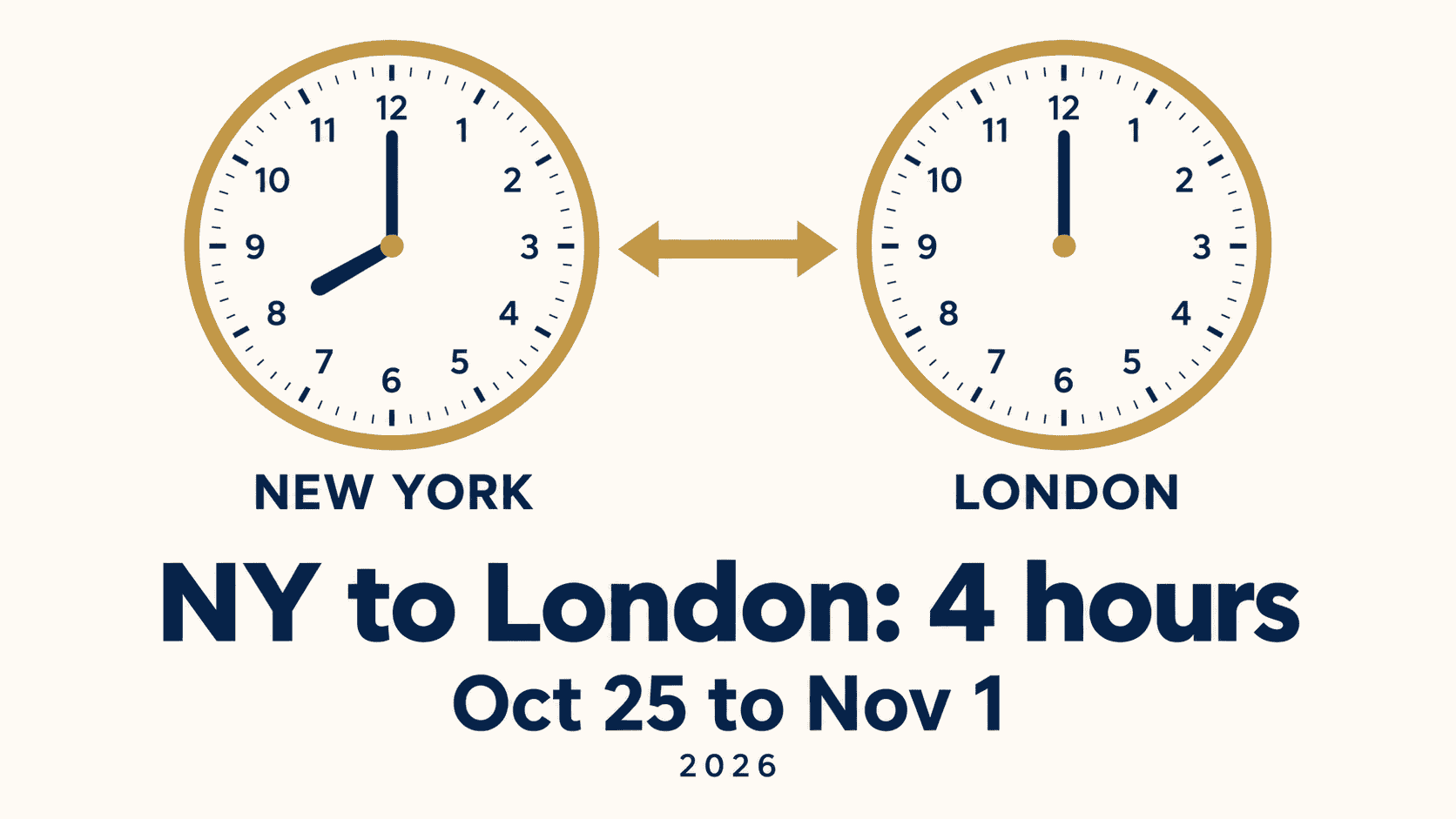
Make sure to check your calendar for the week between the two changes, because transatlantic time differences shrink by an hour. Here are the exact dates and times, what to do, who doesn't change clocks, and whether daylight saving time could end for good.
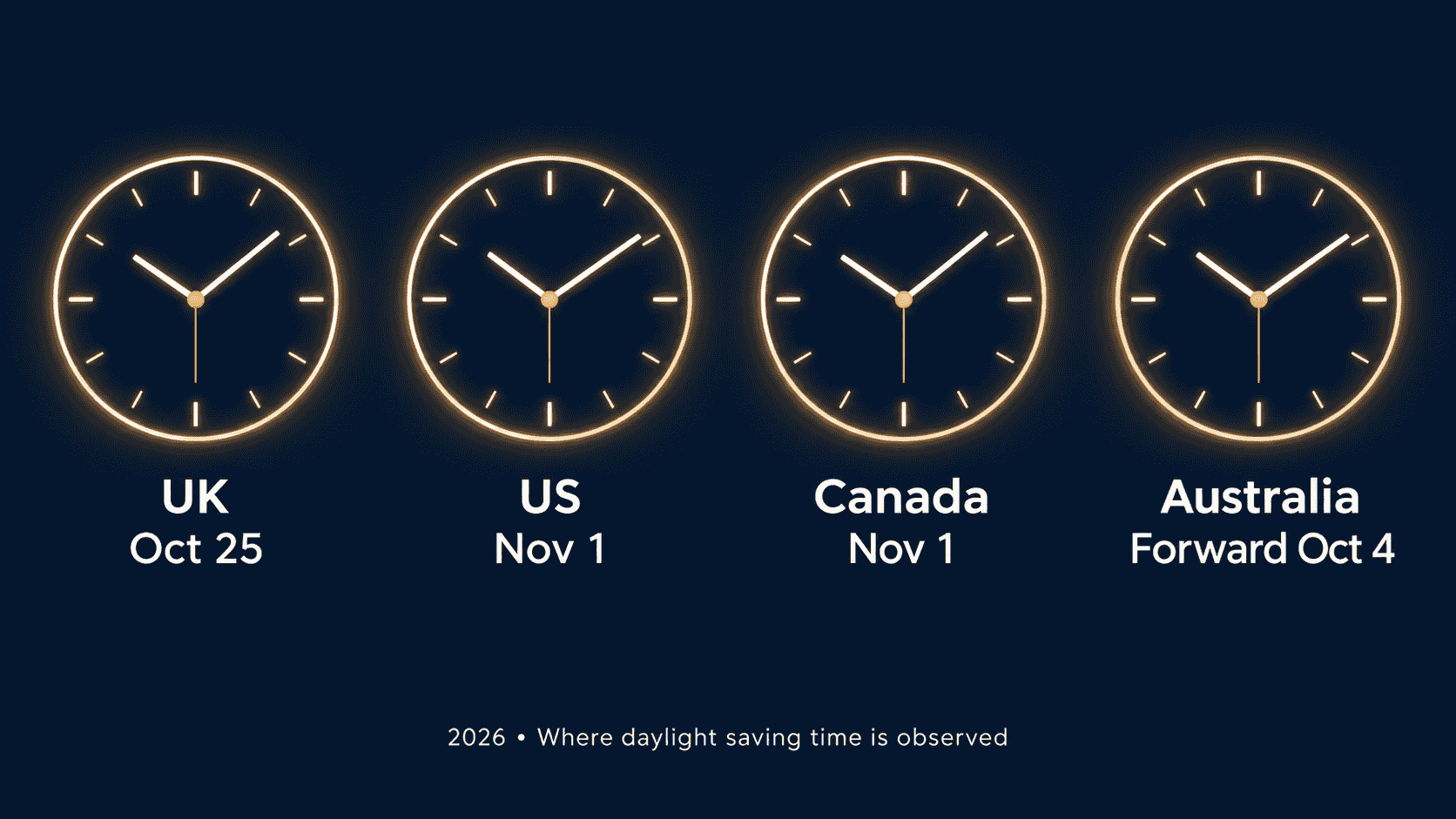
Region | Date | Time | What happens |
|---|---|---|---|
United Kingdom and Ireland | Sunday, October 25 | 2:00 am BST | Clocks go back to 1:00 am GMT |
European Union | Sunday, October 25 | 3:00 am CEST (central Europe) | Clocks go back one hour |
United States | Sunday, November 1 | 2:00 am local time | Clocks go back to 1:00 am |
Canada | Sunday, November 1 | 2:00 am local time | Clocks go back to 1:00 am, in provinces that observe it |
Australia (ACT, NSW, SA, TAS, VIC) | Began Sunday, October 4 | 2:00 am | Clocks went forward; they go back on April 4, 2027 |
The gap week: from October 25 to November 1, New York is 4 hours behind London instead of the usual 5, so double-check meeting times.
Next spring: US and Canadian clocks go forward on Sunday, March 14, 2027, and UK and European clocks on Sunday, March 28, 2027.
What to do when the clocks go back
You gain an hour of sleep, and the main job is updating the clocks that don't change themselves.
- Phones, laptops and smartwatches usually update automatically if automatic date and time is switched on.
- Cars, ovens, microwaves, wall clocks and some watches need changing by hand, so do it before bed on the Saturday night.
- Meetings across time zones: check invites for the week of October 25 to November 1, when US and UK or European times are off by an hour.
- Smoke and carbon monoxide alarms: many fire services use the clock change as a reminder to test them and replace batteries.
- Sunsets get earlier: expect darkness around an hour sooner, which matters for school runs, cycling and driving home.
Places that don't change their clocks
Country | Places that stay on one time |
|---|---|
United States | Hawaii and most of Arizona stay on standard time all year |
Canada | Saskatchewan does not change; British Columbia made its final change in March 2026 and now stays on Pacific daylight time; Alberta has moved to what it calls "Alberta time", matching Saskatchewan all year |
Australia | Queensland, Western Australia and the Northern Territory do not observe daylight saving |
United Kingdom | The whole country changes |
Quebec still changes its clocks on November 1. A 2024 public consultation found about 91% of respondents wanted to stop, and nearly three-quarters preferred year-round daylight time, but the province says it is still studying the results and wants to stay coordinated with Ontario and New York.
Will daylight saving time end for good?
Not yet in the US. On July 14, 2026, the House passed the Sunshine Protection Act by 308 to 117. The bill would make daylight saving time permanent nationwide, and it now needs the Senate. The Senate passed a similar bill unanimously in 2022, but it stalled in the House, and this time it could face opposition in the upper chamber.
Until it becomes law, which also requires the president's signature, federal rules are unchanged and clocks go back on November 1. Supporters say year-round daylight time would improve public safety and boost evening activity, while some lawmakers would rather stay on standard time all year, so there is no agreement on which time to keep.
In Europe, the European Commission has started a new impact study, but nothing has been adopted and the October 25 change will happen as usual. The UK has no current plans to stop changing its clocks.
Sleep tips for the fall back
Gaining an hour is easier on the body than losing one in spring, but it can still unsettle sleep for a few days.
- Shift gradually. Go to bed 15 to 20 minutes later for a few nights before the change, rather than waiting for the weekend.
- Get morning light. Daylight soon after waking helps reset your body clock.
- Keep a steady schedule. Wake up at your usual new clock time, even if you are tempted to sleep in.
- Limit caffeine and alcohol in the afternoon and evening.
- Watch children and pets. They often wake an hour early at first, so adjust their routines in small steps.
Clocks going back FAQ
When do the clocks go back in 2026? In the UK and Europe on Sunday, October 25, and in the US and most of Canada on Sunday, November 1.
What time do the clocks change? At 2:00 am local time in the US and Canada, which goes back to 1:00 am. In the UK, at 2:00 am BST, which goes back to 1:00 am GMT.
Do the clocks go back or forward? Back one hour in the fall, so you gain an hour of sleep.
Is the US getting rid of daylight saving time? Not yet. The House passed the Sunshine Protection Act on July 14, 2026, but the Senate has not, so clocks still change on November 1.
Which US states don't change their clocks? Hawaii and most of Arizona.
Do clocks change in Australia? In ACT, NSW, South Australia, Tasmania and Victoria, yes. They went forward on October 4 and go back in April. Queensland, Western Australia and the Northern Territory don't change.
When do the clocks go forward again? March 14, 2027, in the US and Canada, and March 28, 2027, in the UK and Europe.
Sources
Reporting based on government and timekeeping sources as of October 16, 2026.
- Farmers' Almanac: Daylight Saving Time 2026
- WorldTimeData: US, UK and EU dates
- Universal Time Date: clocks in every major country
- timechange.org: 2026 daylight saving dates
- Explaining Science: clocks go back October 25
- House Energy and Commerce Committee: House passes the Sunshine Protection Act
- The Hill: House passes bill to make daylight saving time permanent
- Wikipedia: Sunshine Protection Act
- MTL Blog: Quebec's time change and the places that ditched it
- WorldTimesSync: DST 2026 worldwide