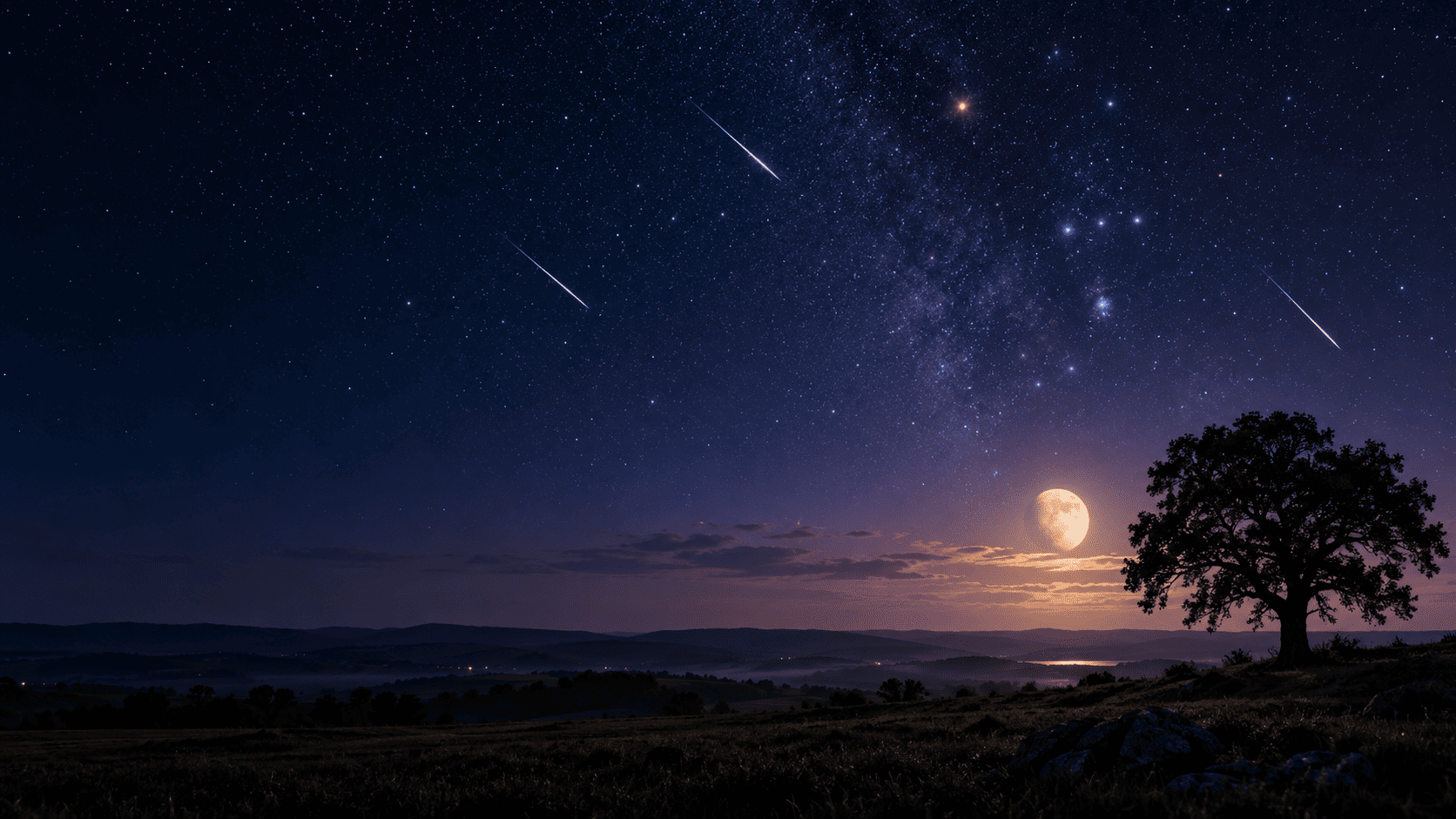
The Orionid meteor shower peaks overnight on October 21 to 22, 2026, but a bright moon will wash out many meteors early in the night. The shower produces up to about 15 to 20 meteors an hour under perfect conditions, and it is made of dust shed by Halley's Comet.
The trick this year is timing. The Moon will be about 77% to 83% lit and sets in the small hours, so the best chance to see meteors is in the dark stretch between moonset and dawn. Here is exactly when to look, where to go and what to expect.
Orionids 2026 at a glance
Detail | Fact |
|---|---|
Peak night | October 21 to 22, 2026 |
Active | About October 2 to November 7 |
Rate at peak | Up to about 15 to 20 meteors an hour (ideal conditions) |
Where they appear from | Near Orion's club, but they streak across the whole sky |
Moon | About 77% to 83% lit, waxing gibbous |
Best time | After moonset until dawn, around 3 am to first light |
Equipment | None; your eyes are best |
Best time to watch the Orionids
The darkest window runs from moonset to the first light of dawn, and the shower improves through the night as Orion climbs higher.
Place | Moon sets | Best time on the peak night | Meteors an hour from a dark site |
|---|---|---|---|
New York | 3:12 am EDT | About 4:25 am EDT | Up to 18 |
London | 2:49 am BST | About 4:35 am BST | Up to 17 |
From New York, the radiant is about 63 degrees up in the south-south-east at 4:25 am. Toronto shares New York's time zone, so expect similar timing, and moonset times shift a few minutes with longitude. For Los Angeles, Chicago, Vancouver or Australian cities, check your local moonset time on a sky app or Time and Date, and plan to watch from moonset until dawn.
The peak is broad, so nights on either side are worth a look too. If you watch before moonset, put the Moon behind a building or tree and scan the part of the sky away from it.
How to watch the Orionid meteor shower
- Find a dark site. Get away from city lights, ideally to a spot with a wide, open view of the sky.
- Check your local moonset time. Plan to be out from moonset until dawn, when the sky is darkest.
- Let your eyes adjust. Give them 20 to 30 minutes in the dark and avoid looking at your phone, or use a red light.
- Lie back and look wide. Meteors can appear anywhere, so take in as much sky as possible rather than staring at one spot.
- Dress warmly and bring a chair or blanket. You could be outside for a while on a cold October night.
- Be patient. The quoted rate is an ideal ceiling, and you will usually see a third to a half of it under a good dark sky, and less under moonlight.
You do not need a telescope or binoculars, because they narrow your view.
Where the Orionids come from
The Orionids are made of tiny grains shed by Halley's Comet over many orbits. Each October, Earth passes through the comet's old debris trail, and the grains burn up in the atmosphere as fast, fine streaks, often with lingering trails.
The meteors appear to radiate from a point near the upraised club of Orion the Hunter, which rises around 11 pm. It is one of two showers linked to Halley, the other being the Eta Aquariids in spring. The comet itself will not return to the inner solar system until 2061.
Other sky events this October and November
Date | Event | What to know |
|---|---|---|
October 21 to 22 | Orionid meteor shower peak | Best between moonset and dawn |
October 23 | Moon near Neptune | Neptune needs a telescope |
October 26 | Hunter's Moon (full Moon) | Full at 04:11 UTC, which is 12:11 am EDT; it rises near sunset in the east |
October 26 | Uranus at opposition | Best seen with binoculars or a telescope, though the bright Moon makes it harder |
October 31 | Halloween | A moonlit sky, with the Moon in the Gemini region near Pollux |
November 4 to 5 | Southern Taurids peak | Slow, sometimes bright fireballs |
November 11 to 12 | Northern Taurids peak | Fireballs again, under a darker sky |
The Southern Taurids are already active and the northern branch joins around October 20, but their main peaks come in November. There is no lunar eclipse on October 26, so the Hunter's Moon will look like a normal full Moon.
How to photograph the Orionids
Catching a meteor on camera takes luck, so take many frames.
- Use a tripod or lean your phone against something solid.
- Go wide. Use the widest lens, or the 0.5x camera on a phone, and point it towards Orion's area of the sky, away from the Moon.
- Use night mode or a long exposure. Try 15 to 30 seconds, with a high ISO such as 1600 to 3200 on a camera.
- Shoot continuously. Use an interval timer or a series of exposures, then check the frames for streaks.
- Use the moonlight. Bright moonlight washes out meteors but can light a landscape beautifully, so include trees, hills or buildings for a striking foreground.
- Keep batteries warm. Cold drains them quickly.
Orionid meteor shower FAQ
When is the Orionid meteor shower in 2026? It peaks overnight on October 21 to 22, and is active from about October 2 to November 7.
What time should I watch? Between moonset and dawn. From New York the best time is around 4:25 am EDT, and from London around 4:35 am BST.
How many Orionids can I see per hour? Up to about 15 to 20 under perfect dark skies, and fewer in practice, especially with a bright Moon.
Will the Moon spoil the Orionids this year? It will wash out fainter meteors early in the night, since it is 77% to 83% lit, but it sets before dawn, which leaves a dark window.
Do I need a telescope? No. Use your eyes, because the sky is the best view.
Can I see the Orionids from Australia? Yes. The shower is visible from both hemispheres. Check your local moonset time and watch from then until dawn.
Where do the Orionids come from? From dust left behind by Halley's Comet.
orionids 2026, when is the meteor shower, halley’s comet meteor shower, meteor shower tonight, best time to watch meteor shower, hunter’s moon 2026, october 2026 night sky
Orionids, Meteor Shower, Halley’s Comet, Night Sky, Astronomy, Hunter’s Moon, Stargazing, October 2026
Sources
Reporting based on astronomy calendars and observatory guides as of October 15, 2026.
- EarthSky: Orionid meteor shower 2026
- Orbital Radar: Orionids peak times for 12 cities
- Royal Museums Greenwich: Orionids in the UK
- In-The-Sky.org: Orionid meteor shower 2026
- Farmers' Almanac: Orionid meteor shower
- Star Walk: Orionid meteor shower in October 2026
- Space.com: October full moon 2026
- Star Walk: 2026 astronomy calendar
- Ondatravel: sky events in October 2026
- Telescope Advisor: what to see in October 2026