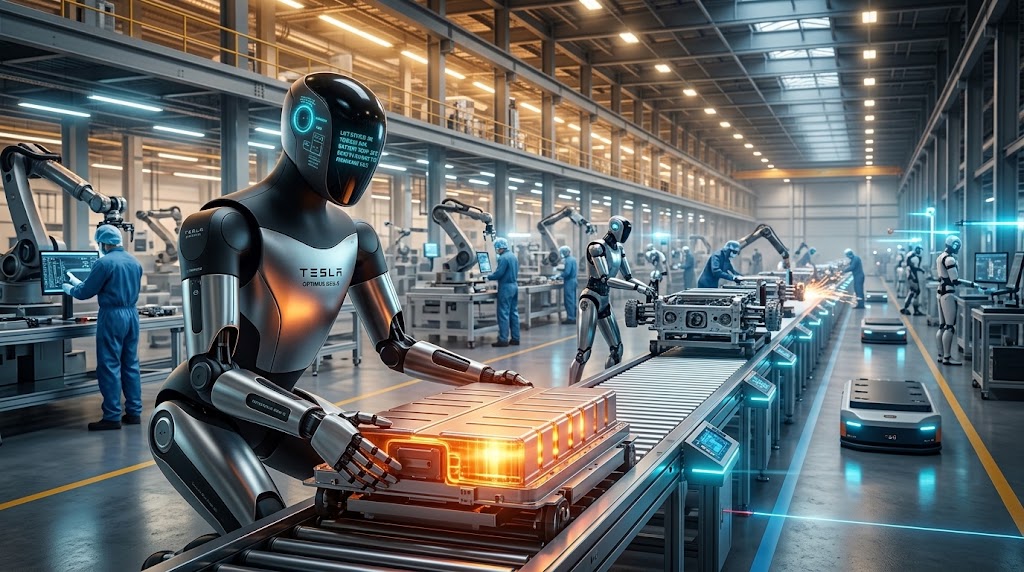
Blue-Collar Bots: Humanoid Robots Have Reached the Factory Floor—But They Haven't Taken It Over
For years, humanoid robots existed mostly in carefully edited videos. In 2026, several are finally entering real automotive plants. The important question is no longer whether a humanoid can pick up a box. It is whether the machine can perform useful work repeatedly, safely and cheaply enough to deserve a place beside conventional industrial automation.
By Deep Tech & Automation Desk | Sunday, August 30, 2026
There is a moment in every emerging technology when the demonstration stops being the interesting part.
A robot walking across a stage?
Interesting.
A robot folding a shirt?
Interesting.
A humanoid dancing, jumping or serving drinks?
Good video.
But manufacturing asks a much harsher question:
Can it show up tomorrow morning and do the same boring task for ten hours?
Then again the next day.
And the next.
Without dropping components.
Without stopping production.
Without requiring three engineers standing nearby.
Without costing more than the problem it is supposed to solve.
That is the threshold humanoid robotics is beginning to approach in 2026.
Not a “robot takeover.”
Not the disappearance of factory workers.
Something more consequential:
humanoids are starting to accumulate genuine production-floor evidence.
BMW has already run Figure robots on an automotive assembly line.
Mercedes-Benz is teaching Apptronik's Apollo to operate in manufacturing environments.
BMW's Leipzig plant is testing Hexagon's AEON.
Tesla is converting part of its historic Fremont vehicle factory into an Optimus production line.
And companies across the United States, Germany and China are racing to prove that a human-shaped machine can become something factories will actually buy.
The sector has moved beyond science fiction.
But it has not yet moved beyond skepticism.
1. BMW Gave the Industry Its Most Important Humanoid-Robot Dataset
If you want to understand where industrial humanoids really stand in 2026, start with BMW's plant in Spartanburg, South Carolina.
Figure AI sent its Figure 02 humanoid there for an extended production deployment.
This was not merely a robot performing an isolated demonstration in an innovation lab.
According to Figure and BMW, Figure 02 eventually operated on an active assembly line.
The results are unusually concrete.
Figure says the robot:
worked more than 1,250 hours,
loaded more than 90,000 parts,
contributed to production of more than 30,000 BMW X3 vehicles,
and operated 10-hour shifts from Monday through Friday.
The task involved taking sheet-metal components and positioning them for part of the vehicle-production process.
This matters because the factory floor does not care how impressive a robot looks.
It cares about:
cycle time,
accuracy,
availability,
safety,
integration,
reliability,
and cost.
Figure 02 finally gave the industry meaningful numbers to discuss.
2. But Figure 02 Is Already History
Here is where many 2026 articles become outdated.
Figure 02 is not the company's current production robot.
Figure announced in November 2025 that it was retiring the entire Figure 02 fleet following the introduction of Figure 03.
The BMW deployment therefore represents a completed phase of the programme rather than hundreds of Figure 02 robots still working there today.
That actually makes the result more useful.
The purpose of a pilot is not necessarily to keep the same machine forever.
It is to discover:
what breaks,
what slows production,
what workers dislike,
what the robot struggles to see,
where manipulation fails,
how software communicates with factory systems,
and which tasks actually justify humanoid hardware.
Those lessons feed the next generation.
In June 2026, Figure 03 arrived back at BMW Spartanburg.
This time, Figure moved from a relatively constrained sheet-metal loading task toward a more complicated sequencing and logistics workflow.
That progression tells us more about the sector than another viral demonstration.
The robot is being given harder work.
3. Figure 03 Is Being Asked to Move Through the Factory
The new BMW task requires more than standing in one location and manipulating parts.
Figure says Figure 03 must perform a workflow involving:
walking,
manipulating components,
repositioning its body,
and pulling a heavy wheeled cart.
Its newer Helix 02 software coordinates the robot's arms, hands, torso and locomotion during the task.
This is important because humanoids only make economic sense if their shape provides some advantage.
Factories already have excellent fixed robots.
If a task can be performed by a six-axis industrial arm bolted to the floor, that machine may be:
faster,
cheaper,
more accurate,
easier to maintain,
and more predictable
than a humanoid.
The potential advantage of the humanoid is mobility plus manipulation.
A human-shaped robot can theoretically walk into infrastructure originally designed around human bodies rather than requiring an entirely new production cell.
That is the real business case.
Not looking human.
Using a human-compatible workplace.
4. Helix Is Where Figure Thinks the Real Advantage Lives
Humanoid hardware is spectacular to look at.
The bigger competitive battle may be software.
Figure calls its AI system Helix.
The original Helix model introduced in 2025 combined visual perception, language understanding and learned motor control.
One component of the system produces upper-body control commands at 200 Hz, allowing the robot to continuously adjust its wrists, fingers, head and torso.
In January 2026, Figure introduced Helix 02, expanding learned control across the entire body.
The system uses a hierarchy:
a higher-level system interprets goals,
another system turns perception into body movement at 200 Hz,
and a lower-level controller operates at 1 kHz to maintain balance and coordinate forces.
That distinction is important.
Humanoid robotics is no longer simply about programming:
move arm 14 degrees
then:
close gripper
then:
walk three steps.
The ambition is increasingly:
show the robot the world, tell it what outcome is required, and let a learned model control the movement.
That is what the robotics industry means by Physical AI.
5. The Robot Must Deal With a World That Refuses to Stay Still
Traditional factory automation works beautifully because factories remove uncertainty.
A component arrives in a known orientation.
A fixture holds it at a known location.
A robot follows a known trajectory.
Repeat.
Humanoid robots are being built for the opposite problem.
The box may be rotated.
The cart may be slightly farther away.
A component may be stacked differently.
A worker may move something.
A package may collapse.
A tool may not be where the robot expected.
These are small inconveniences for humans.
They are enormous problems for automation.
Figure's Helix development therefore focuses heavily on:
vision,
history,
force feedback,
tactile sensing,
and learned control.
In one logistics benchmark, Figure reported its improved Helix system handling packages in roughly 4.05 seconds per package while maintaining accuracy above 92%.
That is not yet proof of general-purpose factory intelligence.
It is evidence that the software is becoming more capable of handling variation.
6. Tesla Is Taking a Completely Different Route
Figure's strategy is to deploy with outside enterprises such as BMW.
Tesla has a more unusual advantage.
It owns factories.
That means Tesla can develop Optimus inside the environments where it eventually wants the machine to work.
But the current public record is much more conservative than many online “deployment trackers” suggest.
You may have seen claims that Tesla already has:
1,000 Optimus Gen 3 robots
performing battery assembly and other productive factory work.
Tesla itself has not published a verified fleet count supporting that claim.
In January 2026, Tesla said the Gen 3 design was still planned for unveiling and that production was targeted to begin before the end of the year.
By April, Tesla said it was preparing its first large-scale Optimus factory.
By July, the company had decommissioned the old Model S and Model X production lines in Fremont and was installing the first Optimus production line.
But Tesla's Q2 position was still:
production expected to start soon.
Initial robots would be used in what Tesla calls the Optimus Academy, primarily for training-data collection and further development.
That is a big industrial commitment.
It is not the same thing as 1,000 production humanoids already replacing factory labour.
7. Tesla Has Turned a Car Factory Into a Robot Factory
Tesla's commitment becomes clearer when you look at the physical manufacturing strategy.
The company ended production of the Model S and Model X at Fremont.
The space is being converted into Optimus production.
Tesla says the first-generation production line is designed for an eventual capacity of one million robots per year.
Gigafactory Texas is being prepared for a second-generation line with an eventual design capacity of 10 million units annually.
Those numbers are extraordinary.
But there is an essential distinction:
design capacity is not production volume.
A factory designed to build one million robots per year does not mean one million robots exist.
In July, Elon Musk himself warned investors that Optimus may be the hardest manufacturing ramp Tesla has ever attempted, because almost every major component represents a new supply-chain problem.
That may be the more important Optimus story in 2026.
Tesla is no longer merely designing the robot.
It is attempting to industrialize it.
8. The $20,000 Optimus Is Still a Future Target
Another number repeated everywhere is:
$20,000.
Sometimes:
$20,000–$30,000.
That should not be described as today's purchase price.
You cannot currently order an Optimus from Tesla for $20,000.
Tesla has no public commercial price.
Musk has said that when Optimus reaches steady-state production above one million units annually, he believes its production cost can fall below $20,000.
He also explicitly said:
the selling price is a separate question and would depend on market demand.
That is a long-term manufacturing target.
Not a 2026 invoice.
Current industry estimates suggest early production units may cost many times that amount to manufacture before scale, component redesign and supply-chain maturity bring costs down. Counterpoint Research estimated Optimus V3 manufacturing cost above $60,000 during the second half of 2026.
The economics are promising.
They are not settled.
9. This Means the Famous “3–6 Month Payback” Isn't Verified Either
Imagine a factory pays $20,000 for a robot.
The machine operates nearly continuously.
Human labour costs $30 an hour.
Easy calculation:
robot pays for itself in months.
This is how many humanoid ROI claims are constructed.
But that calculation leaves out nearly everything that actually matters.
Real factory economics include:
robot purchase price,
financing,
maintenance,
battery replacement,
software fees,
integration,
supervision,
downtime,
safety engineering,
spare units,
tooling,
training,
and productivity relative to a human worker.
If the humanoid operates at half the speed of a person, the economics change.
If it requires frequent intervention, they change again.
JPMorgan analysts recently estimated that industrial humanoids could eventually operate around $10–$12 per hour, compared with roughly $30 per hour for some manufacturing labour—but this is an analytical projection, not a universally demonstrated factory cost today.
The most important number in humanoid robotics therefore may eventually be:
fully loaded cost per useful task.
The industry has not standardized that metric yet.
10. Mercedes-Benz Is Training Apollo in Berlin
Tesla and Figure receive most of the attention.
Apptronik is another serious participant.
Its Apollo humanoid has been undergoing work with Mercedes-Benz since the companies announced their relationship in 2024.
Mercedes says its Berlin Digital Factory Campus is testing Apollo for repetitive intralogistics work.
Potential applications include:
transporting components,
moving modules toward production areas,
and performing early quality inspections.
The Berlin work has another interesting characteristic.
Mercedes factory employees are helping transfer their knowledge to Apollo using:
teleoperation,
augmented reality,
and training inside the manufacturer's digital-production environment.
The goal is increasing autonomy.
That is a better description than saying Apollo has already replaced workers across Mercedes production lines.
It is learning within a real manufacturing environment.
That distinction matters.
11. Apptronik Is Now Extremely Well Funded
The industrial race is also becoming a capital race.
In February 2026, Apptronik announced another $520 million extension to its Series A, bringing the round to more than $935 million and total funding to nearly $1 billion.
Investors include:
Google,
Mercedes-Benz,
B Capital,
AT&T Ventures,
John Deere,
and Qatar Investment Authority.
That investment tells us something about how major companies view humanoid robotics.
Mercedes is not simply watching a viral robot demonstration.
It is investing in the supplier.
John Deere is interested.
Telecommunications companies are interested.
Google is interested.
The commercial ecosystem is forming before the technology itself is mature.
12. BMW Is Also Testing a Completely Different Humanoid in Germany
BMW's humanoid strategy is not exclusively tied to Figure.
At its Leipzig plant in Germany, BMW is working with Hexagon Robotics' AEON.
The robot is visually quite different from Figure.
It has a humanoid upper body but moves using a wheeled base.
That design sacrifices walking.
It gains:
stability,
speed,
energy efficiency,
and simpler movement across factory floors.
BMW began testing AEON at Leipzig in late 2025 and expanded the programme during 2026.
The planned applications include:
high-voltage battery assembly,
component manufacturing,
inspection,
and other production-support tasks.
By June, Hexagon said AEON had begun performing production tasks in the plant while continuing training for additional manufacturing applications.
This raises a fascinating question:
Does a factory humanoid actually need legs?
13. Wheels May Beat Feet
Humans have legs because evolution did not design factories.
Robots do not have that constraint.
A wheeled platform:
uses less energy,
is mechanically simpler,
can be more stable,
and may move faster over flat concrete.
Factories are filled with flat floors.
So why build legs?
The answer is versatility.
A biped can theoretically:
step over obstacles,
navigate stairs,
use spaces designed around human movement,
turn in confined areas,
and operate where wheels cannot.
But if 95% of a factory task takes place on flat floors, wheels may be the smarter engineering solution.
AEON's design is therefore a useful reminder:
the future factory robot may be human-compatible without being perfectly human-shaped.
14. One Thousand AEON Robots Are Planned—But Over Seven Years
Another number that needs context is:
1,000 robots.
In April 2026, Hexagon and Schaeffler announced plans for at least 1,000 AEON humanoids across Schaeffler's global manufacturing network.
That sounds like an immediate thousand-robot deployment.
It isn't.
The rollout is planned across seven years, through approximately 2032.
As recently as August 19, 2026, AEON was entering Schaeffler's Humanoid Gym, where the robots are being trained, validated and prepared for factory tasks.
Again, the industry is scaling.
But the scaling is more gradual than some headline numbers suggest.
15. Humanoid Robots Are Not “Replacing Factory Automation”
There is another misconception.
Factories already contain robots.
Lots of them.
Industrial robotics has been automating manufacturing for decades.
Robotic arms:
weld,
paint,
assemble,
pick,
machine,
inspect,
and package.
They are exceptionally good at repetitive tasks.
Humanoids are therefore not entering empty factories.
They are entering environments containing extremely mature competitors.
A humanoid needs to justify itself where fixed automation struggles.
The most promising areas appear to include:
material movement,
machine tending,
kitting,
parts sequencing,
inspection,
warehouse manipulation,
and tasks that change too frequently to justify a custom automation cell.
The advantage is not:
robots are better than humans.
It is:
one general-purpose machine might eventually handle several tasks for which factories currently need different specialized systems or manual labour.
16. Reuters Found the Industry Is Still Much Less Mature Than the Hype Suggests
This week, Reuters published an unusually sober examination of China's rapidly growing humanoid industry.
The conclusion was important:
hardware has improved rapidly,
but reliable autonomous factory intelligence remains a major bottleneck.
Robots that look impressive during choreographed demonstrations may still struggle with the:
precision,
adaptability,
reliability,
and task understanding
required for real production.
Conventional robotic arms often remain far more effective for narrowly defined work.
That criticism applies well beyond China.
The industry's hardest problem is no longer:
Can we make a humanoid stand?
It is:
Can we make it useful?
17. The Hands May Be Harder Than the Legs
A humanoid walking smoothly makes the best video.
The hand may determine whether the robot makes money.
Factories are built around objects humans manipulate effortlessly.
Connectors.
Flexible cables.
Clips.
Bolts.
Bags.
Tools.
Fragile components.
Irregular packages.
Thin sheet material.
Many tasks require simultaneously controlling:
position,
force,
friction,
orientation,
and tactile feedback.
Humans perform these calculations unconsciously.
Robots do not.
This is why Tesla has spent enormous engineering effort on its hand design.
Figure 03 adds tactile sensing and cameras in the palms.
Helix 02 uses those signals for tasks as delicate as manipulating individual pills and syringes in research demonstrations.
The robot revolution may ultimately depend less on dramatic walking and more on fingertips.
18. Training Data Is Becoming the New Factory Asset
Tesla has millions of cars collecting driving data.
That helped shape its autonomous-driving strategy.
Humanoid robots create a harder problem.
Where do you get billions of examples of:
picking a box,
opening a drawer,
loading a machine,
connecting a cable,
moving a component,
sorting products,
or operating a tool?
Figure is investing heavily in this problem.
On August 25, 2026, the company announced Index, an initiative intended to build a large and diverse dataset for physical-world intelligence.
Tesla is creating the Optimus Academy.
Mercedes workers are teleoperating Apollo to demonstrate tasks.
Figure trains models using human motion and robot experience.
The emerging principle is clear:
the robot fleet generates the data that trains the next robot fleet.
This may become one of the biggest competitive advantages in Physical AI.
19. The Factory Is Becoming a Classroom
This creates an unusual economic transition.
At first, companies may deploy humanoids not because the machines are already cheaper than workers.
They may deploy them because every hour produces valuable training data.
A robot fails to grip something.
That failure becomes data.
A worker corrects it.
That correction becomes data.
The robot learns another task.
More data.
A hundred robots collect more experience.
A thousand collect dramatically more.
This creates a potential flywheel:
more robots → more experience → better models → more useful robots → more deployments → more data.
Tesla understands this from autonomous driving.
Figure is explicitly pursuing it.
Apptronik is doing the same through enterprise partnerships.
That is why early deployment numbers matter even before the economics become perfect.
20. Manufacturing Is Probably the Right Place to Start
Why are so many humanoid companies starting in factories rather than homes?
Because factories are controlled.
A factory has:
known floors,
known objects,
known workflows,
trained staff,
limited public access,
predictable lighting,
safety procedures,
and measurable tasks.
A home is chaos.
Children.
Pets.
Laundry.
Stairs.
Glass.
Food.
Unpredictable objects.
An industrial environment lets robotics companies gradually expand complexity.
Move one part.
Then ten different parts.
Then operate a machine.
Then navigate between stations.
Then coordinate with workers.
Manufacturing is essentially the training ground for general-purpose robots.
21. The Real Competition Isn't Figure vs Tesla
The headline comparison is tempting.
Figure vs Optimus.
But the market is broader.
Important players now include:
Figure,
Tesla,
Apptronik,
Hexagon Robotics,
Agility Robotics,
Boston Dynamics,
UBTech,
Unitree,
1X,
Sanctuary AI,
XPeng,
and numerous Chinese embodied-AI startups.
Each is making different trade-offs involving:
cost,
hands,
battery life,
walking,
wheels,
AI architecture,
remote operation,
manufacturing strategy,
and target markets.
There may not be one humanoid architecture.
Just as factories use many different machines today, they may eventually use several kinds of general-purpose robots.
22. Humanoid Robots May Be Bought Like Employees—or Rented Like Cloud Servers
Another unanswered question is commercial structure.
Should a manufacturer buy a robot?
Lease it?
Pay per hour?
Pay per completed task?
Subscribe to the AI software?
Use Robotics-as-a-Service?
Each model changes economics.
A $100,000 robot sounds expensive.
A robot supplied for:
$8 per productive hour
may sound very different to a procurement department.
This is why the future robotics business may resemble cloud computing.
Factories may care less about owning hardware than about purchasing:
reliable robotic capacity.
That could turn robotics companies into recurring-revenue software-and-service businesses rather than traditional equipment manufacturers.
23. The Robot Must Eventually Compete With the Forklift
Humanoid developers often compare themselves with human labour.
There is another comparison.
Existing equipment.
Suppose a robot needs to move boxes across a warehouse.
A forklift already exists.
A conveyor exists.
An autonomous mobile robot exists.
Suppose it loads parts into a machine.
A fixed industrial robot may already do it faster.
The humanoid becomes attractive when the task requires enough flexibility that specialized automation becomes uneconomical.
That means procurement managers will ask:
Why humanoid?
If the answer is simply:
because it looks futuristic
the purchase will not survive a budget meeting.
24. The Best First Jobs May Be the Ones Humans Don't Want
Industrial humanoids have a much stronger case when tasks are:
ergonomically difficult,
repetitive,
physically exhausting,
unsafe,
or extremely hard to staff.
BMW specifically highlighted the physically tiring nature of the sheet-metal handling task performed by Figure 02.
This is probably where humanoids gain social acceptance fastest.
Not:
replace a skilled technician.
Instead:
take the repetitive material-moving job that injures backs and struggles with recruitment.
The technology then becomes a workplace tool rather than merely a labour-replacement story.
25. What Has Actually Changed in 2026?
Strip away the dramatic headlines and several important things have genuinely happened.
Figure has production evidence.
Its earlier-generation robot accumulated more than 1,250 hours inside a real BMW production environment.
Figure has returned with a more capable robot.
Figure 03 is now working on a harder BMW logistics workflow.
BMW expanded humanoid experimentation into Europe.
AEON is operating in the Leipzig programme.
Mercedes is moving Apollo toward autonomy.
The Berlin programme continues turning human demonstrations into robot capabilities.
Tesla committed real factory space to Optimus.
An iconic car-production area at Fremont is becoming a humanoid-robot production line.
Large-scale orders are beginning to appear.
Schaeffler's planned 1,000-unit AEON rollout represents a serious industrial commitment, even though deployment spans years.
Those are not laboratory milestones.
They are commercial ones.
26. What Has NOT Happened Yet?
Factories have not been taken over.
Tesla has not publicly verified 1,000 Gen 3 robots autonomously replacing factory workers.
Optimus does not have a confirmed retail price.
Figure has not publicly proven a universal $25-per-hour operating cost.
Three-to-six-month humanoid ROI is not an established industry benchmark.
Humanoids are not outperforming fixed industrial robots across most factory tasks.
Fully general robotic intelligence does not exist.
Even Elon Musk said during Tesla's latest earnings call that today's impressive online humanoid demonstrations are often programmed or teleoperated and that generalized useful robotics remains an unsolved challenge.
That admission is important.
It reveals where the industry actually stands.
The Blue-Collar Robot Revolution Will Probably Look Boring
The first successful factory humanoid will not be remembered because it performed a backflip.
It will be remembered because it did something painfully ordinary.
Picked up a component.
Moved it.
Placed it correctly.
Repeated the operation 4,000 times.
Recharged.
Came back tomorrow.
Worked beside people without causing trouble.
And eventually became cheap enough that nobody thought the machine itself was remarkable.
That is how industrial revolutions actually win.
They stop being demonstrations.
They become infrastructure.
The humanoid robotics industry is not there yet.
But in 2026, something important has changed.
BMW now has real operating data.
Mercedes has real training environments.
Hexagon has real production pilots.
Figure has moved to a new generation.
Tesla is building a real manufacturing line.
Robotics companies are raising billions.
And factory managers finally have more to examine than glossy promotional videos.
The question has therefore changed.
Not:
Can a humanoid robot work in a factory?
BMW has already shown that carefully constrained tasks can be performed.
The questions now are harder:
How many tasks?
How reliably?
At what speed?
At what cost?
For how many hours?
With how much human help?
And how quickly can the learning from one robot spread across an entire fleet?
Whoever answers those questions first may not merely build the best humanoid.
They may build the next major platform for industrial labour.
Frequently Asked Questions
Are humanoid robots actually working in factories in 2026?
Yes, but deployment remains limited. Figure 02 completed a substantial BMW production deployment, Figure 03 has returned to BMW for new logistics work, Hexagon's AEON is being tested in BMW production, and Mercedes-Benz continues work with Apptronik Apollo. These are real industrial programmes, not evidence that factories have broadly replaced human labour.
How many hours did Figure robots work at BMW?
Figure reported more than 1,250 hours of runtime for Figure 02 during its BMW Spartanburg programme. It also moved more than 90,000 parts and contributed to production of more than 30,000 BMW X3 vehicles.
Is Figure 02 still working at BMW?
No. Figure retired the Figure 02 generation. Figure 03 arrived at BMW Spartanburg in June 2026 for a new logistics and sequencing workflow.
What is Helix?
Helix is Figure's Vision-Language-Action AI system for controlling its humanoid robots. The original system generated upper-body control at 200 Hz, while Helix 02 expands learned control across the whole body through a multi-level architecture.
Does Tesla already have 1,000 Optimus Gen 3 robots working in factories?
Tesla has not publicly provided a verified official count supporting that claim. Its July 2026 update said the Fremont Optimus production line was being installed and that initial builds would be used for training and functionality development. Claims of 1,000+ productive Gen 3 units should therefore not be presented as established Tesla data.
Is Tesla Optimus Gen 3 in mass production?
Not yet at demonstrated mass-production scale. Tesla has converted its former Model S/X area in Fremont for Optimus and says production should begin in 2026, but management has warned that the early manufacturing ramp will be difficult and slow.
How much does Tesla Optimus cost?
There is no confirmed public sale price in August 2026. Elon Musk has said that once production exceeds roughly one million units per year, he expects manufacturing cost to fall below $20,000. He has also said the eventual selling price would depend on demand.
Does a humanoid robot cost $25 per hour to operate?
There is no authoritative industry-wide figure. Operating cost depends on hardware price, financing, software, maintenance, utilization, productivity and support. Some industry analyses project future humanoid operating costs around $10–$12 per hour, but these are projections rather than universal verified production costs.
Is the humanoid robot payback period really three to six months?
Not as a general rule. That number depends on assuming low hardware prices, high utilization and productivity close to human labour while ignoring or minimizing integration and maintenance costs. There is not yet enough standardized industrial data to claim a universal three-to-six-month ROI.
What is Apptronik Apollo doing at Mercedes-Benz?
Mercedes-Benz is testing Apollo for manufacturing and intralogistics tasks such as moving components and performing basic quality inspection. Workers have also used teleoperation and augmented reality to transfer task knowledge to the robots.
What is Hexagon AEON doing at BMW?
AEON is being integrated into BMW's Leipzig plant for tasks including manufacturing support, inspection and eventually high-voltage battery assembly and component production. The programme remains a progressive industrial deployment rather than a factory-wide robot workforce.
Does AEON walk?
AEON uses a wheeled mobile base rather than conventional humanoid legs. It combines this mobility system with a humanoid upper body capable of using different tools and gripping systems.
Is Schaeffler really buying 1,000 humanoid robots?
Schaeffler and Hexagon announced a plan to deploy at least 1,000 AEON robots across Schaeffler's global manufacturing network over seven years. It is a long-term rollout, not 1,000 robots already operating today.
Are humanoid robots cheaper than human workers?
Not universally. The economics depend heavily on task, utilization, robot speed, purchase price, maintenance, supervision and local labour costs. Current factory pilots are still gathering the evidence needed to answer that question reliably.
Why use a humanoid instead of a normal industrial robot?
Humanoids may become useful for tasks that require mobility and manipulation across spaces already designed for humans. Fixed industrial robots usually remain superior for repetitive operations that can be fully engineered around a dedicated automation cell.
Will humanoid robots replace factory workers?
Some repetitive, hazardous or ergonomically difficult tasks may increasingly be automated. However, current deployments are limited, and humanoids still face major challenges in reliability, dexterity, autonomy and economics. Broad replacement of factory workers is not a demonstrated 2026 reality.
Editorial Note: Humanoid robotics is an unusually hype-sensitive technology sector. Deployment counts, hourly operating costs and future sale prices often combine company targets, analyst estimates and actual field results. This article distinguishes verified production evidence from forecasts wherever possible. Tesla has not publicly verified claims of more than 1,000 Optimus Gen 3 robots performing productive factory work as of August 30, 2026.
factory humanoid robots, Figure 03 BMW, Tesla Optimus 2026, Apptronik Apollo Mercedes, Hexagon AEON BMW, physical AI manufacturing, Helix 02, humanoid robot factory automation
industrial robotics, factory automation, warehouse automation, robotics software, manufacturing AI, machine vision, robot-as-a-service, industrial sensors, automation consulting, smart factory technology
Humanoid Robots, Physical AI, Figure AI, Tesla Optimus, BMW, Apptronik, Factory Automation, Robotics, Manufacturing, Artificial Intelligence