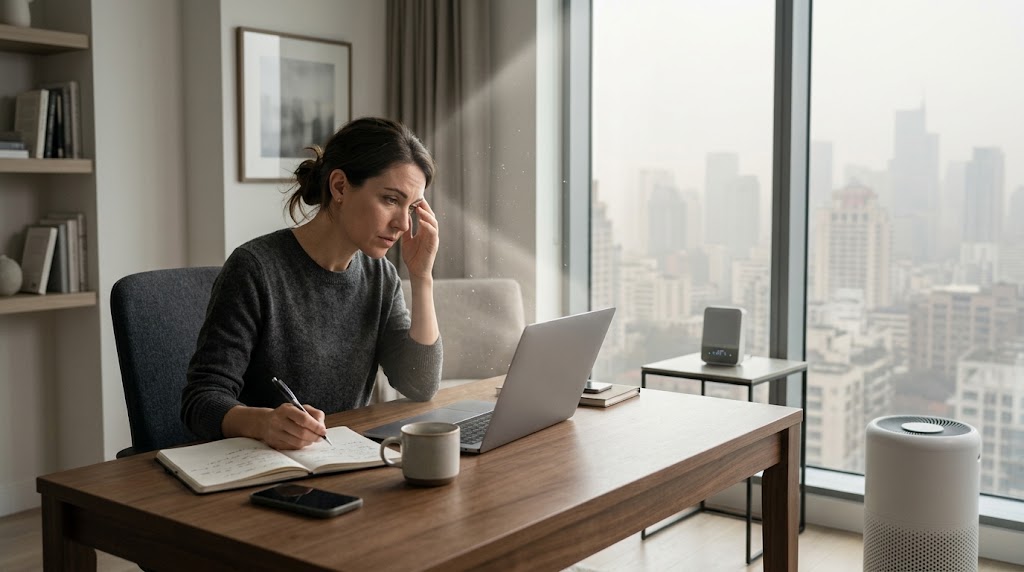
You sit down to work.
The laptop is open.
Coffee is ready.
You slept reasonably well.
But somehow your mind feels slower than it should.
Concentration takes effort.
You reread the same paragraph.
A task that should take 20 minutes stretches toward an hour.
Most of us immediately blame ourselves.
Not enough sleep.
Too much screen time.
Stress.
Poor motivation.
Maybe we need another coffee.
But researchers are increasingly investigating another factor that is literally surrounding us while we work:
the air we breathe.
A major study published in Nature Human Behaviour on September 21, 2026 examined air pollution and the productivity of highly skilled workers.
Its conclusion is difficult to ignore.
Higher exposure to PM2.5—the extremely small particles found in polluted air—was associated with measurable declines in the research productivity of scholars in China.
And the effects did not appear to operate only through illness.
Researchers also found evidence of reduced working hours and weaker collaboration.
The emerging lesson is important:
Air pollution may not only damage health over the long term. It may also quietly affect what we are capable of doing today.
We Usually Think of Air Pollution as a Lung Problem
When someone says "air pollution," most people think about coughing.
Asthma.
Traffic fumes.
Burning eyes.
Perhaps heart and lung disease.
Those concerns are justified.
Fine particulate matter is one of the most extensively studied environmental pollutants.
PM2.5 refers to airborne particles with a diameter of 2.5 micrometres or smaller.
They are tiny enough to penetrate deep into the lungs, and some components can enter the bloodstream.
The World Health Organization links particulate air pollution to cardiovascular and respiratory disease and notes evidence involving other organs and neurological outcomes as well.
But a different question is becoming increasingly important.
What happens before somebody becomes clinically ill?
Could breathing polluted air affect:
attention,
memory,
mental speed,
decision-making,
collaboration,
and the amount of productive work people can perform?
The answer emerging from several lines of research is increasingly difficult to dismiss.
Scientists Studied People Whose Work Happens Mostly in Their Heads
Much previous research on pollution and productivity focused on physically demanding jobs.
That makes sense.
If polluted air makes breathing harder or increases illness, physical work may suffer.
But researchers Xiaofang Dong, Liecheng Qiao and Yinggang Zhou wanted to investigate something different:
high-skilled knowledge work.
Their study examined academic researchers across China and connected air-pollution measurements with detailed publication records.
Rather than simply asking workers how productive they felt, the researchers used academic publications as an observable measure of output.
Using an instrumental-variable design intended to isolate pollution effects from other factors, they estimated that every 1 microgram per cubic metre increase in annual PM2.5 exposure was associated with a 0.23% decline in publications.
Average PM2.5 exposure across their study period was approximately 45.9 µg/m³.
The researchers estimated that a 1% increase in PM2.5 corresponded to roughly 1,053 fewer academic publications nationwide in their dataset.
The negative effects were stronger during heavily polluted years and appeared particularly pronounced among younger and highly productive scholars.
That is not the same as saying pollution makes every office worker exactly 0.23% less productive.
It doesn't.
The population was Chinese academics, productivity was measured largely through publication output, and statistical estimates from one setting should not be mechanically transferred to everyone.
But the study provides unusually strong evidence that knowledge work itself may carry an air-pollution cost.
The Researchers Found Clues About Why Productivity Fell
The most interesting part may not be the publication number.
It is what researchers found underneath it.
Higher pollution levels were associated with:
fewer working hours,
more hospital visits,
and reduced scholarly collaboration.
Those findings suggest several pathways may operate simultaneously.
Some people may become physically unwell.
Others may work fewer hours.
Collaboration may become more difficult.
And cognitive performance itself may be affected.
The researchers' mobile-phone-location analysis also provided evidence consistent with reduced time spent working when pollution increased.
Think about what that means for the modern economy.
We spend enormous amounts of money optimizing productivity.
Faster computers.
Standing desks.
Project-management software.
Artificial intelligence.
Noise-cancelling headphones.
Coffee machines.
Productivity workshops.
Yet one of the variables affecting performance may simply be floating through the room.
Office Workers Have Shown Similar Cognitive Patterns
This isn't the first study to raise the issue.
An earlier year-long international study tracked 302 office workers across six countries: the United States, United Kingdom, China, India, Mexico and Thailand.
Researchers measured indoor PM2.5 and carbon dioxide concentrations while workers completed cognitive tests involving attention, inhibition and arithmetic.
When PM2.5 concentrations increased, participants generally responded more slowly and performed worse on several measures.
Higher carbon dioxide concentrations—a useful indicator of reduced ventilation in occupied spaces—were also associated with poorer performance on several tests.
That study was observational, so it cannot prove every performance change was directly produced by pollution.
But its findings fit an increasingly consistent picture.
The air in an office is not merely background.
It is part of the working environment.
We immediately recognize that a room can be:
too hot,
too cold,
too noisy,
too dark,
or too crowded.
Perhaps we need to become equally conscious of whether it is too polluted.
Another 2026 Study Found Immediate Cognitive Differences
There is fresh evidence outside office buildings too.
A 2026 study in Kenya used portable air monitors directly at cognitive-testing locations instead of estimating pollution from distant monitoring stations.
Higher PM2.5 exposure during testing was associated with lower performance, particularly in:
executive function,
memory,
and visuospatial tasks.
Researchers reported progressively more negative estimates at higher pollution concentrations.
Again, this should not be interpreted as:
"One polluted afternoon permanently damages your intelligence."
That would go far beyond the evidence.
The more reasonable takeaway is that environmental conditions can influence cognitive performance in the short term—and PM2.5 increasingly appears to be one of those conditions.
What Exactly Is Floating in PM2.5?
PM2.5 is not one chemical.
It is a size category.
These microscopic particles can include mixtures of:
sulfates,
nitrates,
black carbon,
mineral dust,
organic compounds,
metals,
smoke particles,
and other substances.
Major outdoor sources vary by location but include:
traffic,
industrial activity,
power generation,
construction,
waste burning,
household fuel combustion,
dust,
and fires.
Because PM2.5 particles are extraordinarily small, they remain suspended in air and can be inhaled deep into the respiratory system.
WHO considers particulate matter one of the pollutants with the strongest evidence of substantial health effects.
But outdoor pollution is only half the story.
Going Indoors Does Not Automatically Mean the Air Is Clean
We spend much of our lives indoors.
Homes.
Offices.
Schools.
Cars.
Shopping centres.
Yet outside particles can enter buildings through doors, windows and ventilation systems.
Indoor activities can create additional pollution.
Cooking.
Smoking.
Candles.
Certain combustion appliances.
Dust-generating activities.
Poorly maintained ventilation.
The result is that the room where you feel protected from outdoor pollution may still contain significant particulate matter.
This is especially relevant during:
heavy smog,
dust events,
wildfire smoke,
or periods of intense outdoor pollution.
Public-health agencies recommend improving filtration and managing ventilation appropriately during severe smoke events rather than assuming closed doors automatically create clean indoor air.
Your Air Conditioner Is Not Necessarily an Air Purifier
This is another common misunderstanding.
Cooling air and cleaning air are different jobs.
An air conditioner may lower temperature without removing fine particles efficiently.
Central HVAC systems can filter particles, but performance depends heavily on the type of filter installed, airflow, maintenance and whether air is bypassing the filter.
Portable air cleaners with genuine HEPA filters are specifically designed to capture airborne particles.
The U.S. Environmental Protection Agency defines HEPA filters as capable, under test conditions, of removing at least 99.97% of particles measuring 0.3 micrometres, with even higher efficiency for many particles above and below that challenging size.
That does not mean buying an air purifier magically eliminates all health risk.
Room size matters.
Filter replacement matters.
Placement matters.
Outdoor pollution matters.
And no portable device can compensate for every source of poor indoor air.
But air cleaning is a real engineering intervention—not simply wellness marketing.
The Productivity Industry Has Mostly Ignored the Room
Think about a typical productivity article.
It tells you to:
wake up earlier,
create a morning routine,
use the Pomodoro technique,
turn notifications off,
drink water,
write a to-do list,
or use another app.
Some of that can be helpful.
But there is something slightly absurd about treating productivity as though it exists entirely inside an individual's willpower.
Human performance happens inside environments.
The brain needs:
oxygen,
sleep,
appropriate temperature,
manageable stress,
nutrition,
and countless biological conditions we barely notice when they are functioning normally.
Air quality belongs on that list.
A person struggling to concentrate in a polluted room may not simply need "more discipline."
They may need a cleaner room.
The Workplace Economics Could Be Huge
For an individual, a small productivity change can sound trivial.
For an organization employing 50,000 people, it isn't.
Imagine tiny reductions in:
focus,
working time,
collaboration,
accuracy,
and output
repeated across thousands of employees over hundreds of working days.
That becomes an economic question.
The new Nature Human Behaviour study is particularly important because it extends the pollution-productivity conversation into highly skilled work.
The authors found effects across academic fields and investigated mechanisms involving work time, health and collaboration.
That suggests clean air should not only be viewed as an environmental or employee-benefit issue.
For companies, universities and governments, it may also be infrastructure for productivity.
Schools Should Be Part of This Conversation Too
If pollution can influence adult cognitive performance, the question naturally extends to environments where young people spend hours learning.
Schools often focus heavily on:
curriculum,
teachers,
technology,
class size,
and exams.
Those things matter.
But learning happens inside physical spaces.
Temperature.
Noise.
Lighting.
Ventilation.
And air.
A child cannot choose the filtration system in their classroom.
An employee cannot always choose the air quality inside an office.
That makes clean indoor air partly an institutional responsibility rather than simply an individual lifestyle decision.
Can You Tell When PM2.5 Is High?
Not reliably.
Sometimes poor air quality is obvious.
The sky looks hazy.
Traffic fumes are visible.
You smell smoke.
Your throat feels irritated.
But fine particulate pollution can also be difficult to detect without measurement.
The particles themselves are microscopic.
That is why air-quality monitoring matters.
Many weather services now display an Air Quality Index (AQI) or particulate readings alongside temperature and rain forecasts.
Checking air quality may eventually become as routine as checking whether it will rain.
Before:
a run,
a children's outdoor activity,
a long commute,
opening every window,
or scheduling demanding outdoor work.
The exact advice depends on local conditions, pollution source and an individual's health circumstances.
What Can an Ordinary Person Actually Do?
Air pollution is fundamentally a public-infrastructure problem, so personal actions cannot solve it completely.
But exposure can sometimes be reduced.
Check air quality
When pollution is unusually high, knowing about it is the first step.
Local air-quality monitors, trusted weather services and public agencies can help determine whether outdoor conditions are poor.
Use effective filtration indoors
A properly sized HEPA air cleaner can reduce indoor particle concentrations.
For central systems, higher-efficiency filters may help when compatible with the equipment.
CDC guidance also recommends ensuring filters are correctly fitted and replaced on schedule.
Reduce indoor particle sources
During polluted periods, creating additional indoor particles defeats part of the purpose of filtration.
Public-health guidance during smoke events specifically warns about activities such as smoking, burning candles and some high-emission cooking methods.
Think about ventilation intelligently
Opening windows is excellent when outdoor air is clean.
It may be counterproductive when outdoor pollution is extremely high.
Conversely, permanently sealing a crowded room can allow carbon dioxide and other indoor pollutants to accumulate.
Good indoor-air management therefore involves ventilation plus filtration, adjusted to actual conditions rather than following one rule all year.
Maintain equipment
A dirty or poorly installed filter is not the same thing as a functioning filtration strategy.
Buildings need ventilation and filtration systems that are actually maintained.
Don't Turn Air Quality Into Another Obsession
There is an important balance here.
Modern life already gives us endless metrics to worry about.
Sleep scores.
Steps.
Heart rate.
Screen time.
Calories.
Productivity.
Now air quality.
The goal is not to stare anxiously at a pollution monitor all day.
Nor should someone assume every tired afternoon was caused by PM2.5.
Human concentration is affected by countless factors.
The useful lesson is much simpler:
Air quality is a legitimate part of the environment that affects human health and may affect performance.
It deserves attention without becoming another source of panic.
The Invisible Part of Productivity
We love explanations that make performance feel controllable.
Wake earlier.
Work harder.
Download the right application.
Find the perfect routine.
But human beings are biological systems living inside physical environments.
Sometimes performance improves not because we become more motivated, but because the environment stops working against us.
The latest research adds air quality to that conversation in a striking way.
A polluted city does not only impose costs through hospitals and disease years later.
It may also impose smaller costs every day:
a researcher who leaves work earlier,
a collaboration that does not happen,
a task performed more slowly,
a difficult idea that requires slightly more effort,
a worker who assumes the problem is their concentration.
You may never see a PM2.5 particle.
You may never smell it.
You may not know it entered the room.
But increasingly, research suggests that doesn't mean your body—or perhaps your work—is unaware of it.
So the next time you're trying to improve your focus, don't only look at the screen in front of you.
Consider something far more basic.
What are you breathing while you work?
air pollution productivity, PM2.5 productivity, air pollution brain, air quality concentration, PM2.5 cognitive performance, indoor air quality, office air quality, air pollution focus, air pollution work performance, fine particulate matter, air quality health, cognitive performance, workplace productivity, clean indoor air, HEPA air purifier
HEPA air purifier, indoor air quality monitor, smart air quality monitor, HVAC filtration, home air purifier, office air purifier, air filtration system, MERV filter, environmental monitoring, smart home devices, workplace wellness, commercial HVAC systems
Why Do You Feel Guilty When You Rest?
Circadian Biology: Why Timing Changes How We Feel
The Psychology of Doom Spending
Latest Lifestyle & Human Psychology Research
New Science That Changes Everyday Life
What if your bad concentration isn't entirely your fault?
A Nature Human Behaviour study published today found that higher PM2.5 air pollution was associated with lower productivity among highly skilled researchers.
The researchers also found fewer working hours, more hospital visits and reduced collaboration as pollution increased.
We spend fortunes optimizing our laptops, desks and productivity apps.
Maybe we should start paying more attention to the air around them.
Reader Question
You check the weather before leaving home—but when was the last time you checked the air you were going to breathe all day?
Research Notes
The main study was published in Nature Human Behaviour on September 21, 2026. Using pollution records and academic publication data from China, researchers estimated that each 1 µg/m³ increase in annual PM2.5 was associated with a 0.23% decline in publication output. The authors used an instrumental-variable design to estimate a causal effect and reported supporting mechanisms involving working hours, hospitalization and collaboration. The result applies directly to the population and measures studied and should not be interpreted as an exact productivity penalty for every worker.
Separate evidence supports the broader concern. A multicountry longitudinal office study found higher indoor PM2.5 and CO₂ associated with slower responses and poorer performance on several cognitive measures. A 2026 Kenyan study using local portable pollution monitors also found higher contemporaneous PM2.5 associated with lower executive-function, memory and visuospatial performance.
WHO identifies fine particulate matter as a major health risk because particles can penetrate deeply into the lungs and, for some components, enter the bloodstream.