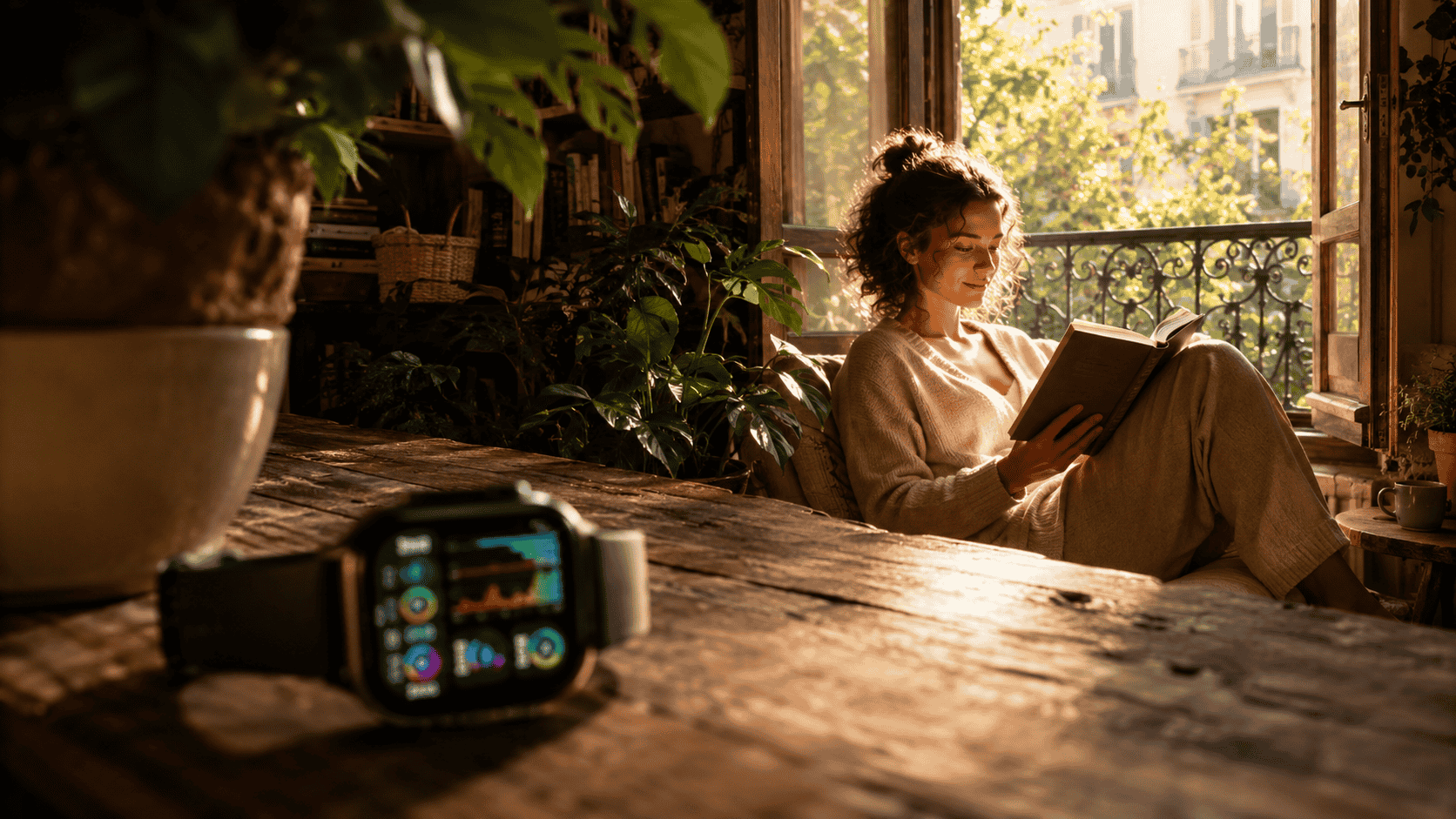
We spent years measuring every step, calorie, heartbeat and minute of sleep. Now a very different wellness movement is gaining ground: stop treating yourself like a machine.
After years of sleep scores, cold plunges, calorie targets and productivity dashboards, people are beginning to ask an unexpectedly radical question: what if feeling well matters more than scoring well?
By Lifestyle & Culture Desk | Thursday, August 20, 2026
Your watch says you slept badly.
You felt fine until you checked.
Now the app says your recovery score is 62.
Your resting heart rate is slightly elevated. You missed yesterday's step target. Your sleep efficiency has dropped. The morning routine you saved on Instagram says you should already have meditated, stretched, journaled, taken supplements, exposed your eyes to sunlight and completed a cold plunge.
It is 7:18 a.m.
And somehow you are already behind.
That feeling may explain one of the most interesting cultural shifts of 2026.
After years of being encouraged to optimize everything, a growing part of wellness culture is pushing in the opposite direction.
The Global Wellness Summit has given the movement a wonderfully direct name:
The Over-Optimization Backlash.
Its 2026 trends report argues that wellness has become so measurable that, for some consumers, wellbeing has started feeling less like something we experience and more like something we must perform correctly. Sleep gets scored. Glucose gets graphed. Biological age gets estimated. Steps, calories, heart-rate variability and recovery all become numbers competing for attention.
The backlash does not mean people have suddenly stopped caring about health.
Quite the opposite.
People still want to sleep well, feel strong, manage stress and live longer.
They are simply becoming suspicious of the idea that every healthy life must look like a dashboard.
And that distinction may define wellness in 2026.
We Turned Wellness Into Another Job
There was something seductive about the quantified-self movement.
More information promised more control.
If you could measure your sleep, perhaps you could improve it.
If you knew exactly how much you moved, maybe you would move more.
If you tracked food, heart rate, recovery, glucose, hydration and exercise, perhaps the mysteries of the body would become manageable.
For many people, these tools genuinely are useful.
Wearables can reveal patterns.
Health apps can encourage activity.
Sleep data can prompt useful conversations.
Fitness tracking can make progress visible.
The problem begins when information quietly turns into obligation.
You stop going for a walk because you enjoy walking.
You go because the ring is not closed.
You stop asking, “Do I feel rested?”
You ask, “What did the app say?”
That tension has become visible enough that sleep specialists even use a proposed term for one version of it: orthosomnia.
Orthosomnia describes an excessive pursuit of “perfect” sleep driven by tracker data. Sleep Foundation notes that it is not a formally recognized sleep disorder, but researchers and clinicians have raised concerns that becoming preoccupied with imperfect wearable data can itself generate stress around sleep.
There is an almost comic contradiction in that.
A device intended to help you sleep can make you anxious about sleeping correctly.
And perhaps that is the perfect metaphor for the over-optimization era.
1. The New Wellness Flex Is Not Caring About the Score
The cultural mood has changed.
For a while, wellness social media looked like competitive discipline.
Wake up earlier.
Train harder.
Eat cleaner.
Measure more.
Improve your biological age.
Optimize your hormones.
Stack your supplements.
Fix your morning.
Perfect your evening.
The person with the most elaborate protocol appeared to be winning.
But people eventually become tired of turning every ordinary human activity into a performance metric.
Eating is allowed to be enjoyable.
Walking can just be walking.
A holiday does not need to become a “longevity intervention.”
And a Sunday afternoon does not require a measurable return on investment.
The Global Wellness Summit describes the emerging correction as a shift toward meaning over measurement, emotional repair over constant optimization, and experiences that emphasize connection and sensation rather than self-surveillance.
That is a striking change in language.
The old wellness question was:
How can I perform better?
The new one sounds more like:
How can I actually feel better?
2. The “Soft Life” Was Never Just About Expensive Hotels
Social media has attached another phrase to this mood:
the soft life.
The internet version can look almost absurdly luxurious.
White linen.
Expensive skincare.
Quiet hotel rooms.
Matcha.
Spa robes.
A beautiful woman reading beside an infinity pool while apparently having no emails, debts or responsibilities.
But that aesthetic obscures where the phrase came from.
The “soft life” has roots in Nigeria and Black women's conversations around ease, rest and rejecting the assumption that struggle should be a permanent condition of life. As the phrase spread internationally, it became increasingly associated with luxury and aspirational consumption, sometimes losing its original cultural meaning.
That background matters.
A soft life does not have to mean refusing ambition.
It can simply mean refusing the belief that suffering proves ambition.
You can care deeply about your work without allowing it to consume every evening.
You can exercise without punishing yourself.
You can pursue financial success and still sleep.
You can rest without first earning permission.
That may be why the idea is resonating again in 2026.
It provides language for something many people already feel:
I still want a good life. I just don't want to destroy myself building it.
3. Nervous-System Regulation Is Suddenly Everywhere
Another phrase has escaped therapy rooms and entered everyday internet vocabulary:
“regulating your nervous system.”
Scroll long enough and you will encounter people discussing being “dysregulated,” “stuck in fight-or-flight,” stimulating the vagus nerve or attempting a “nervous-system reset.”
This is not imaginary as a cultural trend.
The Global Wellness Summit named The Rise of Neurowellness one of its major trends of 2026, while Forbes reported in June that nervous-system regulation had become one of the wellness industry's most talked-about ideas.
The basic physiological idea is real.
The autonomic nervous system helps regulate automatic processes including heart rate, breathing, digestion and responses to stress.
Stress activates systems that help us respond to perceived threats.
Other processes support rest and recovery.
But social media has a habit of turning complicated physiology into simple slogans.
The University of California San Diego noted this summer that “nervous-system regulation” language is now appearing everywhere online, alongside breathing techniques, cold exposure and supposed vagus-nerve exercises. Experts caution that the internet can oversimplify what these practices actually do.
So the useful takeaway is not that every uncomfortable feeling means your nervous system is “broken.”
And there is no magical 30-second trick that permanently resets human physiology.
The more sensible idea is much less dramatic:
recovery matters.
Sleep matters.
Movement matters.
Time outdoors matters.
Relationships matter.
Periods without constant stimulation matter.
And simple breathing or relaxation practices can be useful tools for some people without needing to be marketed as miracle treatments.
4. Somatic Wellness Is Moving Into the Mainstream
This interest in the body has also helped popularize somatic practices.
“Somatic” simply relates to the body.
In the wellness world, the term is now used across a broad range of approaches involving movement, breathing, body awareness and physical sensations.
Some are rooted in established therapeutic approaches.
Others are much more loosely defined.
And social media sometimes blurs the difference.
That is why consumers should be careful with dramatic claims that a particular movement, shake, scream, breathing sequence or “release” can cure trauma or treat a medical condition.
But as a cultural phenomenon, the attraction makes sense.
For years, wellness was extremely cerebral.
Calculate.
Measure.
Track.
Analyse.
Now people seem interested in experiences where the goal is simply to feel something.
Dance.
Stretch.
Breathe.
Sing.
Laugh.
Sit quietly.
Spend time with other people.
That is much harder to quantify.
Perhaps that is precisely the appeal.
5. Wellness Is Leaving the Clinic and Going to the Dance Floor
One of the strangest—and most joyful—wellness trends of 2026 is what the Global Wellness Summit calls the “festivalization of wellness.”
The basic idea is that wellness is becoming more social, musical and experiential.
Think sober morning raves.
Community sauna gatherings.
Movement events.
Dance-based wellness experiences.
Fitness festivals.
Multi-day resort programmes combining music, movement, recovery and communal activities.
The trend report points to wellness gatherings built around participation, connection and collective emotional release rather than solitary self-improvement.
This feels almost like a correction to the isolation of optimization culture.
Biohacking often happens alone.
You wear your tracker.
You monitor your numbers.
You follow your protocol.
You optimize your body.
Festival-style wellness says:
Come outside.
Dance with somebody.
Meet people.
Laugh.
Sweat.
Go home feeling more alive.
The commercial wellness industry has noticed.
Hotels, resorts, spas and destination wellness businesses are increasingly designing experiences around community rather than simply offering individual massages or private meditation.
For wellness tourism, that could be a significant shift.
The luxury may no longer be solitude.
It may be belonging.
6. The Bedroom Is Becoming the New Status Symbol
For years, aspirational lifestyle culture focused heavily on mornings.
The 5 a.m. club.
The perfect breakfast.
The cold shower.
The run before sunrise.
The journal.
The productivity routine.
But the wellness backlash is giving the other end of the day far more attention.
Not:
How early can you wake up?
But:
How well can you wind down?
That creates an entire lifestyle category around protecting the evening.
A calmer bedroom.
Comfortable bedding.
Lower lighting.
Less late-night scrolling.
Reading.
A predictable sleep schedule.
Fewer notifications.
The concept sounds commercially convenient because there is an enormous market for mattresses, pillows, blackout curtains, sleep technology, lighting and other bedroom products.
But some of the underlying advice is refreshingly basic.
Sleep Foundation's guidance continues to emphasize fundamentals such as maintaining a consistent sleep schedule, winding down before bed and reducing electronics in the bedroom.
No 27-step nighttime ritual is required.
Your bedroom does not need to become a laboratory.
In fact, that may defeat the point.
7. The Irony: The Anti-Optimization Trend Is Already Being Optimized
Of course, capitalism moves quickly.
The moment people say:
“I am exhausted by wellness products telling me I am not well enough,”
someone inevitably creates a product designed to solve it.
There are now devices marketed around relaxation.
Recovery wearables.
Neurotechnology.
Breathwork subscriptions.
Sleep systems.
Wellness apps.
Sound programmes.
Luxury digital-detox retreats.
Stress-management resorts.
And increasingly elaborate experiences designed to help consumers escape the very hyperconnected lifestyles created partly by technology.
This does not automatically make those products useless.
Some may be excellent.
But consumers should recognize the contradiction.
The over-optimization backlash itself can become another optimization market.
Suddenly you can buy the perfect candle, perfect supplement, perfect weighted blanket, perfect sleep retreat and perfect app to help you stop caring about perfection.
We are very good at turning rebellion into a shopping category.
That does not invalidate the trend.
It just makes skepticism useful.
8. Wellness Travel Is Getting Quieter—and More Social at the Same Time
Two seemingly opposite travel desires are emerging.
One is lower stimulation.
People want nature.
Dark skies.
Quiet.
Good sleep.
Fewer screens.
A slower schedule.
The other is meaningful connection.
Group movement.
Shared meals.
Music.
Community wellness.
Collective experiences.
Those impulses are not really contradictory.
Both respond to the same problem:
modern life often leaves people simultaneously overstimulated and socially undernourished.
You can spend an entire day surrounded by notifications and still feel lonely.
That creates a fascinating opportunity for the wellness tourism industry.
Hotels and resorts no longer need to compete only on marble spas and expensive treatment menus.
The new luxury may be an environment that helps a person feel:
calm,
connected,
well rested,
and genuinely present.
Even stargazing is being positioned as a wellness experience in 2026, with travel operators and luxury resorts developing dark-sky programmes built around awe, reflection and reduced stimulation.
Sometimes the newest wellness technology is simply looking up.
9. “Micro-Recovery” May Beat the Perfect Morning Routine
Another recent wellness conversation captures the backlash beautifully:
micro-recovery.
Instead of constructing an enormous self-care routine that becomes another task on the schedule, the idea is to insert tiny periods of recovery into normal life.
Step outside.
Move away from the screen.
Take a brief walk.
Sit quietly.
Breathe slowly.
Call someone you like.
Do nothing useful for five minutes.
Recent wellness coverage has framed these small recovery moments as a practical alternative to increasingly rigid morning routines.
The appeal is obvious.
A wellness habit that requires 90 minutes every morning is unavailable to many people.
Parents have children.
Workers commute.
Caregivers have responsibilities.
People work shifts.
Life happens.
The softer version of wellness asks whether something small and sustainable might ultimately be more useful than something perfect and impossible.
That may be one of the healthiest ideas inside the entire trend.
10. The Real Luxury of 2026 Might Be Unmeasured Time
There was a time when luxury meant possessing things most people could not afford.
A large house.
A luxury car.
An expensive watch.
Those signals still exist.
But modern life has made something else surprisingly scarce:
undisturbed time.
An hour without notifications.
Dinner without checking your phone.
A walk with nowhere to arrive.
An evening with no work waiting behind another tab.
A conversation that is not interrupted.
Eight hours in bed without wondering whether the watch approves.
These things cost very little in theory.
In practice, they have become difficult to protect.
That is perhaps why “soft life” imagery has become so powerful.
Underneath the silk sheets and beautifully photographed tea is something more universal.
People want permission to stop performing.
11. There Is a Danger in Romanticizing the Soft Life
The backlash deserves one correction of its own.
Rest is important.
But rest is not the same as avoidance.
Boundaries are valuable.
But every uncomfortable responsibility is not automatically “toxic.”
A person cannot always resign from a stressful job, book a wellness retreat or design an aesthetically perfect slow morning.
Economic reality exists.
Children need care.
Bills arrive.
Illness happens.
Families need us.
Therapists discussing the soft-life trend have warned that it can become unhelpful if self-care is used to avoid necessary responsibilities or difficult emotions rather than restoring the ability to engage with life.
That is a useful distinction.
A healthy soft life does not mean:
Nothing difficult should ever happen to me.
It means:
Difficulty does not need to become my identity.
12. You Do Not Need to Throw Away Your Fitness Tracker
The easiest conclusion would be to declare technology the villain.
That would miss the point.
Fitness trackers can be useful.
Sleep technology can be useful.
Health data can be useful.
Meditation apps can be useful.
Performance goals can be motivating.
The backlash is not fundamentally against information.
It is against allowing information to become judgment.
A sleep score should be information.
Not a grade.
A missed workout should be an event.
Not a moral failure.
A day of rest is not evidence that you have lost discipline.
And health does not become meaningless simply because it cannot fit neatly on a graph.
The smartest version of 2026 wellness may therefore combine the two worlds.
Use technology when it genuinely helps.
Ignore it when it starts making you feel worse.
Measure what matters.
But remember to live the part that cannot be measured.
The Revenge of the Human
There is something almost poetic about where wellness has ended up.
We built better sensors.
Better dashboards.
Better analytics.
Better algorithms.
We gained the ability to measure things about ourselves that previous generations could barely imagine.
And then, after measuring everything, we rediscovered something ancient:
Humans need rest.
Humans need other humans.
We need music.
Movement.
Touch.
Nature.
Joy.
Sleep.
Meaning.
And sometimes we need an afternoon during which absolutely nothing impressive happens.
The Global Wellness Summit describes 2026 not as a rejection of science but as a recalibration—away from endless performance and toward emotional repair, recovery and embodied wellbeing.
That is probably the most accurate description of the moment.
The future of wellness will still contain sensors, diagnostics, advanced medicine and technology.
But increasingly, it may also contain a simple idea:
Your body is not a productivity project.
You do not need 99.9% uptime.
You do not need to win at sleeping.
You do not have to turn every meal, workout, holiday or quiet evening into evidence that you are becoming a better version of yourself.
Sometimes the healthiest thing you can do is stop optimizing the moment long enough to actually experience it.
And in 2026, that may be the most rebellious wellness trend of all.
Frequently Asked Questions
What is the Over-Optimization Backlash?
The Over-Optimization Backlash is a 2026 wellness trend describing growing resistance to constant health tracking, biohacking and performance-focused self-improvement. The Global Wellness Summit identifies it as a movement toward connection, emotional wellbeing, pleasure and less obsessive measurement.
Is the Over-Optimization Backlash a real 2026 trend?
Yes. The Global Wellness Summit formally included The Over-Optimization Backlash among its major wellness trends for 2026. It is also connected with its separate trends around neurowellness and more social, experiential forms of wellness.
What does “soft life” mean?
Soft life generally describes prioritizing ease, emotional wellbeing and reduced unnecessary stress instead of glorifying constant struggle. The phrase has roots in Nigeria and became especially associated with Black women's conversations around rest, comfort and wellbeing before becoming a wider global social-media trend.
Is soft life the same as being lazy?
No. A balanced interpretation of soft life is not about abandoning responsibilities or ambition. It is about reducing unnecessary pressure and creating room for rest alongside meaningful goals.
What is neurowellness?
Neurowellness is an emerging wellness category centered on stress regulation, recovery and resilience, combining areas such as behavioral science, sensory environments, body-based practices and consumer neurotechnology. It should not be confused with medical treatment for neurological or mental-health conditions.
What is nervous-system regulation?
The phrase generally refers to the body's capacity to respond to stress and return toward a calmer state. Online discussions often include breathing, mindfulness, movement and time in nature, but experts caution that social-media claims about instant “vagus nerve resets” or curing dysregulation can oversimplify the science.
What is orthosomnia?
Orthosomnia is a proposed term describing an excessive focus on achieving perfect sleep based on data from wearable sleep trackers. It is not currently a formally recognized sleep disorder.
Can fitness trackers make sleep anxiety worse?
For some people, becoming overly focused on sleep scores and potentially inaccurate wearable estimates may increase anxiety around sleep. Trackers can still be useful, but their measurements should not be treated as perfect medical assessments.
What is somatic wellness?
Somatic wellness is a broad term for practices emphasizing body awareness, movement, breathing and physical sensations. Some approaches have clinical foundations, while other social-media practices may make claims that exceed the available evidence.
What is the festivalization of wellness?
The festivalization of wellness describes the growing popularity of social wellness experiences built around music, movement, community and collective participation, including sober raves, movement gatherings and wellness festivals.
What is a sleep sanctuary?
A sleep sanctuary is an informal lifestyle term for creating a bedroom and evening routine that supports rest. Evidence-based basics remain straightforward: a consistent sleep schedule, a wind-down period and reducing disruptive electronics can all support better sleep habits.
Is the 2026 wellness backlash anti-technology?
No. The more accurate interpretation is that consumers are questioning constant self-surveillance and pressure, rather than rejecting useful health technology altogether.
Editorial Note: This article discusses cultural and consumer wellness trends rather than providing medical or mental-health treatment advice. “Neurowellness,” “nervous-system regulation” and somatic practices are broad terms whose social-media use may exceed the scientific evidence for specific products or techniques.
wellness trends 2026, soft life 2026, nervous system regulation, neurowellness, somatic wellness, anti-hustle culture, sleep tracker anxiety, wellness festival trend
sleep technology, wellness retreats, sleep products, recovery technology, mental wellness apps, wellness tourism, spa resorts, fitness wearables, mattresses and bedding, stress management programs, wellness subscriptions
Wellness Trends 2026, Soft Life, Anti-Hustle, Neurowellness, Sleep, Stress, Digital Detox, Wellness Travel, Somatic Wellness, Lifestyle