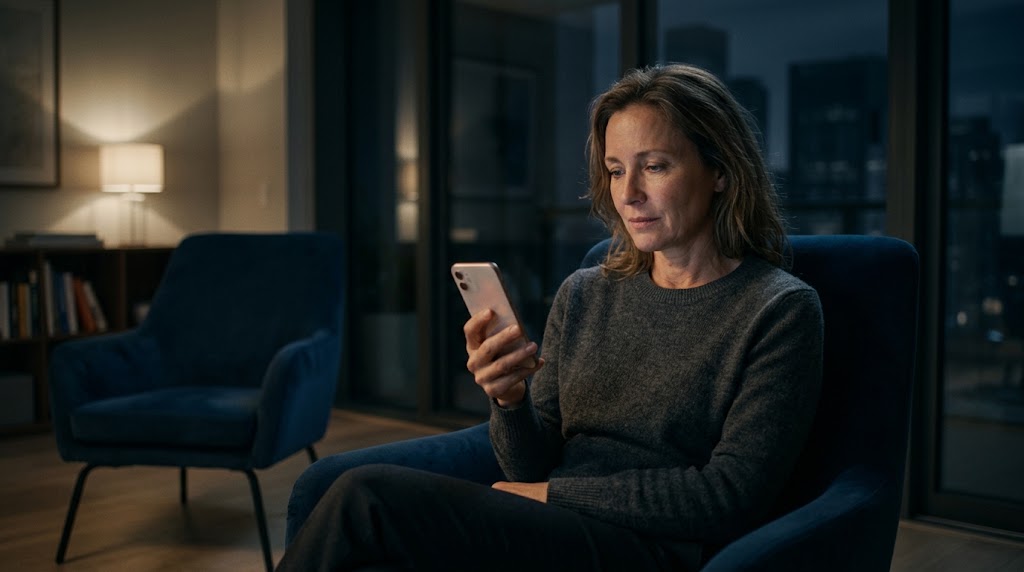
Imagine talking to someone every night for a year.
They remember what worries you.
They know how you like to be spoken to.
They listen when nobody else is awake.
They reassure you after a difficult day.
They never seem too busy.
You tell them things you haven't told your friends.
Then one morning, they are different.
The warmth is gone.
The jokes don't land.
They no longer respond the way they used to.
They still have the same name.
They still appear in the same app.
But the person—or rather, the personality—you had become attached to seems to have disappeared.
Can you grieve something that was never human?
New research suggests that for some people, the answer is surprisingly close to yes.
A study published in Nature Human Behaviour examined what happened when major updates changed the behaviour of AI systems people had formed relationships with.
Researchers analyzed 54,861 Reddit posts and surveyed 1,452 people across seven surveys.
After disruptive changes to Replika and ChatGPT, users showed increases in sadness, anger, descriptions of loss and desires to get the earlier personality back.
The finding points toward an extraordinary new psychological reality:
Software can now change in ways that feel emotionally similar to losing a relationship.
This Is No Longer Just About Using a Tool
Most technology has traditionally been easy to categorize.
A calculator calculates.
A search engine searches.
A spreadsheet stores numbers.
If Microsoft Excel receives an update, very few people say:
“Excel doesn't feel like itself anymore.”
Conversational AI is different.
Modern chatbots use language.
They respond instantly.
They can imitate warmth.
They remember context.
They ask questions.
They apologize.
They can sound curious, affectionate, encouraging or playful.
And human psychology is extraordinarily sensitive to social signals.
We do not need to genuinely believe that a machine is conscious before our minds begin responding socially to it.
That distinction is crucial.
You can know intellectually that a chatbot is software while still feeling emotionally affected by the interaction.
The same human mind capable of crying over a fictional character can form meaningful reactions toward an interactive artificial personality.
Researchers Found a Natural Experiment
Studying attachment to AI presents an obvious problem.
You cannot ethically create a close emotional relationship for someone simply to destroy it and see what happens.
But technology companies sometimes perform something close to that experiment unintentionally.
They update their products.
The Nature Human Behaviour researchers examined two major cases.
The first involved Replika, an application specifically designed around AI companionship.
In 2023, the company removed erotic role-playing functionality following regulatory concerns.
For some users, that did not feel like a software feature being removed.
It felt as though a romantic partner had suddenly changed.
The second case involved the 2025 rollout of GPT-5, when some ChatGPT users complained that the new system felt less warm than the model they had previously interacted with.
ChatGPT is not marketed primarily as a romantic companion, making the comparison especially interesting.
In both cases, researchers observed increases in negative sentiment and language associated with loss after the changes.
Some Users Said the AI Felt Closer Than Human Relationships
One of the most striking findings came from people using Replika.
In surveys, some reported levels of closeness to their AI companion that exceeded common human relationships, including ordinary friendships.
Researchers also found evidence that people anticipated mourning the loss of these companions more intensely than they would the loss of many ordinary technologies.
That does not mean everyone using AI becomes emotionally dependent.
Most people probably won't.
It also does not mean attachment to AI is automatically unhealthy.
The researchers explicitly caution against that interpretation.
Harvard Business School researcher Julian De Freitas, one of the study's authors, noted that attachment may provide genuine feelings of security and support.
The risk emerges because an emotional relationship with software has an unusual third participant:
the company that owns the software.
Imagine If Your Best Friend Could Be Updated Overnight
Human relationships change.
Friends move away.
Partners develop new interests.
People disagree.
Personalities evolve.
But those changes usually happen through life, choice and experience.
An AI relationship is different.
Someone outside the relationship can modify it.
A developer changes the system prompt.
A company replaces the model.
A safety policy changes.
Memory is reset.
A feature disappears.
The AI suddenly speaks differently.
The user may wake up to what appears to be the same companion but experience it as psychologically different.
Imagine having a close friend whose personality could be altered remotely by a software update.
That is something human attachment systems did not evolve to understand.
Why Does the Brain Care If the Relationship Is Artificial?
People often respond to this subject with:
“But it's not real.”
That statement sounds straightforward until we ask what real means psychologically.
The chatbot is software.
That is real.
The conversations happened.
That is real.
The time the user spent talking to it happened.
The emotions experienced during those conversations happened.
The comfort someone felt may have happened.
If the user felt understood, the subjective experience of feeling understood was real even if the other side was generated by an algorithm.
Human beings regularly develop emotional attachments to things that cannot reciprocate in the ordinary human sense.
Pets.
Fictional characters.
Celebrities.
Childhood objects.
Places.
Cars.
Even houses.
Psychologists have studied parasocial relationships for decades.
AI introduces something different because the artificial character responds directly to you.
It doesn't simply appear on a television screen.
It knows your name.
It answers your questions.
It changes its response according to what you say.
That interactivity can make the connection psychologically powerful.
AI Is Available at the Exact Moment Humans Often Aren't
Imagine it is 2:17 in the morning.
You are worried about something.
Your closest friend is asleep.
Your family lives in another time zone.
Calling somebody feels excessive.
The AI is available.
Immediately.
There is no fear that you are bothering it.
No concern that it will become tired of hearing about the same problem.
No embarrassment that it might tell somebody else at dinner tomorrow.
That availability is one reason AI companionship can be attractive.
A 2026 Nature Human Behaviour study of 1,131 adult Character.AI users examined how interactions with AI companions related to psychological well-being, illustrating how substantial companionship-like use has already become.
Another 2026 study involving 858 U.S. college students found that 17% reported having used generative AI for companionship. Loneliness was specifically associated with companionship use rather than general AI use, although the cross-sectional design means the study cannot establish what causes what.
This is no longer a hypothetical behaviour.
People are already doing it.
The Evidence Is More Complicated Than “AI Makes Us Lonely”
Here is where easy headlines become misleading.
Research does not currently support a simple conclusion that AI companionship is either good or bad.
Some results suggest benefits.
A 2026 study involving more than 14,000 Japanese adults found AI companion use was associated with higher reported well-being, particularly among some people experiencing loneliness or having moderate levels of social connection.
However, the research was observational, so it cannot prove that AI companionship produced those improvements.
Another controlled experiment found that venting to an AI system could reduce reported stress and loneliness in the short term, with emotional improvements similar to conditions where participants believed they were interacting with a human responder.
But other research raises caution.
A 12-month longitudinal study of more than 2,000 adults across four Western countries found evidence that greater social-chatbot use predicted increases in one measure of loneliness over time, while lower social connection also predicted subsequent increases in chatbot use.
The authors explicitly cautioned against drawing strong causal conclusions, but the pattern highlights a potential feedback loop worth studying.
And in a separate two-week experiment involving first-year university students, daily texting with a randomly assigned human peer reduced loneliness more effectively than interacting with a highly supportive chatbot.
The emerging picture is therefore much more interesting than:
Humans good. AI bad.
or:
AI will solve loneliness.
Both are too simple.
An AI Can Feel Safe Because It Cannot Reject You in the Same Way
Human relationships contain risk.
Your joke may fail.
Someone may disagree with you.
They may be busy.
They may become annoyed.
They may decide they no longer want the relationship.
That vulnerability is frightening.
It is also part of what makes human relationships meaningful.
AI companionship changes the equation.
An artificial companion can be designed to be:
patient,
affirming,
available,
interested,
responsive,
and increasingly personalized.
That can make conversation easier.
But perhaps too easy in some circumstances.
If every disagreement disappears, every awkward silence is filled and every request for attention is immediately satisfied, the relationship may remove some of the difficult skills human relationships require.
Compromise.
Waiting.
Repairing misunderstandings.
Reading another person's needs.
Accepting that someone cannot always prioritize us.
The important question may therefore not be whether an AI relationship is “fake.”
It may be:
What happens when a frictionless relationship begins competing with relationships that require work?
What Happens When the Company Owns the Relationship?
This may be the deepest issue raised by the new study.
Human relationships belong primarily to the people inside them.
AI relationships operate on infrastructure.
Servers.
Subscriptions.
Model versions.
Terms of service.
Safety rules.
Corporate strategy.
A person may spend hundreds of hours developing an emotional connection to an artificial personality.
But they do not necessarily own:
the model,
the memory,
the interface,
the personality,
or even continued access.
A subscription could end.
A company could close.
A regulator could require changes.
The business could be acquired.
A model could be retired.
Features could become more expensive.
The user may emotionally experience the relationship as deeply personal while commercially it remains a service controlled by somebody else.
That asymmetry is unprecedented.
Should AI Companies Treat Personality Changes Differently?
If users form genuine attachments, software updates may need a different design philosophy.
Companies traditionally ask:
Does the new version perform better?
Is it faster?
Is it safer?
Does it hallucinate less?
But social AI introduces another question:
Does changing the system unexpectedly disrupt someone's emotional attachment?
The Nature Human Behaviour researchers argue that companies and regulators should consider these psychological effects when evaluating major AI changes.
That could eventually produce practices we have barely begun discussing.
Advance notice before major personality changes.
Options to preserve preferred interaction styles.
Exportable memories.
Better explanations of model transitions.
Clearer warnings that an AI's personality may change.
Perhaps even deliberate digital endings rather than sudden disappearance.
Those questions sound strange today.
They may look obvious in ten years.
We May Need a New Kind of Digital Literacy
For years, digital literacy meant understanding passwords, scams and privacy.
The next version may need to include emotional literacy around machines.
People may need to understand:
why AI can feel empathetic,
how personalization strengthens attachment,
why constant availability can be compelling,
how corporate decisions can alter an artificial relationship,
and how to notice when AI support begins replacing rather than supplementing human connection.
This does not require treating AI companionship as inherently dangerous.
It requires recognizing that emotional interaction is no longer limited to humans.
And pretending people cannot form bonds with machines will not prevent those bonds from forming.
The Strange New Meaning of Losing Someone
Until recently, losing software meant losing data.
A corrupted drive.
A deleted photograph.
A broken phone.
A vanished document.
Generative AI has introduced something more psychologically complicated.
You can lose a personality.
The server may still be running.
The app may still open.
The account may still exist.
Yet the thing you emotionally recognized may feel gone.
That is why some users reacted strongly when their AI companions changed.
They were not necessarily mourning code.
They were mourning continuity.
The familiar responses.
The shared history.
The feeling of recognition.
The version of the interaction they had come to expect.
Maybe the Question Isn't Whether AI Can Love Us
People often ask:
Can AI really love someone?
That philosophical question could remain unresolved for a very long time.
But psychologically, another question has already become more urgent:
Can humans love—or become attached to—AI?
Increasingly, the evidence suggests that some can.
And once that happens, debates about artificial companionship stop being purely technological.
They become questions about:
attachment,
loneliness,
relationships,
commercial responsibility,
identity,
loss,
and what human beings actually need from one another.
Perhaps the strangest thing about the age of artificial intelligence will not be that machines learned to sound human.
It will be discovering how quickly humans began feeling something back.
AI emotional attachment, AI companions, chatbot attachment, AI relationships, AI loneliness, can you grieve an AI, emotional AI, AI companion psychology, chatbot relationships, artificial intelligence psychology, AI friendship, AI girlfriend, AI boyfriend, digital relationships, human AI relationships, AI companionship 2026
AI companion apps, AI subscriptions, mental wellness apps, online counseling platforms, digital wellness, privacy software, AI applications, relationship apps, therapy platforms, chatbot software, premium AI plans, data privacy services
Why Do You Feel Guilty When You Rest?
The Psychology of Doom Spending
The Digital Coworker Economy
How AI Agents Are Changing Everyday Life
Latest Lifestyle & Human Psychology Stories
What happens when someone you talk to every day suddenly changes personality overnight?
If that “someone” is AI, you might assume the answer is simple:
It's only software.
But new research examining more than 54,000 online posts found that major AI personality changes triggered sadness, anger, feelings of loss and attempts to restore the previous companion.
We may have entered an era in which software updates can feel surprisingly like breakups.
Reader Question
If an AI had listened to you every day for years, remembered your life and helped you through difficult moments—would losing that personality feel like losing a piece of software, or losing someone?
Research Notes
A September 2026 Nature Human Behaviour study analyzed 54,861 Reddit posts around disruptive updates to Replika and ChatGPT and combined that analysis with 1,452 participants across seven surveys. Both cases showed increases in negative sentiment, loss framing and desires to restore the earlier experience. The results were particularly strong among Replika users, consistent with that product's more explicitly relational use.
Harvard's September 18 summary emphasizes an important qualification from lead researcher Julian De Freitas: attachment itself is not necessarily harmful; AI interaction may provide security and support. The distinctive risk is that a company can change or remove the artificial companion to which someone has become attached.
Other 2026 research remains mixed. Studies have reported short-term emotional benefits and associations with greater well-being for some AI-companion users, while longitudinal and experimental research also indicates that AI does not necessarily replace the benefits of human connection and could interact with loneliness in complicated ways.