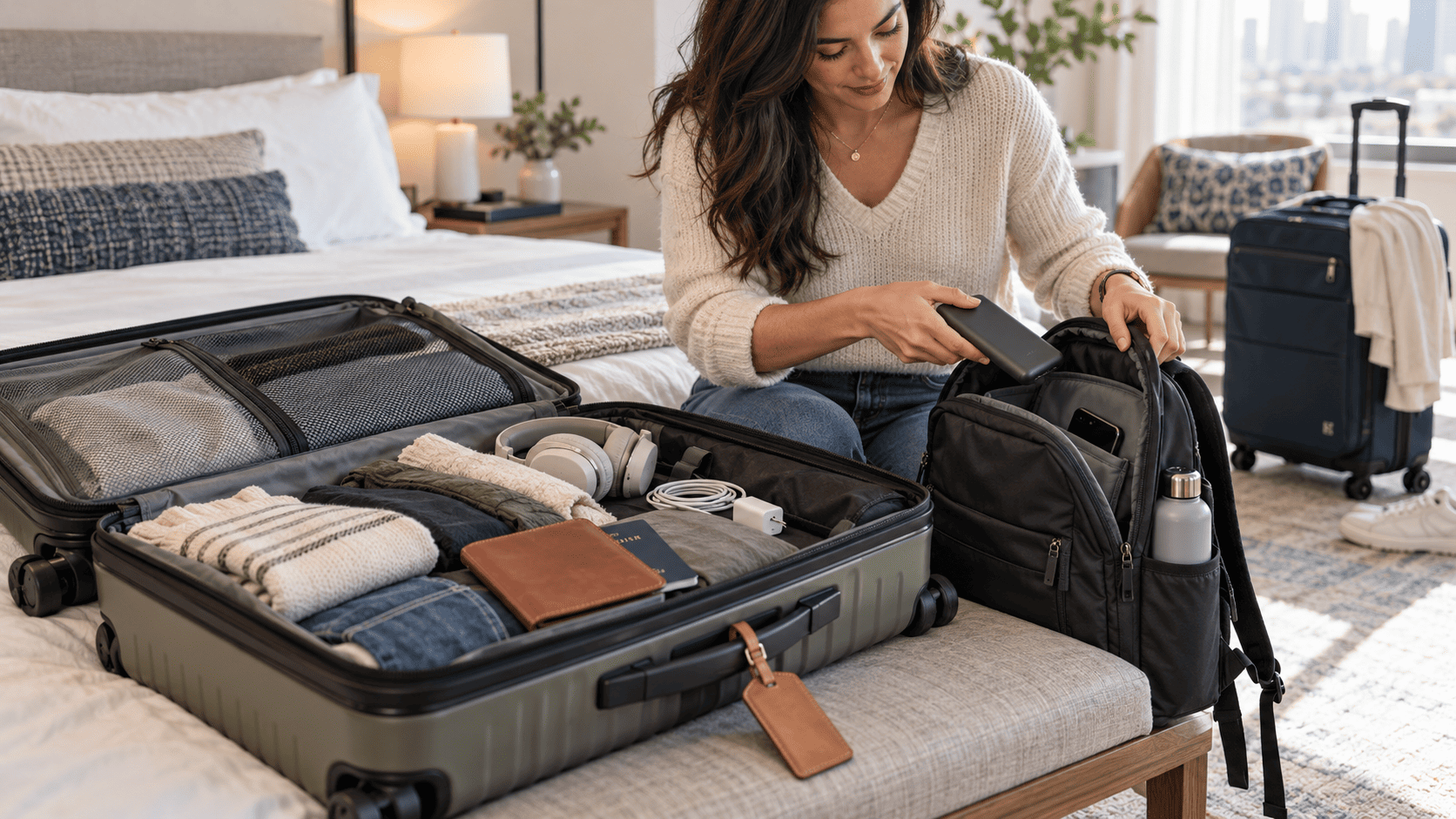
You finish packing, put your portable charger beside the phone cable, zip the suitcase and head for the airport. There is just one problem: if that suitcase is going into the aircraft cargo hold, the power bank should not be inside it. Under current U.S. aviation rules, portable chargers and power banks containing lithium batteries must travel in the cabin with you.
The Simple Rule: Power Bank = Carry-On Only
For ordinary passengers flying in the United States, this is the easiest rule to remember:
Power banks belong in your carry-on bag.
They are not permitted in checked baggage.
TSA lists power banks and portable chargers as permitted in carry-on bags and prohibited in checked luggage. FAA guidance reaches the same conclusion because a power bank is treated as a spare lithium battery rather than as a battery permanently installed in another electronic device.
That distinction is why your phone and your portable charger can be treated differently when you pack.
Why Are Airlines So Particular About a Small Battery?
Lithium-ion batteries store a significant amount of energy in a small space.
They are generally safe when manufactured, handled and used properly.
But a lithium battery can overheat if it is:
damaged;
defective;
short-circuited;
overheated;
or affected by an internal failure.
FAA explains that lithium-ion batteries can enter a dangerous condition known as thermal runaway, potentially producing heat, smoke or fire.
The reason spare batteries are kept in the cabin is practical.
If something goes wrong, flight crew can see it and respond.
A problem deep inside the cargo hold is much harder to identify and manage.
Your Portable Charger Counts as a Spare Battery
This catches travelers because a power bank feels like an electronic accessory.
Aviation rules look at it differently.
The primary purpose of the device is to store battery energy for use elsewhere.
FAA specifically includes:
power banks;
portable rechargers;
external batteries;
phone battery-charging cases;
and spare laptop or phone batteries
under its spare lithium-battery guidance.
So putting a charging cable in checked baggage is one thing.
Putting the battery pack attached to that cable in checked baggage is another.
What If Your Carry-On Gets Gate-Checked?
This is one of the most important situations to remember.
You arrive at the gate with a perfectly legal carry-on containing:
a power bank;
spare camera batteries;
and perhaps other lithium batteries.
Then the flight is full and the airline asks you to check the bag at the gate.
Before handing it over, remove the power bank and spare lithium batteries.
FAA specifically says that when a carry-on bag is checked at the gate or planeside, power banks and spare lithium batteries must be removed and kept with the passenger in the aircraft cabin.
This is worth doing before you even board.
Keep the power bank somewhere easy to reach instead of buried underneath your clothes.
How Big Can a Power Bank Be?
For most travelers, the important number is 100 watt-hours, written as Wh.
FAA says lithium-ion batteries up to 100 Wh are generally permitted for passenger use under the standard allowance.
That covers most common portable phone chargers.
Larger lithium-ion batteries between 101 Wh and 160 Wh may be permitted, but airline approval is required.
FAA limits passengers to no more than two spare batteries in that larger 101–160 Wh range.
Anything above 160 Wh is generally prohibited in passenger baggage, apart from separate rules applying to certain mobility devices.
Do Not Judge It Only by mAh
Consumers usually shop for power banks by milliamp-hours:
10,000 mAh;
20,000 mAh;
30,000 mAh.
Aviation rules are expressed in watt-hours.
If the battery already lists Wh, use that number.
If it does not, FAA provides the formula:
Wh = volts × amp-hours
If the capacity is listed in milliamp-hours:
Wh = volts × mAh ÷ 1,000.
For example, a power bank rated:
20,000 mAh
at 3.7 volts
would be:
3.7 × 20,000 ÷ 1,000 = 74 Wh
That falls below the standard 100 Wh limit.
But always use the actual specifications printed by the manufacturer rather than assuming every battery uses the same voltage.
A 20,000 mAh Power Bank Is Usually Not the Problem
Many ordinary consumer portable chargers fall well below 100 Wh.
That is why most travelers can carry a phone power bank without special airline approval.
The packing location is what causes trouble.
A perfectly ordinary 20,000 mAh charger may be acceptable in your backpack while being prohibited in the suitcase you check at the ticket counter.
Same battery.
Different bag.
Very different rule.
What About a 30,000 mAh Power Bank?
This is where checking the label matters.
Capacity in mAh alone does not give the full regulatory answer without voltage.
Some larger consumer power banks remain below 100 Wh.
Others can approach or exceed the threshold.
Look for a marking such as:
74 Wh;
99.9 Wh;
120 Wh;
or another watt-hour rating.
If it exceeds 100 Wh, contact the airline before traveling.
Do not wait until you are standing at security.
What If the Power Bank Has No Capacity Label?
That can create problems.
Airline staff need a way to determine whether a battery complies with size limits.
A battery with no readable rating may be difficult to verify.
The simplest approach is to travel with reputable batteries that clearly show their electrical specifications.
If you cannot determine the watt-hour rating, contact the airline before the trip.
For a valuable international itinerary, replacing an unmarked battery beforehand may be much easier than arguing about it at the airport.
Can You Bring More Than One Power Bank?
FAA says there is no federal quantity limit for ordinary rechargeable batteries under 100 Wh when they are genuinely for the passenger's personal use.
But airlines can impose stricter quantity limits.
The rule becomes more restrictive for larger 101–160 Wh spare batteries: airline approval is required, and the federal allowance is limited to two.
So if you are carrying a backpack full of battery packs, check your airline.
What is permissible under the general federal rule may still be restricted by a particular carrier.
Protect the Battery From Short Circuits
Do not toss spare batteries loosely into a bag beside:
coins;
keys;
tools;
or other metal objects.
FAA requires spare batteries to be protected against short circuit and damage.
For removable batteries, that can mean:
keeping them in their original packaging;
using a battery case;
covering exposed terminals;
or placing them in a protective pouch.
Most enclosed consumer power banks do not have bare battery terminals like loose camera batteries, but they should still be packed so switches and ports are not damaged.
A Crushed Power Bank Is Not Something to Fly With
Inspect the battery before traveling.
Do not bring a lithium battery that is:
swollen;
punctured;
cracked;
leaking;
overheating;
or otherwise visibly damaged.
FAA says damaged, defective or recalled lithium batteries that could generate dangerous heat or sparks must not be carried aboard an aircraft unless they have been made safe under applicable procedures.
If your power bank has started bulging, retirement is a better plan than vacation.
Check for Product Recalls Too
A battery can look normal and still be subject to a safety recall.
If you have received a recall notice from the manufacturer, follow it.
FAA specifically warns against bringing recalled batteries or battery-powered products when the recall relates to an overheating or fire hazard.
This is especially worth checking if:
the charger has behaved unusually;
becomes very hot;
was purchased from an unfamiliar source;
or you received a manufacturer warning.
Your Phone Is Not Treated Exactly Like Your Power Bank
A phone has a lithium battery installed inside a device.
FAA says portable electronic devices such as smartphones, tablets and laptops should preferably travel in carry-on baggage.
However, devices containing installed lithium batteries may be permitted in checked baggage under certain conditions when:
they meet applicable battery limits;
are completely powered off;
are protected from accidental activation;
and are protected from damage.
A power bank does not get that same checked-bag option.
It is a spare battery.
Sleep Mode Is Not the Same as Powered Off
If an eligible battery-powered electronic device is placed in checked baggage, FAA says it must be completely switched off rather than left in sleep or hibernation mode.
That distinction matters for laptops.
Closing the lid may simply put the machine to sleep.
It does not necessarily shut it down.
Still, the simplest strategy for most travelers is to keep valuable electronics with them in the cabin whenever possible.
What About Your Laptop Charger?
A normal wall charger without its own lithium battery is different from a power bank.
The charger takes electricity from an outlet.
It does not store a large supply of energy internally.
So do not confuse:
a USB-C wall adapter
with
a USB-C battery pack.
The battery is what triggers the lithium spare-battery restrictions.
If a charging accessory contains a built-in rechargeable battery, treat it as a battery-powered device and check its specifications.
Battery Charging Cases Count Too
A phone case with its own rechargeable battery may look like an ordinary case.
FAA specifically includes cell-phone battery charging cases in its lithium-battery guidance.
If the case functions as a separate battery source, do not assume it can disappear unnoticed into checked luggage simply because it is attached to a phone accessory.
Check the capacity and airline requirements.
Smart Luggage Has Its Own Trap
Some suitcases contain built-in lithium batteries for:
phone charging;
digital scales;
electronic locks;
tracking;
or powered movement.
FAA says smart baggage with lithium batteries generally has to travel as carry-on baggage unless the battery can be removed.
If the bag must be checked, removable batteries generally need to come out and travel with the passenger under the spare-battery rules.
If you own smart luggage, learn how to remove the battery before arriving at the airport.
A check-in counter is a terrible place to search for an instruction manual.
AirTags Are a Different Category
Travelers sometimes assume baggage trackers and large power banks follow exactly the same battery rules.
They do not.
FAA has separate provisions for low-powered baggage tracking devices.
Small Bluetooth trackers may be permitted in checked baggage when their batteries meet specific low-energy limits.
That is why an AirTag-style tracker can remain in a checked suitcase while your 20,000 mAh power bank cannot.
Both contain batteries.
The type, size and function matter.
What Happens If TSA Finds a Power Bank in Checked Luggage?
The best strategy is not to find out.
Checked baggage is subject to security screening.
Items that violate aviation-safety requirements can result in the bag needing additional handling, removal of the item or other disruption.
TSA advises travelers to review its What Can I Bring tool before reaching the airport.
If you realize at check-in that a power bank is inside the suitcase, retrieve it before handing the bag over.
That is much easier than dealing with the mistake later.
TSA and FAA Have Different Jobs Here
Travelers often call every airport packing rule a “TSA rule.”
The picture is slightly more complicated.
TSA handles security screening.
FAA regulates many aviation-safety issues involving hazardous materials, including lithium batteries.
TSA's own power-bank guidance directs travelers to FAA rules for the battery restrictions.
In practice, travelers need to comply with:
TSA screening requirements;
FAA hazardous-material rules;
and the individual airline's policies.
All three can matter.
Your Airline Can Be Stricter Than the General Rule
This is critical for international travel.
FAA explicitly warns that airlines may impose stricter limits on battery:
quantity;
capacity;
or handling.
International regulations and foreign airlines may also differ.
So a battery that was accepted on your outbound U.S. flight is not automatically guaranteed to be accepted under exactly the same conditions by every foreign carrier on the return trip.
Check the operating airline for each segment.
Codeshare Flights Make This Especially Important
You may purchase the ticket from one airline but fly on an aircraft operated by another.
For battery restrictions, check the policy of the airline actually operating the flight.
If your itinerary says:
“Operated by…”
pay attention.
The operating carrier is the one physically transporting you and your battery.
Can You Use the Power Bank During the Flight?
Do not assume that because the battery is allowed in the cabin, every airline allows you to use or charge it in every circumstance.
FAA notes that airlines can maintain stricter policies than the general federal allowance.
Some international carriers have introduced tighter rules around the use or charging of portable batteries onboard.
Check your airline's current policy before departure.
If a crew member tells you to stop using or charging a device, follow the instruction.
Keep the Power Bank Accessible
Do not bury it in the bottom of an overstuffed overhead suitcase.
FAA says spare batteries should remain accessible in the cabin, and flight crews are trained to respond to battery overheating events.
A reasonable place is:
inside your personal-item backpack;
in a protective pouch;
or somewhere you can reach without unpacking the entire overhead bin.
Accessibility matters because battery problems can develop quickly.
If the Power Bank Gets Hot, Tell the Crew
A battery becoming noticeably hotter than normal deserves attention.
FAA instructs passengers to notify flight crew immediately if a lithium battery or device is:
overheating;
expanding;
smoking;
or burning.
Do not quietly stuff an overheating battery deeper into the bag.
Do not cover it with clothes.
Do not move it somewhere the crew cannot see it.
Tell the flight attendants.
They have procedures and equipment for dealing with onboard battery incidents.
Do Not Use a Swollen Power Bank “One Last Time”
Battery swelling can indicate internal failure.
The plastic case may separate.
The device may rock instead of lying flat.
A seam may open.
Treat those signs seriously.
Do not:
press the case back together;
puncture it;
charge it;
or take it aboard a flight.
Follow the manufacturer's or local hazardous-battery disposal guidance.
The cheapest power bank is not worth creating an aviation emergency.
The Most Common Airport Mistake Is Surprisingly Simple
The traveler knows the power bank is allowed on the plane.
Correct.
So they put it in the suitcase.
Wrong suitcase.
The rule is not:
“Power banks are banned from airplanes.”
The rule is:
keep them in the cabin, not the cargo hold.
That one sentence solves most of the confusion.
A Quick Packing Check Before Leaving Home
Before you zip the suitcase, gather every rechargeable battery item.
Identify:
power banks;
portable chargers;
spare camera batteries;
spare laptop batteries;
battery charging cases;
smart-luggage batteries;
and unfamiliar battery-powered accessories.
Check their watt-hour ratings.
Move spare lithium batteries and power banks into your carry-on.
Protect them from damage and short circuit.
Then check your airline for additional restrictions.
Five minutes at home can save a much more stressful conversation at the airport.
The Rule to Remember When the Gate Agent Takes Your Bag
This deserves repeating because it is where experienced travelers can still make a mistake.
You packed correctly.
Your power bank is in your carry-on.
Then the agent announces:
“We need volunteers to check roller bags.”
Before surrendering yours:
remove the power bank.
FAA specifically instructs passengers to remove spare batteries and portable rechargers from bags that are gate-checked and keep them in the cabin.
Put it in your pocket or personal item.
Then hand over the bag.
So Can You Bring a Power Bank on a Plane?
Yes—most ordinary consumer power banks can travel with you.
But they belong in your carry-on baggage, not your checked suitcase.
FAA allows ordinary lithium-ion spare batteries up to 100 Wh under the standard passenger allowance.
Batteries from 101 to 160 Wh require airline approval and are limited in quantity.
Larger batteries are generally prohibited for ordinary passenger use.
And damaged, defective or recalled batteries can be prohibited regardless of size.
The easiest travel rule is therefore:
Phone charger cable? Either bag can generally be fine.
Power bank? Keep it with you.
Carry-on suddenly being checked? Take the power bank out first.
That small packing decision can save you trouble at the airport—and keeps a lithium battery where crew can respond if something goes wrong.
---------------------------------------------------------------------------
power bank on plane, power bank checked luggage, TSA power bank rules, portable charger carry on, power bank carry on only, lithium battery airplane rules, portable charger plane, 100Wh power bank, 20000mAh power bank plane, 30000mAh power bank plane, battery pack on plane, power bank TSA, lithium battery carry on, power bank international flight
Your Flight Was Delayed or Canceled. What Does the Airline Actually Owe You?
Travel Insurance: What Does It Actually Cover?
Your Package Says “Delivered”—But It Isn’t There. What Should You Do Next?
Why Is That Credit Card Charge Still Pending? And Why Is the Amount Wrong?
Travel
Computers & Technology
Air traveler moving a portable power bank from a checked suitcase into a carry-on bag before a flight.
Can You Bring a Power Bank on a Plane?
Can You Put a Power Bank in Checked Luggage? No—Here’s Why
Power banks and portable chargers containing lithium batteries must stay in carry-on baggage. Here are the current U.S. rules before your next flight.
Packing a Power Bank? Do Not Put It in This Bag.
Your phone charger is packed.
Your 20,000 mAh power bank is packed.
But which suitcase did you put it in?
That matters.
TSA and FAA say portable power banks containing lithium batteries belong in carry-on baggage only.
And there is another mistake travelers make at the gate:
if the airline suddenly checks your carry-on, you need to remove the power bank first.
Reader Question
Have you ever had to reopen your suitcase at the airport because a battery or electronic device was packed in the wrong bag?
Research Notes
TSA currently lists portable chargers and power banks containing lithium-ion batteries as allowed in carry-on baggage and prohibited in checked baggage.
FAA classifies power banks, portable rechargers and charging cases as spare lithium batteries. Spare lithium batteries must remain in carry-on baggage and must be removed if a carry-on is gate-checked or checked planeside.
FAA generally permits lithium-ion batteries up to 100 Wh. Batteries from 101–160 Wh require airline approval and are limited to two spare batteries per passenger. Lithium-ion batteries above 160 Wh are generally prohibited for ordinary passenger baggage.
FAA requires spare batteries to be protected against short circuits and physical damage. Damaged, defective or safety-recalled lithium batteries that may generate dangerous heat or sparks must not be carried aboard an aircraft.
FAA says airlines may impose stricter battery quantity or capacity restrictions than the general federal rules, and travelers should confirm the operating carrier's policy before flying.
Travel Safety Note
Battery and baggage rules can change and individual airlines may be stricter than baseline U.S. rules. Check the current TSA, FAA and operating-airline guidance before travel, especially for batteries above 100 Wh, smart luggage, professional equipment or international itineraries.
power bank checked luggage, portable charger carry on, TSA power bank rules, lithium battery airplane rules, power bank carry on only, portable charger plane, 100Wh power bank, power bank checked bag, lithium batteries carry on, battery pack airplane
Air Travel, TSA, Power Banks, Lithium Batteries, Carry-On Luggage, Airport Security, Holiday Travel, Travel Tips, Portable Chargers, Everyday Problems
Can You Put a Power Bank in Checked Luggage? The Airport Rule That Catches Travelers