The towels used to dry in one cycle. Now they come out warm but damp, so you press Start again and assume the dryer is simply getting old. But longer drying time is not just an inconvenience: the U.S. Consumer Product Safety Commission says clothes remaining damp after a normal cycle—or suddenly taking longer than usual to dry—can indicate a blocked lint screen or exhaust duct.
Start With the Simplest Question: Is Air Actually Leaving the House?
A clothes dryer does more than heat wet laundry.
It also has to move large amounts of warm, moist air out of the drum and through an exhaust duct to the outdoors.
If that airflow becomes restricted, drying slows dramatically.
The dryer can keep tumbling.
It can keep producing heat.
The clothes can even feel hot.
But moisture has nowhere efficient to go.
That is why a dryer can appear to be “working” while taking twice as long to finish the job.
CPSC warns that lint buildup in the dryer or exhaust duct can block airflow, cause excessive heat buildup and contribute to fires.
Warm Clothes Do Not Prove the Dryer Is Working Properly
This is an important clue.
You open the dryer.
The towels are hot.
They are also damp.
At first that seems contradictory.
If the dryer is hot, why are the clothes still wet?
Because drying depends on both heat and airflow.
The machine heats moisture out of the fabric.
Then airflow has to carry that moisture away.
If the exhaust path is restricted, humid air can remain inside the system longer and the dryer may need far more time to remove the same amount of water.
So:
hot clothes + long drying time
can actually strengthen the case for an airflow problem.
Clean the Lint Screen First
This should happen before or after every load.
CPSC recommends cleaning the lint screen or filter with each drying cycle.
A lint-covered screen restricts air moving through the dryer.
Even a partially clogged screen can reduce performance.
Remove the filter.
Clean off the visible lint.
Then reinstall it properly.
That takes less than a minute.
If drying performance immediately improves, you may have found at least part of the problem.
But a Clean Lint Screen Does Not Mean the Vent Is Clean
This is where many households stop troubleshooting too early.
You clean the lint filter every load.
Good.
Lint can still pass beyond the filter.
Over time, it can accumulate:
inside the dryer;
inside the transition duct behind it;
in the longer exhaust duct through the wall;
and around the outside vent opening.
CPSC specifically recommends periodic cleaning of the dryer vent and exhaust duct in addition to routine lint-filter cleaning.
The filter is the first line of defense.
It is not the entire exhaust system.
Go Outside While the Dryer Is Running
This is one of the most useful checks you can perform without disassembling anything.
Find the dryer exhaust outlet on the exterior of the house.
Run the dryer.
Observe the vent.
CPSC recommends checking the outside vent while the dryer operates to make sure exhaust air is escaping properly.
The exterior flap should generally open when air is flowing.
If there seems to be very little airflow—or the flap barely moves—the exhaust path may be restricted.
Do not stick your hand or tools into moving or hot equipment.
You are simply looking for evidence that air is actually making it through the system.
A Vent Flap That Barely Opens Is a Clue
Imagine the dryer is running at full power.
Inside the machine, a blower is trying to push humid air out.
Outside, the vent flap barely moves.
Something may be restricting the path.
Possible causes include:
lint buildup;
a crushed duct;
a kink;
a disconnected section;
an obstructed exterior hood;
or another airflow problem.
The dryer should not have to fight its own exhaust system.
Check the Vent Hood for Obvious Blockage
Exterior vents can become obstructed.
Lint can collect around the opening.
Leaves or debris can interfere.
In cold climates, snow or ice can sometimes block vents.
Pests may also create problems in some installations.
CPSC says the outdoor vent should be checked to confirm that air is escaping and that the vent or duct is not blocked.
Never intentionally cover a dryer vent simply to stop cold air from entering the house.
The dryer needs a safe exhaust path.
The Duct Behind the Dryer Matters More Than It Looks
Pull a dryer slightly away from the wall and you may see a short transition duct connecting the appliance to the home's exhaust system.
That small section can create big problems if it is:
crushed;
sharply bent;
kinked;
poorly connected;
or made from unsuitable material.
CPSC recommends rigid or corrugated semi-rigid metal ducting rather than plastic or thin foil accordion-style duct because the latter can trap lint more easily and are more vulnerable to crushing and kinking.
If your dryer is pushed tightly against the wall, inspect whether the duct has been compressed behind it.
Pushing the Dryer Back Can Accidentally Create the Problem
You clean behind the machine.
Then slide it back.
The dryer now looks neat against the wall.
But perhaps the exhaust duct folded sharply behind it.
Drying times suddenly become longer.
The machine itself did not fail.
Its airway did.
That is why a dryer that begins behaving badly immediately after being moved deserves an inspection of the transition duct before an expensive service call.
Long Vent Runs Can Make Lint Problems Worse
Some dryers exhaust directly through the wall behind them.
Others have much longer paths.
The duct might travel:
up through a wall;
across a basement ceiling;
through an attic;
or several yards before reaching outdoors.
Every bend and additional length adds resistance.
A poorly designed long run can also create more places for lint to accumulate.
The exact allowable duct length depends on the dryer manufacturer, duct configuration and local code requirements.
Do not assume every dryer can safely exhaust through the same length of duct.
Do Not Add More Flexible Hose Just Because It Is Convenient
The easiest path is not necessarily the safest or best-performing one.
Long loops of flexible duct can sag, bend and collect lint.
CPSC recommends rigid or corrugated semi-rigid metal ducting because it supports stronger airflow and is less susceptible to kinking and crushing than plastic or foil accordion-style products.
If the exhaust layout needs major changes, have it evaluated by someone familiar with dryer installation and applicable codes.
Why Restricted Airflow Can Become a Fire Issue
Lint is combustible.
Dryers produce heat.
Restricted exhaust can cause excessive heat buildup.
CPSC explicitly warns that fires can occur when lint accumulates inside dryers or their exhaust ducts and blocks airflow.
CPSC says thousands of U.S. residential fires are attributed to household clothes dryers annually. Its published estimates have placed the average at roughly 6,400 clothes-dryer fires per year in one recent safety campaign.
That does not mean every slow dryer is minutes away from catching fire.
It means unexplained airflow problems deserve attention rather than becoming the household's new normal.
Two Cycles Are Not Just Costing You Time
If one load used to require 45 minutes and now requires 90, the dryer is operating much longer.
For an electric dryer, that means its motor and heating elements may be energized for more time.
For a gas dryer, the appliance may consume more fuel and electricity.
Either way, repeated extra cycles can increase energy use.
You may notice the problem first in the laundry room.
Then later in the utility bill.
Restoring normal airflow can improve both drying performance and efficiency.
Before Blaming the Dryer, Check the Washer
There is another overlooked possibility.
Maybe the dryer did not become worse.
Maybe the clothes are entering it much wetter.
If the washing machine's spin cycle is not removing as much water as it used to, the dryer now has a much harder job.
After the washer finishes, inspect the clothes.
Are they:
unusually heavy;
dripping;
or noticeably wetter than normal?
If yes, troubleshoot the washer too.
A poor spin cycle can masquerade as a dryer problem.
A Heavy Comforter Can Be a Different Problem
Not every long cycle indicates a clogged vent.
Large bulky items can trap moisture.
Comforters.
Heavy blankets.
Thick towels.
Dense bedding.
A dryer that handles ordinary clothing normally but struggles only with a huge comforter may simply be dealing with an unusually difficult load.
Follow the care label and dryer manufacturer's load recommendations.
Do not judge the entire machine from one oversized item.
Overloading the Dryer Slows Everything Down
Clothes need space to tumble.
Tumbling exposes wet fabric to heated moving air.
Pack the drum too tightly and items can remain compressed together.
Air cannot circulate as effectively.
Moisture removal slows.
That can make an otherwise healthy dryer seem weak.
Try a normal-sized load.
If performance improves significantly, load size was contributing.
Too Small a Load Can Confuse Some Automatic Cycles Too
Modern dryers often use moisture sensors.
With a tiny load, fabric may not consistently contact the sensor bars.
The machine may end an automatic cycle earlier than expected.
If only very small loads come out damp, try an appropriate timed cycle or follow the manufacturer's recommendations for small loads.
That is very different from a full load taking two complete cycles.
The pattern matters.
Automatic Dry Sensors Can Become Dirty
Many dryers estimate dryness using moisture sensors inside the drum.
Residue from fabric-care products can sometimes coat sensor surfaces.
If the dryer ends the cycle prematurely even though clothes remain damp, consult the owner's manual for the location and approved cleaning procedure.
Do not scrub components with random chemicals.
Follow the manufacturer's instructions.
A clean sensor can only help if the airflow and heating system are already working normally.
Fabric Softener Sheets Can Leave Residue
Dryer sheets may leave a film on certain surfaces, including lint screens or moisture-sensing components.
If the lint screen looks clean but water seems slow to pass through its mesh during cleaning, check the manufacturer's maintenance instructions.
Some screens can accumulate invisible residue.
Again, do not use a cleaning method that the dryer manufacturer does not approve.
The objective is restoring airflow, not damaging the filter.
What If the Dryer Has Airflow but No Heat?
Now the diagnosis changes.
A dryer that tumbles normally but produces little or no heat may have a heating-system problem.
Depending on the appliance, possible causes can involve:
electric heating components;
gas ignition or burner components;
controls;
temperature sensors;
thermal protection devices;
or electrical supply.
These are service issues.
Do not open electrical panels or gas components unless you are qualified to work on the appliance.
Electric Dryers Can Sometimes Run With a Power-Supply Problem
Many full-size electric dryers use a 240-volt circuit.
In some electrical fault conditions, the drum motor can still run while the heating system does not receive the power it needs.
The result is confusing:
the dryer spins;
the timer works;
but clothes remain cold or barely warm.
If the machine has suddenly stopped heating, follow the manufacturer's troubleshooting guidance and have the electrical supply checked safely.
Do not repeatedly reset breakers if they keep tripping.
A recurring breaker problem needs diagnosis.
Gas Dryers Need Proper Combustion and Venting
A gas dryer adds fuel-burning equipment to the picture.
If it tumbles but does not heat consistently, the ignition or gas system may need service.
Do not perform improvised work on:
gas valves;
burners;
connectors;
or combustion components.
Use a qualified appliance professional.
And remember that the exhaust system still matters just as much for a gas dryer as it does for an electric one.
A Burning Smell Is Not a “Finish the Load and See” Situation
Stop the dryer if you notice:
a burning smell;
smoke;
sparks;
abnormal overheating;
or unusual mechanical noises.
Unplug the appliance if it can be done safely and follow manufacturer guidance.
For gas appliances, use appropriate professional assistance.
If there is smoke or fire, leave the home and call emergency services.
Do not keep the dryer running because the clothes are almost finished.
Laundry is replaceable.
A house is not.
The Top of the Dryer Feeling Warm Is Not Automatically Dangerous
Dryers produce heat.
Some exterior warmth is normal.
The concern is a change from normal operation.
Pay attention when:
the machine becomes unusually hot;
the laundry room becomes excessively warm;
clothes are scorching hot;
drying times become much longer;
or the dryer repeatedly shuts itself down.
Those symptoms can indicate airflow or mechanical problems.
Compare the dryer with how it normally behaves, not with the expectation that it should remain cold.
Do Not Ignore Repeated Overheating Shutdowns
Some dryers contain safety devices that interrupt operation when temperatures become excessive.
If your dryer repeatedly stops mid-cycle and works again only after cooling, do not treat that as a convenient self-reset feature.
It may be protecting the appliance from an underlying problem.
Blocked airflow is one possibility.
A component fault is another.
Have the machine inspected.
A safety device repeatedly activating is telling you something.
Check Behind the Dryer for Lint
CPSC recommends cleaning behind the dryer because lint can accumulate there.
This is easy to overlook because the area is hidden.
When safely accessible, keep the space around the appliance free from:
lint;
dust;
boxes;
laundry piles;
cleaning products;
and unnecessary clutter.
CPSC specifically recommends keeping the area around the dryer clean and free of clutter.
The Inside of the Dryer Can Accumulate Lint Too
Cleaning the visible filter does not remove every particle that gets inside the appliance cabinet.
CPSC recommends periodic cleaning of the dryer's interior chassis by a qualified service person to minimize lint accumulation.
Do not dismantle the appliance simply because you watched a video online.
Internal electrical and gas components can create serious hazards.
Professional cleaning is appropriate when access requires opening the appliance cabinet.
How Often Should the Dryer Vent Be Cleaned?
There is no perfect schedule for every house.
Vent length, dryer use, duct design and household size all matter.
CPSC has advised cleaning lint from the vent pipe at least annually in its dryer-fire prevention guidance.
A household doing several loads every day may need to inspect the system more often than someone who runs the dryer twice per week.
The most important thing is watching performance.
If drying times begin increasing before your usual maintenance interval, investigate then.
Do not wait for the calendar.
A Dryer Vent Cleaning Should Cover the Whole Exhaust Path
Cleaning only the few inches you can reach from outside may not remove lint farther inside the duct.
Likewise, vacuuming behind the dryer does not clean a long exhaust run hidden in a wall.
If the vent path is long, difficult to access or heavily restricted, professional cleaning may be appropriate.
After any work, verify that the duct is properly reconnected and that the exterior vent is exhausting correctly.
CPSC specifically reminds homeowners to reconnect dryer ducting to both the appliance and outdoor vent before operating the dryer again.
Avoid Vent-Cleaning Scare Tactics
A slow dryer deserves investigation.
It does not mean every homeowner needs an expensive package of unrelated services.
Ask:
What is actually blocked?
Can you show me?
How much airflow is present?
Is the duct damaged or simply dirty?
Does the exhaust route meet the dryer manufacturer's requirements?
What exactly is included in the quoted work?
Evidence is more useful than fear.
Bird Guards Can Become Lint Traps
Some exterior covers contain screens or guards intended to keep pests out.
But fine screens can also collect lint and restrict airflow.
Dryer exhaust outlets generally need to open freely while operating.
If an exterior termination is repeatedly clogging, ask whether the vent hood is appropriate for dryer exhaust and compliant with local requirements.
Do not install ordinary insect screening over the outlet simply because it fits.
Look for Condensation Around the Vent in Cold Weather
Dryer exhaust contains moisture.
In cold climates, poor venting can sometimes produce condensation problems.
If you notice:
water around duct joints;
dampness near the vent;
or moisture where the duct travels through cold areas,
have the exhaust system inspected.
A properly designed dryer vent should carry moist air outdoors rather than releasing it into walls or attics.
A Disconnected Dryer Vent Can Create More Than a Drying Problem
If the duct separates behind the dryer or inside the house, warm moist air and lint can be dumped indoors.
That can contribute to:
high indoor humidity;
lint buildup;
poor indoor air quality;
and, depending on the appliance and configuration, additional safety concerns.
If the laundry room suddenly becomes much warmer, more humid or lintier than usual, check the exhaust connection.
For a gas dryer, correct venting is especially important.
Do Not Vent a Dryer Into the Attic or Crawlspace
A clothes dryer is designed to exhaust outdoors.
Sending warm, wet, lint-laden air into a building cavity can create moisture and lint accumulation.
ENERGY STAR and building-energy guidance generally emphasize venting clothes dryers directly outdoors when controlling household moisture.
If you discover that your dryer terminates inside the building rather than outside, have the installation corrected according to code and manufacturer requirements.
Clothes Contaminated With Oil Need Special Care
This is an important safety issue that many people do not know.
CPSC warns that clothes contaminated with substances such as:
gasoline;
cooking oils;
cleaning agents;
finishing oils;
or stains
require special care because residual chemicals can create ignition risks.
CPSC advises washing such clothing thoroughly, preferably more than once when appropriate, and using the lowest heat setting and a cycle with a cool-down period if machine drying is used.
Always follow the garment, chemical and appliance safety instructions.
Some contaminated items should not be placed in a dryer at all.
Do Not Leave Certain Heated Loads Piled Together
CPSC warns that clothing contaminated with oils or other volatile substances can remain hazardous even after drying and should not be left piled in the dryer or laundry basket if there is a risk of ignition.
This is especially relevant for:
oily kitchen towels;
rags used with finishing oils;
and similar materials.
Laundry safety is not just about lint.
The material being dried matters too.
What About Dryer Balls?
Dryer balls can help separate some fabrics and may improve airflow between items.
They are not a solution for:
a clogged exhaust;
a failed heating system;
a bad moisture sensor;
or an overloaded machine.
If drying time has suddenly doubled, do not buy accessories before investigating the basic airflow and appliance condition.
Fix the actual problem.
Should You Replace the Dryer Because It Is Old?
Age matters.
But poor drying performance alone does not prove that replacement is necessary.
A ten-year-old dryer with:
a clogged vent;
crushed duct;
or dirty lint path
may perform badly even though the core appliance still works.
A brand-new dryer connected to the same clogged duct may perform badly too.
That is why airflow should be checked before spending hundreds or thousands of dollars on replacement.
A new machine cannot breathe through a blocked pipe.
A New Dryer Can Even Reveal an Old Vent Problem
Homeowners sometimes replace an old dryer because clothes take forever to dry.
The new dryer arrives.
The same problem continues.
Now everyone is confused.
The exhaust system was the bottleneck all along.
Before replacing an appliance, ask whether the vent path has been inspected and whether outside airflow is strong.
That single check can prevent an expensive misdiagnosis.
When Replacement Does Make Sense
Replacement becomes more reasonable when the dryer has:
major mechanical failure;
repeated expensive repairs;
serious cabinet or drum damage;
obsolete or unavailable parts;
significant electrical or gas-system problems;
or other defects that make continued repair impractical.
Compare the repair cost with the age and condition of the appliance.
But first separate:
dryer problem
from
house vent problem.
They are not the same repair.
The Fastest Troubleshooting Order
If clothes suddenly need two cycles, use this order.
Clean the lint screen.
Try a normal-sized load.
Check whether the washer is spinning clothes properly.
Run the dryer and inspect the outdoor exhaust airflow.
Look for a crushed or kinked transition duct.
Check whether the exterior flap opens.
Notice whether the dryer is heating normally.
Listen for unusual sounds.
Watch for excessive heat or burning odors.
If airflow remains weak or the machine behaves abnormally, stop guessing and have the exhaust system and appliance inspected.
This sequence starts with the easy, inexpensive possibilities before moving toward major repairs.
So Why Is Your Dryer Suddenly Taking Forever?
Sometimes it is the dryer.
Often, the first thing to investigate is airflow.
CPSC specifically says that clothes remaining damp at the end of a normal drying cycle—or drying taking longer than usual—can signal that the lint screen or exhaust duct is blocked.
And that is important for more than convenience.
Lint buildup and restricted exhaust can contribute to excessive heat and dryer fires.
So if one cycle becomes two, do not simply make the second cycle part of your laundry routine.
Clean the filter.
Check the outside vent.
Inspect the exhaust path.
And find out why the machine is taking longer.
The extra 45 minutes may be the dryer’s way of telling you that the problem is somewhere behind it.
----------------------------------------------------------------------
dryer taking too long to dry, dryer takes two cycles to dry, clothes still damp after dryer, dryer not drying clothes, dryer vent clogged, clogged dryer vent symptoms, dryer vent cleaning, dryer overheating, clothes dryer fire risk, lint buildup dryer, dryer takes forever to dry, dryer hot but clothes wet, dryer vent airflow, clothes dryer maintenance
Your Electric Bill Jumped—But You Didn’t Use More Power. What Changed?
Why Are Your Windows Wet Every Morning? What Condensation Is Telling You About Your Home
Your Furnace Still Works. So When Does Replacing It Actually Save Money?
Do You Really Need Air-Duct Cleaning? What the Evidence Says
Your Water Heater Is Making That Noise for a Reason. Repair It—or Replace It?
Why Does Your Smoke Alarm Always Chirp at 3 A.M.? There’s a Reason
Home & Garden
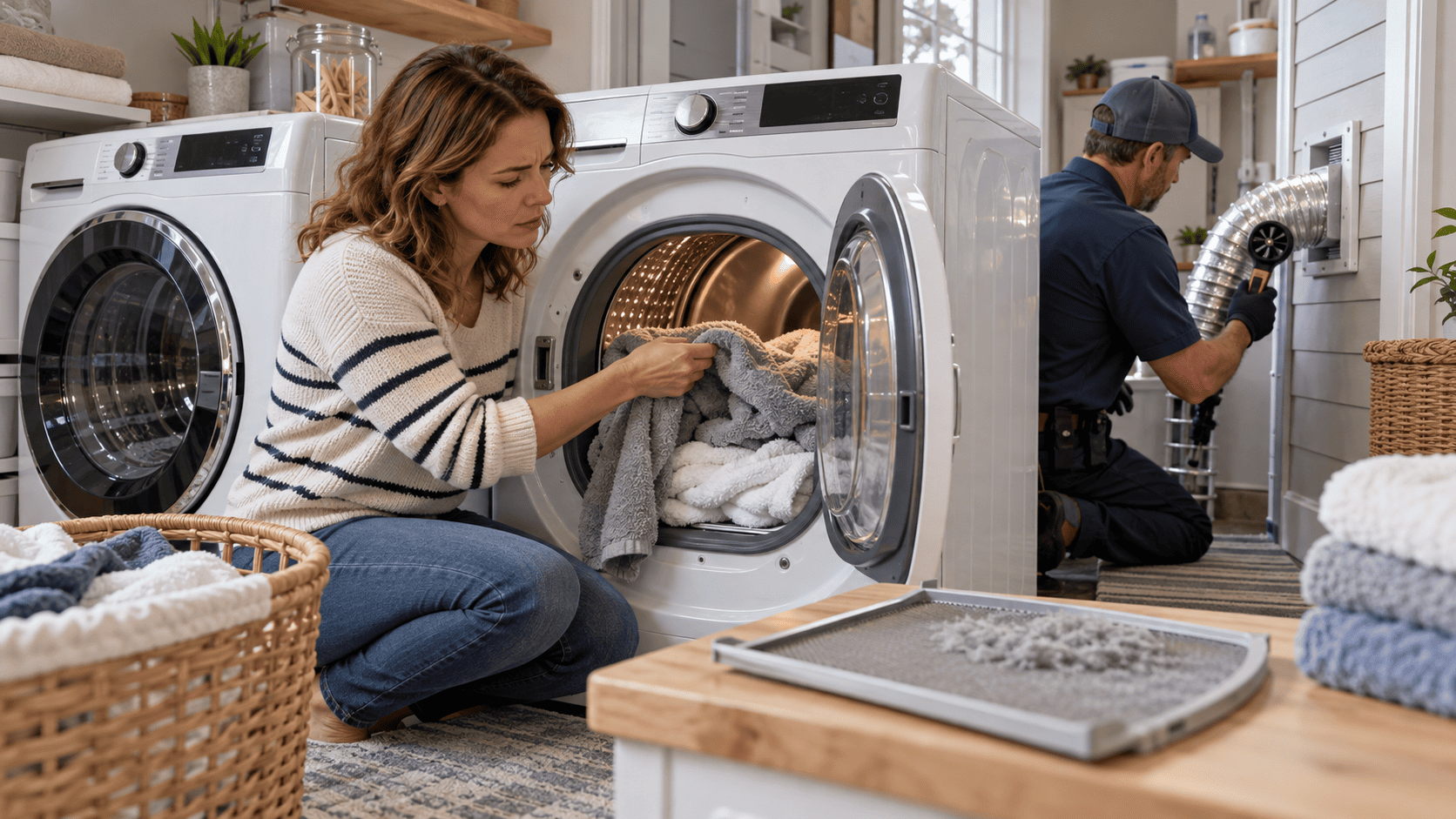
Homeowner checking damp clothes inside a dryer while inspecting the dryer vent after laundry begins taking two cycles to dry.
Why Is My Dryer Taking So Long to Dry Clothes?
Your Dryer Needs Two Cycles to Dry Clothes. That Can Be a Warning Sign
If clothes suddenly need two dryer cycles, do not automatically blame the appliance. Restricted airflow or lint buildup may be slowing drying and increasing heat.
Your Dryer Used to Need One Cycle. Now It Needs Two. Check This.
Your towels used to dry in one cycle.
Now they come out hot—and still damp.
So you press Start again.
That may be costing more than time.
CPSC says unusually long drying can be a sign that the lint screen or exhaust duct is blocked.
And restricted airflow can allow excessive heat to build inside a dryer.
Before replacing the appliance, go outside while it is running and check one thing:
Is air actually coming out of the vent?
Reader Question
Has your dryer ever slowly gone from one cycle per load to two without you realizing when the change started?
Research Notes
The U.S. Consumer Product Safety Commission says lint accumulation in clothes dryers or exhaust ducts can restrict airflow, cause excessive heat buildup and contribute to fires. CPSC says clothes remaining damp after a normal cycle or requiring longer-than-usual drying times can be a sign that the lint filter or exhaust path is obstructed.
CPSC recommends cleaning the lint screen before or after each load, periodically cleaning dryer vents and exhaust ducts, checking the exterior vent while the dryer operates, and keeping the area behind and around the dryer clear of lint and clutter.
CPSC recommends replacing plastic or foil accordion-style transition ducting with rigid or corrugated semi-rigid metal duct because flexible plastic and foil products can trap lint and are more easily kinked or crushed, reducing airflow.
CPSC has estimated an annual average of approximately 6,400 U.S. clothes-dryer fires in one published safety campaign, causing injuries and significant property damage. Its current clothes-dryer safety material continues to warn that thousands of residential fires annually are attributed to household gas and electric dryers.
CPSC also warns that clothing contaminated with gasoline, cooking oils, cleaning agents, finishing oils or similar substances needs special laundering and drying precautions because residual material can create ignition hazards.
Safety Note
Stop using a dryer if you see smoke, sparks, flames, unusual overheating, smell burning, or observe physical or electrical damage. Do not disassemble gas, electrical or internal dryer components unless qualified to do so. Follow the manufacturer’s instructions and use a qualified appliance technician or dryer-vent professional when the exhaust path is inaccessible, heavily blocked or requires repair.
dryer takes two cycles to dry, clothes still damp after dryer, dryer vent clogged, dryer not drying clothes, dryer vent cleaning, dryer overheating, lint buildup dryer, dryer takes forever to dry, clothes dryer fire risk, dryer airflow problem
Clothes Dryer, Dryer Vent, Laundry, Home Maintenance, Fire Safety, Energy Efficiency, Appliances, Lint, Home Improvement, Everyday Problems