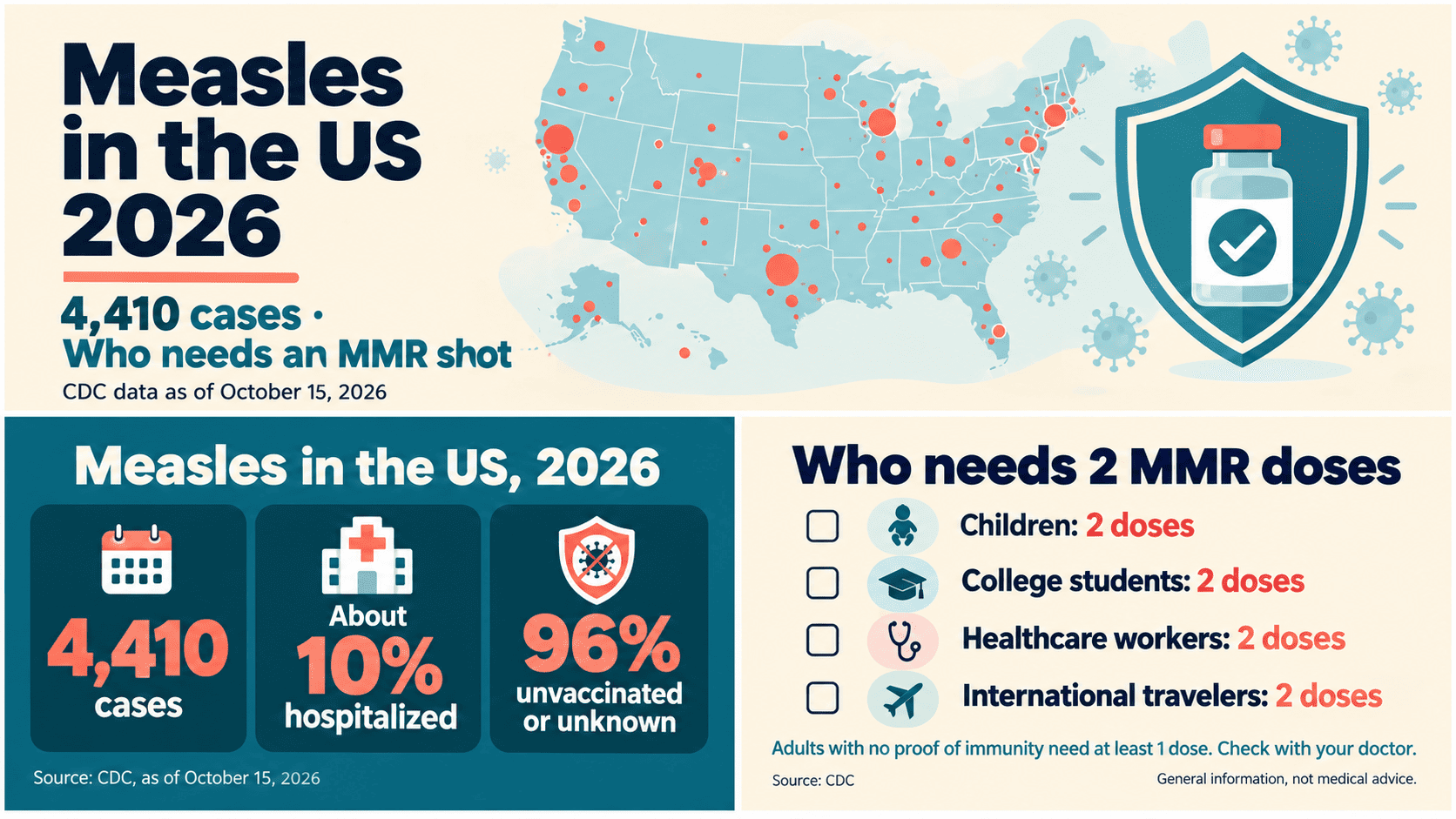
The United States has reported 4,410 confirmed measles cases in 2026 as of October 15, the CDC said on October 16. That is about 93% more than all of 2025 (2,289 cases) and the highest annual total since measles was declared eliminated in 2000. The country is on track for its worst year since 1991.
About 96% of cases are in people who are unvaccinated or whose vaccination status is unknown, and roughly 10% of patients have been hospitalized. Here is where the outbreaks are, the symptoms to know, who needs an MMR shot and what to do if you think you or your child has measles. This is general information, not medical advice.
Measles in the US 2026: the numbers
Measure | Latest |
|---|---|
Confirmed cases (as of October 15) | 4,410, up 330 from a week earlier |
All of 2025 | 2,289 |
New outbreaks in 2026 | 42 |
Cases linked to outbreaks | 96% |
Unvaccinated or unknown vaccination status | 96% |
Hospitalizations | 451 (about 10%) |
Deaths | 2 confirmed by the CDC; Pennsylvania has reported 5, and a county coroner a sixth |
Age groups | Ages 5 to 19: 42% of cases; adults 20 and over: 41% |
States with cases | 45 states and Washington, DC |
The CDC recently changed how it counts measles deaths, using National Center for Health Statistics data rather than state reports, so its death count is lower than state figures. The Pan American Health Organization is due to review the US measles elimination status at its meeting in November, after postponing the decision from April.
Doctors say the true total is probably higher, because many families with measles are never tested.
Where the major outbreaks are
State | Case count | Status |
|---|---|---|
Pennsylvania | About 1,260 cases as of October 16, with 238 hospitalizations | The largest outbreak in the country this year, centered on Lancaster and Mifflin counties; the state reports five deaths and a coroner reported a sixth |
Wisconsin | 258 cases as of October 6 | Still growing, mainly in southwest counties |
Ohio | 206 cases | Third outbreak of the year declared July 30 |
Virginia | 178 cases | Count unchanged since mid-September |
Texas | 192 cases | Down from 803 in 2025 |
Florida | 148 cases | Up from 8 last year |
New York | 108 cases as of October 3 | State disaster emergency declared October 5, the first such declaration |
Arizona | 110 cases | Down from 222 last year; the Mohave County outbreak was declared over in June |
Kentucky | 94 cases | Concentrated in western Kentucky |
South Carolina's outbreak in Spartanburg County, which reached 997 cases, was declared over on April 27. It was the largest single outbreak since elimination in 2000. Utah's outbreak has 724 diagnosed residents, with none reported in the last three weeks.
In New York's emergency order, pharmacists, paramedics and midwives can give measles vaccines and nurses can order testing. In Pennsylvania, providers gave more than 53,000 MMR doses in September, more than double a typical month, according to the state.
Measles symptoms and how it spreads
Measles is one of the most contagious diseases, and it can be dangerous in babies and young children.
Stage | What happens |
|---|---|
7 to 14 days after exposure | First symptoms: high fever (can pass 104°F), cough, runny nose and red, watery eyes |
2 to 3 days after symptoms begin | Tiny white spots (Koplik spots) may appear inside the mouth |
3 to 5 days after symptoms begin | A rash starts as flat red spots at the hairline, spreads down the face, neck, body, arms and legs, and the fever can spike |
How it spreads: through the air when an infected person coughs or sneezes. People are contagious from about four days before the rash appears until about four days after, according to the CDC, and the virus can linger in the air in a room after the person has left.
Complications
- About 1 in 5 unvaccinated people in the US who get measles is hospitalized.
- About 1 in 10 children with measles gets an ear infection.
- As many as 1 in 20 children gets pneumonia, the most common cause of death from measles in young children.
- About 1 in 1,000 children develops encephalitis (brain swelling), which can cause convulsions, deafness or intellectual disability.
- Nearly 1 to 3 in 1,000 children who get measles die.
- Pregnant women are at risk of premature birth and low birth weight.
- Measles can weaken the immune system for months or even years, which scientists call immune amnesia.
Those at higher risk of complications include children under 5, adults over 20, pregnant women and people with weakened immune systems.
Who needs an MMR shot
The CDC says the best protection against measles is the MMR vaccine (measles, mumps and rubella). Two doses are 97% effective against measles, and one dose is 93% effective. Most people who are vaccinated are protected for life.
Group | CDC recommendation |
|---|---|
Children | Two doses: the first at 12 to 15 months and the second at 4 to 6 years |
Adults | At least one documented dose if there is no evidence of immunity |
College students, healthcare workers, international travelers and close contacts of people with weakened immune systems | Two doses, at least 28 days apart |
Infants 6 to 11 months who will travel internationally | One early dose before travel, then two more doses after the first birthday |
People in an outbreak area | Public health authorities may advise an extra dose |
Evidence of immunity means written proof of vaccination, a blood test showing immunity, a lab-confirmed past infection or being born before 1957. If you can't find your records, the CDC says it is safe to get another dose.
Vaccinated in the 1960s? Documentation of a live measles vaccine means you probably don't need another. People vaccinated before 1968 with a killed vaccine, or an unknown type, should be revaccinated.
Who should check with a doctor first: people who are pregnant or may be pregnant, have a weakened immune system, have had a severe allergic reaction to a previous dose, or have other conditions the CDC lists. MMR is safe for breastfeeding mothers, and the CDC says there is no link between the MMR vaccine and autism.
Cost and access: most insurance plans cover MMR, and the Vaccines for Children Program provides free vaccines for eligible children. You can also ask at pharmacies, health departments and community clinics.
If you think you or your child has measles
- Call before you go in. Phone your doctor, urgent care or health department first, so they can arrange care without exposing others in the waiting room.
- Stay home and keep away from others, especially babies, pregnant women and people with weak immune systems.
- If you were exposed and aren't immune, talk to a doctor quickly. MMR within 72 hours of exposure may give some protection or make illness milder, and some high-risk people can get immune globulin within 6 days.
- Go to emergency care for trouble breathing, a high fever that won't come down, severe drowsiness, seizures, confusion or signs of dehydration, and tell staff about the possible measles first.
- Follow health department advice on how long to stay home.
Measles myths and facts
Myth | Fact |
|---|---|
"Measles is just a rash" | It can cause pneumonia, brain swelling, hospitalization and death |
"The MMR vaccine causes autism" | Studies in many countries have found no link |
"Vaccinated people can't get measles" | It is possible but uncommon, and symptoms are usually milder |
"It's only a children's disease" | In 2026, 41% of cases are in adults |
"Getting measles builds good immunity" | Measles can damage the immune system for months or years |
Measles in the US FAQ
How many measles cases are there in the US in 2026? 4,410 confirmed cases as of October 15, 2026, according to the CDC.
Which state has the most measles cases? Pennsylvania, with about 1,260 cases as of October 16.
What are the first signs of measles? High fever, cough, runny nose and red, watery eyes, usually 7 to 14 days after exposure, followed by a rash about 3 to 5 days later.
How contagious is measles? It is one of the most contagious diseases. People can spread it from about four days before the rash appears until about four days after.
Who should get the MMR vaccine? All children (two doses), and adults without evidence of immunity (at least one dose, with two for some groups such as healthcare workers, students and international travelers).
How effective is the MMR vaccine? Two doses are 97% effective against measles, and one dose is 93% effective.
What should I do if I've been exposed? Call your doctor or health department. MMR within 72 hours may help, and some high-risk people can get immune globulin within 6 days.
Is there a measles treatment? There is no specific antiviral cure, so care focuses on supportive treatment and on watching for complications, with hospital care when needed.
Sources
This article is general information, not medical advice. Data as of October 20, 2026.
- CDC: measles cases and outbreaks
- CDC: measles symptoms and complications
- CDC: measles vaccination
- Contagion Live: measles update, October 16, 2026
- Detroit News (Reuters): CDC reports 4,410 measles cases as outbreak grows
- ABC News: more than 4,400 measles cases reported in the US
- Becker's Hospital Review: measles in 2026, where the major outbreaks stand
- USAFacts: how many measles cases are there in the US
- AAP Red Book Online: measles outbreaks