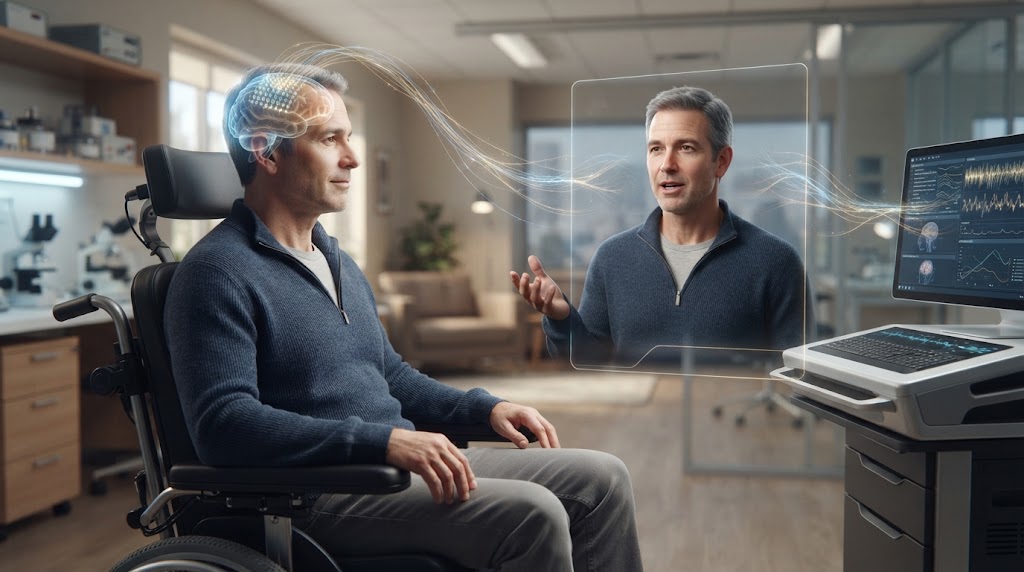
Scientists have demonstrated a brain-computer interface that can decode intended speech and body gestures at the same time, allowing people with severe paralysis to communicate through a digital avatar. The advance moves neuroprosthetics beyond simply restoring words toward something much closer to natural human expression.
Published: September 15, 2026
Can a Brain Implant Restore Body Language? Scientists Decode Speech and Gestures at the Same Time
Brain implants have already helped people with paralysis turn neural activity into words. Now researchers have demonstrated something more subtle: one implant decoding both intended speech and gestures such as nodding, waving and shrugging—simultaneously.
By Health & Science Desk | September 15, 2026
Human communication is not made of words alone.
Imagine somebody saying:
“Maybe.”
Now imagine that person nodding while saying it.
Then imagine them shaking their head.
The spoken word is identical.
The meaning is not.
A shrug can communicate uncertainty.
A wave can say hello without speech.
A nod can reinforce agreement.
A hand movement can add emphasis before a sentence has even finished.
For people who lose both speech and body movement because of severe paralysis, this entire layer of communication can disappear at once.
Over the past several years, brain-computer interfaces have begun recovering pieces of that lost ability.
Some systems can turn attempted speech into text.
Others can control a computer cursor.
Others can synthesize a person's voice or animate parts of a digital face.
Now scientists at the University of California, San Francisco have demonstrated a new step:
one implanted brain-computer interface that can decode intended speech and physical gestures at the same time.
The study, published September 14 in Nature Neuroscience, showed that electrical activity recorded from a single high-density implant over the sensorimotor cortex could drive parallel speech and gesture decoders—and use those outputs to control a personalized virtual avatar.
It is an early proof of concept.
The simultaneous system was tested in only two participants.
Its vocabulary was limited.
It required brain surgery.
And it is nowhere close to a consumer device.
But the goal is unusually human:
not merely helping somebody produce words again,
but helping them express themselves.
What Exactly Did the Researchers Build?
The implant used in the study was a high-density electrocorticography, or ECoG, array.
Unlike an EEG cap, which records electrical activity through the skull, ECoG electrodes sit much closer to the brain.
The device contained 253 disk-shaped electrodes, spaced about 3 millimetres apart.
The arrays were surgically placed beneath the skull over the left hemisphere, covering regions of the sensorimotor cortex involved in speech production and body movement.
The electrodes do not read sentences stored somewhere inside the brain.
Instead, they measure patterns of electrical activity generated when a participant attempts to perform actions such as:
speaking,
nodding,
waving,
shrugging,
or moving parts of the upper body.
Machine-learning models then learn associations between particular neural patterns and the intended action.
The decoded output can be sent to a computer.
In this experiment:
speech appeared as text
while
gestures animated a personalized digital avatar.
And the two could happen together.
Why Is Doing Both at Once Difficult?
At first, this might sound straightforward.
If scientists already know how to decode speech and already know how to decode movement, why not simply run both systems simultaneously?
Because the brain is not organized like a computer hard drive with neatly separated folders.
Speech signals here.
Arm signals there.
Head movement somewhere else.
There is some anatomical organization.
But the neural populations involved in different movements can partially overlap.
The UCSF researchers found that electrodes responding during speech and those responding during gestures were not completely separate.
Some areas of the precentral gyrus showed activity during both.
That creates a decoding problem.
A system trained only on someone saying a phrase by itself may behave differently when that same person tries to say the phrase while also nodding.
Likewise, a movement decoder trained only on isolated gestures may misinterpret neural activity when speech is happening simultaneously.
The researchers therefore tested models in three situations:
speech only
gesture only
and
speech + gesture together.
Their key discovery was that training the models on both isolated and simultaneous behaviour improved performance when the two decoders were operating in parallel.
In other words:
the AI had to learn what natural multitasking looks like inside the brain.
Who Took Part in the Study?
Three people with severe paralysis participated in the broader movement-decoding experiments.
Their conditions included:
brainstem stroke
and
amyotrophic lateral sclerosis, or ALS.
The most advanced simultaneous speech-and-gesture experiments focused on two participants.
One participant had severe speech and movement impairment following a brainstem stroke.
He silently attempted five phrases and performed or attempted gestures including:
waving,
nodding,
hand shaking,
and clapping.
The second participant had ALS, a progressive neurodegenerative disease affecting the nerve cells controlling voluntary movement.
He used a set of:
10 speech phrases
and
10 gestures
including actions such as a shrug and thumbs-up.
Because his physical movement was severely impaired, some gestures were imagined rather than visibly performed.
That point is important.
The system is not watching the body and guessing the gesture.
It is decoding the brain activity associated with the person's attempt or intention to perform it.
How Accurate Was It?
The results varied depending on the task and participant.
For one participant with ALS, real-time simultaneous decoding across ten speech phrases and ten gestures achieved about:
70% accuracy for speech
and
66% accuracy for gestures.
In a smaller conversational demonstration, average performance reached:
75% for speech
and
85% for gestures.
Another participant showed very high performance in a more limited conversational test, although the number of trials and possible responses was substantially smaller.
That distinction matters.
A system selecting among five possible responses can achieve high accuracy much more easily than one trying to understand unrestricted everyday conversation.
The study therefore should not be interpreted as:
“Scientists can now decode anything a paralysed person wants to say or gesture.”
They cannot.
The researchers demonstrated a constrained vocabulary in an experimental setting.
The achievement is the architecture:
one implant → multiple kinds of intended communication → decoded in parallel.
Why Decode Gestures If Speech Can Already Be Restored?
Because communication is not transcription.
A text box can tell somebody what you said.
It cannot always tell them how you meant it.
Imagine four conversations.
“Sure.”
“Sure” + enthusiastic nod.
“Sure” + shrug.
“Sure” + head shake.
The word stays the same.
The social meaning changes.
Gestures can communicate:
certainty,
doubt,
agreement,
rejection,
urgency,
humour,
attention,
emotion,
and emphasis.
Nature's report on the research highlights exactly this problem: ordinary communication depends heavily on body language as well as speech.
For somebody with paralysis, restoring speech alone may therefore recover information while still leaving part of their personality trapped.
The long-term ambition of multimodal BCIs is much bigger.
Not:
“Can we make the computer output the correct sentence?”
But:
“Can the system help this person communicate like themselves again?”
The Digital Avatar Is More Important Than It Looks
The researchers connected the decoded signals to a personalized full-body virtual avatar.
If the BCI detected a gesture, the avatar performed it.
If it decoded speech, the words appeared as text.
The researchers also demonstrated a virtual conversation in which the participant's avatar could interact with another avatar using:
speech alone,
gestures alone,
or
both simultaneously.
This may initially seem cosmetic.
It is not.
Imagine somebody with severe paralysis communicating through a conventional typing interface.
The words arrive.
But the listener does not see:
the intended wave,
the emphatic nod,
the shrug,
or the bodily rhythm normally accompanying speech.
A digital embodiment can potentially return some of that missing social information.
Previous UCSF work had already demonstrated a BCI controlling a digital face and synthesized voice.
This new work extends the concept toward multi-effector communication—different forms of intended movement operating together.
The destination is not merely brain-to-text.
It is something closer to:
brain-to-presence.
Is This “Mind Reading”?
No.
That phrase is likely to appear around almost every brain-decoding breakthrough.
But it misrepresents what this system actually does.
The researchers did not place an implant into a participant and begin extracting arbitrary thoughts.
The models had to be trained.
Participants were asked to attempt specific phrases or specific gestures.
The system learned the neural patterns associated with those intended actions.
It then classified new attempts among the vocabulary it had been taught.
So if a participant is sitting quietly thinking about:
their childhood,
a private memory,
a political opinion,
or what they want for dinner,
this study does not demonstrate that the implant can simply recover those thoughts.
The difference is enormous.
This system decodes brain activity connected to intended communication and attempted motor behaviour.
That is not the same thing as unrestricted access to someone's inner monologue.
Why Does the Brain Still Produce Movement Signals When the Body Cannot Move?
This is one of the most fascinating ideas behind neuroprosthetics.
Paralysis can disconnect intention from execution without necessarily eliminating the brain's ability to formulate the movement.
A person may intend:
move my hand,
say hello,
nod yes,
or
shrug,
but damage to the nervous system prevents the appropriate muscles from carrying out that instruction.
Brain-computer interfaces attempt to intercept the signal earlier in the chain.
Instead of:
brain → spinal cord / motor pathway → muscle → movement
the pathway becomes:
brain → electrode → computer decoder → external device.
The muscle can effectively be bypassed.
That external device might be:
a cursor,
robotic arm,
speech synthesizer,
text interface,
wheelchair,
or digital avatar.
This is why paralysis does not necessarily mean the brain has stopped representing the intended action.
The command can still exist even when the body cannot execute it.
The Study Also Revealed Something Interesting About the Motor Cortex
Classic diagrams often present the motor cortex as a tidy map of the body.
One region controls the hand.
Another controls the face.
Another controls the tongue.
Reality appears more complicated.
The UCSF team found broad organization across the sensorimotor cortex, but the neural activity for speech and upper-body movement also showed overlap.
That helps explain why building a combined decoder is difficult.
But it also reveals why a sufficiently large cortical implant can potentially support many forms of output.
The researchers used an electrode grid spanning a relatively broad sensorimotor area.
That allowed the same implanted device to capture activity related to:
speech,
orofacial movements,
hands,
arms,
and other movements.
The result suggests that future BCIs may not need separate brain implants for every function.
One sufficiently capable interface might eventually support multiple forms of control.
Brain Interfaces Have Advanced Remarkably Quickly
This breakthrough sits inside a larger progression.
In 2012, researchers demonstrated that people with paralysis could use brain signals to control robotic arms.
In 2021, an attempted-handwriting BCI achieved about 90 characters per minute with 94% raw accuracy—an important milestone toward practical brain-to-text communication.
By 2025, researchers had demonstrated BCIs capable of producing more natural synthesized speech from attempted vocalization.
And in 2026, another Nature Medicine study showed that a man with ALS could use a speech-and-cursor BCI independently at home on a near-daily basis, addressing one of the field's biggest practical challenges: systems that work without a laboratory team standing beside the user.
The direction is clear.
BCIs are gradually moving from:
single laboratory demonstrations
toward
multi-function systems capable of fitting into daily life.
The new speech-and-gesture work adds another missing piece:
natural communication often involves several motor systems at once.
Why AI Is Essential to the System
The implant records enormous amounts of electrical information.
Those signals are noisy.
Different electrodes respond differently.
Neural activity varies between people.
The same intended action can even produce slightly different patterns across repetitions.
Machine-learning algorithms are therefore used to find patterns humans could never reliably identify by looking at raw electrical traces.
The decoder learns:
when this distributed neural pattern appears, the participant is probably attempting this phrase
or:
this pattern corresponds to a particular gesture.
Importantly, the researchers found that the training data mattered enormously.
Models trained only on isolated speech and gestures did not automatically perform well when speech and gestures occurred together.
Adding simultaneous examples improved performance.
That is a useful reminder that AI systems are only as good as the situations represented during training.
Even the brain changes context.
What Are the Biggest Limitations?
There are several.
1. The study was tiny
Only three participants took part in the broader movement-decoding experiments.
Only two were used in the simultaneous speech-and-gesture portion.
That is enough for a proof of concept.
It is nowhere near enough to establish how well the system would work across the large and diverse population of people with paralysis.
2. The vocabulary was restricted
One participant used:
5 speech utterances,
4 gestures,
and 12 combined speech-and-gesture pairings.
Another used:
10 phrases,
10 gestures,
and 100 possible combinations.
Natural language contains effectively unlimited sentences.
Natural body language is also enormously varied.
The research demonstrates simultaneous decoding.
It does not yet reproduce unrestricted human conversation.
3. It requires surgery
The ECoG array is implanted beneath the skull.
The electrodes sit on the brain's surface, connected through hardware secured to the skull and external electronics.
Any implanted neural device raises issues involving:
surgery,
infection,
hardware durability,
signal stability,
maintenance,
and long-term safety.
Those trade-offs may be reasonable for somebody with profound paralysis.
They are very different from the risk calculation for a healthy person.
4. Every brain is different
The researchers observed variation in how movement-related signals were organized across participants.
Stroke and neurodegenerative disease can also change neural organization.
A decoder developed for one person may therefore not simply work in another person's brain.
Future systems will need either:
much faster individual calibration,
or
models able to generalize across people.
That remains an important research challenge.
Could This Eventually Control a Robot Body?
Potentially, parts of the same principle could be used.
The system already decodes intended motor actions.
A digital avatar is simply one possible output.
In theory, decoded neural commands could eventually control:
robotic arms,
assistive devices,
smart-home systems,
powered wheelchairs,
or other physical machines.
But this study did not demonstrate unrestricted robotic body control.
The gestures were limited.
The goal was communication.
That distinction matters.
A system decoding a shrug for a virtual avatar is not equivalent to safely controlling a complex humanoid robot.
Could It Restore Facial Expression Too?
Possibly.
UCSF researchers have previously demonstrated systems in which attempted speech controlled:
synthetic voice
and
facial animation.
The natural direction for future research would be to combine more channels of expression:
speech,
facial movement,
head movement,
hand gestures,
and perhaps other body movements.
A future user might say:
“I'm fine.”
And the system could potentially communicate not only the words but also:
a smile,
a nod,
a gesture,
and a personalized synthetic voice.
At that point the neuroprosthesis begins recovering not simply language—
but some of the social richness surrounding language.
What About Privacy?
This technology also raises a future question that will become increasingly important as BCIs improve.
Brain data is unusually intimate.
A conventional computer can record:
what you type,
where you click,
and what you search.
A brain-computer interface records electrical activity generated by the nervous system itself.
Current clinical BCIs remain narrow and heavily supervised.
But if future systems become:
wireless,
always on,
cloud-connected,
and capable of decoding more types of intention,
society will need rules concerning:
who owns neural data,
where it is stored,
who can train AI on it,
whether employers or insurers can access it,
and whether users can permanently delete it.
Today's system is not secretly reading people's private thoughts.
But the technology is advancing rapidly enough that neural privacy should be designed before it becomes a crisis, not after.
Does This Mean Paralysis Could Eventually Be “Cured”?
No.
A neuroprosthesis and a cure are different things.
This system does not repair:
a damaged brainstem,
degenerating motor neurons,
or disconnected muscles.
It creates an alternative pathway around part of the damage.
That can still be life-changing.
Consider eyeglasses.
They do not biologically rebuild the eye.
They compensate for an impaired function.
A sophisticated BCI could play a similar role for some forms of paralysis:
not curing the underlying disease,
but restoring capabilities the disease removed.
Communication may be one of the most important of those capabilities.
Why This Research Matters More Than a Faster Typing Speed
For years, BCI performance could be discussed with numbers:
characters per minute,
words per minute,
accuracy,
latency.
Those measures are important.
A communication system that is painfully slow is difficult to use.
But people do not communicate like stenographers.
We hesitate.
Gesture.
Laugh.
Nod.
Wave.
Emphasize.
Interrupt.
React silently.
Body language carries meaning alongside vocabulary.
That is why this study represents a conceptual change.
It asks something beyond:
How efficiently can we extract words from brain activity?
It asks:
How much of human expression can technology restore?
The Destination Is Not Telepathy
It is tempting to frame every brain implant breakthrough as the beginning of science-fiction telepathy.
This one is more interesting when described accurately.
A person knows what they want to communicate.
Their brain produces patterns associated with attempting those words and movements.
Paralysis prevents their body from fully expressing them.
The implant records the neural activity.
AI translates it.
A digital system completes the action that the body could not.
There is nothing mystical about that chain.
What is remarkable is that the chain is becoming fast and accurate enough to feel useful.
And now it can carry more than words.
From Brain-to-Text to Brain-to-Presence
That may ultimately be the most important implication of the research.
Restoring text is powerful.
Restoring voice is better.
Restoring a face adds another layer.
Restoring gestures begins returning the rhythm of human conversation itself.
The current experiment is still small.
Its vocabulary is limited.
The hardware is invasive.
Accuracy is far from perfect.
And years of clinical research will be required before systems like this become routine medical tools.
But its direction is unmistakable.
Scientists are no longer asking only whether a paralysed person's brain can operate a machine.
They are beginning to ask whether the machine can help that person become visibly and socially present again.
The future neuroprosthesis may therefore look less like a keyboard controlled by thoughts.
And more like a digital extension of the person using it.
A voice.
A face.
A wave.
A nod.
A shrug.
Sometimes the difference between communication and conversation is that small.
Frequently Asked Questions
What did the new brain implant accomplish?
Researchers demonstrated that one high-density cortical implant could decode intended speech and upper-body gestures simultaneously and use those outputs to control a personalized digital avatar.
Where was the research conducted?
The work was led by researchers at the University of California, San Francisco, and was published in Nature Neuroscience on September 14, 2026.
How many electrodes were used?
The implanted ECoG array contained 253 electrodes positioned across a relatively large area of the sensorimotor cortex.
How many people participated?
Three participants with severe paralysis took part in the broader movement-decoding research. The simultaneous speech-and-gesture experiments focused on two participants.
What caused their paralysis?
Participants included people with severe paralysis resulting from brainstem stroke and ALS.
What kinds of gestures could the BCI decode?
Experimental gestures included actions such as nodding, waving, shrugging, clapping and giving a thumbs-up, depending on the participant and task.
Could the system decode speech and gestures at exactly the same time?
Yes. That is the main advance. Parallel models decoded attempted speech and intended gestures during simultaneous trials.
How accurate was it?
In one participant's real-time simultaneous task involving ten phrases and ten gestures, speech decoding reached about 70% accuracy and gesture decoding about 66%. Performance varied by participant and experimental task.
Is this mind reading?
No. The system was trained to recognize specific neural patterns associated with attempted or imagined speech and movements. The research does not demonstrate the ability to extract arbitrary private thoughts.
Does the patient need to physically move?
Not necessarily. Some participants attempted movements they could barely perform, while one participant imagined certain gestures. The implant decoded neural activity associated with the intended action.
Can people use this technology at home yet?
This particular simultaneous speech-and-gesture system remains experimental. Other BCI research has demonstrated long-term independent home use of speech and cursor interfaces, showing that the broader field is moving toward practical deployment.
Does the implant cure paralysis?
No. It bypasses part of the impaired motor pathway by translating neural activity into computer commands. It does not repair the underlying neurological disease or injury.
Could future BCIs control robots?
The same general principle could potentially control assistive hardware, but this study specifically demonstrated communication using text and an avatar rather than unrestricted robotic-body control.
Why are gestures important?
Gestures carry information about emphasis, emotion, uncertainty and social intention. A nod, shrug or head shake can substantially change the meaning of spoken words.
brain computer interface 2026, BCI speech decoder, paralysis communication implant, ALS brain implant, brain implant gestures, digital avatar BCI, speech neuroprosthesis, brain implant AI
Brain-Computer Interface, Paralysis, ALS, Stroke, Neuroscience, Brain Implant, Artificial Intelligence, Speech Decoder, Neuroprosthetics, UCSF