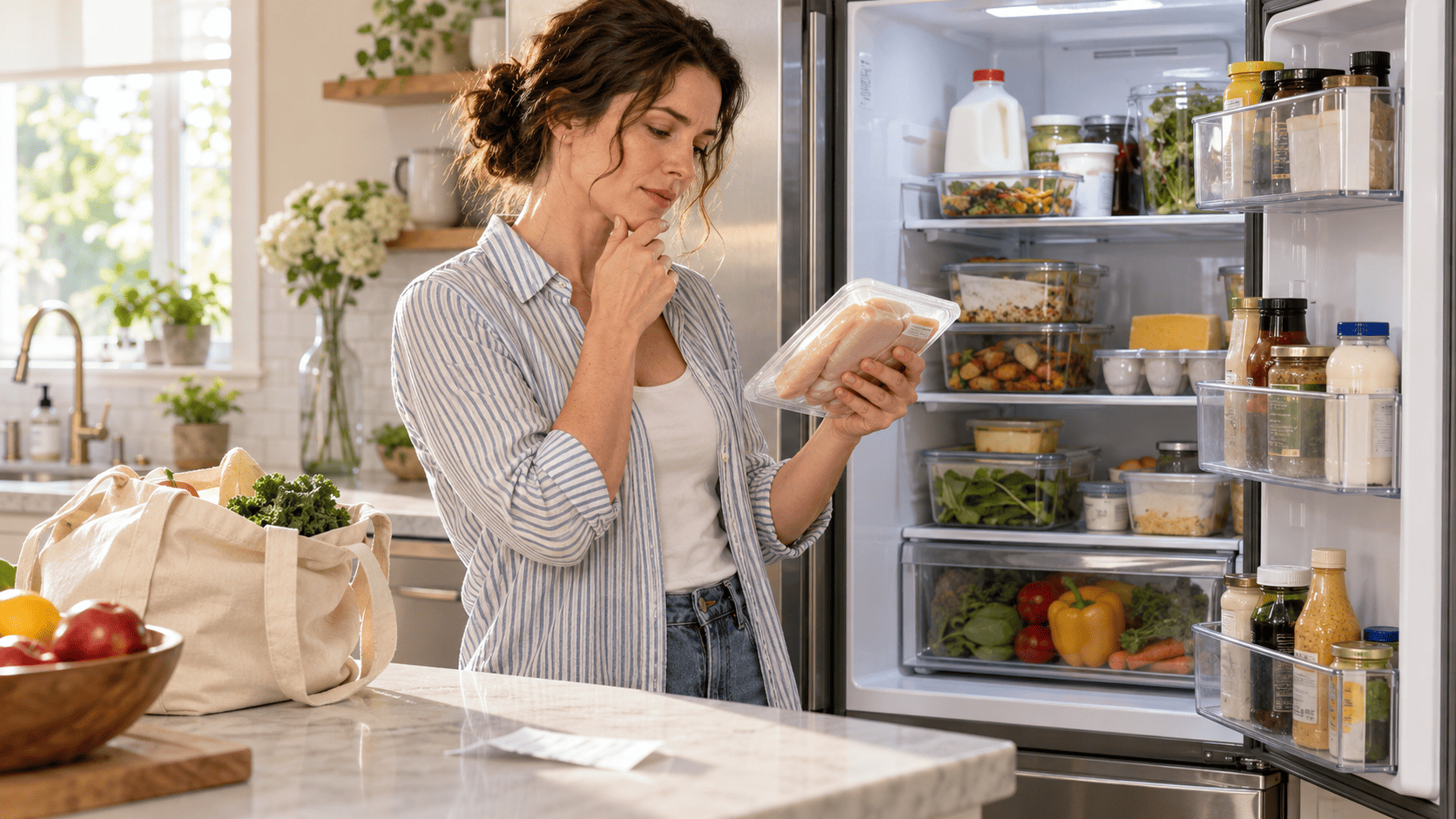
You open the refrigerator, find a carton dated yesterday and hesitate. Is it now unsafe, or did the manufacturer simply expect it to taste best before that date? In the United States, the answer is more complicated than most grocery shoppers realize: for most foods, the date printed on the package is not a universal federal expiration deadline.
First: Most Food Dates Are About Quality, Not an Automatic Safety Deadline
This is the biggest misconception.
USDA says that, with limited exceptions, federal law does not require food manufacturers to place expiration-style dates on foods.
FDA similarly says there is no nationally uniform system of phrases for open food dating, which is why shoppers encounter labels such as:
Best By
Best if Used By
Sell By
Use By
Enjoy By
and other variations.
For many packaged foods, these dates are primarily intended to tell you when the manufacturer expects the product to retain its best flavor or quality.
That means midnight does not necessarily transform perfectly good food into dangerous food.
But that also does not mean every old food is safe to eat.
The printed date is only one piece of the decision.
“Best If Used By” Usually Means Quality
FDA and USDA both support the phrase “Best if Used By” as a clearer way for manufacturers to indicate the point after which a product's quality may begin declining.
FDA says a food past its “Best if Used By” date may still be consumable, although consumers should look for meaningful changes in characteristics such as color, consistency or texture.
Think of it as:
“This should be at its best before this date.”
Not automatically:
“This becomes dangerous tomorrow.”
A box of crackers may become stale.
Cereal may lose crispness.
A shelf-stable sauce may gradually lose flavor.
Those are quality changes.
They are not the same thing as a pathogen making a refrigerated food unsafe.
What Does “Sell By” Mean?
A Sell By date is largely aimed at retailers.
USDA says a Sell-By date tells a store how long to display a product for inventory management.
It is not itself a food-safety date.
That distinction matters.
Suppose you buy chicken on the Sell By date.
The important question afterward is not:
“Is today printed on the package?”
It is:
“How long has this raw chicken been stored in my refrigerator?”
USDA recommends using or freezing raw poultry and ground meat within 1 to 2 days of purchase and raw beef, veal, pork and lamb steaks, chops and roasts within 3 to 5 days.
Storage time matters.
“Use By” Is Where Things Become More Confusing
Consumers understandably interpret Use By as a hard expiration date.
But on most U.S. foods, the terminology is not that simple.
USDA says that, except for infant formula, food dates generally are not indicators of safety under federal law.
Manufacturers can use different phrases to communicate product dating as long as labeling is truthful and not misleading.
That means you should not assume every package carrying “Use By” is governed by one universal federal food-safety rule.
There is, however, one major exception you should remember.
Infant Formula Is Different
Do not apply the casual “probably still fine” approach to infant formula.
FDA requires a Use By date on infant formula containers and says formula should not be used after that date.
The manufacturer guarantees the required nutrient content and quality only through the labeled use-by date.
So when you see:
Use By
on infant formula,
treat it differently from the Best By date on a box of crackers.
Follow the label.
Why Is the System So Confusing?
Because the United States has historically had many different phrases without one universal national consumer-facing date-labeling vocabulary for most foods.
FDA says phrases can vary significantly among manufacturers.
That confusion has consequences.
FDA estimates that misunderstanding food date labels accounts for approximately 20% of consumer food waste.
Imagine millions of households repeatedly throwing away food simply because yesterday's date passed—even when the date was intended primarily as a quality recommendation.
That is a lot of groceries.
And a lot of money.
But Do Not Swing Too Far in the Other Direction
Learning that Best By is usually about quality can create a second mistake:
“Dates don't matter, so I can just smell everything.”
That is not safe reasoning.
FDA warns that food can contain harmful pathogenic bacteria even when it:
looks normal;
smells normal;
and tastes normal.
Spoilage organisms and disease-causing organisms are not the same thing.
A bad smell can tell you food is spoiled.
A normal smell cannot guarantee food is safe.
That is why safe storage time, refrigeration and handling matter just as much as appearance.
Your Nose Is Useful—but It Is Not a Laboratory
If milk smells sour, something is clearly wrong.
If leftovers are slimy or visibly moldy, discard them.
If a package is swollen, leaking or otherwise abnormal, do not use it.
But the reverse does not work reliably.
Food that looks and smells perfectly normal can still contain pathogens.
FDA explicitly warns consumers not to rely solely on appearance, odor or taste to determine safety.
So never taste questionable food merely to determine whether it is safe.
For Refrigerated Foods, Time and Temperature Often Matter More Than the Printed Date
Your refrigerator should be kept at 40°F (4°C) or below.
FoodSafety.gov uses that temperature for its cold-storage guidance.
Why does this matter?
Because refrigeration slows bacterial growth.
It does not stop it completely.
A package can still be within its printed date and become unsafe if it was:
left in a hot car;
stored above safe refrigeration temperature;
opened long ago;
or handled improperly.
The label cannot know what happened after the food left the factory.
Leftovers Have Their Own Clock
This is one of the easiest rules to remember.
USDA says refrigerated leftovers should generally be used within 3 to 4 days.
If you will not eat them during that period, freeze them.
So if you made chicken on Monday, the relevant question on Saturday is not whether the original chicken package had a later date.
The meal has been cooked.
A new storage timeline began.
The leftover container needs to be judged by how long the cooked food has been refrigerated.
Your Takeout Has a Clock Too
Restaurant food does not receive a safety exemption because you paid someone else to cook it.
If you take leftovers home, refrigerate them promptly.
USDA recommends getting perishable leftovers into refrigeration within 2 hours, or within 1 hour when temperatures are above 90°F.
Then use refrigerated leftovers within approximately 3 to 4 days.
That applies whether the food came from:
your kitchen;
a restaurant;
a holiday dinner;
or a delivery order.
The Mystery Container in the Back of the Fridge Is the Real Problem
A common household mistake is saving leftovers without recording when they were made.
Three days later:
“Was this from Tuesday?”
“No, I think Wednesday.”
“Maybe Sunday?”
At that point, the date-label debate is irrelevant.
You no longer know the storage history.
An easy solution is to put the date on the container.
A piece of masking tape and a pen can save a lot of uncertainty.
Raw Ground Meat and Poultry Need Faster Decisions
Some refrigerated foods have much shorter recommended storage periods than people expect.
USDA says raw ground meat, poultry and seafood should generally be used or frozen within 1 to 2 days.
Fresh beef, veal, lamb and pork steaks, chops and roasts generally get 3 to 5 days under refrigeration.
This is why blindly staring at the package date can be misleading.
When the product entered your refrigerator matters.
“But the Sell By Date Is Three Days Away” Is Not a Storage Plan
Imagine you purchase chicken several days before its Sell By date.
You place it in the refrigerator.
Then you decide to cook it four days later because the date printed on the package has not yet arrived.
That conflicts with USDA's much shorter home-storage recommendation for raw poultry.
The store's inventory date and your refrigerator-storage timeline are solving different problems.
If you will not use raw meat or poultry promptly, freezing it is usually the better choice.
The Freezer Changes the Equation
FDA says properly handled food stored continuously at 0°F (-18°C) remains safe indefinitely from a microbial-growth perspective, although quality can decline over time.
That is another important distinction:
freezer storage recommendations often describe quality, not a moment when the frozen food suddenly becomes unsafe.
Freezer burn, for example, is primarily a quality problem.
Texture and flavor may deteriorate.
The food does not become automatically dangerous simply because freezer burn appears.
Freezing Does Not Rescue Food That Was Already Mishandled
Do not interpret the freezer as a reset button.
If perishable food sat unrefrigerated for an unsafe amount of time, putting it in the freezer afterward does not reverse whatever happened during that period.
Safe freezing starts with food that has been handled safely in the first place.
The freezer pauses much bacterial growth.
It does not travel backward through time.
What About Milk?
Milk creates a lot of date anxiety.
The printed date may be intended to communicate product freshness or quality depending on the manufacturer and state requirements.
But once milk is opened, actual storage conditions matter greatly.
Was it kept consistently cold?
Was it left on the breakfast table for a long time?
Does your refrigerator run warm?
Has the carton been repeatedly exposed to room temperature?
The printed date cannot account for those variables.
Use the manufacturer's instructions and proper refrigeration rather than treating the date as the only information that matters.
What About Eggs?
Eggs also require proper refrigeration rather than date-only decision-making.
FoodSafety.gov's cold-storage chart provides specific storage guidance for refrigerated eggs and many other products.
Do not leave eggs unrefrigerated for extended periods and assume the date on the carton guarantees safety.
And discard cracked eggs rather than storing them as though nothing happened.
What About Yogurt?
A yogurt container past a quality date does not automatically become dangerous at midnight.
But again, storage history matters.
If it remained properly refrigerated and is only slightly past a Best By date, the printed date may largely concern quality.
If the container is:
swollen;
leaking;
moldy;
or has other obvious signs of spoilage,
discard it.
And if you cannot establish safe handling or refrigeration, the appearance alone cannot guarantee safety.
Canned Food Plays by Different Rules
Shelf-stable canned foods can remain usable long beyond the short dates associated with refrigerated foods when the cans remain intact and are stored properly.
But the container itself matters.
FoodSafety.gov advises against using damaged, swollen, rusted or severely dented cans.
A bulging can is not the moment to debate Best By terminology.
Discard unsafe-looking packages.
Do not taste the contents to investigate.
Opened Cans Start a New Storage Timeline
Once canned food is opened, it is no longer functioning as a sealed shelf-stable product.
USDA says opened high-acid canned foods such as many tomato products and fruit can generally be refrigerated for about 5 to 7 days, while opened low-acid canned foods such as meat, beans, soups and many vegetables generally have a shorter 3 to 4 day refrigerated storage period.
Again:
opening the package changes the situation.
Does Mold Mean You Can Just Cut Off the Bad Part?
Be careful with generalized internet advice here.
Whether a moldy food can be salvaged depends on what kind of food it is.
Soft, moist foods can allow contamination to extend beneath the visible surface.
FDA's simple consumer guidance is conservative: mold is a sign of spoilage, and the safest practice is to discard moldy food.
Do not casually scrape visible mold from:
soft leftovers;
sauces;
yogurt;
or similar foods
and assume everything underneath is fine.
What About Bread With One Moldy Slice?
Mold spreads through microscopic structures that are not necessarily limited to the visible colored patch.
The simplest household approach is not to perform surgery on visibly moldy bread.
Discard it.
Saving a few slices of bread is not worth gambling on contamination you cannot see.
The Refrigerator Door Is Warmer Than You Think
Food does not experience identical temperatures everywhere inside a refrigerator.
The door warms more whenever it is opened.
That makes it a poor place for especially temperature-sensitive foods.
Keep highly perishable products in consistently cold parts of the refrigerator rather than treating every shelf as identical.
And consider using an inexpensive refrigerator thermometer instead of assuming the temperature setting on the dial reflects the actual temperature.
FDA recommends keeping the refrigerator at 40°F or below.
Your Fridge Can Look Cold and Still Be Too Warm
A refrigerator light works.
The milk feels cool.
That does not tell you the exact temperature.
If food seems to spoil unusually quickly, check actual refrigerator temperature.
Possible causes of poor cooling can include:
a door not sealing properly;
overloading;
blocked airflow;
a dirty condenser area;
or mechanical problems.
Food safety starts with the environment where the food is being stored.
Do Not Pack the Refrigerator So Tightly That Air Cannot Circulate
Cold air needs room to move.
An overfilled refrigerator can develop uneven temperatures.
That becomes especially relevant around holidays when every shelf is crowded with:
turkey;
pies;
drinks;
leftovers;
and meal-prep containers.
If your refrigerator is packed like a suitcase, monitor its temperature.
Cold food needs actual refrigeration, not merely a location called “the refrigerator.”
The Pantry Has Quality Dates Too
Dry packaged foods often remain usable beyond quality dates when stored properly.
But quality can deteriorate.
Crackers soften.
Spices lose potency.
Cereal becomes stale.
Oils can become rancid.
The fact that a date is primarily about quality does not mean the product is immortal.
Look for:
package damage;
insects;
moisture;
off odors;
unusual discoloration;
or other deterioration.
Food dates are useful information.
They are simply not the whole story.
Once a Package Is Open, the Printed Date Becomes Less Useful
Imagine two jars with the same Best By date.
One has never been opened.
The other has been open in the refrigerator for three months.
Those are no longer equivalent products.
Opening can expose food to:
oxygen;
moisture;
microorganisms;
and repeated temperature changes.
Follow any “refrigerate after opening” and “use within…” instructions on the package.
The original date was established for a particular storage condition.
You changed that condition when you opened it.
Your Condiment Collection Deserves an Audit
Most refrigerators contain at least one condiment nobody remembers opening.
Mustard.
Salad dressing.
Salsa.
Mayonnaise.
Asian sauces.
Pickles.
Jam.
The solution is not memorizing hundreds of storage limits.
Use a reliable storage reference.
FoodSafety.gov recommends the FoodKeeper resource, which contains storage guidance for hundreds of foods and beverages.
When uncertain about a particular product, checking an authoritative food-specific guide is much better than relying on a random comment thread.
FoodKeeper Is More Useful Than Guessing
FDA and FoodSafety.gov point consumers toward FoodKeeper for information on how long different foods can be stored.
That is valuable because there is no single rule such as:
“Everything lasts seven days.”
Different foods behave differently.
A raw chicken breast, hard cheese, unopened mustard and cooked rice do not belong on the same storage timeline.
Use food-specific guidance.
Food Left on the Counter Has a Different Rule
The printed date becomes much less relevant when temperature control fails.
USDA says perishable foods and leftovers should generally not remain at room temperature for more than 2 hours.
When ambient temperatures exceed 90°F, that drops to 1 hour.
This matters at:
parties;
barbecues;
buffets;
picnics;
and holiday dinners.
A casserole can be two days before its “date” and still be unsafe if it spent too long in the wrong temperature conditions.
Putting It Back in the Fridge Does Not Erase Those Hours
Another common mistake:
food sits out for hours;
everyone finishes eating;
the leftovers go back into the refrigerator;
the next day they look fine.
Refrigeration slows future bacterial growth.
It does not undo earlier temperature abuse.
When food has exceeded safe holding times, follow food-safety guidance rather than trying to save it because it still smells normal.
Who Should Be Extra Careful?
Foodborne illness can be particularly serious for:
pregnant people;
young children;
older adults;
and people with weakened immune systems or certain health conditions.
FoodSafety.gov specifically identifies groups at increased risk of severe foodborne illness.
For higher-risk households, conservative handling and storage practices are particularly important.
An internet experiment to see “how long this is actually good” is not worthwhile.
Can You Trust “If in Doubt, Throw It Out”?
It is a safe slogan.
But using it for every quality date can produce unnecessary food waste.
A better approach is:
If the food was mishandled or its safe storage history is uncertain, do not gamble.
But:
If a shelf-stable food is simply past a Best By quality date, that alone may not mean it is unsafe.
That distinction protects both food safety and your grocery budget.
A Better Refrigerator System Takes Five Minutes
Pick one shelf or basket for:
Eat First
When foods are approaching the end of their useful storage period, put them there.
FDA recommends designating a space for foods that need to be used soon as a way to reduce food waste.
Now the half-container of strawberries does not disappear behind the new groceries.
Tonight's dinner gets easier too.
Use the Freezer Before the Food Becomes a Problem
If you realize on day two that you will not eat those leftovers by day four, freeze them now.
Do the same with meat you purchased but no longer plan to cook immediately.
Freezing should be a planning tool.
Not an emergency procedure performed after food has already spent too long in the refrigerator.
Label Your Own Food
Restaurant containers do not arrive with a useful household storage history.
Neither does the casserole you cooked Sunday.
Write:
what it is;
and the date it went into the refrigerator.
That tiny habit eliminates the weekly conversation:
“Is this still good?”
You will know how long it has actually been there.
Do a Five-Minute Fridge Check Before Grocery Shopping
Before buying more food:
look at what is already open;
check leftovers;
move older foods forward;
freeze anything you will not use soon;
and add expiring ingredients to your meal plan.
FDA specifically recommends checking the refrigerator regularly and eating or freezing foods before they need to be thrown away.
This saves more money than debating expiration dates after food has already been forgotten.
The Fastest Way to Read a Food Date
When you pick up a product, ask three questions.
1. What does the wording say?
Best If Used By?
Sell By?
Use By?
2. What kind of food is it?
Shelf-stable crackers are different from raw chicken.
3. What has happened to it since purchase?
How long has it been refrigerated?
Has it been opened?
Was it left out?
Was it frozen?
Is the package damaged?
Those answers tell you far more than the calendar date by itself.
So Is Food Safe After the “Best By” Date?
Sometimes, yes.
A Best By or Best if Used By date on many U.S. foods primarily indicates the manufacturer's expectation for peak quality rather than a universal federal safety cutoff. FDA and USDA encourage “Best if Used By” specifically because it helps distinguish quality from safety.
But that does not mean you should eat food indefinitely.
Safety depends on:
the type of food;
refrigeration;
storage duration;
whether it has been opened;
how it was handled;
and whether specific safety instructions apply.
For refrigerated perishables, follow reliable storage-time guidance.
For leftovers, remember the 3-to-4-day refrigerator rule.
For raw poultry and ground meat, think 1 to 2 days, not “whenever the Sell By date arrives.”
And for infant formula, the Use By date actually matters: do not use it after that date.
The smartest question is therefore not:
“Has the date passed?”
It is:
“What does this date mean—and has this particular food been stored safely?”
That one distinction can keep good food out of the trash without turning your refrigerator into a food-safety experiment.
-----------------------------------------------------------------------------------------
best by date, best by vs use by, sell by date meaning, food expiration dates, is food safe after best by date, expired food safe to eat, use by date meaning, grocery expiration dates, food storage times, how long leftovers last, food safety refrigerator, USDA food dates, FDA expiration dates, FoodKeeper
Your Electric Bill Jumped—But You Didn’t Use More Power. What Changed?
Your Dryer Needs Two Cycles to Dry Clothes. That Can Be a Warning Sign
Why Is That Credit Card Charge Still Pending? And Why Is the Amount Wrong?
Your Package Says “Delivered”—But It Isn’t There. What Should You Do Next?
That “Best By” Date Is Not Necessarily an Expiration Date
Best By, Sell By and Use By can mean different things. Here’s how to decide when food is still usable—and when storage time matters more than the printed date.
The Date Passed Yesterday. Do You Really Have to Throw the Food Away?
The carton says:
Best By Oct. 20.
Today is Oct. 21.
Trash it?
Not automatically.
For most U.S. foods, the printed date is not a federally mandated safety deadline.
But there is a catch:
the date may matter less than how long the food has actually been sitting in your refrigerator.
And one common product is a major exception where the Use By date really should not be ignored.
Reader Question
Which food date confuses you most—Best By, Sell By or Use By?
Research Notes
FDA says there is currently no universally accepted U.S. terminology for open date labeling on most packaged foods. It supports “Best if Used By” as a standard quality-based phrase and estimates that confusion over date labels accounts for roughly 20% of consumer food waste.
USDA says food dating is generally not federally required except in limited cases and that dates are typically provided to help retailers and consumers judge product quality. A Sell By date is intended primarily for retail inventory management rather than as a safety cutoff.
FDA requires infant formula to carry a Use By date and says formula should not be used after that date.
USDA recommends keeping refrigerated leftovers for 3 to 4 days. Raw poultry, seafood and ground meats generally should be used or frozen within 1 to 2 days, while fresh beef, veal, lamb and pork steaks, chops and roasts generally have a 3-to-5-day refrigerated storage window.
FDA warns that pathogenic bacteria can be present even when food looks, smells and tastes normal. Appearance and odor therefore cannot replace safe time-and-temperature handling.
FoodSafety.gov recommends keeping refrigerators at 40°F or below and provides the FoodKeeper resource for storage guidance covering hundreds of foods and beverages.
Food Safety Note
This article provides general food-storage information. Follow package-specific instructions, recall notices and current FDA/USDA guidance. When a perishable food has been improperly refrigerated, left out too long, has an uncertain storage history, or shows signs of contamination or package damage, discard it rather than tasting it to determine safety
best by vs use by, sell by date meaning, food expiration dates, is food safe after best by date, expiration date on food, use by date, food storage times, how long leftovers last, grocery expiration dates, food safety
Food Safety, Grocery Shopping, Food Waste, Expiration Dates, Best By Dates, Refrigeration, Meal Planning, Kitchen Tips, Food & Drinks, Everyday Problems