Did an Ancient Computer Predict the End of the World?
The idea sounds like science fiction.
A computer from the early 1970s predicts that modern civilization could collapse in the 21st century. Decades later, researchers compare the old forecast with real-world data and find that parts of it still look uncomfortably close.
So is this a real scientific warning, or just viral fear packaged as history?
The honest answer is this:
It is based on a real study, but many viral versions exaggerate it.
There was no magical ancient computer. There was no hidden prophecy. And it did not predict the exact “end of the world.”
What really happened was more serious, and also more useful.
In 1972, a research team linked to MIT and commissioned by the Club of Rome published The Limits to Growth, a famous report about population, industrial output, pollution, food production and resource use on a finite planet. The report used a system dynamics model called World3 to explore possible futures under different assumptions.
The model did not say, “The world will end on this date.”
It asked a harder question:
What happens if population, industrial production and resource consumption keep growing while the Earth’s resources and pollution sinks remain limited?
That question is still relevant today.
What Was World3?
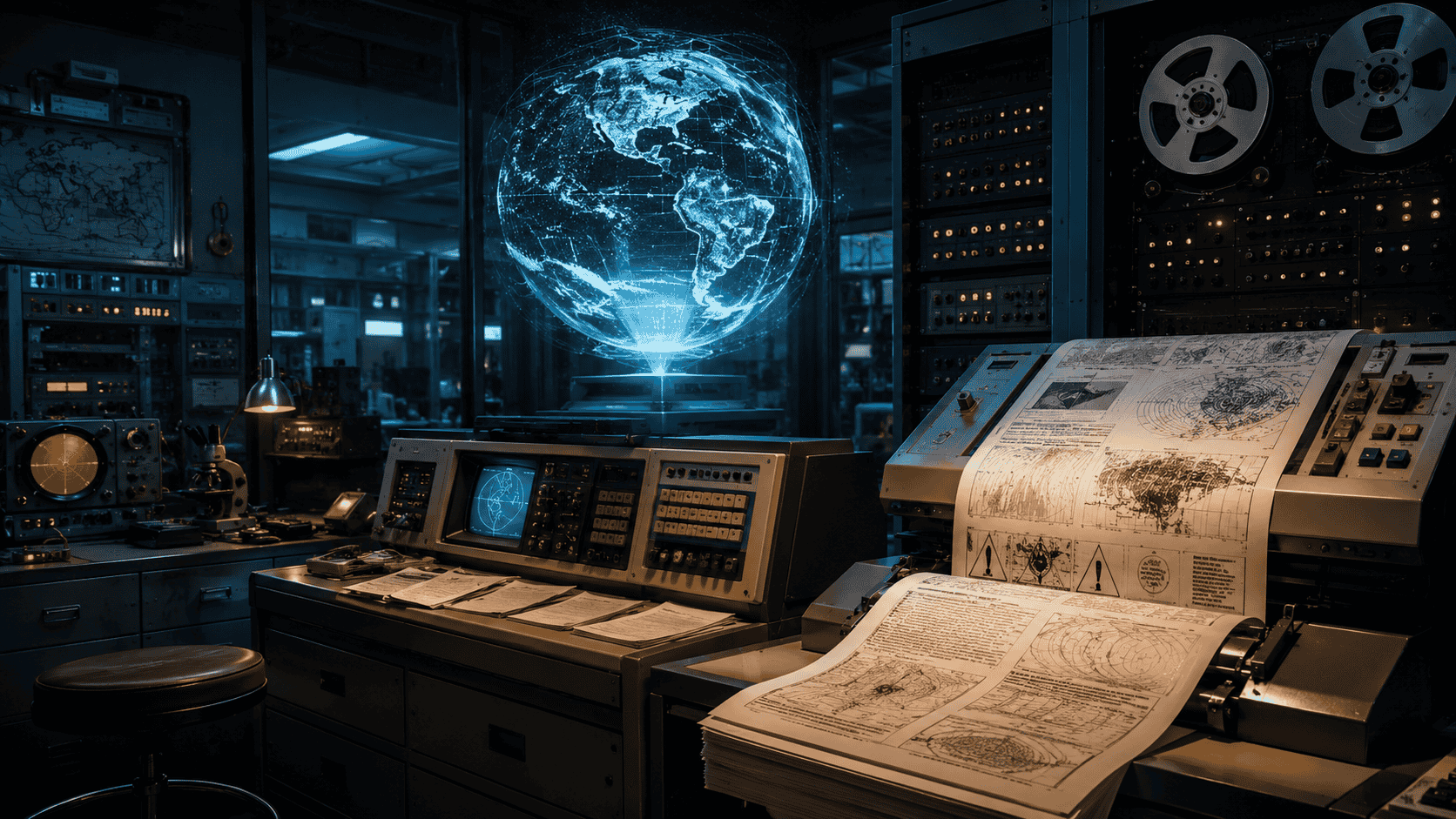
World3 was a computer model designed to simulate interactions between major global systems.
It looked at broad variables such as population, industrial output, food, services, non-renewable resources and pollution. The goal was not to predict tomorrow’s weather or one country’s economy. It was to understand long-term global pressures. The Club of Rome later summarized that the model studied key relationships between population, fertility, mortality, industrial output, food, services, non-renewable resources and pollution.
This matters because the 1970s were not the age of modern AI, cloud computing or today’s supercomputers.
Yet researchers were already using computers to ask big planetary questions.
That part is true.
But calling World3 an “ancient computer” is misleading. It was not a mysterious machine. It was a model built by researchers using the computing tools available at the time.
Did It Predict Collapse Around 2040?
This is where the story becomes more complicated.
The model showed several scenarios. In some of them, if humanity continued with high resource use and pollution while delaying major changes, industrial output and other indicators could peak and decline during the 21st century.
That is not the same as predicting the exact end of civilization.
It is a warning about overshoot.
Overshoot means a system grows beyond what its environment can support. At first, growth looks successful. More production. More consumption. More population. More output. But if the system depends on finite resources and produces too much pollution, it can hit limits and decline.
That was the central warning of The Limits to Growth.
WIRED described the original report as a computer-modeled warning that continued over-extraction, pollution and unsustainable population growth could lead to collapse within a century, while also noting that the model offered scenarios where humanity could choose a more sustainable path.
So the “2040 collapse” claim is partly rooted in real modeling, but it is often simplified too much online.
The model was not a date-stamped prophecy.
It was a scenario-based warning.
Was the Study Secret or Suppressed?
No strong evidence supports the idea that the study was secretly buried for decades.
The Limits to Growth was not hidden. It became a major public report, sold widely and triggered heated debate. WIRED notes that the book sold millions of copies and was translated into many languages.
It was controversial, yes.
It was criticized, yes.
Some economists, politicians and industry voices rejected its assumptions and conclusions.
But “dismissed” is not the same as “secret.”
The report entered public debate and has remained one of the most discussed environmental and economic studies of the last century.
So any claim that it was a lost archive discovery should be treated carefully.
The real story is not that the warning vanished.
The real story is that many societies continued to prioritize growth while postponing difficult resource and pollution decisions.
Did Modern Researchers Confirm It?
There have been multiple efforts to compare the old scenarios with real-world data.
One widely discussed update came from Gaya Herrington, who compared empirical data with several Limits to Growth scenarios. Her work, published in the Journal of Industrial Ecology, found that actual data aligned most closely with scenarios that suggested serious decline could occur if society continued on unsustainable paths.
This does not mean “the end of the world is confirmed.”
It means some real-world trends have followed the warning patterns closely enough to deserve attention.
That is important.
A model from 1972 cannot capture every modern development: renewable energy growth, digital technology, climate policy, global trade shifts, demographic transitions or future innovation.
But it can still be useful if its core warning remains valid:
Unlimited material growth cannot continue forever on a finite planet without consequences.
What Did the Model Get Right?
The model’s strength was not in predicting exact dates.
Its strength was in identifying system behavior.
It warned that population growth, industrial expansion, resource extraction and pollution are connected. If one part of the system grows aggressively without balancing the others, pressure builds elsewhere.
That insight still feels modern.
Climate change, biodiversity loss, water stress, soil degradation, energy transition challenges and pollution all show that economic activity cannot be separated from planetary limits.
The New Yorker, reviewing the long debate around growth, noted that The Limits to Growth warned about the link between resource consumption, population growth and ecological exhaustion, while also observing that economic growth continued dramatically after the book’s publication.
That is the tension.
The world did keep growing.
But environmental pressures also deepened.
Both things can be true.
What Did Critics Get Right?
Critics were also not completely wrong.
The original model was simplified. It could not include every political, technological, cultural and economic factor. It could not predict specific innovations or policy changes. It treated the world at a very broad level.
All models simplify reality.
A model is not a crystal ball.
It is a tool for thinking.
That is why the best way to read World3 is not as a prophecy, but as a warning system.
It tells us what could happen if certain patterns continue.
It does not remove human choice.
Is the “End of the World” Claim False?
The phrase “end of the world” is too dramatic.
The study did not predict that Earth would explode, humanity would vanish, or life would stop in 2040.
It warned that industrial civilization could face severe stress or decline if resource use, pollution and population pressures remained unmanaged.
That is a very different claim.
A serious decline in industrial output, living standards, food security or public stability would be devastating.
But it is not the same as the literal end of the world.
So the viral version is exaggerated.
The underlying warning is real.
Is There Still Hope?
Yes.
This is one of the most important parts people often miss.
The Limits to Growth was not only a doom report. It also presented the possibility of different futures if societies changed direction. The Club of Rome’s own summary emphasizes that the challenge of overshoot is real but can be addressed through forward-looking policy and societal decisions.
That means the message is not:
“Collapse is guaranteed.”
The message is:
“Delay makes the problem harder.”
Humanity still has choices.
Those choices include cleaner energy, less waste, smarter resource use, better urban planning, circular economy systems, stronger climate policy, sustainable agriculture, cleaner industry and more responsible consumption.
Technology can help.
But technology alone is not enough if the system keeps rewarding unlimited extraction and waste.
Why This Story Keeps Going Viral
The story goes viral because it combines three powerful emotions:
Fear.
Mystery.
Validation.
People are fascinated by the idea that an old computer “knew” what modern leaders ignored.
But that framing can be dangerous.
It turns a complex systems study into a doomsday myth.
The better lesson is not that one machine predicted our fate.
The better lesson is that researchers warned decades ago about patterns we still struggle to manage.
And the uncomfortable part is that the warning was not impossible to understand.
Grow forever on a finite planet, and eventually limits push back.
Final Verdict: Fact or False News?
This story is partly factual but often exaggerated.
Fact: A real 1972 report used the World3 model to study global growth, resources, pollution and possible long-term decline.
Fact: Later researchers compared real-world data with the original scenarios and found concerning similarities.
False or misleading: It was not a secret ancient computer prophecy.
False or misleading: It did not predict the exact end of the world.
False or misleading: 2040 should not be treated as a guaranteed collapse date.
The real takeaway is more mature than the viral headline.
The future is not fixed.
But the warning is serious.
A computer model from the 1970s did not prove that civilization must collapse. It showed that if humanity ignores limits, delays reform and treats the planet as endless, decline becomes a realistic outcome.
That is not prophecy.
That is systems thinking.
And it may be one of the most important lessons of our time.





Discussion
Comments
Approved comments are published after moderation to keep discussion useful and spam-free.
No comments yet. Start the discussion below.