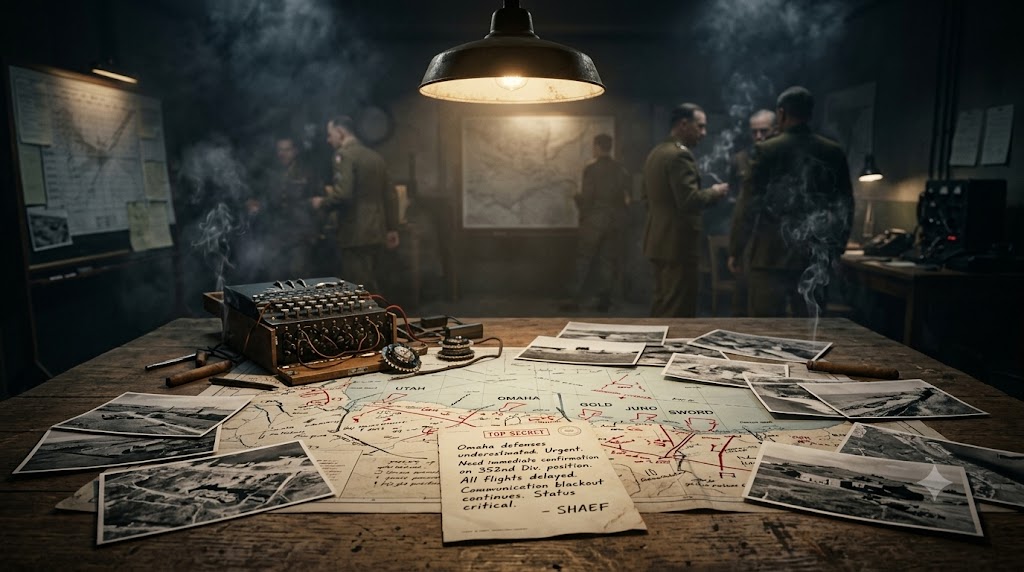
History, Declassified: Uncovering the Intelligence Failures of D-Day
When we think of June 6, 1944, the narrative is often one of absolute triumph. The D-Day landings are widely celebrated as a masterclass in military strategy, deception, and overwhelming logistical might. The success of Operation Fortitude—the elaborate phantom army campaign designed to trick Hitler into thinking the invasion would happen at Pas-de-Calais—is legendary.
But beneath the surface of the "perfect" invasion lies a much grittier reality.
Digging into declassified archives and historical controversies reveals a series of undeniable intelligence failures and miscalculations that nearly unraveled the Allied foothold in Normandy. History isn't just about celebrating the victories; it's about dissecting the razor-thin margins of error. Let's break down the critical intelligence blind spots the Allies faced on the beaches of France.
The Omaha Beach Miscalculation
The most devastating intelligence failure of D-Day occurred on the sands of Omaha Beach. Allied command expected a relatively manageable fight against a static, lower-tier coastal defense unit. Instead, the first waves of American troops ran into a meat grinder.
The Missing Division: Allied intelligence severely underestimated the strength and determination of the German forces defending Omaha Beach.
Hidden Strongpoints: While the Allies had mapped out general defensive lines, they lacked precise data on specific machine-gun nests, camouflaged artillery positions, and reinforced strongpoints.
The Cost: This lack of perfect intelligence meant assaulting troops were pinned down by unexpected, devastating resistance. This intelligence gap led directly to the disproportionately high casualties suffered during the initial waves of the amphibious assault.
The Airborne Scatter
Before the amphibious landing craft ever dropped their ramps, American and British paratroopers were tasked with securing the flanks, vital bridges, and key terrain behind enemy lines. However, the reality of the drop was utter chaos.
Weather and Navigation: Planners misjudged the challenging weather conditions and the difficulty of navigating over unfamiliar territory in total darkness.
Widespread Dispersion: Rather than landing in concentrated, combat-ready groups, paratroopers were widely scattered across the French countryside.
Desperate Battles: Many units found themselves completely isolated and were forced to fight desperate, uncoordinated battles to survive and achieve their objectives.
The Fog of War in Headquarters
Perhaps the most glaring sign of intelligence failure was the sheer lack of information flowing back to Supreme Headquarters Allied Expeditionary Force (SHAEF).
During the crucial initial hours of the invasion, Supreme Commander General Dwight D. Eisenhower was essentially flying blind. He had to send a message to Army Chief of Staff Gen. George C. Marshall stating that while preliminary reports were "satisfactory," he had received no official confirmation that the "leading ground troops are actually ashore". To make matters worse, SHAEF communications personnel fell 12 hours behind in transcribing radio traffic, and a critical Army decoding machine completely broke down.
The "In Case of Failure" Letter
The success of D-Day was never a foregone conclusion. No one understood this better than Eisenhower himself. Before dawn on June 5, facing uncertain weather forecasts and a highly prepared enemy, he drafted a press release to be used only if the invasion collapsed:
"Our landings in the Cherbourg-Havre area have failed to gain a satisfactory foothold and I have withdrawn the troops. My decision to attack at this time and place was based upon the best information available. The troops, the air and the Navy did all that bravery and devotion to duty could do. If any blame or fault attaches to the attempt it is mine alone."
Note: Eisenhower actually misdated this fateful, handwritten note as "July 5" instead of "June 5" under the immense stress of the moment.
The Verdict
D-Day succeeded not because the intelligence was flawless, but because of the immense bravery, brilliant on-the-spot improvisation, and sheer willpower of the troops on the ground. Examining these declassified miscalculations doesn't diminish the heroism of June 6, 1944. Instead, it highlights just how staggering their achievement truly was. They didn't win a rigged game—they overcame a deeply flawed hand.
This video dives into the unanswered questions, missing records, and conflicting accounts that historians are still attempting to piece together about the intelligence gaps and chaotic execution of the Normandy invasion.