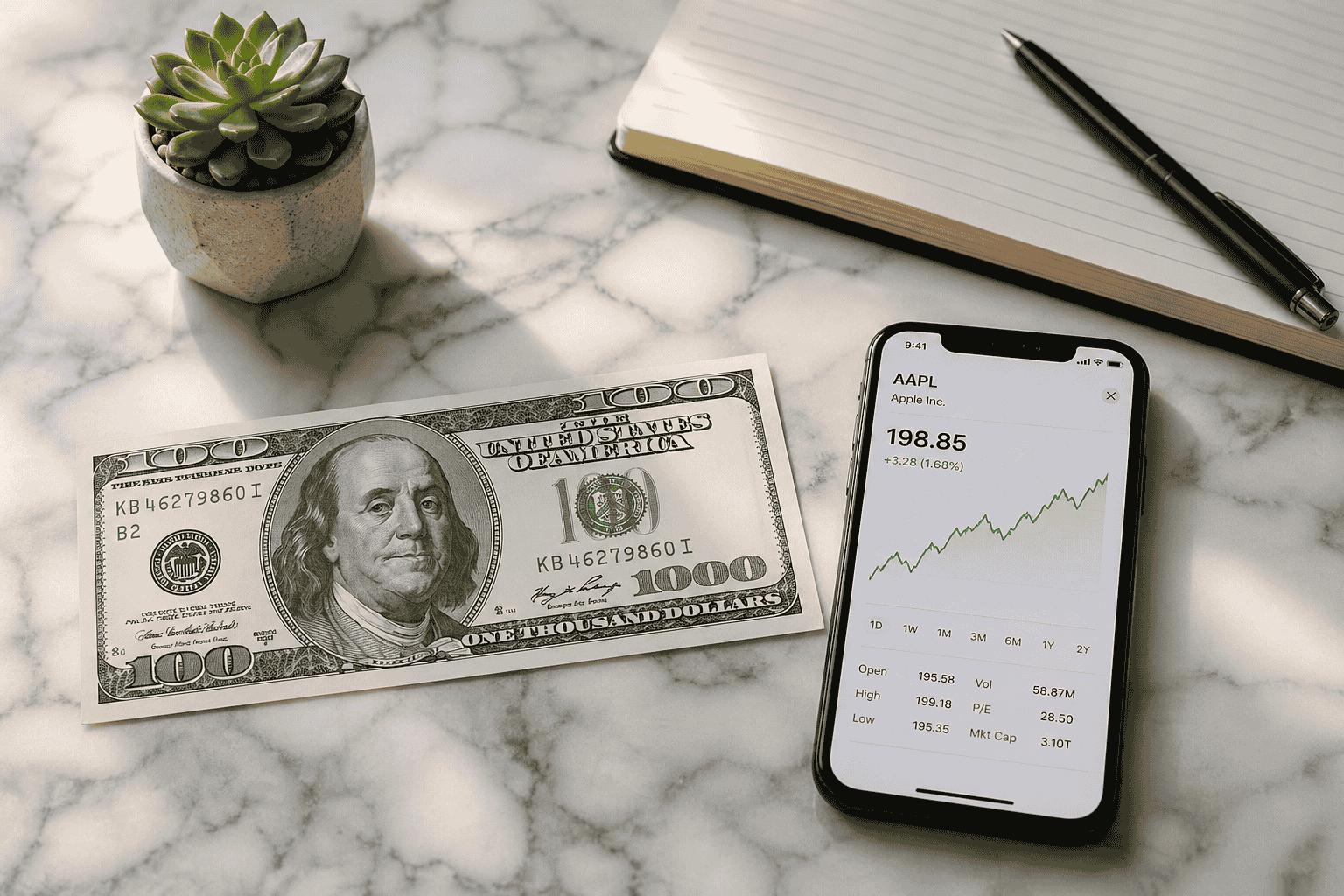
How to Invest $1,000 in 2026: The Smartest Places to Put Your Money Right Now
You don't need a fortune to start building one. Here's exactly where financial advisors say $1,000 should go in 2026 — and the common mistakes that quietly drain beginners dry.
The $1,000 Myth Nobody Talks About
Most people believe you need serious money to start investing. A spare $1,000 feels like barely enough to open a brokerage account, let alone build meaningful wealth. That belief is holding millions of people back — and it's completely wrong.
In 2026, $1,000 is genuinely enough to get started. Fractional shares, zero-commission brokers, and high-yield digital accounts have dismantled every barrier that once made small-scale investing impractical. The only question is: where should that first $1,000 actually go?
This guide answers that question clearly, honestly, and without the financial jargon that makes most investing advice unreadable. Whether you're a complete beginner or someone who's been meaning to "start investing" for three years, here's your 2026 playbook.
Before You Invest a Single Pound or Dollar: Do This First
Before any money goes into the market, two things need to be in place. Skipping these steps is the single biggest mistake first-time investors make.
1. Kill High-Interest Debt First
If you're carrying credit card debt at 20–29% APR — which is the norm in both the US and UK in 2026 — paying it off is the single highest-return "investment" available to you. No stock, bond, or savings account reliably returns 20%+ annually. Paying down $1,000 of high-interest debt is a guaranteed return that beats the market.
The rule of thumb: if your debt interest rate is above 7%, pay it before investing. Below 7%, you can invest alongside repayments.
2. Build a Small Emergency Buffer
Investing money you might need urgently forces you to sell at the wrong time. Before putting $1,000 into any investment, make sure you have at least $500–$1,000 sitting in a separate, accessible savings account. Think of it as insurance against being a forced seller during a market dip.
Option 1: High-Yield Savings Account (Best for Beginners with Short Time Horizons)
If you might need this money within 12 months — for a car, a move, a wedding — a high-yield savings account (HYSA) is the right home for it in 2026.
The best HYSAs in the US are currently paying between 4.5% and 5.1% APY, compared to the national average of just 0.46% at traditional banks. In the UK, easy-access savings accounts from digital banks like Marcus and Chase are offering competitive rates around 4.5–4.9% AER as of early 2026.
Best options in 2026:
US: Marcus by Goldman Sachs, SoFi, Ally Bank, and Discover — all offering above 4.5% APY with no minimum balance
UK: Chase UK, Chip, and Trading 212 Cash ISA — all offering strong rates with easy access
On $1,000 at 5% APY, you'd earn roughly $50 in a year — modest, but completely risk-free and fully liquid. For a beginner, that peace of mind has real value.
Option 2: Index Funds and ETFs (Best for Long-Term Wealth Building)
If you won't need this money for at least 3–5 years, index funds are where most financial advisors would tell you to start — and they'd be right.
An index fund is simply a basket of stocks that tracks a market index, like the S&P 500. Instead of trying to pick winning stocks (a game even professionals lose most of the time), you buy a tiny slice of the 500 largest US companies in one click.
Why Index Funds Win for Beginners
Diversification: One fund spreads risk across hundreds of companies
Low cost: Top index funds charge as little as 0.03% per year in fees
Proven returns: The S&P 500 has averaged roughly 10% annually over the past century
No expertise required: You don't need to read earnings reports or follow market news
The Best Index Funds to Start With in 2026
For US investors, three funds dominate beginner recommendations:
Vanguard S&P 500 ETF (VOO) — 0.03% expense ratio, tracks 500 largest US companies
iShares Core S&P 500 ETF (IVV) — near-identical to VOO, equally popular
Fidelity ZERO Total Market Index (FZROX) — literally 0% fees, covers the entire US stock market
For UK investors, the equivalents are:
Vanguard FTSE All-World UCITS ETF (VWRL) — global diversification in one fund
iShares Core MSCI World UCITS ETF (IWDA) — low cost, globally diversified
With $1,000 in VOO, you'd own fractional shares of Apple, Microsoft, Amazon, Nvidia, and 496 other companies. That's real diversification for the price of a weekend away.
"The stock market is a device for transferring money from the impatient to the patient." — Warren Buffett
Option 3: A Stocks and Shares ISA or Roth IRA (Best Tax-Advantaged Move)
Before choosing what to invest in, make sure you're investing in the right account. Tax-advantaged accounts are one of the most powerful — and most underused — tools available to everyday investors.
For US Investors: The Roth IRA
A Roth IRA lets you invest after-tax dollars and pay zero tax on growth and withdrawals in retirement. In 2026, you can contribute up to $7,000 per year (or $8,000 if you're 50+). On $1,000 invested at 10% annually for 30 years, the difference between a taxable account and a Roth IRA is worth tens of thousands of dollars in avoided tax.
You can open a Roth IRA at Fidelity, Vanguard, or Charles Schwab in about 15 minutes, with no account minimum. Once open, invest the $1,000 directly into an index fund.
For UK Investors: The Stocks and Shares ISA
A Stocks and Shares ISA lets you invest up to £20,000 per tax year, with all growth and income completely tax-free. Every UK investor should max their ISA allowance before investing in a regular account. Platforms like Vanguard UK, Hargreaves Lansdown, and Freetrade all offer easy ISA accounts.
Option 4: Dividend Stocks (Best for Building Passive Income)
If your goal is generating income rather than pure growth, dividend stocks offer a different path. These are shares in established companies — think Johnson & Johnson, Unilever, or National Grid — that pay out a portion of their profits to shareholders quarterly or annually.
A $1,000 investment in a diversified dividend ETF like Vanguard High Dividend Yield ETF (VYM) currently yields around 3–3.5% annually. That's $30–$35 per year in passive income — not life-changing, but it compounds significantly over time as dividends are reinvested.
The real power of dividend investing appears over decades. Reinvested dividends have historically accounted for roughly 40% of the stock market's total long-term return.
Option 5: Government Bonds and I-Bonds (Best for Zero-Risk Returns)
For the truly risk-averse, government-backed bonds offer a middle ground between a savings account and stock market investing.
US Treasury I-Bonds are inflation-linked government savings bonds that currently pay a composite rate in the 4–5% range. They're backed by the US government, meaning default risk is essentially zero. The catch: money is locked up for at least 12 months, and there's a penalty for withdrawing within 5 years.
In the UK, Premium Bonds through NS&I offer a tax-free prize fund equivalent to roughly 4% annually, with the added lottery-like chance of larger prizes. Your capital is 100% government-guaranteed.
The Smartest Allocation for Your First $1,000 in 2026
If you asked ten financial advisors how to split a $1,000 first investment, most would land somewhere close to this framework — adjusted for your situation:
Emergency fund top-up (if needed): $200–$300 — non-negotiable foundation
Index fund in a tax-advantaged account: $500–$700 — core long-term wealth engine
High-yield savings (if you need liquidity): $200–$300 — for anything you might need within 12 months
This isn't a glamorous strategy. It won't make you rich overnight. But it's the approach that consistently builds real wealth over time — and critically, it's the approach that survives market crashes, recessions, and the inevitable moments when you're tempted to panic-sell.
The 5 Beginner Mistakes That Quietly Destroy Returns
1. Trying to Time the Market
Study after study shows that even professional fund managers cannot consistently predict market movements. The best strategy for a $1,000 investment is to put it in and leave it — not to wait for the "right moment" that never arrives.
2. Paying Too Much in Fees
A fund charging 1% in annual fees vs 0.03% might sound insignificant. Over 30 years on $1,000, that difference costs you approximately $6,000 in foregone returns. Always check the expense ratio before buying any fund.
3. Checking Your Portfolio Too Often
Markets fall. Portfolios dip. Investors who check daily are far more likely to panic-sell at the wrong time. Set your investment up, automate future contributions if possible, and check in quarterly at most.
4. Putting Everything in One Stock
Concentrating $1,000 in a single company — even a great one — exposes you to catastrophic loss if that company has a bad year. Diversification is the closest thing to a free lunch in investing.
5. Waiting Until You Have "More Money"
Time in the market beats timing the market. $1,000 invested at 25 grows to roughly $17,000 by age 65 at 7% annual return. The same $1,000 invested at 35 grows to only $8,700. Starting is the most important step.
Your 2026 Action Plan: What to Do This Week
Day 1: Check your debt. Anything above 7% interest? Put the $1,000 there first.
Day 2: Open a Roth IRA (US) or Stocks & Shares ISA (UK) if you don't already have one. Fidelity, Vanguard, and Freetrade are all free to open.
Day 3: Transfer your $1,000 into the account and invest in a single broad index fund — VOO, VWRL, or equivalent.
Day 7: Set up a small automatic monthly contribution — even $25–$50 — so your portfolio grows on autopilot.
Month 3: Review once. Check that nothing has changed in your situation. Then leave it alone.
The Bottom Line
Investing $1,000 in 2026 isn't complicated — it just requires choosing to start. The best investment account is the one you actually open. The best fund is the one you actually buy. The best time was yesterday; the second best time is today.
Open the account. Buy the index fund. Set the automatic contribution. Then let time do the heavy lifting.
Disclaimer: This article is for informational purposes only and does not constitute financial advice. Always consult a qualified financial advisor before making investment decisions. Past market performance does not guarantee future results.
how to invest 1000 dollars 2026, best investments beginners 2026, where to invest money 2026, index funds beginners, roth ira 2026, stocks and shares isa uk, high yield savings account 2026, beginner investing guide





Discussion
Comments
Approved comments are published after moderation to keep discussion useful and spam-free.
No comments yet. Start the discussion below.