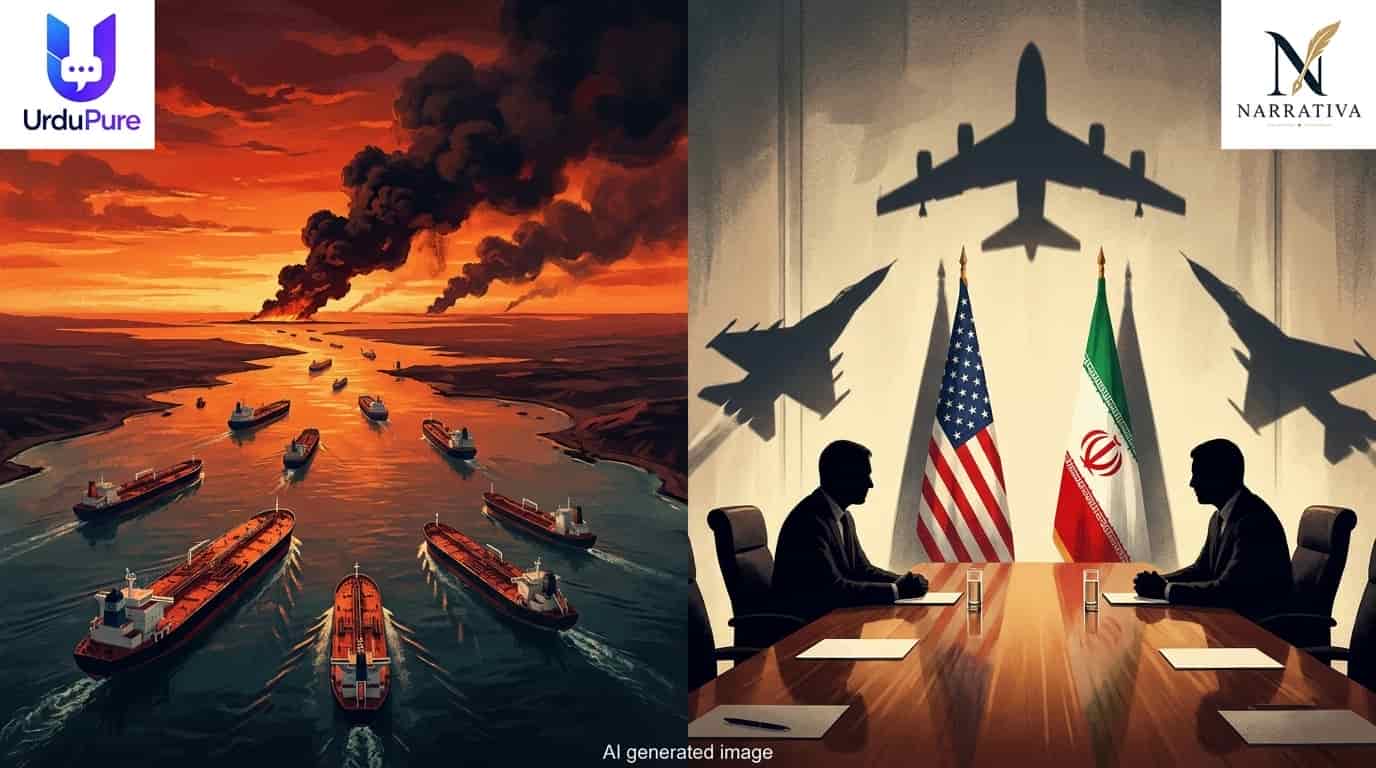
Inside the US-Iran Nuclear Deal: How a Tentative Agreement Emerged From Three Months of War, Missile Strikes and the Strait of Hormuz Crisis
The Deal That Might End the War — If Trump Signs It
At 11:47pm on May 28, 2026, CNN's live blog carried a single line that stopped the world's foreign policy establishment mid-breath: The US and Iran have reached a tentative agreement to open the Strait of Hormuz and begin nuclear talks. Three hours later, the addendum arrived: President Trump has not signed off on it yet.
Those two sentences capture, with crystalline precision, everything you need to understand about the most dangerous geopolitical standoff of 2026. An agreement exists. It may not hold. The 60-day clock has not yet started. And the hardest issues — the fate of Iran's highly enriched uranium stockpile, the question of "zero enrichment" demanded by Washington and rejected by Tehran, and the future of Iran's ballistic missile programme — remain unresolved, parked in a future negotiation that may never happen if the tentative deal collapses before it is formalised.
To understand why this moment matters so profoundly, you need to understand everything that happened in the 90 days preceding it. Because the deal being discussed on May 28 emerged from three months of strikes, counter-strikes, a closed global trade route, a dead Supreme Leader, and the most consequential American military action since the Iraq War.
How It Started: February 28, 2026 — The Day the US and Israel Struck Iran
The strikes began on February 28, 2026. The United States and Israel launched a coordinated series of attacks against Iran that targeted, simultaneously, three objectives: Iran's nuclear infrastructure at Fordow, Natanz, and Isfahan; its ballistic missile production and storage facilities; and — in what would prove to be the most consequential single action of the entire conflict — the leadership compound in Tehran where Supreme Leader Ali Khamenei was in residence.
Khamenei died in the strikes. The 85-year-old who had led the Islamic Republic since 1989, who had navigated Iran through multiple crises with the United States and Israel, and whose presence had been the defining constant of Iranian foreign policy for three and a half decades, was killed by American and Israeli ordnance on a February night in Tehran.
The immediate global reaction was shock — followed by a rapid, alarming escalation. Iran's Revolutionary Guard Corps launched retaliatory strikes against American bases across the Middle East. The Strait of Hormuz, through which approximately 20% of the world's oil trade and 25% of global LNG shipments transit daily, was closed. Global fuel prices spiked overnight. Iranian proxies activated across the region. And Iran, its supreme leader dead and its nuclear facilities damaged, appointed Khamenei's son as his successor and declared that it would retaliate against every American military asset in the region.
"Iran's nuclear potential has been decimated." — President Donald Trump, speaking after the February 28 strikes
The Pentagon's own assessment told a more complicated story. A July 2025 bomb damage assessment — referencing an earlier Israeli strike sequence — found Iran's nuclear program set back approximately two years. A leaked DIA report was more cautious, concluding that sites were "damaged but not destroyed" and Iran's nuclear capability was "delayed by a few months." The gap between the political claim and the intelligence assessment has been a persistent feature of this conflict's information environment.
The Strait of Hormuz: When Geopolitics Becomes an Oil Price
The closure of the Strait of Hormuz translated the geopolitical into the immediately personal for hundreds of millions of people globally. The Strait — a 21-mile-wide chokepoint between Oman and Iran at the Persian Gulf's mouth — handles roughly one-fifth of all oil traded globally. When Iran closed it, the economic consequences were immediate, global, and steeply regressive: fuel price spikes hit lower-income households hardest, drove inflation upward in already pressured economies, and complicated the monetary policy decisions of central banks from Frankfurt to Washington.
The economic pain of the Strait's closure was, by design, Iran's primary leverage. Tehran could not match American military power. It could make American military action economically costly — not just to Washington but to Washington's allies, to neutral countries, and to the global economy broadly. The Strait's closure was Iran's geopolitical equaliser: a way of making the entire world feel the consequences of American strikes against Iranian territory.
For the Dominican Republic and Caribbean economies — heavily import-dependent on fuel — the Strait closure and resulting energy price spike produced immediate inflationary pressure on food, transport, and electricity costs that filtered directly into household budgets. The Iran war was not a distant geopolitical story for Caribbean families paying higher fuel prices at the pump and higher electricity bills at home.
For the US and UK economies, the fuel price spike complicated the Federal Reserve's and Bank of England's rate-cutting cycles, adding imported inflation at precisely the moment that both central banks were cautiously easing monetary policy after the 2022-2024 tightening cycle.
The Negotiating Table: What Each Side Actually Wants
According to the UK House of Commons Library briefing published May 27 — one of the most comprehensive public summaries of the negotiating positions — five major issues dominate the talks, each echoing the 2015 JCPOA negotiations but in a dramatically more pressured context.
Issue 1: Nuclear Enrichment
The United States demands "zero enrichment" — that Iran eliminate all uranium enrichment activity as a condition of any deal. This is the position that has been rejected by Iran in every previous negotiating round as incompatible with what Tehran calls its "inalienable right" to civilian nuclear energy. Iran has been enriching uranium to 60% purity (weapons-grade is 90%); it has a stockpile of highly enriched uranium whose future is the most complex technical and political issue in the negotiations.
Vice President JD Vance has defined the US's "core goal" as: "an affirmative commitment that [Iran] will not seek a nuclear weapon, and will not seek the tools that would enable them to quickly achieve a nuclear weapon." Whether this definition allows for any domestic Iranian enrichment capability — a position Iran has consistently insisted upon — is the central technical question the "60-day negotiation period" will need to resolve.
Issue 2: Ballistic Missiles
Iran's ballistic missile programme — which provides the delivery mechanism for any future nuclear weapon and which Iran has used for conventional strikes during this conflict — is a US and Israeli redline. Iran views its missile programme as its primary conventional deterrent and has historically refused to include it in nuclear-focused negotiations.
Issue 3: Sanctions Relief
Iran's economy has been under severe sanctions since 2018. Any deal requires a clear framework for sanctions relief — its timing, conditionality, and reversibility. The "snapback" mechanism (by which sanctions automatically reinstate if Iran violates agreement terms) was a contentious feature of the 2015 JCPOA and will be again in any 2026 successor agreement.
Issue 4: Regional Proxies
Iran's network of regional proxies — Hezbollah in Lebanon, Hamas in Gaza, Houthi forces in Yemen, and various militia groups in Iraq and Syria — are not formally part of the nuclear negotiations but are politically inseparable from them. US demands that Iran curtail proxy activity create complications for Tehran's domestic political coalition.
Issue 5: Opening the Strait
The tentative agreement announced May 28 addresses this specific issue first: opening the Strait of Hormuz as the initial confidence-building measure while 60 more days of negotiation address the nuclear programme. This sequencing — economic relief first, nuclear resolution second — is the framework both sides have tentatively accepted, though Trump has not yet formally endorsed it.
Where Trump Stands — and Why His Signature Isn't Guaranteed
The most politically significant detail of the May 28 announcement was the caveat: Trump has not signed off. This is not a diplomatic formality. Trump's relationship with any Iran deal is complicated by his own previous record — he withdrew from the Obama-era JCPOA in 2018, calling it "the worst deal ever negotiated." Any deal he now endorses must be framed as categorically superior to the one he destroyed.
The internal US political dynamics add further complexity. Trump told reporters the day before the tentative agreement that he won't be "rushed into a deal," warning that Iran's efforts to "outlast him won't work because he doesn't care about the midterms." This framing — dismissing the 2026 midterm elections as a pressure factor — is either genuine or strategic, and the distinction matters for assessing how much time the negotiation actually has.
On May 25, the US military announced fresh strikes against Iranian positions — targeting Iranian drones and a launch site around the Strait of Hormuz — just hours after Trump said negotiations were moving forward. The pattern of simultaneous military pressure and diplomatic engagement is either a sophisticated "madman theory" negotiating approach or evidence of internal US government incoherence. Possibly both.
Iran's New Leadership: Khamenei's Son and the Legitimacy Question
The killing of Ali Khamenei created a legitimacy crisis for the Islamic Republic that is more consequential than the physical damage to Iran's nuclear facilities. Khamenei's son — appointed as his successor — lacks his father's revolutionary credentials, his clerical authority, and his decades of accumulated political capital within Iran's complex internal power structure.
The question of whether Iran's new leadership can make and sustain concessions that the previous leadership refused is genuinely open. There are two competing analytical frames. The first: new leadership without Khamenei's ideological rigidity may be more pragmatic, more willing to deal, and less constrained by his specific theological positions on nuclear enrichment as a matter of national sovereignty. The second: new leadership without established authority may be unable to make concessions without appearing weak, may face challenges from hardline Revolutionary Guard factions, and may calculate that diplomatic flexibility is politically more dangerous than continued confrontation.
What Comes Next: Three Scenarios
Scenario 1: The Deal Holds
Trump signs off on the tentative framework. The Strait opens within days, providing immediate global economic relief. 60 days of intensive nuclear negotiations begin under the framework's parameters. The outcome of those negotiations determines whether a full deal is reached — but the immediate crisis de-escalates. Global fuel prices retreat. Regional allies stabilise. This is the outcome global markets are pricing in on May 30.
Scenario 2: The Deal Collapses Before It Starts
Trump declines to sign the framework — either because of domestic political pressure from hardline advisers, because the language on enrichment proves unacceptable, or because the additional "language points" that Vance acknowledged are unresolved create a breakdown. The Strait remains closed. Iran's new leadership faces domestic pressure to demonstrate strength. Military operations resume. This is the tail risk that oil futures are pricing in with continued elevated volatility.
Scenario 3: Partial Opening, Prolonged Negotiation
The most probable outcome given the complexity: Iran makes a symbolic gesture on the Strait that allows partial tanker transit to resume, providing enough economic relief for both sides to claim progress while the nuclear negotiations extend beyond the 60-day framework without reaching resolution. This is the Iran-nuclear-talks pattern that has characterised every negotiating round since 2003 — partial progress, suspended deadlines, and the permanent near-crisis of a nuclear programme that neither side fully controls.
Why This Matters for Every Reader, Everywhere
The Iran-US standoff of 2026 is not a Middle Eastern story with Middle Eastern consequences. It is a global economic event — the Strait of Hormuz closure was a supply shock of comparable magnitude to the 1973 oil embargo — with a political resolution that will shape global energy markets, regional security architecture, and the precedent for nuclear diplomacy for a generation.
For readers in the Dominican Republic: fuel prices at the pump, electricity tariffs, and the inflationary environment that has dominated household budgets since February are all downstream of the Strait closure. The opening of the Strait — if it happens — will provide gradual but measurable relief to the energy cost pressures that Caribbean economies have absorbed.
For readers in the US and UK: the Iran deal will be one of the defining foreign policy judgements of the Trump second term. Its success or failure will be debated through the 2026 midterms and beyond. The nuclear question — whether Iran can be prevented from having a nuclear weapon without permanent occupation or permanent war — is the hardest question in global security.
The answer is forming, tentatively, somewhere between Trump's signature and Tehran's calculation. The world is watching.
Sources: CNN Live Blog May 28 2026; UK House of Commons Library Iran Briefing CBP-10637 (May 2026); NPR US-Iran Negotiations May 25 2026; Wikipedia — 2025 United States strikes on Iranian nuclear sites; Wikipedia — 2026 Russo-Ukrainian truce; AP wire reporting May 25-28 2026
US Iran nuclear deal 2026, Iran war news today, Strait of Hormuz reopening, Trump Iran agreement, Khamenei killed replacement, Iran nuclear enrichment deal, JD Vance Iran talks, US military strikes Iran May 2026, Iran ceasefire 2026, global oil prices Iran war





Discussion
Comments
Approved comments are published after moderation to keep discussion useful and spam-free.
No comments yet. Start the discussion below.