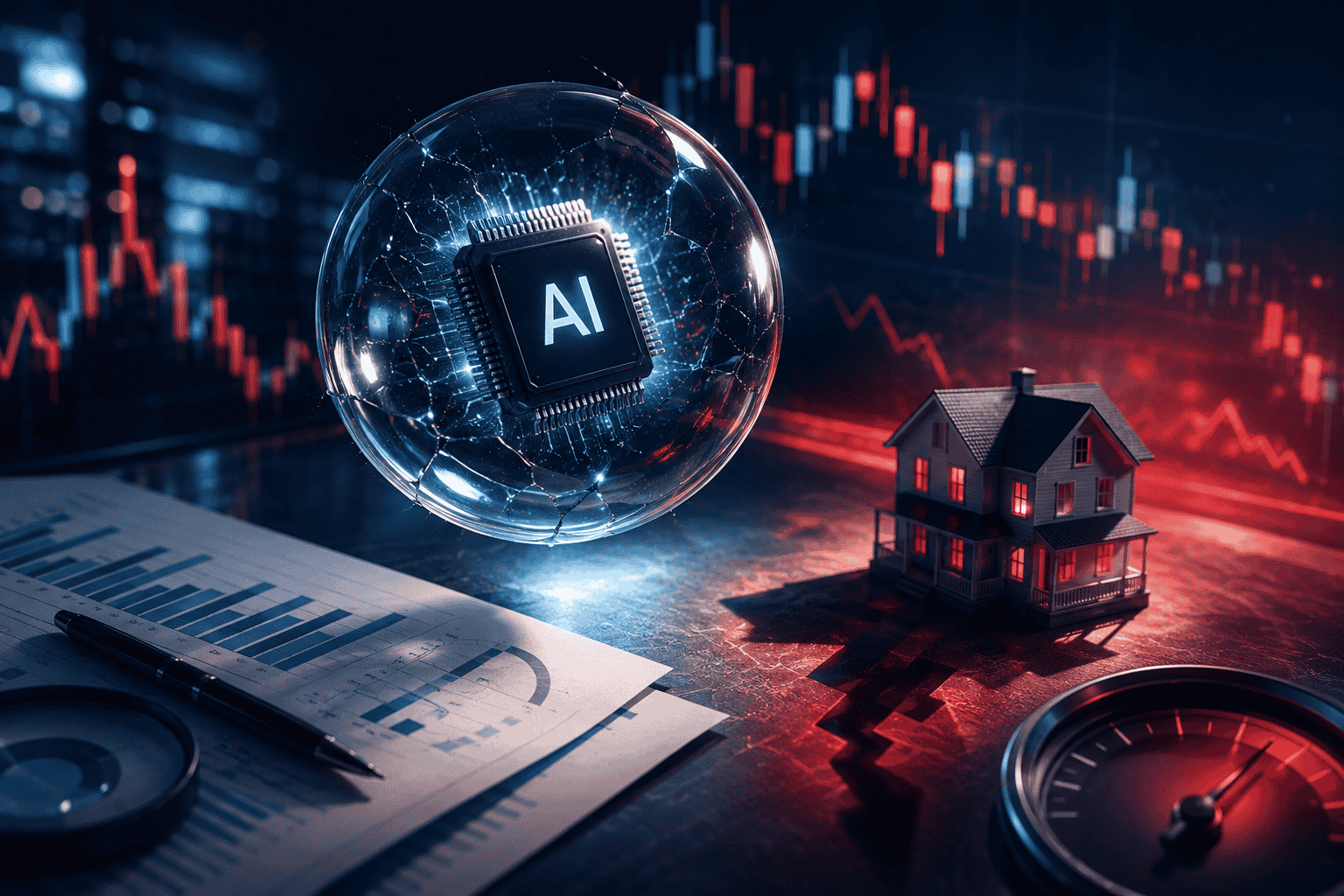
Jeremy Grantham’s AI Bubble Warning: What It Means for Stocks, Housing and Your Money
Some investors become famous because they chase the next big thing.
Jeremy Grantham became famous because he often warned against it.
He is the co-founder of GMO, the Boston-based investment firm known for its long-term, valuation-driven approach. Reuters notes that GMO made its name betting against the late-1990s market mania and the mid-2000s housing boom, two of the most painful bubbles in modern financial history. (Reuters)
Now Grantham is warning about a new danger:
Artificial intelligence.
Not because AI is useless.
Not because the technology is fake.
Actually, his argument is almost the opposite.
Grantham believes the biggest bubbles often form around real, powerful and world-changing ideas. Railroads changed the world. The internet changed the world. But both also produced investment manias that later destroyed huge amounts of capital. Business Insider reported that Grantham has described AI as “obviously a bubble” and one of the biggest bubbles in history, comparing it with earlier investment booms around railroads and the internet. (Business Insider)
That is what makes this warning so important.
The risk is not that AI fails completely.
The risk is that investors pay prices so high that even a revolutionary technology cannot justify them.
Why Jeremy Grantham’s Warning Matters
Markets are emotional.
When a new technology arrives, people often do not ask:
“How much profit will this company actually make?”
They ask:
“What if this changes everything?”
That question can be exciting.
It can also be dangerous.
Grantham’s core investing principle is mean reversion: the idea that extreme asset prices eventually move back toward more normal long-term levels. In a 2026 Kiplinger interview, he described reversion to the mean as a useful historical guide, especially when asset prices move far away from normal valuation levels. (Kiplinger)
This is why he worries about AI stocks.
In his view, the market may be treating AI as if future profits are already guaranteed. But business history rarely works that cleanly.
A technology can be revolutionary and still become a terrible investment at the wrong price.
That is the uncomfortable lesson of bubbles.
The Difference Between AI the Technology and AI the Trade
This distinction matters.
AI may transform search, software, medicine, education, robotics, customer service, coding, security, entertainment and business productivity.
But that does not mean every AI stock is worth any price.
It also does not mean every company spending billions on data centers will earn strong returns.
An academic review published in June 2026 described the AI market as showing both genuine fundamentals and bubble-like fragilities. The paper noted real adoption and revenue growth, but also warned about capital expenditure rising faster than monetization in some areas, high private-market concentration, and investor narratives pricing in productivity gains before they fully appear in cash flows. (arXiv)
That is the balanced view.
AI is real.
The investment boom may still be risky.
Both can be true at the same time.
Why Bubbles Form Around Great Ideas
One of Grantham’s most useful points is that bubbles are not usually built around worthless ideas.
They are built around obvious ideas.
When everyone can see that something is important, everyone wants exposure.
That creates a rush.
Investors buy the leading companies.
Venture capital flows into startups.
Corporations increase spending.
Media attention explodes.
Analysts raise targets.
Retail investors feel they are missing out.
Then valuations start depending less on current profits and more on future dreams.
That is where danger begins.
In his Kiplinger interview, Grantham said AI is a “fully fledged, spectacular bubble” comparable only to railroads and the internet, while also saying AI is obviously an important idea. His argument is that because the idea is so important, investors may overinvest in it too quickly. (Kiplinger)
This is the heart of the AI bubble debate.
The better the story becomes, the easier it is for investors to overpay.
Why Wall Street May Not Warn You in Time
One of Grantham’s sharpest criticisms is aimed at Wall Street itself.
He argues that large investment institutions often struggle to warn clients clearly during a bull market because there is career risk in being early. If an advisor tells clients to reduce exposure and the market keeps rising, clients may leave. If the advisor stays bullish with everyone else, the personal career risk is lower.
In Kiplinger, Grantham said investors should not expect major Wall Street firms to fight a bull market and clearly tell people to get out, because doing so does not make business sense for them. (Kiplinger)
This is a powerful lesson for ordinary investors.
The market does not protect you from overexcitement.
Financial media does not always protect you.
Investment firms do not always protect you.
Your own discipline matters.
What Happens If the AI Bubble Bursts?
Nobody knows the timing.
That is important.
Even Grantham admits timing is extremely difficult. In the Kiplinger interview, he said prices could fall anytime from very soon to a couple of years from now, because the timing of bubbles is “completely difficult.” (Kiplinger)
That uncertainty is exactly what makes bubbles dangerous.
They can keep rising after they already look expensive.
They can make cautious people look foolish.
They can punish investors who are early.
Then suddenly, the story changes.
A company misses earnings.
Capital spending looks too high.
Revenue growth slows.
Competition increases.
Margins shrink.
Investors start questioning future profits.
The same stocks that looked unstoppable begin to fall.
Business Insider reported Grantham’s view that Nvidia could lead the AI trade down if the bubble bursts, with other AI-linked companies following before some winners later emerge from the wreckage. (Business Insider)
This pattern is common in technology history.
The technology survives.
Many investors do not.
Why AI May Not Automatically Lead to Higher Profits
AI can increase productivity, but productivity does not always convert neatly into investor profit.
There are several reasons.
First, competition can destroy margins.
If every company gets access to similar AI tools, the advantage may become temporary.
Second, infrastructure is expensive.
Data centers, chips, electricity, cooling systems and technical talent cost enormous amounts of money.
Third, customers may resist price increases.
People may love AI features but not want to pay enough to justify the investment.
Fourth, open-source models and cheaper competitors can reduce pricing power.
Fifth, regulation, copyright disputes and privacy concerns can create unexpected costs.
This is why AI investors must ask a hard question:
Who actually captures the profit?
The chipmaker?
The cloud provider?
The software company?
The data owner?
The electricity provider?
The user?
The answer may be different from what the market currently assumes.
The Strategy Grantham Suggests: Do Not Depend Too Much on the AI Trade
The most useful part of Grantham’s warning is not panic.
It is positioning.
The lesson is not necessarily “sell everything.”
The lesson is “do not let your future depend on one crowded trade.”
GMO’s recent view, reported by Business Insider, is that AI looks like a classic investment bubble, but the warning is focused on the AI trade rather than the entire global market. GMO sees opportunities outside AI, especially in developed-market value stocks and non-U.S. small-cap value stocks, particularly Japan. (Business Insider)
That is a practical idea.
Investors do not need to predict the exact top of AI stocks.
They can reduce concentration risk.
They can diversify away from the most expensive names.
They can look at markets and sectors where expectations are lower.
They can hold enough cash or bonds for near-term needs.
They can avoid leverage.
They can stop chasing performance after a huge run.
This is not glamorous.
But good risk management is rarely glamorous.
A Simple Protection Checklist for Ordinary Investors
Before worrying about whether the AI bubble bursts next month or next year, ask yourself these questions.
How much of your portfolio depends on a handful of AI-linked companies?
Do you own broad index funds that are heavily weighted toward the largest tech stocks?
Are you buying because of valuation or because of fear of missing out?
Do you have an emergency fund outside the stock market?
Do you need this money within the next three to five years?
Would a 30% drop in your portfolio force you to sell?
Are you diversified across countries, sectors and asset classes?
Do you understand what you own?
Are you investing with a plan or reacting to headlines?
This is where personal finance becomes more important than market prediction.
You do not need to know exactly when a bubble ends.
You need to make sure one market event cannot destroy your financial life.
Why Grantham Says U.S. Stocks Look Expensive
Grantham has long argued that U.S. stocks are expensive by historical standards.
In the Kiplinger interview, he said the U.S. equity market is about as overpriced as it has ever been on long-term valuation measures such as the Shiller price-to-earnings ratio. He also said investors should look at cheaper alternatives when one asset has delivered gigantic outperformance. (Kiplinger)
This is not a short-term trading call.
It is a long-term valuation call.
Expensive markets can keep rising.
Cheap markets can stay cheap.
But over long periods, the price you pay matters.
That is why Grantham’s advice is built around patience.
He is not saying investors should guess every market move.
He is saying investors should avoid being trapped in the most overpriced part of the market when better long-term opportunities may exist elsewhere.
Housing: Why the 30% Price-Fall Argument Gets Attention
Grantham’s housing comments are especially uncomfortable because homes are not only investments.
They are where people live.
They are tied to family, identity, security and social status.
But the affordability problem is real.
Reuters reported in June 2026 that U.S. mortgage rates had hovered around 6.6% in recent months, far above the previous decade’s average of 4.3%, and that analysts expected rates to remain above 6% through 2028. The same Reuters poll said U.S. home prices were about 55% above pre-pandemic levels, far outpacing income growth. (Reuters)
This is why people talk about prices needing to fall.
A house can be a good asset and still be unaffordable at current prices.
A market can avoid a crash and still be painful for buyers.
A homeowner can have large paper gains while first-time buyers are locked out.
AP reported that the average U.S. 30-year fixed mortgage rate was 6.49% in late June 2026, staying close to 6.5% for several weeks. AP also noted that higher mortgage rates reduce purchasing power by adding hundreds of dollars a month in borrowing costs. (AP News)
That is the housing squeeze:
High prices.
High mortgage rates.
Weak affordability.
Low transaction volume.
Buyers cannot buy.
Sellers do not want to give up old low-rate mortgages.
The market freezes.
What a 30% Housing Correction Would Mean
A 30% decline in house prices would not affect everyone the same way.
For first-time buyers, it could improve affordability if mortgage rates do not rise further and if lending conditions remain available.
For recent buyers with small down payments, it could create negative equity.
For homeowners who bought years ago, it might reduce paper wealth but not necessarily change monthly payments.
For real estate investors, it could pressure rental economics and leverage.
For banks and lenders, it could increase credit risk if unemployment rises.
For the broader economy, it could weaken consumer confidence.
That is why housing corrections are politically and emotionally difficult.
Lower prices help buyers.
Lower prices hurt owners.
But if prices stay too high relative to incomes, the next generation remains locked out.
There is no painless solution.
What Homebuyers Should Do Now
Homebuyers should not make decisions based only on dramatic crash predictions.
They should run numbers.
Can you afford the payment comfortably?
Can you handle repairs, insurance, taxes and emergencies?
Would you still be okay if prices fell after you bought?
Do you plan to stay long enough to ride out volatility?
Are you buying a home or speculating on appreciation?
Are you comparing mortgage offers?
Are you keeping cash after closing?
A home should not depend on perfect conditions.
If the purchase only works because rates fall, prices rise and nothing goes wrong, the deal may be too fragile.
The Chemicals and Fertility Warning: Why It Belongs in the Same Conversation
At first, fertility, chemicals and investing may seem unrelated.
But Grantham often connects markets with long-term civilization risks: climate, resources, demographics, pollution and social decline.
That is why chemical exposure enters the discussion.
The concern is that some everyday chemicals may interfere with hormone systems. Public-health and environmental researchers often discuss endocrine-disrupting chemicals such as phthalates, bisphenols, PFAS and some pesticides in relation to reproductive and developmental health. The evidence is complex, and not every claim is settled, but the concern is serious enough to appear repeatedly in scientific and public-health discussions. (Wikipedia)
A recent peer-reviewed study covered by The Guardian found hormone-disrupting chemicals in breast milk samples from mothers in Seattle, though the study had limitations including a small sample size. The report also emphasized that breastfeeding remains the safest and most nutritious option, while highlighting the broader concern of widespread chemical exposure. (The Guardian)
For readers, the practical lesson is not panic.
It is reduction of unnecessary exposure.
Use glass or stainless steel when possible.
Avoid heating food in plastic.
Reduce ultra-processed packaged foods.
Choose fragrance-free products where practical.
Wash produce.
Ventilate indoor spaces.
Follow credible medical advice, especially during pregnancy.
Do not treat social-media chemical claims as medical certainty.
This is a health topic, not a fear contest.
What Grantham’s Warning Really Means
The point is not that everyone must agree with Jeremy Grantham.
Many investors disagree with him.
Some argue that AI companies have real revenue, real profits and stronger balance sheets than the dot-com companies of 2000. Business Insider noted that some investors reject the dot-com comparison because today’s leading AI companies have enormous profitability and measurable productivity potential. (Business Insider)
That disagreement matters.
A good investor should listen to both sides.
The bullish case says AI is real, adoption is accelerating, and today’s leaders are stronger than old internet bubble companies.
The bearish case says prices already assume too much, capital spending is enormous, competition will be brutal, and profit margins may disappoint.
The truth may sit between those extremes.
AI may transform the economy while still punishing investors who overpaid.
The Main Lesson for Your Money
Do not build your financial life around one story.
Not AI.
Not housing.
Not crypto.
Not one stock.
Not one country.
Not one prediction.
The future is uncertain.
That is why diversification exists.
That is why emergency funds matter.
That is why valuation matters.
That is why debt discipline matters.
That is why patience matters.
Grantham’s warning should not make ordinary investors panic.
It should make them review their risk.
If your portfolio is balanced, your debt is manageable, your emergency fund is ready, and your time horizon is long, market volatility becomes easier to survive.
If your portfolio is concentrated, your debt is high, your home purchase is stretched, and your confidence depends on prices always rising, you are vulnerable.
The question is not:
“Will Jeremy Grantham be exactly right?”
The better question is:
“Am I prepared if he is even partly right?”
Final Thought
Jeremy Grantham’s AI bubble warning is powerful because it does not dismiss AI.
It respects AI.
That is exactly why it worries him.
The greatest bubbles are often built around the greatest stories.
Railroads changed the world.
The internet changed the world.
AI may change the world too.
But investors can still lose money if they confuse a great technology with a great price.
Housing has the same lesson.
A home can be valuable, necessary and emotionally important.
But if prices disconnect too far from incomes, affordability eventually becomes a crisis.
The smartest response is not fear.
It is discipline.
Avoid overconcentration.
Question easy money stories.
Respect valuation.
Keep cash for emergencies.
Be careful with debt.
Think long term.
And remember:
The market does not reward the person who believes the best story.
It rewards the person who survives long enough to make good decisions when the story changes.
This article is for education and general information only. It is not personal financial, investment, tax, legal or medical advice. Speak with a qualified professional before making decisions about your money, health or home purchase.
Frequently Asked Questions
Who is Jeremy Grantham?
Jeremy Grantham is the co-founder of GMO, a Boston-based investment firm known for long-term, valuation-based investing. Reuters notes that GMO built its reputation by betting against the late-1990s mania and the mid-2000s housing boom. (Reuters)
Did Jeremy Grantham predict the dot-com crash and housing collapse?
GMO became known for warning about major market bubbles, including the late-1990s tech mania and the mid-2000s housing boom. However, predicting a bubble is different from timing the exact crash, and even Grantham has said timing bubbles is extremely difficult. (Reuters)
Why does Grantham think AI is a bubble?
Grantham argues that AI is an important technology attracting too much money too quickly. He compares it with railroads and the internet: real innovations that still produced painful investment busts. (Kiplinger)
Does an AI bubble mean AI is fake?
No. A bubble can form around a real technology. The concern is not that AI has no value; the concern is that investors may pay prices that already assume too much future success.
What should investors do if they fear an AI bubble?
The most practical response is to review concentration risk, avoid chasing hype, diversify globally, keep an emergency fund, reduce leverage, and make sure money needed soon is not exposed to high volatility. GMO has pointed to opportunities outside the AI trade, including developed-market value stocks and non-U.S. small-cap value stocks. (Business Insider)
Are U.S. stocks too expensive?
Grantham believes U.S. equities are historically expensive on long-term valuation measures. Other investors disagree, especially because many leading U.S. tech companies generate real profits. The safer approach for ordinary investors is to avoid overconcentration and understand what they own. (Kiplinger)
Why are house prices such a big concern?
U.S. home prices remain high while mortgage rates are also elevated. Reuters reported that U.S. home prices were about 55% above pre-pandemic levels, while mortgage rates around 6.6% have kept affordability under pressure. (Reuters)
Should I wait for a housing crash before buying?
Not necessarily. A better approach is to buy only if the monthly payment, repairs, taxes, insurance and emergency savings are manageable. Waiting for a crash can be risky because prices, rates and inventory may not move in your favor.
Can AI stocks still rise from here?
Yes. Expensive markets can become more expensive before they correct. That is why timing bubbles is difficult. Investors should focus less on guessing the top and more on managing risk.
What is the biggest lesson from Grantham’s warning?
The biggest lesson is not panic. It is preparation. Avoid depending too heavily on one story, one sector, one market or one asset class.
Jeremy Grantham AI bubble, AI bubble, stock market bubble, Jeremy Grantham investing strategy, GMO investing, artificial intelligence stocks, Nvidia bubble, Magnificent Seven stocks, US stock market bubble, housing market correction, house prices fall 30%, mortgage rates 2026, investment risk, portfolio diversification, value investing, mean reversion, stock market crash warning, AI investing risks, housing affordability, personal finance
Jeremy Grantham, AI Bubble, Stock Market, Investing, Housing Market, Mortgage Rates, Personal Finance, Value Investing, GMO, Artificial Intelligence, Market Crash, Portfolio Risk





Discussion
Comments
Approved comments are published after moderation to keep discussion useful and spam-free.
No comments yet. Start the discussion below.