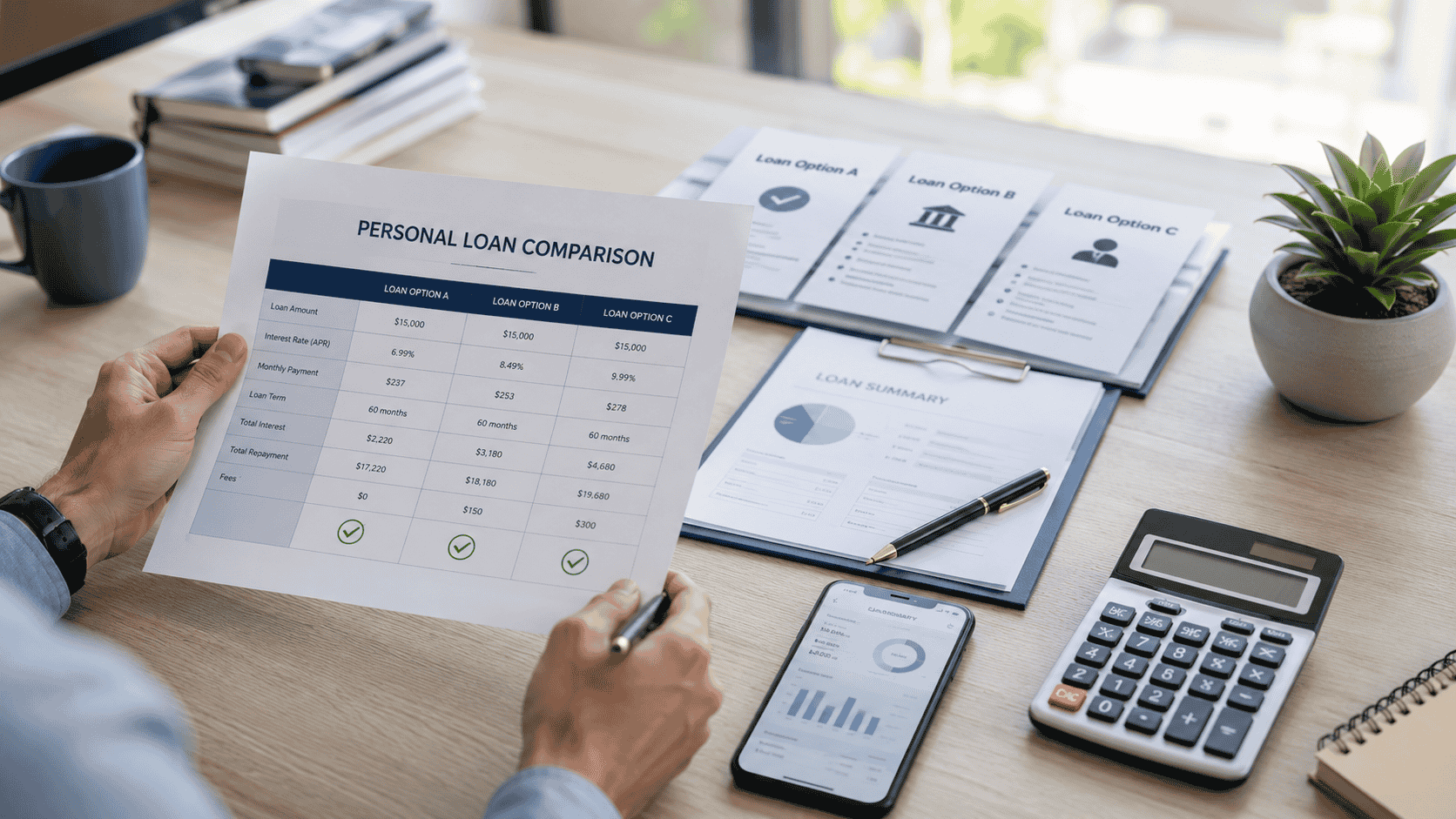
Personal Loans Explained: How to Compare Rates Before Borrowing
A personal loan can be useful when you need money for a serious purpose.
It can help with debt consolidation, emergency repairs, medical bills, moving costs, education expenses, wedding expenses, or home improvement projects.
But a personal loan is still debt.
That means you should never borrow only because money is available.
Before applying, you need to understand how personal loans work, how lenders calculate rates, what APR means, what fees to watch for, and how to compare offers correctly.
The real question is not:
“How much can I borrow?”
The better question is:
“How much will this loan really cost me?”
What Is a Personal Loan?
A personal loan is usually an installment loan. You borrow a fixed amount of money and repay it in fixed payments called installments over an agreed period. The Consumer Financial Protection Bureau explains that a personal installment loan is repaid in fixed amounts called installments.
Most personal loans are paid back monthly.
For example, if you borrow $10,000 for three years, you will normally make payments every month for 36 months.
Each payment includes part of the original amount borrowed and part of the interest.
The amount you borrowed is called the principal.
The cost of borrowing is called interest.
The full cost of the loan may also include fees.
That is why comparing only the monthly payment is not enough.
Why People Use Personal Loans
People commonly use personal loans for debt consolidation, home repairs, emergency expenses, medical bills, moving costs, wedding expenses, education costs, and large planned purchases.
A personal loan can be helpful when it replaces expensive debt with a lower-cost loan.
For example, if someone has high-interest credit card debt and qualifies for a lower-rate personal loan, debt consolidation may reduce interest and simplify payments.
But debt consolidation only works if the borrower avoids creating new debt after the old debts are paid.
Otherwise, the personal loan becomes one more problem instead of a solution.
Interest Rate vs APR
This is one of the most important parts of comparing personal loans.
The interest rate is the cost you pay to the lender for borrowing money.
APR stands for annual percentage rate.
APR includes the interest rate plus certain fees charged with the loan. The CFPB explains that APR is a measure of the interest rate plus additional fees charged with the loan.
In simple words:
Interest rate tells you part of the cost.
APR tells you more of the real cost.
If one lender offers a lower interest rate but charges a high origination fee, that loan may not be cheaper.
If another lender offers a slightly higher interest rate but no major fees, it may cost less overall.
That is why borrowers should compare APR, not just the advertised interest rate.
Why Personal Loan Rates Are Different for Everyone
Two borrowers can apply for the same loan amount and receive completely different offers.
That is because lenders price risk.
If the lender believes you are likely to repay on time, you may receive a lower APR.
If the lender sees more risk, your APR may be higher.
Lenders usually look at your credit score, credit history, income, employment status, debt-to-income ratio, loan amount, loan term, payment history, existing debts, and whether the loan is secured or unsecured.
A strong credit profile can help you qualify for better rates.
A weak credit profile can make borrowing more expensive.
The Federal Reserve also publishes consumer credit data, including finance-rate information for personal loans at commercial banks, showing that loan rates move with broader credit conditions.
Secured vs Unsecured Personal Loans
Most personal loans are unsecured.
That means you do not have to provide collateral such as a car, home, or savings account.
Unsecured loans are convenient, but they may have higher rates because the lender takes more risk.
A secured loan requires collateral.
Collateral can sometimes help you qualify or get a lower rate.
But it also creates danger.
If you fail to repay, the lender may be able to take the asset used as collateral.
For most borrowers, an unsecured personal loan is simpler.
But if you are considering a secured loan, read the terms carefully and understand exactly what you could lose.
Fixed Rate vs Variable Rate
Many personal loans have fixed rates.
A fixed rate means the interest rate stays the same during the loan term.
This makes budgeting easier because your monthly payment is predictable.
Some loans may have variable rates.
A variable rate can change over time.
That means your payment may increase later.
For most borrowers, a fixed-rate personal loan is easier to manage.
A lower variable rate may look attractive at first, but it can become risky if rates rise.
Loan Term: Why It Matters
The loan term is the time you take to repay the loan.
A shorter term usually means higher monthly payments but lower total interest.
A longer term usually means lower monthly payments but higher total interest.
This is where many borrowers make mistakes.
They choose the lowest monthly payment without checking the full cost.
For example, a five-year loan may feel easier than a three-year loan because the monthly payment is lower.
But you may pay interest for two extra years.
That can make the loan more expensive.
The best loan term is one that keeps your payment affordable without keeping you in debt longer than necessary.
Fees to Watch Before Borrowing
Personal loans may include fees.
Not every lender charges the same fees, so this is a key comparison point.
Common fees may include origination fees, application fees, late payment fees, returned payment fees, processing fees, and prepayment penalties. The CFPB notes that personal installment loans may include additional fees that factor into the overall cost of the loan.
The origination fee is especially important.
If you borrow $10,000 with a 5% origination fee, the lender may deduct $500 and send you only $9,500.
But you may still repay the full $10,000 plus interest.
That is why you should always ask:
How much money will I receive?
How much will I repay?
What is the APR?
Are there any fees?
Is there a prepayment penalty?
How to Compare Personal Loan Offers
Do not compare personal loans by monthly payment only.
A lower monthly payment can hide a longer term, higher fees, and higher total interest.
Compare these points instead.
Compare APR
APR is the best starting point because it includes interest and certain fees.
If the loan amount and term are the same, the lower APR is usually cheaper.
Compare Total Repayment
Ask how much you will repay over the full loan term.
This gives you the clearest picture of the real cost.
A loan with a low monthly payment may still cost more overall if the term is long.
Compare Monthly Payment
The payment must fit your budget.
A loan is not affordable just because you are approved.
It is affordable only if you can repay it without missing bills or depending on more debt.
Compare Loan Term
A shorter term can save interest.
A longer term can reduce monthly pressure but may cost more overall.
Choose balance.
Compare Fees
Check origination fees, late fees, returned payment fees, and prepayment penalties.
A loan with no origination fee may be cheaper than a loan with a lower advertised rate.
Compare Lender Reputation
Check whether the lender is transparent, licensed, easy to contact, and clear about costs.
A poor lender can turn even a small loan into a stressful experience.
Prequalification Can Help
Many lenders offer prequalification.
Prequalification gives you an estimated rate, loan amount, and payment before you submit a full application.
This is useful because it allows you to compare multiple offers before choosing a lender.
But prequalification is not final approval.
The final offer may change after the lender verifies your income, credit, documents, and other details.
Still, it is a smart first step before submitting a full application.
When a Personal Loan Makes Sense
A personal loan can make sense when it improves your financial position.
It may be useful when you are consolidating high-interest debt at a lower APR.
It may help when you need money for an urgent necessary expense.
It may make sense when you have a clear repayment plan.
It may be useful when the monthly payment fits your budget.
It may help when the loan has transparent terms and a reasonable total repayment cost.
A personal loan should have a purpose.
It should not be used for random spending.
When You Should Avoid a Personal Loan
Avoid a personal loan when the purpose is unnecessary.
Do not borrow to impress others.
Do not borrow for luxury spending you cannot afford.
Do not borrow if you already struggle with monthly bills.
Do not borrow if the APR is too high.
Do not borrow if fees are unclear.
Do not borrow from a lender that pressures you to decide quickly.
Do not borrow from anyone asking for upfront fees before approval.
The FTC warns that advance-fee loan scams often involve promises of loans but require fees before approval or funding.
A legitimate lender should clearly explain the APR, fees, payment schedule, and loan terms.
Personal Loan vs Credit Card
A personal loan may be better for a large fixed expense because it gives you a structured repayment plan.
You know the monthly payment.
You know the loan term.
You know when the loan should end.
A credit card may be useful for small purchases if you pay the full balance every month.
But credit cards can become expensive if you carry a balance.
Before choosing between a personal loan and a credit card, compare the APR and repayment plan.
Do not assume one is always better.
Personal Loan vs Payday Loan
A personal loan is usually a structured installment loan from a bank, credit union, or online lender.
A payday loan is usually a short-term, high-cost loan.
Payday loans can trap borrowers in a cycle of borrowing and repayment pressure.
For most people, payday loans should be avoided.
Safer alternatives may include credit union loans, payment plans, emergency savings, debt counseling, family support where appropriate, negotiating bills directly, or employer salary advance programs.
Personal Loan vs Buy Now, Pay Later
Buy Now, Pay Later can feel easy because the cost is split into smaller payments.
But it can encourage overspending.
A personal loan may be better for larger planned expenses because it has a clearer repayment structure.
Buy Now, Pay Later may be useful only for small purchases that you can repay on time.
Before using Buy Now, Pay Later or a personal loan, ask:
Would I still buy this if I had to pay cash today?
If the answer is no, borrowing may not be wise.
How to Improve Your Chances of Getting a Better Rate
You can improve your chances before applying.
Check your credit report.
Pay bills on time.
Reduce credit card balances.
Avoid too many loan applications.
Lower your debt-to-income ratio.
Borrow only what you need.
Choose a shorter term if affordable.
Compare banks, credit unions, and online lenders.
Consider applying with a co-borrower only if both people fully understand the responsibility.
Even a small rate difference can matter over time.
Questions to Ask Before Borrowing
Before accepting a personal loan, ask yourself:
Do I really need this loan?
Can I delay the expense and save instead?
What is the APR?
What is the total repayment amount?
What is the monthly payment?
Can I afford the payment comfortably?
Are there origination fees?
Are there late fees?
Is there a prepayment penalty?
Is the rate fixed or variable?
How long will I be in debt?
What happens if my income drops?
Is this loan helping me or covering poor spending habits?
These questions can protect you from expensive mistakes.
Personal Loan Red Flags
Be careful if a lender guarantees approval before checking your profile.
Be careful if a lender asks for money upfront.
Be careful if a lender uses pressure tactics.
Be careful if a lender avoids explaining APR.
Be careful if a lender refuses to provide written terms.
Be careful if a lender has no clear contact information.
Be careful if a lender asks for payment through gift cards, wire transfers, or unusual methods.
Be careful if the offer sounds too good to be true.
The safe approach is simple:
Do not rush.
Verify the lender.
Read the agreement.
Compare offers.
Trust numbers, not promises.
How Much Should You Borrow?
Borrow the smallest amount that solves the real problem.
Do not borrow extra just because the lender approves more.
A higher loan amount means more interest and more monthly pressure.
If you need $5,000, do not borrow $8,000 just because it is available.
Extra borrowing often becomes extra spending.
Extra spending becomes extra debt.
How to Repay a Personal Loan Smartly
Once you take a personal loan, repayment discipline matters.
Set up automatic payments if possible.
Keep the payment date close to payday.
Build a small emergency fund.
Pay extra when possible if there is no prepayment penalty.
Avoid taking another loan before finishing the first.
Track your balance every month.
The faster you repay safely, the less interest you usually pay.
Common Mistakes to Avoid
Choosing the Lowest Monthly Payment Only
A low monthly payment may come with a long term and higher total interest.
Always compare total repayment.
Ignoring APR
Interest rate alone is not enough.
APR gives a better cost comparison.
Borrowing More Than Needed
Extra money feels helpful today but creates more debt tomorrow.
Not Comparing Lenders
Different lenders can offer different rates to the same borrower.
Compare at least three offers before choosing.
Missing Fees
Origination fees, late fees, and penalties can increase the real cost.
Taking Loans for Wants Instead of Needs
A personal loan should support a clear purpose, not impulsive spending.
Applying Without Checking Credit
Knowing your credit profile can help you understand what rates to expect.
Trusting Guaranteed Approval Ads
Guaranteed approval offers can be risky, especially when upfront fees are involved.
Final Thought
A personal loan can be useful, but only when it is chosen carefully.
The smartest borrower does not ask only:
“How much can I borrow?”
The smarter question is:
“How much will this loan really cost me?”
Before borrowing, compare APR, fees, loan term, total repayment, monthly payment, and lender reputation.
Use prequalification when available.
Avoid upfront-fee promises.
Borrow only what you need.
And make sure the loan supports your financial life instead of weakening it.
Debt should have a purpose.
A personal loan should be a tool, not a trap.
This article is for educational purposes only and is not personal financial advice.
Frequently Asked Questions
What is a personal loan?
A personal loan is usually an installment loan where you borrow money and repay it in fixed amounts over time.
What is APR on a personal loan?
APR means annual percentage rate. It includes the interest rate plus certain loan fees, making it useful for comparing the real cost of borrowing.
Is a personal loan better than a credit card?
It depends on the APR, fees, loan purpose, and repayment plan. A personal loan may be better for a fixed expense or debt consolidation if the APR is lower than your credit card APR.
Can I use a personal loan for debt consolidation?
Yes, but it only helps if the new loan has a lower cost and you avoid creating new debt after consolidation.
Should I choose the loan with the lowest monthly payment?
Not always. A lower monthly payment may mean a longer term and higher total interest.
What fees should I watch for?
Watch for origination fees, late payment fees, returned payment fees, application fees, and prepayment penalties.
Are online personal loans safe?
They can be safe if the lender is legitimate, transparent, licensed, and clear about APR and fees. Avoid lenders asking for upfront fees before approval.
How many lenders should I compare?
Compare at least three lenders before choosing a personal loan.
Should I borrow more than I need?
Usually no. Borrow only what solves the actual problem, because extra borrowing increases interest and repayment pressure.
What is the safest way to borrow?
The safest way is to borrow only when needed, compare APR and fees, choose a manageable payment, read the full agreement, and repay on time.
personal loans, personal loans explained, compare personal loan rates, personal loan APR, personal loan interest rate, unsecured personal loan, secured personal loan, debt consolidation loan, personal loan fees, loan comparison, borrowing money, installment loan, personal finance, loan repayment, best personal loan rate, online personal loans, loan prequalification, fixed rate loan, variable rate loan, personal loan calculator






Discussion
Comments
Approved comments are published after moderation to keep discussion useful and spam-free.
No comments yet. Start the discussion below.