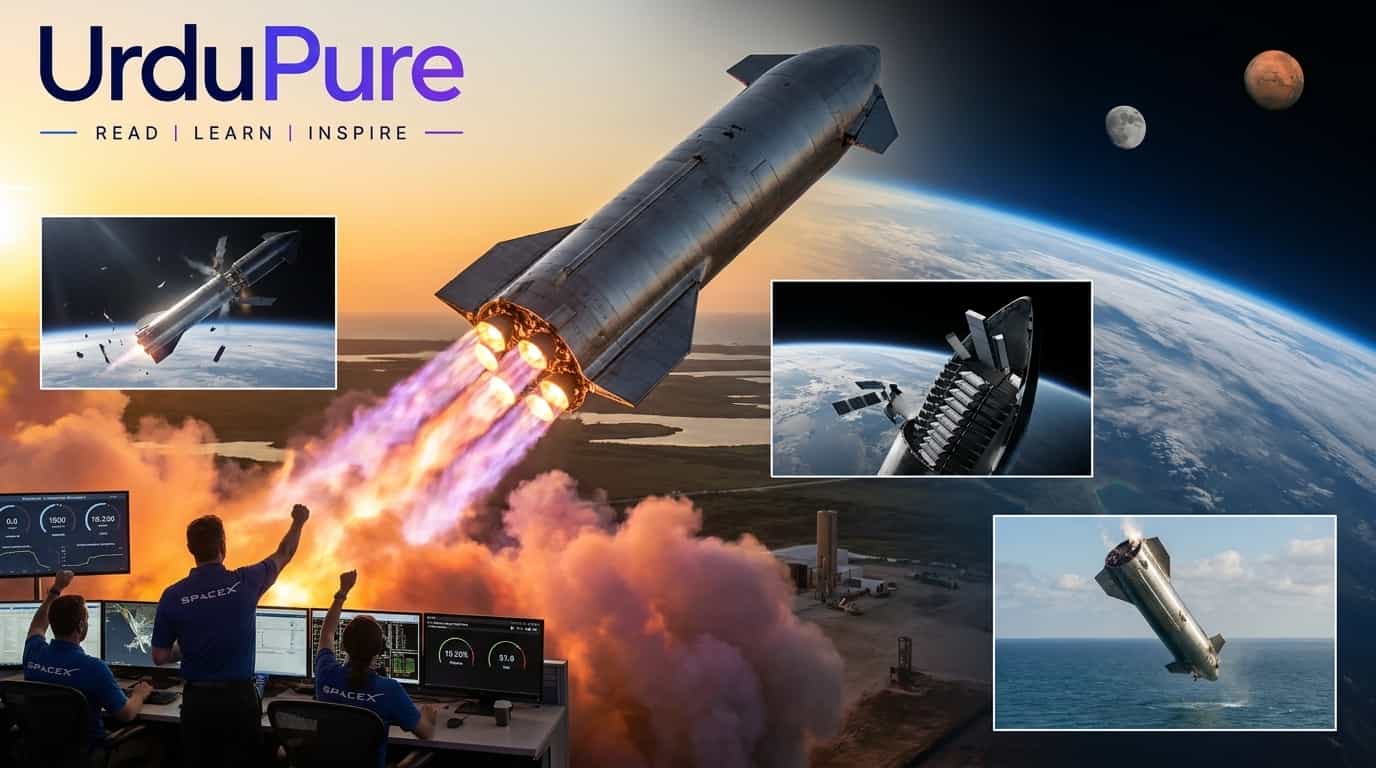
SpaceX Starship V3 Just Launched: What Happened in Flight 12, Why It Matters, and What Comes Next for the Moon and Mars
At 6:30 p.m. EDT on Friday, May 22, 2026, the world's most powerful rocket rose from a brand-new launch pad in South Texas and punched through the atmosphere with 18 million pounds of thrust. Starship Version 3 — the vehicle SpaceX says will take humans to the Moon and eventually to Mars — had finally flown.
The result was exactly what a "test flight" is supposed to look like: a mix of stunning success and hard-won failure. The Ship upper stage, Ship 39, completed its mission — reaching Space Engine Cutoff (SECO), deploying 22 modified Starlink simulators into orbit for the first time in program history, and splashing down in the Indian Ocean as planned. The Super Heavy booster, Booster 19, did not. Multiple engine failures during the boost-back burn sent it tumbling into an uncontrolled hard landing in the Gulf of Mexico. It was expended rather than recovered.
SpaceX, characteristically, is treating this as progress. By the program's own standards — and by the standards of how massively complex aerospace systems are actually developed — they are right to do so.
Here is the complete breakdown of what happened, what was new about this vehicle, what the failures mean, and what this flight says about SpaceX's Moon and Mars timelines.
The Flight, Minute by Minute
A Scrub Before the Success
Flight 12 was originally scheduled for Thursday, May 21. The launch was scrubbed at the final hour by an uncooperative hydraulic pin in one of the launch tower arms that refused to retract to its pre-launch position. SpaceX reset overnight and attempted again on Friday, May 22 — this time successfully.
Liftoff occurred at 22:30:24 UTC, using the newly constructed Pad 2 at SpaceX's Starbase facility in South Texas. This was the first launch from Pad 2 — previously, all Starship flights had launched from the original Pad 1. The dual-pad infrastructure matters enormously for SpaceX's long-term goal of launching Starship weekly: two pads means teams can prepare one rocket for launch while the other is being refurbished, doubling potential flight cadence without doubling the total infrastructure footprint.
T+0 to T+2:24 — The Booster Phase
All 33 Raptor 3 engines on the Super Heavy booster lit cleanly and the vehicle cleared the pad. The first two minutes and twenty-four seconds went nominally: the rocket performed its full powered ascent through the lower atmosphere, reaching max-q (maximum aerodynamic pressure) and throttling through without issue. Hot-staging separation — the process by which Ship 39's six Raptor engines ignite while still mated to the booster, then the two stages split apart — executed as planned. This was described by SpaceX's livestream team as performing "nominally."
The problems began immediately after staging. Booster 19 was programmed to flip around, execute a boost-back burn to reverse its trajectory, and head back toward Starbase for a controlled splashdown in the Gulf of Mexico. Multiple Raptor engines failed to re-ignite for the sustained boost-back burn as designed. Rather than returning to its target, Booster 19 tumbled and came down in an uncontrolled hard landing in the water — almost certainly destroyed on impact. Recovery was technically planned but not executed; the booster was categorised as expended.
T+2:24 Onward — The Ship's Solo Flight
Ship 39's six Raptor engines fired and it continued upward on its own. One engine shut down during ascent — the ship reached SECO on five of its six Raptors, with the shutdown captured on camera. This was not catastrophic; the remaining five engines were sufficient to complete the mission's primary objectives.
In space, Ship 39 achieved the following milestones for the first time in Starship program history:
22 Starlink mass simulator payloads deployed on orbit — the first time Starship has actually deployed objects in space. Two of the 22 simulators were modified with cameras pointing back at Ship's underside, gathering real-time imagery of the heat shield tiles during flight — data that will directly inform decisions about heat shield improvements on future flights.
Single Raptor 3 engine relight in space confirmed.
Various reentry stress maneuvers — SpaceX intentionally stressed the ship's rear flaps at maximum dynamic pressure during reentry, and performed a dynamic banking maneuver to simulate future return-to-launch-site trajectories.
Heat shield tile experiments — engineers intentionally removed one tile before flight to study the effects on adjacent tiles during the extreme heat of reentry. Several tiles were painted white as imaging reference targets.
Planned Indian Ocean splashdown completed. Ship 39 came down as targeted.
"This was not an incremental update. According to SpaceX, Starship V3 incorporates thousands of changes from its predecessor, touching virtually every major system on both the booster and the ship. Hot-staging separation and the full ascent burn both executed nominally."
— Basenor.com Flight 12 live updates, May 22, 2026
What Is Starship V3? A Generation Change, Not a Minor Upgrade
To understand why Flight 12 matters — even with its booster loss — you need to understand what Version 3 actually is, and how significant the generational leap from V2 represents.
Size: The World's Tallest Rocket, Even Bigger Now
Starship V3, stacked with its Super Heavy booster, stands 124.4 metres (408 feet) tall — approximately 1.5 metres taller than V2. The diameter of both stages is 9 metres. It weighs approximately 5,000 tonnes fully fuelled. No rocket in history has ever flown this large. For reference, the Saturn V — which carried Apollo astronauts to the Moon — was 111 metres tall. Starship V3 is more than 13 metres taller and carries roughly twice the propellant mass.
Raptor 3: The Engine That Changes Everything
The beating heart of Starship V3 is the new Raptor 3 engine, and it represents what serious aerospace engineers call a "clean-sheet redesign" rather than an iterative improvement. Key specifications:
Thrust per engine at sea level: approximately 250–280 metric tonnes-force — approximately 9% higher than the Raptor 2, which was rated at 230 tonnes-force. Some sources cite up to 280 tf in optimised test conditions.
Chamber pressure: over 280 bar — an extraordinary figure for a production engine. For context, the F-1 engines that powered Saturn V operated at approximately 70 bar. The Raptor 3 operates at four times that pressure.
33 Raptor 3 engines on the Super Heavy booster — combined booster thrust exceeds 9,200 metric tonnes-force, or roughly 18 million pounds of thrust, compared to approximately 7,400 metric tonnes-force on a Raptor 2 booster. This makes the V3 Super Heavy approximately 25% more powerful at liftoff than its predecessor.
6 Raptor 3 engines on Ship — the upper stage's propulsion is also significantly upgraded.
Beyond raw thrust, the Raptor 3 is designed to be dramatically simpler to manufacture and maintain than Raptor 2. Fewer welds, fewer components, and a more streamlined architecture mean faster production rates and lower per-engine costs — directly relevant to SpaceX's goal of a high-cadence launch programme.
Payload Capacity: A Three-Times Jump Over V2
Perhaps the most consequential single number in the V3 specification is its payload capacity. In reusable configuration — the standard operating mode, where both booster and Ship are recovered and reflown — Starship V3 can carry more than 100 metric tonnes to Low Earth Orbit. This compares to approximately 35 metric tonnes for V2 in reusable mode. In an expendable (non-recovered) configuration, the figure climbs even higher.
Three times the payload capacity changes the economics of almost every mission SpaceX and its customers are planning:
For Starlink next-gen deployment, V3 can carry roughly three times as many satellites per launch, compressing the deployment timeline for SpaceX's next-generation high-bandwidth constellation from years to months.
For NASA's Artemis programme, the larger payload margin reduces mission risk and allows more propellant to be pre-positioned in lunar orbit before astronaut arrival — reducing the number of refuelling flights required per crewed mission.
For commercial customers, 100+ tonne payloads to LEO open up architectures — large space station modules, in-space manufacturing infrastructure, telescope mirrors — that were previously impossible with any existing launch vehicle.
Tank Capacity: More Propellant, More Range
V3's propellant tank capacity has grown from approximately 1,200 tonnes (V2) to approximately 2,000 tonnes. This expanded fuel load is what allows V3's higher payload capacity despite the heavier dry mass that comes with the larger vehicle. The increased propellant volume is also critical for the in-orbit refuelling architecture that NASA's lunar missions depend on.
Structural and Hardware Changes
Four new docking ports on Ship for orbital propellant transfer — essential infrastructure for lunar and Mars missions requiring fuel depots.
50% larger grid fins on Super Heavy — with one fewer fin than V2, but each significantly stronger, incorporating new mechanisms for the booster's catch-arm return.
Revised fuel transfer tube — the component funnelling liquid methane to Super Heavy's Raptor engines received a substantial redesign for improved reliability.
Enhanced heat shielding on Ship — including tile redesigns and new tile configurations being tested in flight, as demonstrated during Flight 12's deliberate single-tile-removal experiment.
Simplified structures — SpaceX reports reductions in dry mass and overall component count, targeting faster turnaround between flights.
Understanding the Booster Loss: Failure or Expected Setback?
The Super Heavy booster's failure to complete its boost-back burn and its uncontrolled hard landing in the Gulf of Mexico is the headline disappointment of Flight 12. But context is essential.
What the Investigation Will Focus On
According to post-flight reporting from TechCrunch, Booster 19 suffered multiple engine failures during its boost-back burn — not a single engine anomaly, but a pattern of failures that prevented the sustained burn needed to reverse its trajectory. SpaceX's teams will now analyse the flight data to determine whether the failures were related to the redesigned fuel transfer tube, Raptor 3 engine behaviour during the unconventional boost-back burn profile, a hardware defect specific to this booster, or a software/control system issue in the updated flight profile.
V3's boost-back burn differs from V2's not just in engine specification but in the overall flight profile. V3 was flying a different return trajectory compared to all previous V2 flights, which traced a route from South Texas to the Indian Ocean. A new vehicle on a new pad with a new flight profile experiencing a novel failure mode is — while frustrating — not surprising.
Why SpaceX Is Not Treating This as a Programme Halt
The critical distinction is what did work. Stage separation was clean. Ship 39 completed the majority of its mission objectives. Orbital deployment of simulators — never previously accomplished — succeeded. The heat shield survived reentry well enough to provide usable data. The Indian Ocean splashdown was on target.
SpaceX's development philosophy, refined over two decades of iterative engineering from Falcon 1 to Falcon 9 to Starship, is "fly, learn, fix, fly again" — and to do so faster than any competitor. Booster 19 was not expected to be recovered on this flight in any case, as recovery was described as a "planned splashdown" in the Gulf rather than a tower catch. The loss is a data point, not a defeat.
Critically, the programme's next hardware is already built. Ship 40, the second V3 upper stage, is already undergoing testing at Starbase ahead of Flight 13. SpaceX's manufacturing tempo means Flight 13 is likely weeks, not months, away — and it will incorporate the lessons from Booster 19's engine failures.
"Every previous Starship was essentially a prototype. V3 is the version SpaceX actually intends to put to work. This was the first flight — not the last."
— Teslarati, May 2026
Why Flight 12 Matters Beyond SpaceX: NASA, Artemis, and the Moon
SpaceX is not developing Starship V3 in isolation. The stakes of this programme extend far beyond one company's ambitions and directly affect the United States government's plans to return astronauts to the lunar surface for the first time since 1972.
NASA's $4 Billion Bet on Starship
NASA has awarded SpaceX more than $4 billion under the Human Landing System (HLS) contract to develop a crewed, human-rated variant of Starship to carry Artemis astronauts from lunar orbit to the Moon's surface and back. The currently targeted mission is Artemis IV, with a crewed lunar landing now scheduled for 2028 — though that date is contingent on a sequence of milestones that Flight 12 was designed to begin demonstrating.
Before NASA will fly astronauts on a Starship-derived lander, SpaceX must demonstrate in-orbit propellant transfer at scale. This requires more than ten tanker Starship flights to fuel a single Moon mission from a propellant depot in low Earth orbit — a choreography of orbital logistics that has never been attempted with any vehicle, let alone one as new as V3. Each of those tanker flights requires a Starship that performs reliably, with a booster that returns and is quickly refurbished for the next launch.
Flight 12's successful Ship performance and orbital payload deployment is a step toward demonstrating that V3 can do the job. The booster failures are a setback on the recovery and reuse timeline. NASA's Acting Administrator Sean Duffy responded to Flight 11 in October 2025 by calling it "another major step toward landing Americans on the Moon's south pole." The agency will now assess Flight 12's results to determine whether the 2028 Artemis IV schedule remains achievable.
The Orbital Refuelling Architecture
The reason V3's expanded propellant capacity of 2,000 tonnes matters so specifically for Artemis is the orbital refuelling equation. A Starship Human Landing System variant departs low Earth orbit for the Moon only after receiving propellant from multiple Starship tanker flights. At V2's 1,200-tonne propellant capacity, this required a larger number of tanker flights. V3's 2,000-tonne capacity reduces the required flight count, compresses the mission timeline window, and makes the entire architecture more robust against individual launch delays.
Four new docking ports on V3 Ship are not cosmetic additions. They are the physical interface for propellant transfer in orbit — the hardware that turns Starship from a single-mission vehicle into a modular component of an orbital refuelling infrastructure. Flight 12's success or failure in demonstrating these systems in future flights will directly determine whether Artemis IV flies in 2028 or slips to 2030.
What This Means for Mars — Elon Musk's End Goal
NASA's Moon missions are, in Musk's public framing, a stepping stone rather than the destination. The destination is Mars — specifically, the establishment of a self-sustaining permanent human settlement that he has described publicly as the primary purpose of his life and SpaceX's existence.
V3's 100-tonne reusable payload capacity is the first version of Starship that genuinely makes Mars colonisation mathematically tractable. The architecture SpaceX has proposed requires launching large quantities of cargo, habitat modules, life support equipment, industrial machinery, and fuel to Mars within a 26-month planetary alignment window. At V2's 35-tonne reusable payload, the number of flights required per window strains credibility. At V3's 100+ tonnes, the logistics begin to look like something that could be accomplished within a realistic industrial production programme.
Musk has said publicly that SpaceX is targeting the first uncrewed Mars landing during the next Mars transfer window in late 2026, using Starship to carry its first payload to the red planet. Whether that timeline holds — it was originally stated for the 2024 window — depends entirely on how quickly V3 can be proven flight-worthy through the test programme that Flight 12 has now begun.
What Comes Next: Flight 13 and the Road to Recovery
SpaceX's near-term programme is now focused on:
Flight 12 data analysis. Engineers will spend the coming weeks analysing telemetry from Booster 19's engine failures to identify root cause and implement fixes for Flight 13. The Raptor 3 engine data collected during both the static fire tests and this flight is the most important engineering output of the mission.
Ship 40 preparation for Flight 13. Already undergoing testing, Ship 40 is the next V3 upper stage. SpaceX's manufacturing pace means it could be stacked with a new V3 booster within weeks of completing the Flight 12 investigation.
Booster recovery attempt on Flight 13 or 14. SpaceX has stated that depending on Flight 12's outcomes, the upcoming flights could attempt the first chopstick-arm catch of a V3 Super Heavy booster — the "mechazilla" return used successfully in V2 testing. Booster 19's failure to perform its boost-back burn will likely push this to Flight 14 at earliest.
In-orbit propellant transfer demonstration. The most critical near-term NASA milestone. This has not yet been attempted and is the single most important thing SpaceX needs to prove for the Artemis HLS programme to proceed.
Pad 1 upgrade completion. SpaceX is upgrading its original pad alongside building out Pad 2's operational capabilities, targeting a two-pad launch cadence. The company has also begun constructing dual launch pads in Cape Canaveral and Kennedy Space Center in Florida — a facility that would enable launches to higher-inclination orbits and reduce range conflicts with other launch providers.
The Bigger Picture: What Starship V3 Means for Human Spaceflight
Every serious analysis of human spaceflight's near-term future runs through Starship. Not because SpaceX is the only player — Blue Origin's New Glenn is flying, United Launch Alliance's Vulcan is flying, Rocket Lab is flying — but because no other vehicle in development or service offers anything close to the payload capacity, intended reusability, and production scale that SpaceX is targeting with V3.
The comparison point is not Falcon 9. It is the entirety of the world's current rocket fleet combined. If V3 achieves even a fraction of its intended flight rate — 52 launches per year, or once a week, is Musk's stated goal for 2026 — it will move more mass to orbit in a single year than the rest of the global launch industry has moved in the last decade. That is not a marketing exaggeration; it is basic arithmetic applied to the specifications.
Flight 12 did not achieve everything SpaceX hoped. The booster loss is a real setback for the recovery-and-reuse architecture that makes Starship's economics work. But the Ship performed. The world's most capable upper stage reached space, deployed payloads, survived reentry, and splashed down on target. On a first test flight of a fundamentally new generation of hardware, from a brand-new launch pad, on a new flight trajectory, that is a result SpaceX — and NASA — can build from.
The Moon is waiting. Mars is further. But for the first time in history, both have a vehicle capable of taking us there at the scale required. It just needs a little more work on the way down.
Key Takeaways
SpaceX Starship V3 (Flight 12) launched May 22, 2026, from the new Pad 2 at Starbase, Texas — the first V3 launch and the first use of Pad 2.
Ship 39 succeeded: reached SECO on 5 of 6 Raptor engines, deployed 22 Starlink simulators into orbit for the first time in programme history, completed reentry experiments, and splashed down in the Indian Ocean as planned.
Booster 19 failed: multiple Raptor engine failures during boost-back burn resulted in an uncontrolled hard landing in the Gulf of Mexico. The booster was expended.
V3 specs: 124.4m tall, 33 Raptor 3 engines on Super Heavy (18 million lbs combined thrust), 100+ metric tonnes to LEO in reusable mode — three times V2's capacity.
Raptor 3 produces approximately 250–280 tonnes-force at sea level at 280+ bar chamber pressure — a 9%+ thrust increase over Raptor 2 and a complete engine redesign.
NASA has invested $4 billion+ in Starship as the Human Landing System for Artemis IV (crewed lunar landing targeted 2028). Flight 12's results affect that timeline directly.
Ship 40 (V3) is already being prepared for Flight 13. SpaceX will fix the booster burn issues and attempt recovery on Flight 13 or 14.
V3 is the first version of Starship that SpaceX intends to operate commercially — for Starlink next-gen deployment, NASA Artemis, and eventually Mars missions.
This article was reported using live coverage from Space.com's Flight 12 launch updates, CBS News, TechCrunch, CNN, NASASpaceflight.com, Teslarati, and Orbital Today, all published May 21–22, 2026. Technical specifications are sourced from SpaceX's published flight overview, New Space Tracker's Flight 12 guide, and independent engineering analysis from Payload Space. All outcome data reflects information available as of approximately 11 PM EDT on May 22, 2026. Post-flight analysis from SpaceX is expected in the coming days and may update the account of specific failure modes.






Discussion
Comments
Approved comments are published after moderation to keep discussion useful and spam-free.
No comments yet. Start the discussion below.