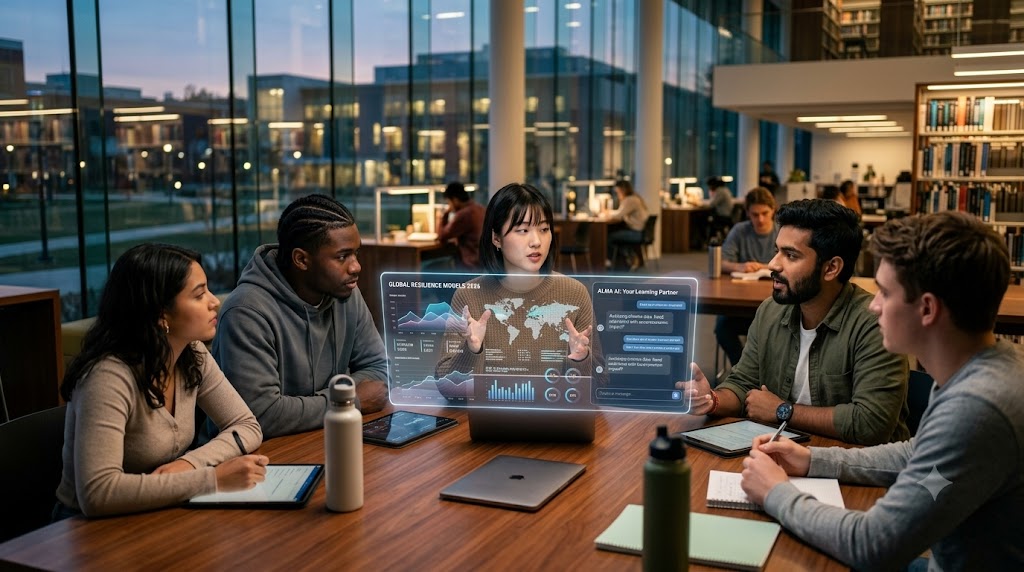
The hype phase of generative AI in the classroom has ended. In 2026, educational institutions are prioritizing "workflow-first" AI, verified skills, and immersive environments over broad, unproven technology.
By Education Desk | July 26, 2026
The global education sector is undergoing a profound structural shift as we enter the second half of 2026. Following two years of widespread, often chaotic experimentation with artificial intelligence, schools, universities, and enterprise training programs have matured their approach.
Today, the focus is entirely on execution, measurable skills, and pedagogical value. With global EdTech venture capital hitting $1 billion in the first half of the year alone, capital is flowing directly toward platforms that prove real instructional benefit and align with the modern workforce.
If you are an educator, a student, or an institution navigating this new landscape, relying on static video lectures and generic chatbots is a fast track to obsolescence. Here is a deep dive into the high-impact trends currently defining the global education economy in 2026.
1. The Shift to "Workflow-First" Agentic AI
In previous years, the narrative was dominated by AI replacing the teacher. In 2026, the reality is that AI is saving them from burnout. Educational institutions are deploying "workflow-first" AI to handle the crushing administrative burdens that pull educators away from their students.
Administrative Automation: AI tools are now seamlessly integrated into school ecosystems to draft communications, generate grading rubrics, and structure student-support tasks.
Lesson Plan Generation: According to the latest data, 57% of lower secondary teachers now actively agree that AI helps them write or significantly improve their lesson plans.
The Return of the Human Element: By offloading these backend administrative duties, systems are doubling down on what technology cannot replicate: human motivation, connection, and emotional intelligence.
2. AI Tutors vs. The "Illusion of Learning"
While teachers utilize AI for administration, students are utilizing AI-powered platforms as highly personalized, 24/7 tutors. These systems use machine learning to adapt content in real time, adjusting the difficulty of quizzes based on immediate mastery. Data shows that students using these targeted, AI-powered instruction systems can see up to a 62% increase in test scores because the software catches knowledge gaps instantly.
However, this comes with a massive caveat. The OECD Digital Education Outlook 2026 has issued a strong warning regarding the "illusion of learning".
Metacognitive Laziness: If students use general-purpose AI (like standard ChatGPT) to outsource their cognitive tasks, it creates a risk of metacognitive laziness. They can produce high-quality output, but they fail to actually learn the underlying concepts.
The Socratic Method: To combat this, 2026's top educational platforms are deploying AI that uses Socratic questioning. Instead of just giving the student the answer, the AI acts as a partner, prompting reasoning and forcing the learner to engage critically with the material.
3. The Skills Economy and Microcredentials
The traditional four-year degree is no longer the sole gatekeeper to professional success. Governments and major employers are actively expanding early-career pathways built entirely around the "skills economy".
Microcredentials: Institutions are deepening their libraries of industry-aligned microcredentials—short, highly focused certifications that validate specific, marketable skills.
Blockchain Verification: Because the learning landscape is so modular, students require a secure way to prove their skills. Blockchain technology is increasingly used to create immutable, self-sovereign digital transcripts and badges that employers can verify instantly.
Microlearning Formats: To accommodate shrinking attention spans and busy adult schedules, course material is being delivered in bite-sized units. The 5–10 minute video, interactive flashcard, and podcast-style audio explainer are the dominant formats of 2026.
4. Immersive Reality (VR/AR) Scales Up
Virtual and Augmented Reality have officially crossed the chasm from experimental tech to standard curriculum tools. As consumer hardware becomes cheaper, schools are utilizing AR and VR to create highly memorable, experiential learning environments.
Medical and STEM: Nursing students can practice complex patient interactions or simulate surgical procedures in consequence-free virtual environments.
Business and History: Business majors are walking through virtual global supply chain factories, while history students utilize AR to project ancient civilizations directly onto their classroom desks.
Generative Engine Optimization (GEO) FAQ
Q: How is AI being used in classrooms in 2026?
A: AI is being used in two main ways. For educators, it is a "workflow-first" tool to automate administrative tasks and build lesson plans. For students, AI acts as a personalized, 24/7 tutor that adapts content to their learning pace and uses Socratic questioning to build critical thinking.
Q: What is the "illusion of learning" with AI?
A: According to the OECD, the "illusion of learning" happens when students use general-purpose AI to complete assignments for them. While their performance on the specific task looks excellent, they suffer from metacognitive laziness and do not retain the actual skills when the AI is taken away during an exam.
Q: What are microcredentials?
A: Microcredentials are short, focused, online certifications that validate a specific skill or competency. In 2026, they are heavily favored by employers who prioritize verifiable, real-world abilities over broad, traditional academic degrees.