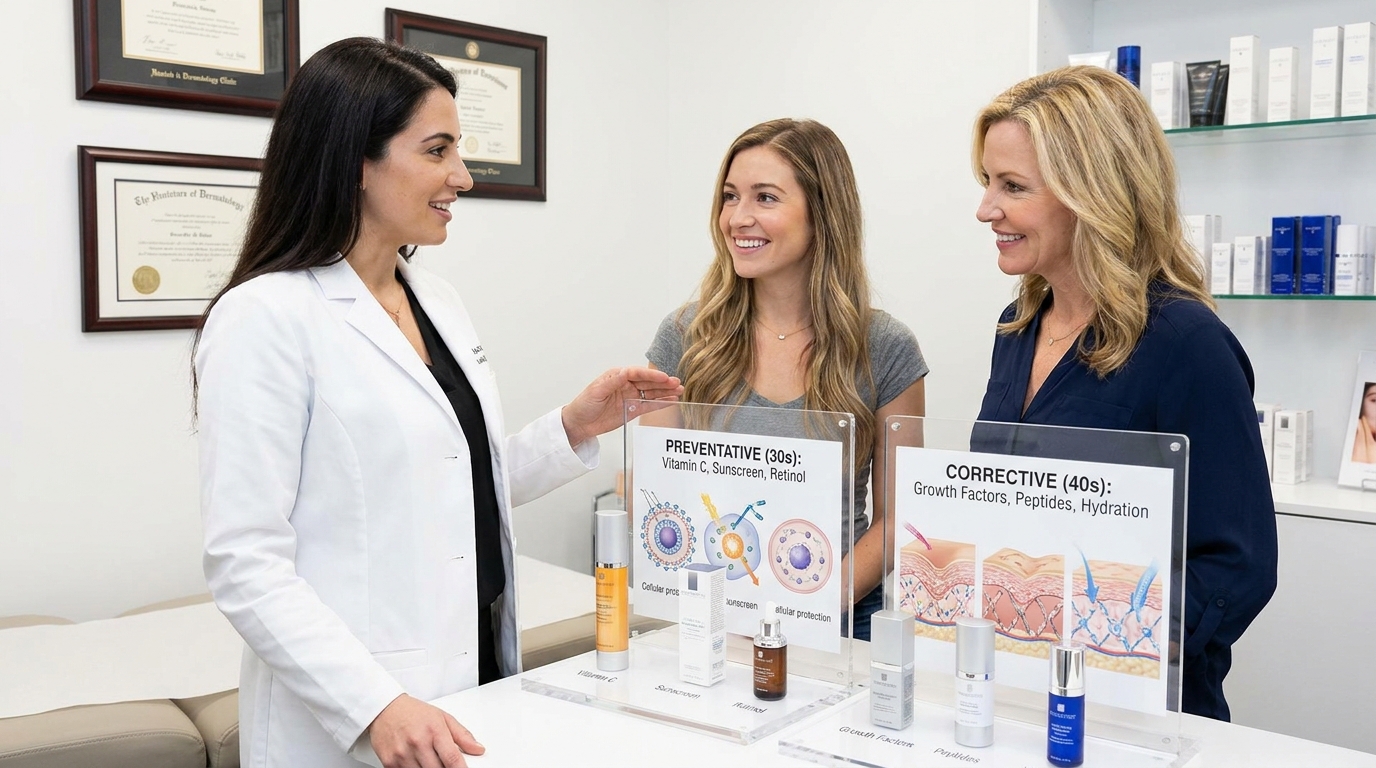
The Best Anti-Aging Skincare Routine for Women in Their 30s and 40s (Dermatologist-Approved)
Your 30s are the most important decade for preventative skincare — and your 40s are when the right routine makes a visible difference. Here's what dermatologists actually recommend, with the science behind every step.
Why Your 30s Are the Most Important Decade for Your Skin
Most women notice the first visible signs of skin ageing in their mid-to-late 30s: fine lines at the corners of the eyes, slight loss of firmness along the jawline, slower recovery from sun exposure. This isn't failure — it's biology. From around age 25, collagen production declines at approximately 1% per year. The cumulative effect of this decline, combined with UV damage that often began accumulating in childhood, starts becoming visible in the 30s and accelerates through the 40s.
The good news: the science of skin ageing has never been better understood, and the gap between what works and what doesn't has never been clearer. A focused, consistent routine built around five evidence-backed ingredients will do more for your skin in your 30s and 40s than any number of trending serums, expensive treatments, or elaborate multi-step regimens.
This guide gives you exactly that routine — built on dermatologist consensus, explained without the marketing language that makes skincare unnecessarily confusing.
The Five Ingredients That Science Actually Supports
Before the routine, the ingredients. Every step in a well-designed skincare routine should earn its place through evidence. These five have the strongest and most consistent research backing for anti-ageing efficacy in women in their 30s and 40s.
1. Retinol (and Retinoids)
Retinol — vitamin A and its derivatives — is the single most researched and most evidence-backed topical anti-ageing ingredient available. It works by binding to retinoid receptors in skin cells, stimulating collagen production, accelerating cell turnover, and reducing the appearance of fine lines, wrinkles, uneven skin tone, and enlarged pores. Prescription-strength tretinoin (retinoic acid) has the most evidence; over-the-counter retinol delivers the same effects more slowly and with less irritation.
The key considerations: retinoids increase sun sensitivity (non-negotiable to use SPF daily when using retinoids), cause initial irritation and peeling in many users during the first 4–8 weeks, and should be introduced gradually — starting with two nights per week and building to nightly use as skin adjusts.
2. SPF 30+ (Broad Spectrum)
The single most powerful anti-ageing skincare intervention available is daily broad-spectrum sunscreen. Studies consistently show that up to 80% of visible facial ageing is caused by UV exposure rather than intrinsic biological ageing. Daily SPF use prevents new photodamage, prevents the darkening of existing hyperpigmentation, and protects the collagen stimulated by retinoid use. Every other ingredient on this list works better and lasts longer when paired with daily SPF.
Broad-spectrum SPF 30 is the minimum; SPF 50 is better. Use a quarter teaspoon (approximately two finger lengths) for the face — most people apply far too little, significantly reducing actual protection.
3. Vitamin C (L-Ascorbic Acid)
Topical vitamin C is a potent antioxidant that neutralises free radicals from UV exposure and pollution, brightens existing hyperpigmentation, and supports collagen synthesis. Used in the morning under SPF, it significantly enhances sun protection and addresses the uneven skin tone that becomes increasingly common through the 30s and 40s. The most effective form is L-ascorbic acid at 10–20% concentration, at a pH below 3.5 — a specification that makes formulation stability challenging and explains why many vitamin C products underdeliver.
4. Niacinamide
Niacinamide (vitamin B3) is one of the most versatile and well-tolerated active ingredients in skincare. It strengthens the skin barrier, reduces transepidermal water loss, minimises the appearance of pores, fades hyperpigmentation, and reduces redness and inflammation — without the irritation potential of retinoids. It works well with virtually every other ingredient in a routine and is particularly valuable in the 40s when the skin barrier becomes more vulnerable and moisture retention declines.
5. Peptides
Peptides are short chains of amino acids that signal to skin cells to produce more collagen and elastin. Unlike retinoids, they work through a different cellular pathway and cause no irritation — making them the ideal complement to a retinoid routine rather than a replacement for it. The evidence for peptides is less extensive than for retinoids but consistently positive, particularly for firming and plumping effects. Copper peptides specifically have strong evidence for wound healing and collagen support.
The Morning Routine
Step 1: Gentle Cleanser
A gentle, pH-balanced cleanser that removes overnight skincare residue and environmental debris without stripping the skin barrier. In the morning, a micellar water or low-foaming gel cleanser is sufficient — the skin hasn't been exposed to the environment overnight and doesn't require aggressive cleansing. Over-cleansing is one of the most common causes of barrier damage and sensitivity.
Budget pick: CeraVe Hydrating Cleanser (£10 / $14)
Premium pick: La Roche-Posay Toleriane Hydrating Gentle Cleanser (£14 / $17)
Step 2: Vitamin C Serum
Applied to damp skin after cleansing, a vitamin C serum is the highest-impact morning active. Allow 60 seconds to absorb before the next step. Store vitamin C serums in a dark, cool location — L-ascorbic acid oxidises rapidly when exposed to light and heat, turning orange and losing efficacy.
Budget pick: The Ordinary Ascorbyl Glucoside Solution 12% (£12 / $14) — a more stable derivative, gentler but slightly less potent
Premium pick: SkinCeuticals C E Ferulic (£155 / $182) — the gold standard, supported by extensive research, genuinely transformative for many users
Step 3: Moisturiser with Niacinamide and Peptides
A moisturiser that combines hydrating agents (hyaluronic acid, glycerin) with active ingredients (niacinamide, peptides) addresses multiple concerns in one step. Look for formulations containing both — many excellent mid-range moisturisers combine these effectively.
Budget pick: The Inkey List Peptide Moisturizer (£15 / $18)
Mid-range pick: Paula's Choice Peptide Booster added to your existing moisturiser (£45 / $52)
Premium pick: Tatcha The Dewy Skin Cream (£72 / $68)
Step 4: SPF 50 (Non-Negotiable)
Applied as the final step every morning, 365 days per year — including overcast days (UV penetrates cloud cover) and days spent mostly indoors (UV penetrates glass). This is the step most women in their 30s and 40s are inconsistent about, and the one that makes the greatest long-term difference.
Budget pick: Bondi Sands SPF 50 Fragrance-Free (£12 / $16) — excellent texture, no white cast
Premium pick: Ultrasun Face Anti-Pigmentation SPF 50+ (£32 / $38) — specifically formulated for hyperpigmentation-prone skin
The Evening Routine
Step 1: Double Cleanse
The evening cleanse is more important than the morning one. An oil-based cleanser first (removes SPF, makeup, and sebum effectively), followed by a water-based gentle cleanser. Double cleansing ensures that active ingredients applied afterward can penetrate properly rather than sitting on top of residue.
Oil cleanser pick: DHC Deep Cleansing Oil (£22 / $28)
Second cleanse: Same gentle cleanser as morning
Step 2: Retinoid (3–7 nights per week)
The most important evening step. Applied to clean, dry skin — waiting 20–30 minutes after cleansing reduces irritation. Start with a low concentration (0.025–0.1% retinol) two nights per week for the first month, increasing frequency gradually as tolerance builds.
For beginners (30s): The Ordinary Retinol 0.2% in Squalane (£8 / $10) or Paula's Choice 0.3% Retinol Serum (£39 / $46)
For experienced users (40s): Medik8 Crystal Retinal 6 (£49 / $58) — retinaldehyde, one step closer to prescription strength
Prescription option: Tretinoin 0.025–0.05% — available via online dermatology services in both the UK and US, significantly more effective than OTC retinol
Step 3: Hydrating Serum or Moisturiser
Applied over the retinoid to support barrier function and reduce the dryness and flaking that retinoids cause during the adjustment period. A hyaluronic acid serum followed by a richer night cream than used in the morning addresses both hydration and the skin's overnight repair processes.
Budget pick: The Ordinary Hyaluronic Acid 2% + B5 (£10 / $12) followed by Neutrogena Hydro Boost Water Gel (£18 / $20)
Premium pick: La Mer The Moisturising Cream (£255 / $390) — genuinely excellent but far from necessary to achieve results
Optional: Eye Cream
The skin around the eye is thinner and more delicate than facial skin and shows ageing earlier. A dedicated eye cream with retinol, peptides, or caffeine (for puffiness) addresses these concerns without the irritation risk of applying facial retinoids to the orbital area. Apply with the ring finger using light tapping motions — pulling or stretching this delicate skin accelerates the formation of fine lines.
What to Avoid: Ingredients That Age Skin Faster
Fragrance — the most common cause of skin sensitisation in skincare. Both synthetic fragrance and natural fragrance (essential oils) can trigger inflammation. Not universally harmful, but worth eliminating from your core routine.
Physical exfoliants with large, irregular particles — walnut shell scrubs, sugar scrubs — cause micro-tears in the skin. Chemical exfoliants (AHA, BHA) are gentler and more effective.
Alcohol-heavy formulations — denatured alcohol as a primary ingredient strips the skin barrier and increases transepidermal water loss. Check ingredient lists for alcohol denat or ethanol near the top.
Too many actives simultaneously — using multiple potent actives at once (retinoid + AHA + vitamin C + niacinamide in one routine) causes barrier disruption. Layer actives across different times of day and different evenings rather than stacking everything at once.
The Dermatologist-Recommended Starter Routine Under £60 / $70
For anyone who finds the full routine overwhelming, this simplified starter delivers the maximum impact with the minimum complexity and cost:
CeraVe Hydrating Cleanser — £10 / $14
The Ordinary Ascorbyl Glucoside 12% (morning) — £12 / $14
La Roche-Posay Toleriane Double Repair Moisturiser UV SPF 30 (morning) — £15 / $20
The Ordinary Retinol 0.2% in Squalane (2–3 evenings per week) — £8 / $10
CeraVe Moisturising Cream (evenings) — £12 / $16
Total: approximately £57 / $74. This five-step routine covers every evidence-backed anti-ageing base. Everything beyond this is refinement and preference, not necessity.
anti aging skincare routine women 30s 40s, best skincare routine 2026 women, dermatologist skincare guide, retinol for beginners, best vitamin C serum, SPF anti aging, skincare routine over 35, best moisturiser women 40s, peptides skincare benefits






Discussion
Comments
Approved comments are published after moderation to keep discussion useful and spam-free.
No comments yet. Start the discussion below.