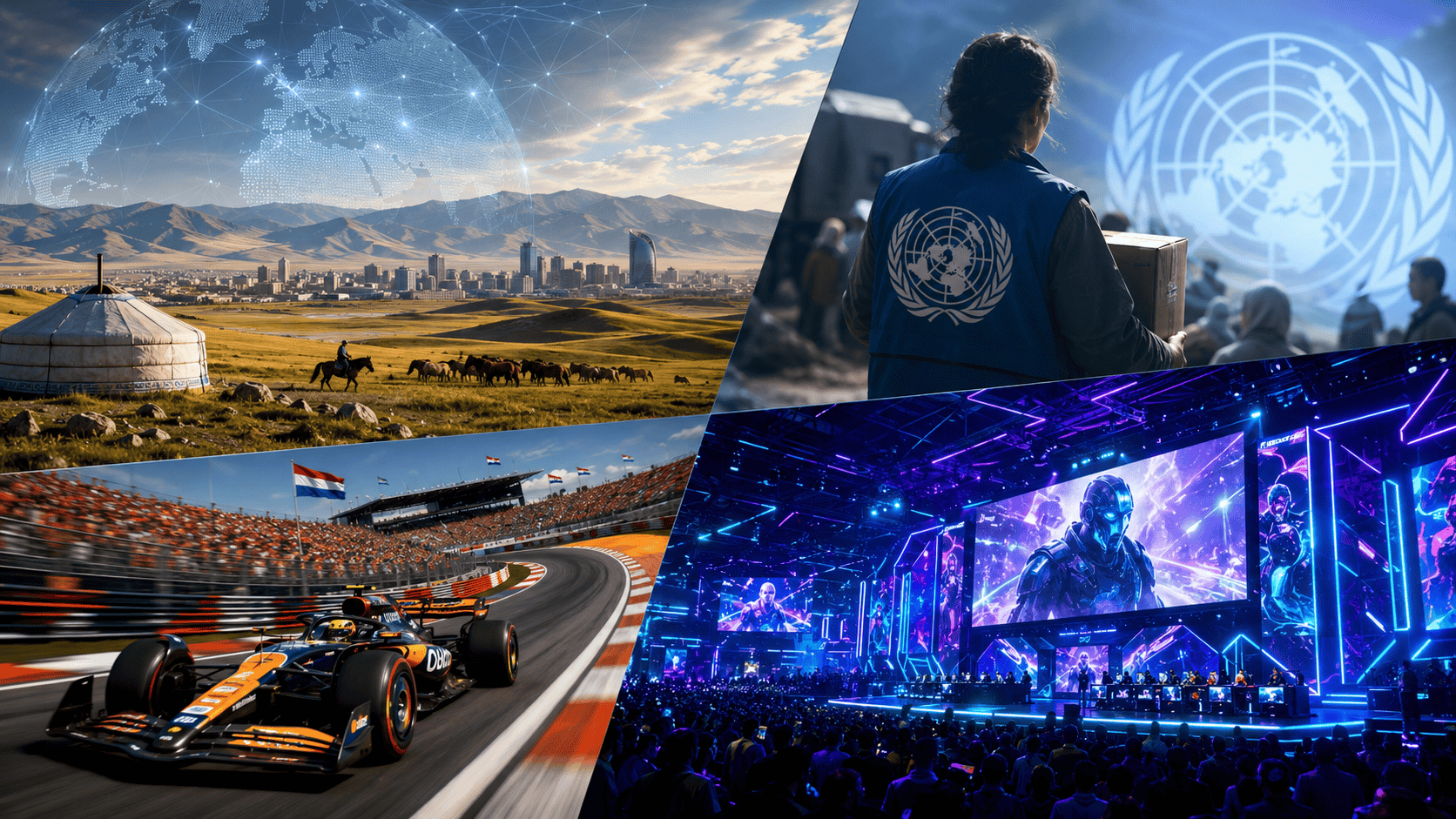
August is ending with an unusually diverse global calendar. From environmental negotiations in Mongolia and humanitarian action worldwide to Formula 1’s farewell at Zandvoort and Gamescom in Cologne, here are four events worth following.
Climate diplomacy, humanitarian action, Formula 1 and gaming are about to collide in one unusually busy stretch of the global calendar.
By Global Trends Desk | Sunday, August 16, 2026
If August has felt busy already, the second half of the month is about to get considerably more interesting.
Over the next two weeks, some of the world's attention will move between four very different places and subjects: the vast landscapes of Mongolia, humanitarian operations around the world, a packed Formula 1 circuit on the Dutch coast and one of Europe's biggest technology and gaming gatherings in Cologne.
They may appear unrelated. In reality, each tells us something about where global attention—and money—is moving.
Governments are debating how to protect productive land and prepare for drought. Humanitarian organizations are confronting increasingly difficult operating environments. Formula 1 is preparing for an emotional farewell at Zandvoort. And the gaming industry is gathering to showcase the products, technology and entertainment trends likely to shape the months ahead.
For readers who want to know what is happening in late August 2026 and why it matters, these are four dates to put on the calendar.
Late August 2026 Events at a Glance
August 17–28: UNCCD COP17 — Ulaanbaatar, Mongolia
August 19: World Humanitarian Day — Worldwide
August 21–23: Formula 1 Dutch Grand Prix — Zandvoort, Netherlands
August 25: Gamescom Opening Night Live — Cologne, Germany
August 26–30: Gamescom 2026 — Cologne, Germany
The four events and their original dates and locations are established in the source calendar.
1. UNCCD COP17: Why the World Is Talking About Land Again
The first major event begins on August 17, when Mongolia hosts UNCCD COP17, the 17th Conference of the Parties to the United Nations Convention to Combat Desertification.
The summit runs through August 28 in Ulaanbaatar under the theme “Restoring Land, Restoring Hope.”
At first glance, a conference about land degradation may not sound as commercially significant as an energy summit, technology exhibition or financial meeting.
Look closer, however, and land sits underneath many of the issues affecting households and businesses every day.
Agricultural production depends on it. Food prices depend on it. Water availability, livestock, rural employment and supply chains are all influenced by the condition of the land that supports them.
That is why COP17 deserves attention beyond environmental circles.
Land Degradation Has Become an Economic Issue
According to the source material, up to 40% of the world's land is affected by degradation.
That has consequences far beyond landscapes looking drier.
When productive land deteriorates, farmers can face lower yields. Governments may need to spend more on drought response and food security. Businesses dealing with agriculture, water, insurance, logistics and commodities can face higher costs and greater uncertainty.
It also explains why topics such as climate finance, sustainable investment, agricultural technology, water management and drought resilience increasingly sit alongside traditional environmental policy.
For investors and companies, sustainability is no longer only about corporate branding. In some industries, environmental resilience is becoming part of basic risk management.
Why Mongolia Is an Appropriate Host
Mongolia has firsthand experience of the challenge.
Nearly 77% of Mongolia's territory is considered degraded, according to the source material.
Its grasslands also support pastoral communities whose livelihoods depend heavily on healthy rangelands.
That gives Mongolia an unusual role at COP17: it is not simply hosting an international conference. It is bringing the conversation to a country where the consequences of land degradation are already visible.
The timing is particularly significant because 2026 is the International Year of Rangelands and Pastoralists, giving greater attention to grazing lands and the communities that rely on them.
What Could Come Out of COP17?
One phrase to watch closely is drought resilience.
Countries are increasingly interested in moving from reacting to drought after it happens to preparing before severe conditions develop.
That means discussions about early warning systems, financing, agricultural resilience, water infrastructure, insurance and restoration projects could become increasingly important.
The summit therefore matters not only to governments.
It matters to farmers, food companies, sustainability investors, development institutions and businesses exposed to agricultural or water-related risks.
And eventually it can matter to consumers too, because environmental stress can work its way through supply chains and show up in something as ordinary as the price of food.
2. World Humanitarian Day: The People Behind the Crisis Headlines
Two days after COP17 begins, the focus shifts from environmental resilience to human survival.
World Humanitarian Day is observed on August 19 every year, recognizing humanitarian workers and people affected by emergencies around the world.
There is a reason August 19 was chosen.
The date is linked to the 2003 bombing of the United Nations headquarters in Baghdad, which killed 22 humanitarian and UN personnel, including Sergio Vieira de Mello.
More than two decades later, the central issue behind the observance remains painfully current.
How do you deliver food, medicine, shelter and emergency support when the people providing that assistance are themselves working in dangerous environments?
Humanitarian Aid Is an Enormous Logistics Operation
Humanitarian work can sometimes be discussed in abstract language.
On the ground, it is intensely practical.
Someone must transport food.
Someone must procure medical supplies.
Temporary shelters have to be built. Water systems have to operate. Communications equipment, vehicles, fuel, security arrangements and emergency logistics all have to work when normal infrastructure may already be damaged.
That makes humanitarian response relevant to areas including global logistics, healthcare, insurance, telecommunications, transportation and supply-chain management.
When any of those systems fail, aid can struggle to reach the people who need it.
Why August 19 Still Matters
World Humanitarian Day is also an opportunity to move beyond the political argument surrounding a conflict or disaster and look at what happens to ordinary people afterward.
Who keeps a hospital running?
Who gets clean water to displaced families?
Who delivers medicine when commercial supply networks have collapsed?
And who protects the workers attempting to perform those jobs?
The observance places those questions back at the centre of the conversation.
Its wider significance comes from issues already highlighted in the source article: civilian protection, humanitarian access, international humanitarian law and emergency funding.
Those subjects may sound institutional, but their consequences are deeply human.
3. Formula 1's Dutch Grand Prix Is Preparing for a Final Farewell
Then the mood changes completely.
On August 21, Formula 1 returns from its summer break at Circuit Zandvoort.
The 2026 Dutch Grand Prix will run from August 21 to August 23, and this one carries more weight than a normal race weekend.
It is scheduled to be the final Dutch Grand Prix at Zandvoort.
For Formula 1 fans, that alone makes the weekend special.
But organizers have added another twist: the farewell weekend will also feature the first Formula 1 Sprint held as part of the Dutch Grand Prix.
What Is Different About the 2026 Weekend?
Friday begins with practice and Sprint Qualifying.
Saturday features the Sprint followed by qualifying for Sunday's Grand Prix.
Then, on August 23, Formula 1 races at Zandvoort for what is scheduled to be the final Dutch Grand Prix of this era.
For viewers, that creates more competitive action across all three days.
For the circuit and surrounding tourism economy, it also means three days of intense international attention.
F1 Is No Longer Just About Racing
Modern Formula 1 sits at the intersection of sport, technology, luxury brands, automotive engineering, travel and entertainment.
That is one reason race weekends now attract audiences far beyond traditional motorsport enthusiasts.
Fans travel internationally to attend races. Hotels fill around host cities. Airlines, hospitality companies, tourism operators and premium brands all participate in the wider economy surrounding a Grand Prix.
Zandvoort has an additional advantage: atmosphere.
Since Formula 1 returned there in 2021, the race has become famous for huge Dutch crowds, orange grandstands and support for Max Verstappen.
Why Zandvoort Is Such a Distinctive Circuit
The circuit runs through coastal dunes and features changes in elevation and heavily banked corners.
It is relatively short by modern Formula 1 standards—4.259 kilometres—and the 2026 Grand Prix is scheduled over 72 laps, producing a race distance of just over 306 kilometres.
Television tends to make every F1 circuit look dramatic.
Zandvoort genuinely is.
The narrow track, sweeping corners, banking and sea of orange spectators give it an identity that is difficult to confuse with anywhere else on the calendar.
That is why August 23 could feel less like the conclusion of another Grand Prix and more like the end of a chapter.
4. Gamescom 2026: Where Gaming Becomes Big Business
After Zandvoort, attention moves across the border to Germany.
Gamescom 2026 takes place in Cologne from August 26 to August 30, while the major Opening Night Live presentation happens a day earlier on August 25.
For gamers, Gamescom is a showcase.
For the industry, it is business.
Publishers, developers, hardware manufacturers, retailers, investors, esports organizations and content creators all converge around the event.
That combination is what makes Gamescom particularly interesting.
Watch August 25 First
For anyone following from home, Gamescom Opening Night Live will probably be the first major date to watch.
It takes place on Tuesday, August 25, with the source article listing an 8 p.m. Central European Summer Time start for the main presentation.
This is where publishers can unveil trailers, gameplay, release dates and new projects in front of a global online audience.
Those announcements do more than create excitement on social media.
A major game reveal can influence interest in gaming laptops, graphics cards, consoles, monitors, accessories, cloud gaming subscriptions and broadband services.
That is one reason the modern gaming industry is closely linked with the wider consumer-technology market.
Gamescom Is Also a Technology Story
Gaming is increasingly connected to developments in artificial intelligence, cloud computing and high-performance hardware.
Developers are experimenting with AI-assisted workflows, animation, localization, game testing and content production.
Hardware companies, meanwhile, continue competing on graphics performance, displays, processors and portable gaming devices.
The original article correctly connects the sector with hardware demand, semiconductors, cloud infrastructure, streaming, subscriptions and digital advertising.
That is why Gamescom should not be viewed simply as an event for people who play games.
It is also a useful window into the future of consumer electronics and digital entertainment.
Cologne Benefits Too
Large international exhibitions also create another economic story: travel.
Visitors need flights and rail tickets. They book hotels. They eat in restaurants and use local transport.
For readers actually considering Gamescom, searches around Cologne hotels, flights to Germany, travel insurance, European rail travel and event tickets naturally increase as the event approaches.
Those travel questions are part of the event experience—not something that needs to be artificially forced into the story.
Why These Four Events Matter Together
On paper, Mongolia's COP17 summit and a Formula 1 race have almost nothing in common.
Neither does World Humanitarian Day with a gaming exhibition.
But put all four on the same calendar and a larger picture appears.
COP17 is about how societies protect the natural resources their economies depend on.
World Humanitarian Day is about what happens when normal systems fail and people must step in to keep others alive.
Formula 1 illustrates the expanding global business of live sport, technology and experience-driven tourism.
Gamescom demonstrates how video games have grown into a major intersection of technology, entertainment, hardware, media and digital commerce.
The source article captured the same broader contrast: environmental resilience, humanitarian pressure, premium live sport and the international gaming economy all converge in the second half of August.
That is what makes this particular stretch of August worth following.
There is something here for almost every kind of reader.
Important August 2026 Dates to Save
August 17: UNCCD COP17 begins in Ulaanbaatar, Mongolia.
August 19: World Humanitarian Day.
August 21: Dutch Grand Prix weekend begins at Circuit Zandvoort.
August 22: Formula 1 Sprint at Zandvoort.
August 23: Final Dutch Grand Prix.
August 25: Gamescom Opening Night Live.
August 26: Gamescom 2026 opens in Cologne.
August 28: UNCCD COP17 concludes.
August 30: Gamescom 2026 concludes.
Frequently Asked Questions
What are the biggest global events in late August 2026?
Four major events are UNCCD COP17 in Mongolia from August 17–28, World Humanitarian Day on August 19, the Formula 1 Dutch Grand Prix from August 21–23 and Gamescom in Cologne from August 26–30.
When is Gamescom 2026?
Gamescom 2026 runs from August 26 to August 30 in Cologne, Germany. Gamescom Opening Night Live takes place on August 25.
When is Gamescom Opening Night Live 2026?
Gamescom Opening Night Live takes place on Tuesday, August 25, 2026, one day before the main Gamescom exhibition begins.
Where is Gamescom 2026 being held?
Gamescom is being held at Koelnmesse in Cologne, Germany.
When is the 2026 Dutch Grand Prix?
The Formula 1 Dutch Grand Prix takes place from August 21 to August 23, 2026, at Circuit Zandvoort in the Netherlands.
Is 2026 the final Dutch Grand Prix?
Yes. The 2026 race is scheduled to be the final Formula 1 Dutch Grand Prix at Zandvoort.
Will the Dutch Grand Prix have an F1 Sprint in 2026?
Yes. The 2026 weekend will feature the first Sprint held as part of the Dutch Grand Prix, with Sprint Qualifying on Friday and the Sprint on Saturday.
When is UNCCD COP17?
UNCCD COP17 runs from August 17 to August 28, 2026, in Ulaanbaatar, Mongolia.
What is the theme of UNCCD COP17?
The conference theme is “Restoring Land, Restoring Hope.”
When is World Humanitarian Day 2026?
World Humanitarian Day falls on Wednesday, August 19, 2026.
Which event should technology readers watch most closely?
Gamescom is likely to have the strongest direct relevance for technology readers because of its links with gaming hardware, AI-assisted game development, cloud technology, semiconductors, streaming platforms and digital entertainment.
Which event matters most for sustainability and climate-related business?
UNCCD COP17 has the strongest connection to sustainability, land restoration, drought resilience, food security, water management and climate-related investment.
Editorial Note: Dates and programme information are based on the confirmed event details available on August 16, 2026. Event organizers may subsequently change schedules.
August 2026 global events, Gamescom 2026 dates, Gamescom Opening Night Live 2026, Dutch Grand Prix 2026, final Dutch Grand Prix, F1 Zandvoort 2026, UNCCD COP17 Mongolia, World Humanitarian Day 2026, global events calendar 2026
gaming technology, gaming hardware, event travel, European tourism, Cologne travel, Zandvoort travel, sports tourism, climate finance, sustainable investment, digital entertainment, automotive technology, hospitality industry