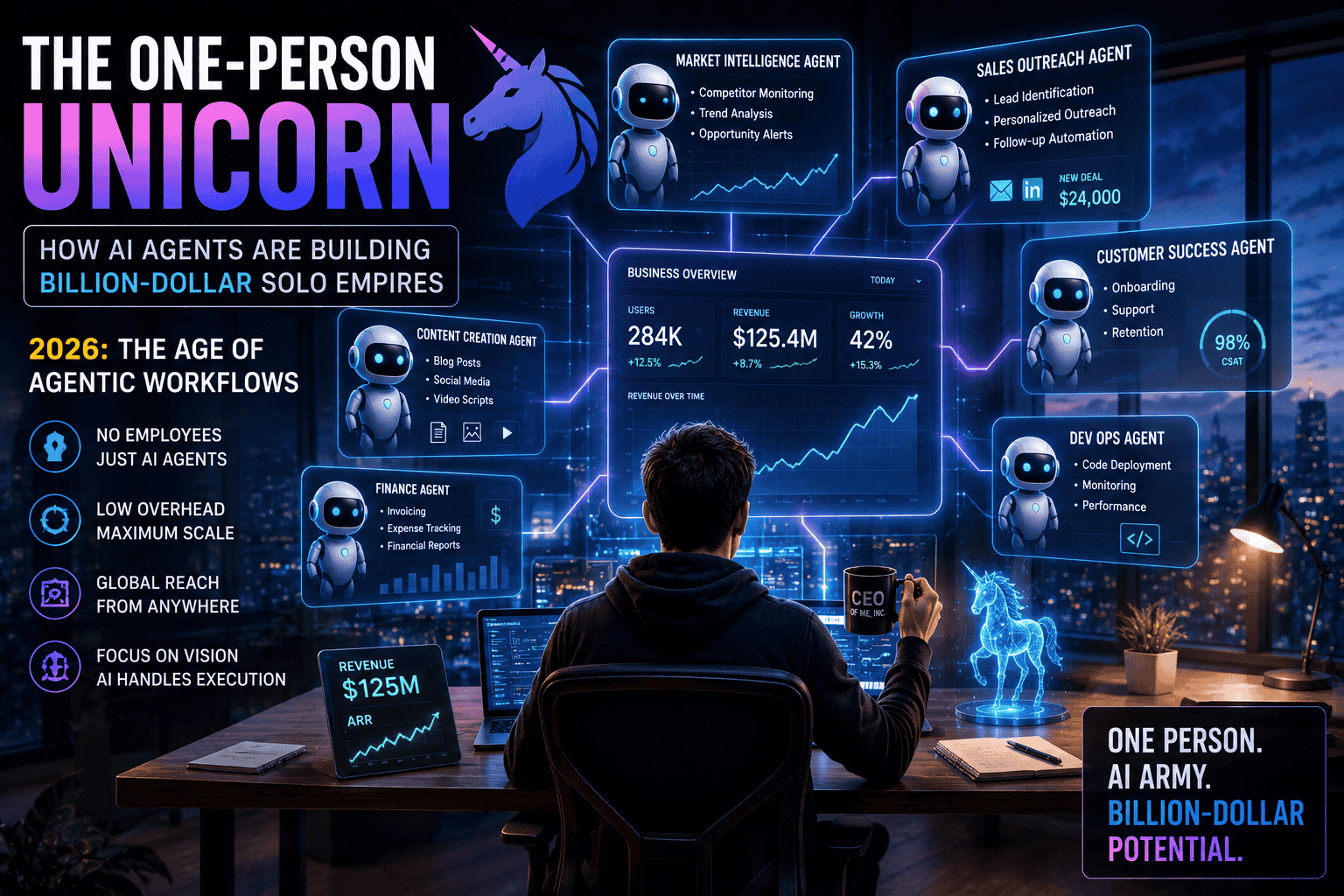
The first one-person billion-dollar company has not been convincingly documented yet. But in 2026, AI agents are already changing the economics that once made such a company impossible.
One founder. No traditional departments. A network of AI agents doing the work that once required programmers, researchers, marketers and operations staff. The billion-dollar version may still be ahead—but the company-of-one revolution has already started.
By Business & Tech Desk | Tuesday, August 18, 2026
There is a strange new question circulating through startup circles in 2026:
How many employees does a billion-dollar company actually need?
A decade ago, the question would have sounded ridiculous.
Growing a technology company normally meant growing a team.
More customers required more customer-support representatives. More software meant more engineers. More leads meant more salespeople. More content meant more writers and designers. Eventually came finance, HR, legal, operations and layers of management needed simply to coordinate all those people.
Revenue and headcount tended to rise together.
Artificial intelligence is beginning to break that relationship.
The idea has become known as the “one-person billion-dollar company” or “one-person unicorn”: a business in which one founder controls the strategy while software, automation and AI agents perform a large share of the execution.
It is an idea famously associated with Sam Altman's prediction that AI would eventually make a billion-dollar company run by a single person possible.
But there is an important reality check.
The one-person unicorn should still be viewed as a prediction, not an established fact of business in 2026.
What has become real is the economic machinery that could eventually produce one.
Nasdaq's Economic Institute reported this year that applications for one-person businesses in the United States have risen more than 20% since early 2025, with the increase concentrated in sectors where AI adoption is particularly high.
That is a much more meaningful story than the hype.
People are not merely talking about AI entrepreneurship.
They are actually starting businesses differently.
The Old Startup Equation Is Breaking
For much of the internet era, scaling a company followed a fairly predictable pattern.
You could automate some work, but eventually growth created more work than the founder could personally handle.
So you hired.
Then you hired people to manage the people you hired.
The organizational chart expanded almost automatically.
AI changes that equation because software is moving beyond simply helping a worker complete an individual task.
Modern agent systems can increasingly receive a goal, use software tools, gather information, take multiple steps and continue working toward an outcome.
OpenAI describes the shift as moving from short chatbot interactions toward delegated, long-horizon tasks, where agents can operate across tools and iterate toward completion.
Anthropic uses an especially simple definition: agents are essentially language models autonomously using tools in a loop.
That difference sounds small.
Economically, it is enormous.
A chatbot answers:
“How should I research these competitors?”
An agent can potentially:
research the competitors,
visit their websites,
organize their pricing,
analyse reviews,
compare product positioning,
create a spreadsheet,
identify gaps,
and prepare a report for the founder to approve.
The human moves from performing every step to defining the objective and reviewing the result.
That is the beginning of the agentic company.
1. AI Doesn't Need to Replace an Employee to Change the Business
A common mistake is to ask:
“Can this AI completely replace a salesperson?”
That may be the wrong question.
Suppose a founder previously needed four people to perform four categories of work.
Now imagine AI handles 60% of each person's repetitive workload.
The founder may not need four employees anymore—even though AI cannot fully perform any one of those jobs.
This is how headcount compression can happen.
The change is less like replacing four people with four robots and more like compressing dozens of recurring tasks into software workflows.
That distinction is important because the most useful AI businesses in 2026 are generally not operating without humans.
They are operating with humans at higher leverage.
Anthropic's own research into real-world agent usage found that software engineering represented almost half of observed agentic activity, while agents in higher-risk areas remained much less common at scale.
So the transformation is real, but uneven.
Coding is changing faster than legal judgment.
Research may automate faster than relationship-based enterprise sales.
Basic customer service can automate faster than handling an angry strategic client worth $500,000 per year.
The future company of one will probably succeed by understanding which work should be automated—and which work should remain human.
2. What Does an AI Agent Actually Do Inside a Solo Business?
The phrase “AI agent” is becoming so overused that it risks losing meaning.
For a solo founder, the useful definition is simple:
An agent is software you delegate work to rather than software you merely operate.
That work can now touch several parts of a business.
Research and Market Intelligence
A market-intelligence workflow can collect information from:
competitor websites,
pricing pages,
industry publications,
customer reviews,
social platforms,
product directories,
and internal sales data.
Instead of manually opening 50 browser tabs every Monday morning, a founder can ask an agent to identify meaningful changes and surface only the information requiring attention.
That is very different from asking a chatbot a one-time research question.
It creates a repeatable business intelligence system.
Software Development
Coding is perhaps the most obvious area of change.
Agentic coding tools can now work across repositories, write and modify code, test implementations and carry out multi-step development tasks.
This does not remove the need for architecture, security reviews or technical judgment.
But it dramatically changes what one technically capable founder can attempt.
A developer who previously needed help with frontend code, backend APIs, testing, documentation and DevOps can increasingly delegate portions of all five areas to AI.
That makes a small SaaS business significantly cheaper to start.
Sales Operations
AI can also reduce some of the administrative burden behind sales.
A workflow might:
identify prospective customers,
research their companies,
qualify accounts,
update a CRM,
prepare personalized outreach,
summarize meetings,
draft follow-ups,
and remind the founder when a deal needs human attention.
The crucial word is prepare.
A business should be very careful about allowing autonomous systems to send large volumes of unsolicited messages or make commitments without appropriate controls.
Good sales automation makes human selling more efficient.
Bad automation simply creates better-looking spam.
Marketing
Marketing workflows can help with:
keyword research,
content briefs,
landing-page drafts,
email campaigns,
ad concepts,
social posts,
analytics summaries,
and content repurposing.
Again, the important transformation is not that AI can write an article.
That has been possible for years.
The transformation is that one workflow can potentially connect the entire cycle:
research → draft → review → publish → measure → learn → improve.
Customer Support
Support is another obvious candidate.
Agents can classify requests, search documentation, produce responses and resolve routine issues.
More complicated problems can then be escalated to the founder.
That creates an important business advantage for solo entrepreneurs.
Customers may receive assistance around the clock even though there is only one human running the company.
3. The “AI Employee” Is Actually a Workflow
This may be one of the most important lessons for entrepreneurs in 2026.
Do not build imaginary departments full of AI personalities.
Build workflows.
A “Chief Marketing Agent” sounds impressive.
A workflow that every morning:
checks yesterday's acquisition data;
identifies falling conversion pages;
compares competitor messaging;
proposes three experiments;
updates a dashboard; and
sends the founder only the decisions requiring approval
is much more useful.
The business value comes from the process, not the AI job title.
Anthropic's guidance on production agents makes a similar point: companies should start with the simplest system that reliably solves the problem and add complex agentic behavior only when simpler workflows are insufficient.
That principle is especially important for a one-person business.
Complexity is expensive even when nobody is receiving a salary.
Agents consume API tokens.
Automations break.
Integrations change.
Models make mistakes.
Cloud services fail.
Every unnecessary agent becomes another system the founder must maintain.
The smartest solo company may therefore have fewer agents than people expect—but each workflow will be extremely well designed.
4. Micro SaaS May Be the Natural Home of the AI Solopreneur
The one-person-company model is particularly well suited to micro SaaS.
Micro SaaS generally means a narrowly focused subscription software product addressing a specific problem for a defined customer group.
Think less:
“I am building the next Salesforce.”
And more:
“I am building the best scheduling and compliance tool specifically for independent dental clinics.”
The second idea has several advantages for a solo founder.
The market is easier to understand.
The product scope is smaller.
Customer problems are clearer.
Marketing can be more targeted.
Support questions repeat.
And automation becomes easier because the business operates within a relatively predictable domain.
AI Changes the Cost of Experimentation
Imagine a developer has ten SaaS ideas.
Under the traditional model, each idea might require weeks or months of coding before customers can meaningfully test it.
That naturally encourages founders to become emotionally committed to a single idea before the market has validated it.
AI-assisted development changes that.
A founder can prototype faster, create landing pages sooner, analyse customer interviews more efficiently and throw away weak ideas at a much lower cost.
That means the biggest advantage may not be building faster.
It may be discovering failure faster.
And cheaper failure is one of the most powerful forms of startup leverage.
5. The New Solo-Founder Technology Stack
Running a serious one-person digital business still requires infrastructure.
The difference is that much of it can now be purchased as software.
A modern solo founder may assemble a business from:
AI models and agent platforms for reasoning and execution;
cloud hosting for applications and databases;
payment processors for recurring subscriptions;
CRM software for customer relationships;
marketing automation for email and lead management;
accounting software for financial records;
analytics platforms for measuring product behavior;
cybersecurity tools for protecting customer data;
customer-support software for tickets and knowledge bases;
and automation platforms for connecting everything together.
This is an important economic point.
The one-person company does not literally contain only one contributor.
It depends on an enormous external ecosystem.
The founder is effectively renting capabilities that previous generations of businesses had to build internally.
Cloud computing replaced the private server room.
Software-as-a-service replaced many administrative systems.
AI may now replace—or at least compress—parts of the traditional office workflow.
The organization becomes smaller because the supply chain becomes smarter.
6. 2026 Has Produced Real Evidence of the Solo-Business Shift
The one-person unicorn itself remains speculative.
The broader shift does not.
Nasdaq launched new research in June 2026 showing that recent growth in U.S. business applications was being driven largely by solo entrepreneurs, particularly in technology, finance and professional services.
Nasdaq later reported that one-person business applications had increased more than 20% since early 2025.
Major AI companies are responding directly to the same market.
Anthropic launched a small-business offering in May 2026 featuring agentic workflows across areas such as finance, operations, sales, marketing, HR and customer service.
OpenAI launched its own small-business initiative in July, emphasizing multi-step agentic work and the ability for lean businesses to handle tasks that might previously have been outsourced or left undone.
Those announcements do not prove that AI has replaced entire companies.
They prove something more useful:
AI vendors now see small and ultra-lean businesses as a major market for agentic software.
7. But Teams Still Have an Advantage
This is where entrepreneurs need to resist the hype.
A May 2026 research paper analysing more than 160,000 Product Hunt launches found a sharp increase in entrepreneurial entry associated with generative AI, particularly among solo founders.
But it found something else too:
Solo entrepreneurs were not becoming more dominant among the highest-quality outcomes.
Team-based ventures remained stronger at the top end of the distribution.
That finding makes intuitive sense.
AI can help one person produce more output.
But companies need more than output.
They need judgment.
Trust.
Relationships.
Different perspectives.
Domain expertise.
Accountability.
Creativity.
Negotiation.
Leadership.
And sometimes a second human who tells the founder:
“This is a terrible idea.”
The future may therefore belong less to literally employee-free companies and more to astonishingly small companies producing the output of much larger organizations.
A five-person company doing what once required 50 people may be economically more important than the mythical company of exactly one.
8. The Founder Becomes an Orchestrator
If AI handles more execution, the founder's job changes.
The most valuable skill may no longer be personally performing every task.
It becomes designing the system that performs the work.
That involves four responsibilities.
Choosing the Right Problem
AI makes it easier to build software.
It does not make customers care.
A founder still needs to identify a painful problem people will actually pay to solve.
This may become even more important as software creation gets cheaper.
When everyone can build, distribution and problem selection become more valuable.
Designing the Workflow
The founder needs to understand how work should move through the company.
What information does the agent need?
Which tools can it access?
What happens when information is missing?
What actions require approval?
What gets logged?
When does the AI stop and escalate?
These are operational-design questions, not merely prompting tricks.
Reviewing Important Decisions
High-leverage businesses require human checkpoints.
Contracts.
Large refunds.
Major pricing changes.
Security incidents.
Hiring.
Financial commitments.
Strategic partnerships.
Sensitive customer disputes.
These are exactly the areas where blindly maximizing automation can become dangerous.
Building Trust
Customers may happily let software reset a password.
They may feel differently about trusting software with a $200,000 contract.
Human relationships remain particularly important in high-value B2B sales, strategic partnerships and complex professional services.
The founder of an AI-native company may therefore spend less time producing work and more time creating trust.
9. A Billion-Dollar Company Is Not the Same as a Billion Dollars in Revenue
The phrase “one-person billion-dollar company” can also be misleading.
A unicorn normally refers to a privately held startup valued at at least $1 billion.
It does not mean the company generates $1 billion in annual sales.
A software company earning $50 million or $100 million a year could theoretically receive a billion-dollar valuation if investors believed its margins, growth and future opportunity justified it.
That makes the one-person unicorn somewhat more plausible than a literal one-person company producing a billion dollars of annual profit.
Software has already demonstrated extraordinary economics because distributing another copy of a digital product can cost very little.
AI pushes this model further.
If the cost of producing software, supporting customers, researching markets and running operations also falls, then revenue per employee can rise dramatically.
The extreme version of that trend is revenue per employee approaching revenue per founder.
That is the economic idea behind the one-person unicorn.
10. The Hidden Costs Nobody Puts in the Viral Posts
There is another side to the story.
AI employees are not free.
A serious agentic company may spend heavily on:
model inference,
API calls,
cloud servers,
databases,
third-party SaaS subscriptions,
cybersecurity,
data storage,
monitoring,
payment processing,
legal services,
accounting,
insurance,
and compliance.
OpenAI's July guidance for businesses specifically emphasizes monitoring AI spending, measuring return on investment and funding agentic workflows based on demonstrated value rather than simply maximizing model usage.
This becomes particularly important as agents run longer tasks.
The founder who replaces a $5,000 monthly salary with $7,000 of unnecessary AI API usage has not invented a better business.
Automation should reduce cost per valuable outcome, not merely reduce headcount.
That means the smartest founder will track agent economics almost like a factory tracks machinery.
How much does this workflow cost?
How often does it succeed?
How often does a human need to fix the result?
How much revenue does it create?
Would a simpler automation be cheaper?
Those questions turn an impressive AI demo into an actual business system.
11. Security Could Become the Solo Founder's Biggest Weakness
There is another uncomfortable truth.
A one-person company has no dedicated security team.
No compliance department.
No internal auditor.
No second person checking whether a sensitive database has accidentally been exposed.
Yet AI agents may have access to increasingly powerful tools:
email,
financial systems,
customer records,
source code,
cloud infrastructure,
CRM databases,
support systems,
and company documents.
The more capable the agent, the more damage a badly designed workflow can potentially cause.
This creates a new principle for the AI-native business:
Automation should increase with reversibility.
Let an agent freely analyse public competitor data.
Be more cautious when it can delete a database.
Let it draft an invoice.
Require approval before money moves.
Let it identify a customer problem.
Require human review before terminating an account.
Anthropic's 2026 study of real-world agent autonomy found that most agent actions observed through its API remained relatively low-risk and reversible, while higher-risk use was not yet occurring at comparable scale.
That is probably a useful design philosophy for solo founders too.
12. What a One-Person AI Company Could Actually Look Like
Imagine a founder running a niche B2B SaaS platform.
At 7:00 a.m., a monitoring agent checks the application overnight.
It identifies two errors and opens technical tasks.
A coding agent investigates one of them and prepares a fix.
A customer-support workflow handles routine questions and flags one enterprise customer requesting special assistance.
A financial workflow reconciles yesterday's subscription payments.
A market-intelligence workflow reports that a competitor has changed pricing.
A marketing workflow identifies a high-performing article and suggests three related topics.
The founder wakes up.
Instead of opening 12 dashboards and trying to determine what happened overnight, they receive:
Three decisions requiring human judgment.
They review the code fix.
Call the enterprise customer.
Approve a pricing experiment.
The rest of the morning goes into product strategy and talking with users.
That is the company-of-one model at its most believable.
Not a founder lying on a beach while AI creates billions of dollars autonomously.
A founder whose attention is concentrated only where human judgment creates the most value.
13. The Biggest Opportunity May Not Be Building the Unicorn
There is an irony in the one-person-billion-dollar-company obsession.
Most entrepreneurs do not need a billion-dollar business.
A solo company earning $300,000 a year with strong margins can completely change someone's life.
A niche SaaS business producing $1 million annually with low operating costs can make its founder exceptionally wealthy.
And unlike the venture-backed unicorn model, the founder may retain ownership and control.
AI therefore opens two very different possibilities.
One is the headline-grabbing dream:
a one-person billion-dollar company.
The other may ultimately affect far more people:
hundreds of thousands of one-person companies earning enough to create genuine financial independence.
Nasdaq's 2026 solo-entrepreneurship data suggests that this second transformation may already be underway.
That could prove economically more important than whichever founder eventually wins the race to become the first solo unicorn.
14. What Should an Aspiring AI Solopreneur Build?
The easiest mistake is starting with the technology.
“I want to build an AI agent business” is not a customer problem.
A better starting point is:
What repetitive, expensive problem does a specific type of customer deal with every week?
Look for work that is:
repetitive,
digital,
time-consuming,
measurable,
high enough value to justify payment,
and structured enough that AI can help reliably.
Possible categories include:
business reporting,
industry-specific document processing,
appointment workflows,
compliance preparation,
specialized analytics,
customer-service automation,
sales research,
property management,
invoice processing,
professional-service administration,
education administration,
or niche operational software.
The winning idea does not need to sound futuristic.
In fact, the best micro SaaS businesses are often painfully boring.
Boring problems frequently have very motivated buyers.
15. The New Competitive Advantage: Workflow Intelligence
As powerful AI models become accessible to more people, simply “having AI” stops being a competitive advantage.
Your competitor can access similar models.
Your customers can too.
The durable advantage becomes understanding:
what should be automated,
how it should be automated,
what proprietary context improves the result,
where humans must intervene,
and how the workflow improves over time.
That is workflow intelligence.
Two founders can use the same underlying AI model.
One builds a generic chatbot.
The other understands dental-clinic insurance claims so deeply that they construct an end-to-end workflow saving every clinic 20 hours per week.
The second founder has a business.
This is why industry expertise may become more valuable—not less—in an AI economy.
The model provides intelligence.
The entrepreneur provides context, judgment and economic purpose.
The Billion-Dollar Question
Will a true one-person company eventually reach a billion-dollar valuation?
It is becoming much easier to imagine.
AI is lowering the cost of software development.
Agents are moving from answering questions to carrying out workflows.
Cloud infrastructure allows tiny companies to serve customers globally.
Digital payments eliminate the need for physical distribution.
Marketing can reach millions without a television advertising budget.
And solo business formation is already rising sharply in AI-intensive sectors.
But 2026 also provides an important warning against getting carried away.
AI makes one person more capable.
It does not make judgment irrelevant.
It does not eliminate customers.
It does not automatically create demand.
And it does not make every task safe to automate.
Recent research suggests that while generative AI is making it dramatically easier for solo entrepreneurs to enter the market, teams still maintain advantages among the strongest outcomes.
So perhaps the most important business lesson of 2026 is not:
“Never hire anyone again.”
It is:
“Do not hire a person merely because your old operating model required one.”
Build the workflow first.
Automate what is repeatable.
Use AI where the economics make sense.
Bring humans in where trust, creativity, expertise or judgment make them valuable.
Then keep the organization as small as it can responsibly remain.
The first one-person unicorn may still be ahead of us.
But the age of the AI-amplified founder has already arrived.
Frequently Asked Questions
Does a one-person billion-dollar company exist in 2026?
There is no widely verified example that establishes the full “one-person unicorn” model as a mature reality. The stronger evidence is that AI is causing substantial growth in solo business formation and allowing founders to operate with fewer resources. Nasdaq reported one-person business applications rising more than 20% since early 2025.
What is a one-person unicorn?
A one-person unicorn would be a privately held company valued at $1 billion or more that is operated primarily by a single founder using software, automation, contractors or AI systems rather than a conventional employee organization.
What are AI agents?
AI agents are systems capable of working toward goals by using models, software tools and repeated actions rather than simply responding once to a prompt. Anthropic describes modern agents as language models autonomously using tools in a loop.
How are AI agents different from chatbots?
A chatbot primarily responds to individual requests. An agent can potentially undertake a longer sequence of actions—researching information, using applications, analysing results and iterating toward a goal. OpenAI describes this as a shift toward delegated, long-horizon work.
Can AI agents replace an entire company?
Not reliably. Agents can automate significant portions of workflows, but human judgment remains important for strategy, relationships, security, financial decisions, unusual customer cases and other high-stakes activities.
What is micro SaaS?
Micro SaaS is a narrowly focused subscription software business designed to solve a specific problem for a particular group of customers. Its limited scope and recurring-revenue model can make it well suited to solo founders.
Why is micro SaaS attractive in 2026?
AI-assisted development can reduce the time and cost involved in prototyping, coding, research, marketing and customer support. This allows founders to test narrower software ideas without immediately building large teams.
What business tasks can AI agents automate?
Common applications include software development, market research, CRM updates, sales preparation, reporting, content workflows and routine customer support. Current commercial agent platforms are increasingly being deployed across these functions.
Are companies actually using AI agents in 2026?
Yes. Agentic systems are now being deployed across production business workflows. Anthropic's 2026 agent report describes adoption across multi-stage organizational workflows, while OpenAI reports growing use of delegated agentic work in enterprises.
Is AI causing more people to start solo businesses?
Nasdaq's Economic Institute says recent U.S. business-formation growth has been driven heavily by solo entrepreneurs, particularly in sectors with high AI adoption. It reported one-person business applications more than 20% above early-2025 levels.
Are solo founders outperforming teams?
Not universally. A 2026 study of more than 160,000 Product Hunt launches found AI had increased solo entrepreneurial entry, but team-based ventures remained more prominent among top-performing launches.
What does it cost to run an AI-native company?
Costs can include model/API usage, cloud hosting, databases, CRM software, cybersecurity, payment processing, accounting, analytics and other SaaS subscriptions. The key metric is not whether AI is cheaper than a salary in isolation, but whether each workflow produces a positive return on investment.
What skills will successful AI solopreneurs need?
The most valuable skills are likely to include problem selection, domain expertise, workflow design, product judgment, sales, security awareness and the ability to decide where AI should—and should not—act autonomously.
Editorial Note: The “one-person billion-dollar company” remains a forward-looking concept rather than an established 2026 business category. This article distinguishes documented growth in AI-enabled solo entrepreneurship from predictions about future billion-dollar valuations.
AI agent workflows, solo founder AI business, micro SaaS 2026, AI business automation, solopreneur 2026, one-person company, agentic AI business, AI startup automation
AI SaaS tools, business automation software, CRM automation, cloud hosting, AI coding tools, sales automation software, accounting software, cybersecurity for startups, payment processing, SaaS business model, AI API costs, marketing automation
AI Agents, Entrepreneurship, Solopreneur, SaaS, Micro SaaS, Business Automation, Startups, Artificial Intelligence, Online Business, Future of Work