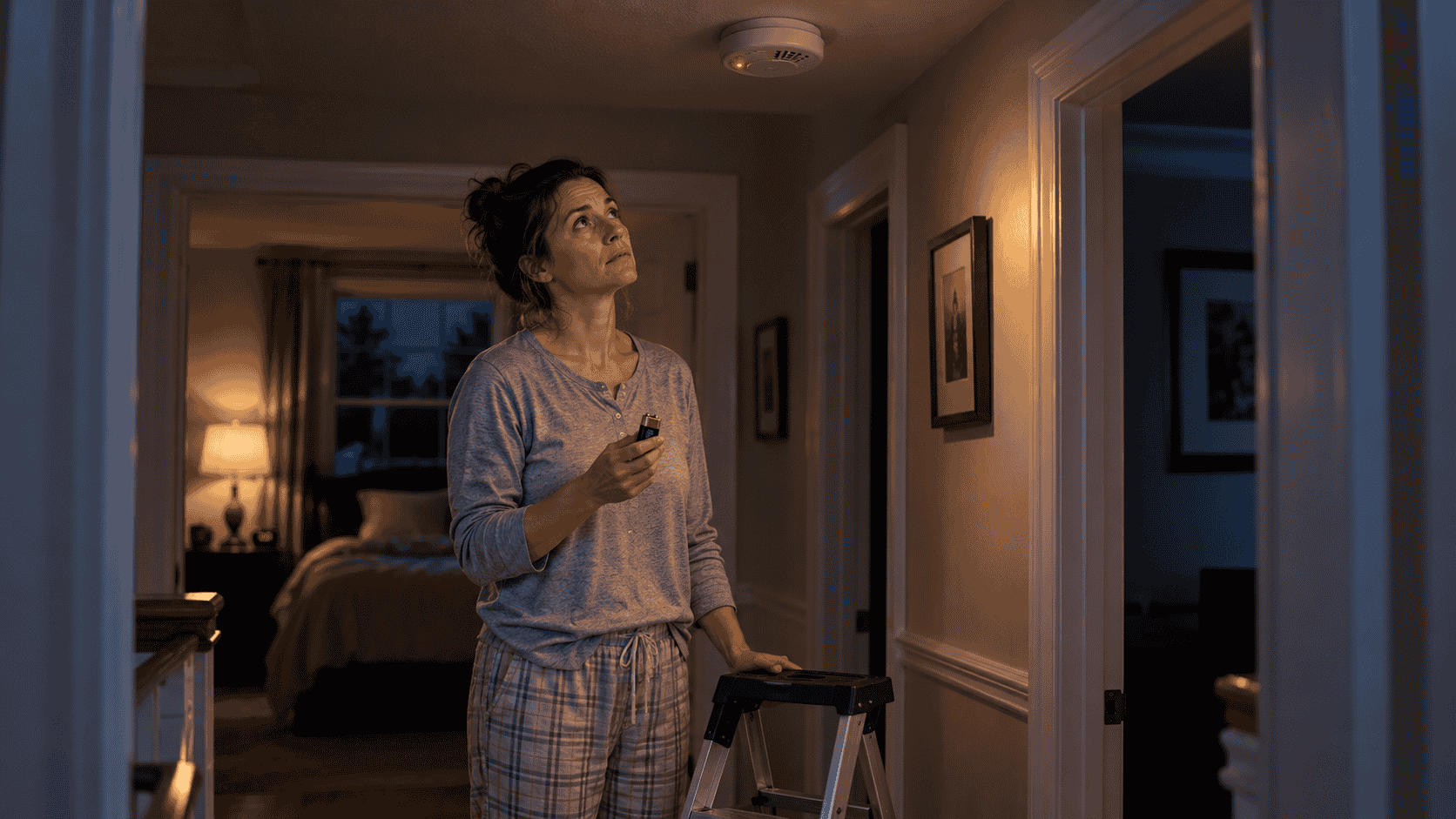
It is 3:17 in the morning and somewhere in the house comes the sound almost every homeowner recognizes: chirp. You wait. Silence. Then—chirp. It can feel as though smoke alarms deliberately wait until everyone is asleep, but there is a surprisingly ordinary reason a weak battery may first complain in the middle of the night.
The 3 A.M. Chirp Is Not Your Imagination
Smoke-alarm manufacturer Kidde explains that a battery nearing the end of its useful charge can become more vulnerable as room temperature falls.
Most homes are coolest during the overnight and early-morning hours. Kidde says the lower temperature can increase the battery's internal resistance enough that an alarm crosses its low-battery threshold and begins chirping. When the house warms later, the chirping may temporarily stop.
That creates the classic mystery:
the alarm chirps at 3 a.m.;
you promise to deal with it in the morning;
morning arrives;
the chirping has stopped.
The battery did not repair itself.
The warmer temperature may simply have pushed it back above the warning threshold.
A Chirp Is Different From an Emergency Alarm
Before troubleshooting anything, listen carefully to the sound.
A small periodic chirp is generally a maintenance warning.
A repeating loud alarm pattern can mean something very different.
NFPA guidance says a repeating sequence of three loud beeps from a smoke alarm indicates smoke or fire: get outside, call 911 and stay outside.
A repeating sequence of four loud beeps from a carbon-monoxide alarm indicates carbon monoxide and also requires leaving the home and calling 911 from outside.
Alarm patterns can vary by manufacturer and model, particularly for combination and smart alarms, so check the instructions for your specific device.
The key point is simple:
do not assume every noise is “just a battery.”
One Chirp Every 30 or 60 Seconds Usually Means Something Needs Attention
NFPA says a single chirp roughly every 30 or 60 seconds commonly signals a low battery in a smoke alarm.
Manufacturer guidance also shows that chirping can have several causes depending on the model, including:
a weak battery;
an incorrectly installed battery;
end-of-life warning;
a malfunction;
dust or contamination;
or certain power conditions.
That is why replacing the battery is a good first step—but not always the last one.
First Question: How Old Is the Alarm?
Turn the alarm gently according to the manufacturer's instructions and look for the manufacture date on the back.
This little date matters more than many homeowners realize.
The U.S. Fire Administration says smoke alarms should generally be replaced 10 years from their manufacture date.
That includes alarms that still look perfectly clean.
It also includes many hardwired alarms.
A smoke alarm is not a permanent fixture like a ceiling light.
Its sensing components age.
So if you discover that the device was manufactured in 2015 or earlier, replacing the entire alarm may make more sense in 2026 than spending the night repeatedly changing batteries.
A New Battery Cannot Make a 12-Year-Old Alarm New Again
This explains one of the most frustrating scenarios.
The alarm chirps.
You replace the battery.
Twenty minutes later:
chirp.
You replace the battery again.
Chirp.
At that point many people assume they bought bad batteries.
Sometimes the alarm itself has simply reached the end of its service life.
NFPA says chirping that continues after a battery replacement can indicate that the smoke alarm itself needs replacement, and USFA recommends replacing smoke alarms at 10 years.
Check the date before sacrificing another battery.
What If It Has a Sealed 10-Year Battery?
Many newer smoke alarms contain a sealed long-life battery that is not designed to be removed.
This changes the response.
You do not open the alarm and replace the battery.
USFA says alarms powered by a nonreplaceable 10-year lithium battery should be replaced according to the manufacturer's instructions, while traditional battery-powered alarms receive replacement batteries.
Kidde's sealed-battery guidance similarly says the battery is designed to power the unit for its service life and that an end-of-life or low-battery condition means the alarm itself needs attention or replacement.
If you have a sealed alarm, do not pry it open looking for a 9-volt battery that was never meant to be changed.
Hardwired Smoke Alarms Can Chirp Too
A smoke alarm connected to household electricity may seem as though it should never have a battery problem.
But many hardwired alarms include a backup battery so the alarm can continue operating during a power outage.
USFA says hardwired alarms generally have backup batteries that require maintenance, while the alarm itself still needs eventual replacement.
So:
“It is hardwired, therefore it cannot be the battery”
is not a safe assumption.
Check the exact model.
A Hardwired Alarm May Also Be Telling You About Power
Manufacturer guidance notes that electrical interruptions or power conditions can sometimes produce chirping in hardwired alarms.
If several hardwired alarms began behaving strangely after:
a power outage;
electrical work;
a breaker trip;
or another electrical event,
the issue may deserve more investigation than simply replacing one battery.
Follow the manufacturer's troubleshooting procedure.
If wiring appears involved, use a qualified electrician rather than experimenting with household electrical connections.
Why Does a Fresh Battery Sometimes Not Stop the Chirping?
Several possibilities remain.
The battery may not be seated correctly.
The battery drawer may not be completely closed.
The replacement battery may be the wrong type.
The alarm may need to be reset according to the manufacturer's instructions.
The unit may be dirty.
Or the alarm may simply be old.
Kidde lists loose batteries, poor battery contact, environmental conditions and end-of-life among possible explanations for intermittent chirping.
Do not keep randomly removing components.
Find the model number and follow the specific manual.
Check That the Battery Is Actually Connected
This sounds almost insulting until it happens.
Some smoke alarms use battery connectors that need to snap firmly into place.
Others use drawers that must close completely.
A battery can look installed while making poor electrical contact.
Kidde recommends verifying that the correct battery is securely installed and that the battery compartment is fully closed.
Take a few seconds to check the simple things before deciding the alarm is defective.
Do Not Mix Old and New Batteries Where the Device Uses More Than One
If your specific alarm uses multiple replaceable batteries, follow the manufacturer instructions for replacing them.
Do not casually mix different battery types, ages or chemistries.
And do not assume a rechargeable battery is appropriate simply because it physically fits.
Alarm manufacturers specify what battery type the unit is designed to use.
The safest answer is the one written in the manual.
Dust Can Cause Trouble Too
Smoke alarms sit near ceilings for years.
Dust accumulates.
Tiny insects can enter openings.
Renovation debris can spread through rooms.
Manufacturer guidance notes that contamination in the sensing chamber can contribute to unwanted alarm behavior, including chirping in some models.
Follow the manufacturer's cleaning instructions.
USFA also recommends maintaining smoke alarms according to manufacturer guidance rather than treating them as devices that can be forgotten once installed.
Do not spray household cleaners into an alarm.
Do not paint it.
And do not attack the sensing chamber with improvised tools.
Steam and Humidity Can Confuse the Situation
A smoke alarm near a bathroom or kitchen may behave differently from one in a dry hallway.
Steam, humidity and condensation can cause unwanted alarms or irregular behavior in some devices.
That does not mean you should simply remove the alarm.
Location matters.
USFA advises following manufacturer instructions for alarm placement and specifically warns against disabling an alarm because of nuisance cooking or steam alarms.
If location repeatedly causes problems, determine whether the alarm should be properly relocated—not removed.
The Alarm Chirping May Not Be the Alarm You Are Standing Under
This is one of the most maddening parts of the problem.
Short, high-pitched chirps bounce around hallways.
You stand under one detector.
Chirp.
It sounds as though it came from the bedroom.
You walk into the bedroom.
Chirp.
Now it sounds as though it came from the hallway.
Before removing every alarm in the house, identify the actual source.
Wait near each device through a full chirp interval.
Remember that the sound could also come from:
a carbon-monoxide alarm;
a combination smoke/CO unit;
a security device;
another battery-powered sensor;
or even an electronic device stored nearby.
Find the source before repairing the wrong thing.
Combination Smoke and CO Alarms Need Extra Attention
A combination alarm can make different sounds for different conditions.
That makes the user manual especially important.
NFPA notes that smoke alarms and carbon-monoxide alarms use different emergency patterns, while CO alarms may also have manufacturer-specific end-of-life sounds.
Do not guess.
If you cannot confidently distinguish a maintenance chirp from a CO alarm condition, move everyone to fresh air and verify the alarm's instructions from a safe location.
Carbon monoxide cannot be seen or smelled.
Never Remove the Battery Just to Make the Noise Stop
At 3 a.m., the most tempting solution is obvious.
Take the battery out.
Go back to sleep.
Deal with it tomorrow.
That creates a different problem:
you may now be sleeping in a home without functioning fire protection.
USFA specifically warns never to disable smoke alarms or remove their batteries as a response to nuisance alarms.
The chirping is annoying because the alarm is trying very hard not to let you ignore it.
Solve the warning.
Do not silence the safety device permanently.
The Same Applies to the “I’ll Replace It Tomorrow” Pile
A surprisingly common household pattern is:
alarm chirps;
alarm is removed;
alarm is placed on a counter;
days pass;
everyone gets used to seeing it there.
Meanwhile the ceiling mount remains empty.
If you have to remove an alarm temporarily for proper battery replacement or replacement of the unit, finish the job.
A disconnected alarm provides no warning.
How Often Should Smoke Alarms Be Tested?
Monthly.
CPSC's 2026 home-heating safety guidance says smoke and CO alarms should be tested every month.
USFA gives the same monthly testing recommendation for common smoke-alarm types.
Use the test button and follow the manufacturer's instructions.
Testing is not the same as waiting until the device chirps.
The chirp is telling you something has already changed.
Routine testing tries to discover a problem before an emergency.
Do Not Test a Smoke Alarm With a Flame
A lighter or match is not a clever smoke-alarm tester.
Manufacturer instructions warn against using an open flame because it can damage the alarm or start a fire.
Use the test button.
If the manufacturer specifies an approved test method beyond that, follow its instructions.
Home safety equipment does not need a DIY stress test.
Where Should Smoke Alarms Actually Be Installed?
USFA recommends smoke alarms:
inside every sleeping room;
outside each separate sleeping area;
and on every level of the home, including the basement.
USFA also recommends interconnected alarms where possible so that when one sounds, they all sound.
That matters because a fire can begin far from where people are sleeping.
An alarm in a basement is much more useful if the bedroom alarms upstairs alert you too.
One Smoke Alarm in the Hallway Is Not a Whole-House System
Many older homes were built when expectations were different.
You may find one detector somewhere near the bedrooms and assume the house is covered.
Modern fire-safety guidance calls for much broader coverage.
Walk through the home and ask:
Is there one on every level?
Inside the sleeping rooms?
Outside the sleeping areas?
In the basement?
Then check their ages.
One brand-new smoke alarm does not compensate for several missing or expired ones.
This Is a Good Time to Check Carbon-Monoxide Alarms Too
Cold weather means many homes begin using furnaces, fireplaces and other fuel-burning equipment more frequently.
CPSC's 2026 winter guidance recommends CO alarms on every level of the home and outside sleeping areas.
A smoke alarm detects smoke.
A carbon-monoxide alarm detects CO.
One is not automatically a substitute for the other unless the device is specifically a combination unit designed to provide both functions.
Check what you actually have.
Smoke Alarms and CO Alarms Do Not Necessarily Have the Same Lifespan
Smoke alarms are generally replaced after 10 years under USFA and NFPA guidance.
Carbon-monoxide and combination-alarm service lives can vary by manufacturer and model.
That means you should not automatically apply the smoke alarm's 10-year rule to every detector on the ceiling or wall.
Look at the label.
Check the manufacture or replacement date.
Follow the specific instructions.
The Date on the Back May Be More Important Than the Battery Date
Suppose you just installed a brand-new battery in an alarm manufactured in 2014.
The battery is new.
The alarm is not.
This is why checking only the battery can create false confidence.
The device itself has a service life.
USFA says smoke alarms should be replaced 10 years after the manufacture date.
If you cannot determine how old an alarm is, replacement can be the safer practical choice.
New Homeowner? Check Every Alarm Before Assuming They Are New
A freshly painted house can contain very old safety equipment.
The previous owner may have replaced batteries without replacing the alarms.
A renovation may have left older hardwired units in place.
When moving into a home, check:
alarm locations;
manufacture dates;
battery types;
testing status;
and whether the devices are interconnected.
It is a simple home-maintenance audit with much more importance than many cosmetic projects.
Renters Should Not Ignore Chirping Either
If you rent and an alarm is chirping, do not assume it is solely a maintenance annoyance for the landlord to deal with someday.
Notify the landlord or property manager promptly and follow applicable local requirements.
If a replaceable battery is the tenant's responsibility under your agreement, address it.
If the device is old, hardwired or malfunctioning, report that clearly.
The important outcome is a functioning alarm.
Why the Fall Time Change Became a Smoke-Alarm Reminder
For years, fire-safety campaigns have linked clock changes with smoke-alarm maintenance because it creates an easy-to-remember household routine.
CPSC recommends testing alarms monthly and replacing batteries at least yearly in alarms that use replaceable batteries, while sealed 10-year units do not receive annual battery replacement.
That distinction matters.
The old advice to “change every smoke-alarm battery when you change the clocks” should not lead someone to tamper with a sealed 10-year alarm.
Know which type you own.
A Simple Label Can Save Confusion Years Later
When installing a new alarm, record the installation date somewhere accessible.
You can also keep a household note listing:
alarm location;
model;
manufacture date;
installation date;
and expected replacement year.
Ten years is a long time.
Most people will not remember whether the hallway detector was installed in 2020 or 2023.
Your future self will appreciate the record.
What Should You Do Tonight If the Alarm Starts Chirping?
First, make sure it is a maintenance chirp and not a smoke, fire or CO emergency pattern.
Then identify the exact device.
Check whether it uses a replaceable battery or a sealed battery.
If it uses a replaceable battery, install the correct fresh battery according to the manufacturer's instructions.
Test the alarm.
Check the manufacture date.
If it is around 10 years old, or if chirping continues despite proper battery replacement and troubleshooting, replace the alarm according to manufacturer guidance.
If it is hardwired and appears to have a power or wiring problem, follow the manual and use a qualified electrician where appropriate.
Do not simply disconnect it and return to bed.
When Should You Replace the Whole Alarm Immediately?
Replacement deserves serious attention when:
the smoke alarm is 10 years old;
a sealed 10-year alarm is signaling end of life or low battery;
the alarm fails its test;
the unit is damaged;
the manufacturer's troubleshooting steps do not resolve a malfunction;
or the device continues chirping after a proper battery replacement and its instructions indicate end of life.
USFA's guidance is straightforward: smoke alarms do not last forever.
The Cheapest Fix Is Not Always Another Battery
A battery can cost only a few dollars.
A new smoke alarm costs more.
That makes repeatedly trying batteries feel sensible.
But once the unit itself has reached the end of its intended service life, a new battery is solving the wrong problem.
The goal is not to stop the noise for the lowest possible price.
The goal is to have a working alarm.
That is a very different standard.
So Why Does the Smoke Alarm Seem to Wait Until 3 A.M.?
Because the middle of the night is often when your house is coolest.
A battery already close to its low-voltage threshold may struggle more as temperatures fall, causing the alarm to begin chirping. Kidde says homes commonly reach their coolest temperatures between roughly 2 a.m. and 6 a.m., which helps explain the familiar middle-of-the-night warning.
When morning warmth arrives, the sound may stop.
But the warning still happened for a reason.
So if the ceiling starts chirping tonight, do not spend the next morning asking:
“Why did it stop?”
Ask:
“What was the alarm trying to tell me?”
Sometimes the answer is a $5 battery.
Sometimes it is a 10-year-old alarm that needs replacement.
And sometimes the sound is not a maintenance chirp at all.
Knowing the difference is what matters.
-------------------------------------------------------------------------------
smoke alarm chirping, smoke detector chirping, smoke alarm chirping at night, smoke detector chirping every 30 seconds, smoke alarm chirping after new battery, hardwired smoke alarm chirping, smoke alarm low battery, smoke detector 3 a.m., smoke alarm keeps beeping, smoke detector 10 years old, smoke alarm end of life, carbon monoxide alarm chirping
Your Furnace Still Works. So When Does Replacing It Actually Save Money?
Do You Really Need Air-Duct Cleaning? What the Evidence Says
A Pipe Bursts at 2 A.M. What Should You Do Before the Plumber Arrives?
Your Water Heater Is Making That Noise for a Reason. Repair It—or Replace It?
Why Did Your Tire Pressure Light Come On Overnight?
Home & Garden
Lifestyle
Homeowner standing in a dark hallway at night looking up at a chirping ceiling smoke alarm while holding a replacement battery.
Why Does a Smoke Alarm Chirp at Night?
Why Does Your Smoke Alarm Always Chirp at 3 A.M.?
That middle-of-the-night chirp is not random. Cooler temperatures can expose a weak battery—but a new battery will not solve every smoke-alarm warning.
Why Does the Smoke Alarm Always Start Chirping at 3 A.M.?
Chirp.
It is 3 a.m.
You replace the battery half asleep—and sometimes the alarm still chirps.
There is actually a reason these warnings so often seem to begin overnight: a weak battery can cross its warning threshold when the house reaches its coolest temperature.
But if a new battery does not fix it, check one number almost everyone forgets:
the manufacture date on the back of the alarm.
Reader Question
Has a smoke alarm ever started chirping in your house in the middle of the night?
Research Notes
The U.S. Fire Administration recommends smoke alarms inside every sleeping room, outside each separate sleeping area and on every level of the home, including the basement. It also recommends monthly testing and replacement of smoke alarms after 10 years.
CPSC's 2026 home-heating safety guidance recommends testing smoke and carbon-monoxide alarms monthly. It says replaceable batteries should generally be replaced at least yearly, while sealed 10-year alarms do not require annual battery replacement.
NFPA guidance distinguishes maintenance chirps from emergency alarms: a single periodic chirp commonly indicates a low battery, while repeating three-beep smoke-alarm patterns indicate smoke/fire and repeating four-beep CO-alarm patterns indicate carbon monoxide. Specific patterns can vary, so homeowners should check the manufacturer's instructions for their device.
Kidde explains that a battery nearing the end of its life can trigger low-battery chirping as nighttime temperatures fall. It says homes are often coolest between roughly 2 a.m. and 6 a.m., which can explain why the warning appears overnight and stops when temperatures rise.
Manufacturer guidance also identifies incorrectly installed batteries, dust or contamination, environmental conditions, end-of-life warnings, malfunctions and certain electrical conditions as possible causes of chirping, depending on the alarm model.
Safety Note
Never assume a loud or repeating alarm is merely a low-battery warning. If a smoke alarm signals fire or a carbon-monoxide alarm signals CO, leave the home immediately, call 911 from outside and stay outside. Do not disable an alarm simply to stop nuisance noise. Follow the specific manufacturer's instructions for battery replacement, resetting, cleaning and end-of-life replacement.
smoke detector chirping, smoke alarm chirping at night, smoke detector beeping every 30 seconds, smoke alarm chirping after new battery, hardwired smoke alarm chirping, smoke detector low battery, smoke alarm 10 years old, smoke detector chirping 3 a.m., carbon monoxide alarm chirping
Smoke Alarm, Home Safety, Smoke Detector, Carbon Monoxide, Batteries, Fire Safety, Home Maintenance, Fall Home Care, Everyday Problems