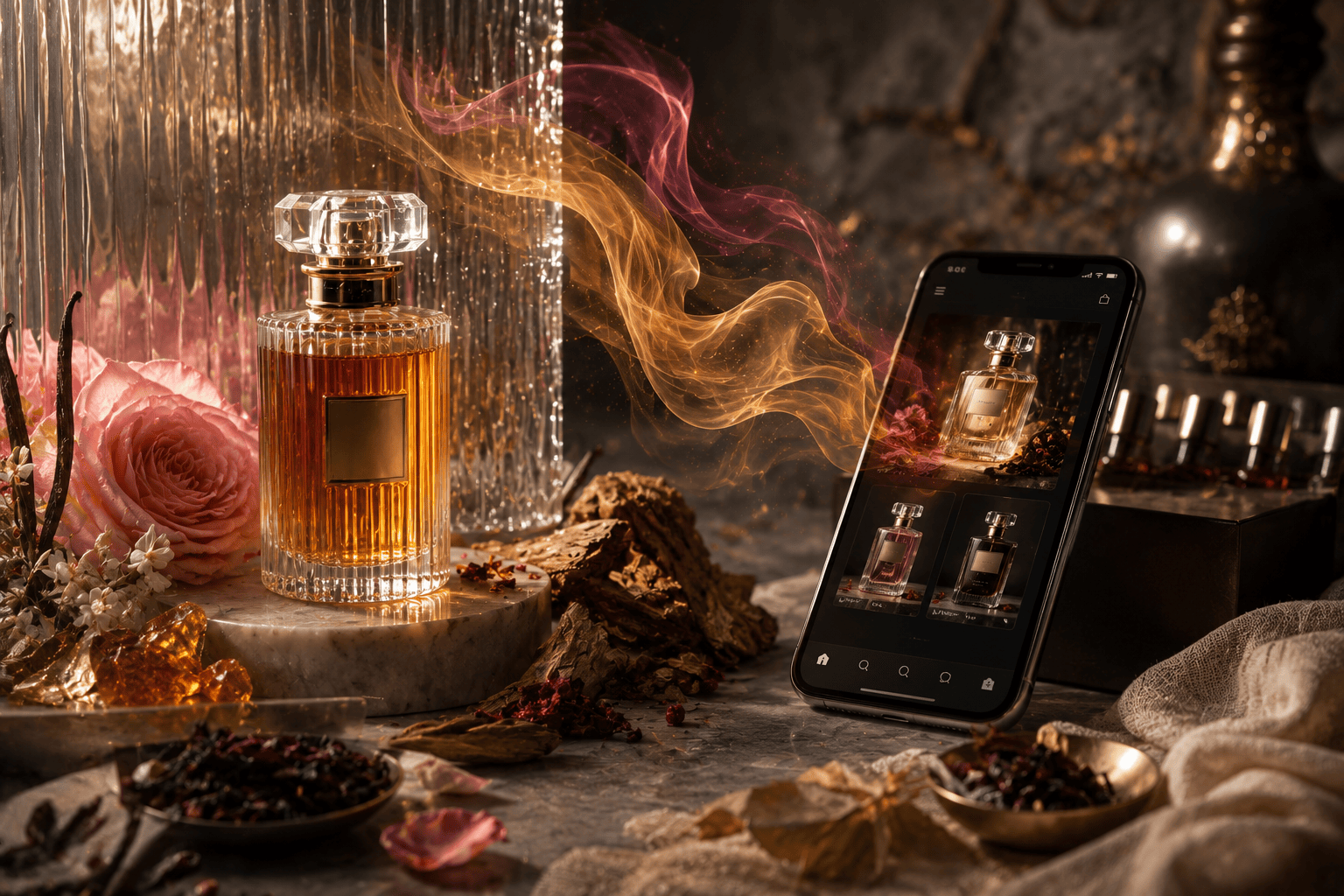
E-commerce can show you a dress, play you a song and demonstrate a phone. Perfume has a harder problem: the one thing the customer actually wants to experience cannot travel through the screen. In 2026, fragrance brands are getting remarkably creative about solving it.
The Architecture of Scent: How Luxury Fragrance Is Being Sold Through a Screen in 2026
You can photograph a bottle. You can describe the ingredients. You can animate the packaging. But you still cannot transmit oud, rose or bergamot through a phone. That impossible gap has turned fragrance into one of e-commerce's most fascinating design problems.
By Design & E-Commerce Desk | Saturday, August 22, 2026
There is a simple question that exposes everything strange about selling perfume online:
Would you spend $200 on something you had never smelled?
Maybe.
Millions of people increasingly do.
But compare fragrance with almost every other major e-commerce category.
If you are buying a television, the website can show you the specifications.
If you are choosing furniture, you can examine dimensions, materials and photographs.
If you are buying shoes, you can see the style and select your size.
A music service can play you the song.
A streaming platform can show you the trailer.
A restaurant can show you the food.
Perfume has no equivalent.
The bottle can be photographed beautifully.
The ingredients can be listed.
A celebrity can endorse it.
A creator can tell you they love it.
But the central product—the smell itself—remains trapped inside the bottle.
Your phone has no fragrance output.
That makes luxury fragrance one of the purest tests of sensory e-commerce.
The website has to persuade your brain to imagine something your senses cannot actually verify.
And in 2026, that challenge is becoming commercially important.
Fragrance remains one of beauty's strongest categories. McKinsey expects it to become the world's third-largest core beauty category by 2030, while prestige and niche scents continue to attract consumers across price levels.
More importantly, fragrance discovery is becoming increasingly digital.
The question facing luxury retailers is no longer whether people will buy perfume online.
They already do.
The question is:
How do you make someone feel confident enough to buy an invisible experience?
The Missing Sense Problem
A fragrance website has a problem that a fashion website does not.
There is a missing sense in the transaction.
The buyer cannot smell:
the sharp first flash of bergamot,
the dry darkness of oud,
the powderiness of iris,
the creaminess of sandalwood,
the sweetness of vanilla,
or the smoky warmth of incense.
So the digital experience has to create a mental simulation.
The customer must begin smelling with imagination.
That is why great perfume commerce feels different from ordinary online retail.
A weak product page says:
Top notes: bergamot, saffron
Heart: rose, patchouli
Base: oud, amber, musk
Technically correct.
Emotionally empty.
A stronger page helps the buyer understand:
When would I wear this?
How does it feel?
Is it bright or dark?
Clean or seductive?
Quiet or commanding?
Would I wear it in Karachi in summer?
At dinner in Dubai?
At a winter wedding?
At work?
On a date?
Does it enter the room before I do?
Or stay close to the skin?
Those are the questions people actually buy fragrance with.
The interface must answer them.
1. Stop Selling Ingredients. Start Selling a Feeling.
The fragrance industry has spent generations speaking in notes.
Bergamot.
Rose.
Vetiver.
Oud.
Tonka bean.
Leather.
Ambroxan.
Orange blossom.
That language is useful to perfume enthusiasts.
For everyone else, it can be surprisingly abstract.
What does vetiver actually smell like to someone buying their first niche fragrance?
What does “amber” mean when amber in perfumery is not simply the smell of fossilized tree resin?
This is where sensory translation becomes powerful.
Instead of merely listing ingredients, the page builds a world around them.
Imagine two descriptions.
Version One
Notes: Cardamom, rose, oud, amber and vanilla.
Now compare it with:
Version Two
The opening is cool and spicy, almost like stepping outside after rain. Rose appears slowly rather than sweetly, before dark oud and warm amber settle close to the skin. Vanilla softens the final hours without turning it into a dessert scent.
The second description is doing more than naming materials.
It is helping the customer simulate the journey.
This is where human fragrance writing still matters enormously.
The objective is not to produce purple poetry around every bottle.
It is to give the buyer a mental picture accurate enough to reduce uncertainty.
2. Color Becomes a Substitute for Smell
Humans naturally connect senses.
Warm colors feel warm.
Pale blue suggests freshness.
Deep brown suggests wood, leather, coffee or earth.
Gold suggests warmth and richness.
Green suggests leaves, herbs and freshness.
Fragrance websites can use these associations deliberately.
Imagine opening a product page for a heavy oud fragrance.
The interface might use:
deep charcoal,
burnished gold,
warm amber lighting,
dark wood,
smoke,
textured leather,
and slow shadows.
Now imagine a citrus fragrance.
The visual language changes:
bright daylight,
white space,
translucent glass,
lime or pale green,
water,
linen,
clean geometry.
Neither design physically recreates the smell.
But each prepares the brain for a different sensory expectation.
This is why a luxury fragrance marketplace should not force every perfume into the same generic white product card.
The design system needs consistency.
The fragrance world needs personality.
3. A Perfume Page Should Have a Scent Map, Not Just a Note Pyramid
The traditional fragrance pyramid—top, middle and base notes—remains useful.
But digital commerce can do much more.
Imagine a visual Scent Map with adjustable dimensions:
Fresh ●●○○○
Sweet ●●●○○
Woody ●●●●○
Smoky ●●●○○
Floral ●●○○○
Spicy ●●●●○
Then add:
Projection
Intimate → Moderate → Strong → Room-filling
Longevity
2–4 hours → 4–6 → 6–8 → 8+
Best Time
Morning / Day / Evening / Night
Climate
Hot / Mild / Cool / Cold
Occasion
Office / Casual / Formal / Date Night / Wedding
Personality
Quiet / Elegant / Mysterious / Playful / Bold
Suddenly, someone who does not know what “labdanum” means can still make a confident decision.
This is an important lesson for luxury e-commerce.
Do not force customers to become experts before allowing them to buy.
Translate expertise into decisions.
4. In 2026, Even Your Pinterest Board Can Become a Perfume Consultation
One of the clearest examples of how sophisticated fragrance discovery has become arrived in June 2026.
Jo Malone London and Estée Lauder Companies launched an experience with Pinterest called Scent Scanner.
The idea is fascinating.
Instead of asking:
“What perfume notes do you like?”
the system can look at the visual world you already love.
Your saved imagery.
Colors.
Textures.
Destinations.
Interiors.
Rituals.
Aesthetics.
Those signals are then translated into personalized fragrance recommendations.
Think about what that means.
A customer may not know that they like:
vetiver,
neroli,
fig,
or cedar.
But they do know that their Pinterest boards are full of:
Mediterranean villas,
white linen,
lemon trees,
stone terraces,
late-afternoon sunlight,
and old wooden furniture.
That visual taste contains emotional information.
Modern fragrance commerce can use it.
This may be a glimpse of where sensory e-commerce is going:
not asking the customer to describe the perfume they want,
but understanding the life they imagine themselves living.
5. The Best Online Fragrance Technology May Be a Tiny 2ml Bottle
There is an amusing limit to all this digital sophistication.
Sometimes the best way to sell someone a smell is still:
let them smell it.
This explains the extraordinary rise of discovery sets.
Instead of asking a customer to blind-buy a full 100ml bottle, the brand sells or sends a small selection of samples.
Perhaps:
five 2ml fragrances.
The customer wears them at home.
Not on a paper strip under department-store lighting.
On their actual skin.
At breakfast.
At work.
Outside.
At dinner.
Hours after application.
Then they decide.
That is arguably a better product trial than the traditional perfume counter.
And the numbers show how important sampling has become.
Circana reported that U.S. prestige mini and discovery fragrance sets grew 41% in unit sales during the first nine months of 2025.
That is not a minor packaging trend.
It is an e-commerce conversion strategy.
6. The Discovery Set Changes the Entire Sales Funnel
Consider the traditional online fragrance journey:
Instagram ad → $220 bottle → customer hesitates → leaves
Now consider:
Instagram ad → $25 discovery set → customer tries five scents → finds favorite → $25 credit toward full bottle → $220 purchase
The second journey changes the psychology.
The customer no longer has to answer:
“Do I trust this website enough to spend $220 on a smell I don't know?”
They only need to answer:
“Would I spend $25 to discover something interesting?”
That is a much easier decision.
The discovery set becomes:
a product,
a lead-generation mechanism,
a customer-acquisition tool,
and a bridge to the high-value purchase.
The cleverest implementation can credit the sample-set price toward the customer's first full bottle.
That makes sampling feel less like spending extra money and more like placing a refundable deposit on discovery.
7. The Customer Should Be Allowed to Say “I Don't Know”
Most fragrance questionnaires are designed by people who already understand fragrance.
That creates terrible questions.
Which fragrance family do you prefer?
Chypre
Fougere
Oriental
Woody aromatic
A normal customer may reasonably respond:
What?
Good personalization starts with language people actually use.
Try:
Where would you wear it?
Work
Dinner
Wedding
Everyday
Date night
Special occasions
How should people notice it?
Only when they're close
A little around me
I want people to notice
I want to make an entrance
Pick a place
Rainy forest
Luxury hotel
Mediterranean coast
Old library
Rose garden
Arabian night market
Clean white bedroom
What do you dislike?
Too sweet
Too smoky
Too floral
Too strong
Too powdery
Too fresh
Now the customer can participate without knowing perfume terminology.
Behind the scenes, the recommendation engine can still map those answers to scent families and products.
The technology stays sophisticated.
The interface stays human.
8. Luxury Is Slower Than Ordinary E-Commerce
Most e-commerce advice says:
make everything faster.
Remove friction.
Reduce clicks.
Move the customer immediately toward checkout.
Luxury requires more nuance.
The website itself should load fast.
Absolutely.
But the experience does not need to feel rushed.
There is a difference between technical speed and emotional speed.
A luxury perfume bottle does not need to explode onto the screen with six promotional badges:
SALE!
ONLY 2 LEFT!
15 PEOPLE ARE VIEWING THIS!
BUY NOW!
Those tactics may increase urgency in mass-market commerce.
They can destroy prestige.
Luxury often communicates confidence by giving the product space.
Large imagery.
Controlled typography.
Subtle animation.
A deliberate transition.
Beautiful photography.
A quiet product page.
The experience says:
This is worth looking at.
Not:
Please buy this before the timer reaches zero.
9. But “Luxury Slow” Cannot Mean a Slow Website
This distinction matters enormously.
A luxury animation that takes 1.5 seconds because it is elegant?
Potentially beautiful.
A product image that takes six seconds to load because the website shipped a giant unoptimized file?
Not luxury.
Just bad engineering.
The customer should experience deliberate motion without experiencing technical friction.
That means:
responsive images,
proper compression,
fast content delivery,
stable page layouts,
careful font loading,
smart caching,
mobile-first performance,
and lightweight interaction design.
A customer should never watch the page jump around while trying to press Add to Bag.
They should never wait for enormous decorative video files before seeing the product.
The best luxury technology disappears.
The visitor notices the perfume.
Not the performance optimization behind it.
10. The Bottle Still Matters Enormously
Digital designers sometimes become so fascinated by interfaces that they forget what fragrance buyers actually see first.
The bottle.
Perfume packaging carries extraordinary psychological weight.
Glass thickness.
Cap.
Metal.
Label.
Liquid color.
Box texture.
Typography.
How light moves through the bottle.
How the atomizer looks.
How it sits beside other objects.
For an unknown perfume brand, photography can determine whether the product feels like:
a $30 imitation,
or a $250 niche fragrance.
That is why high-quality fragrance e-commerce needs more than a standard white-background product shot.
Show:
the bottle at actual scale,
the packaging,
the atomizer,
the cap,
the liquid,
the box opening,
the bottle in a real environment,
and detailed material close-ups.
If the bottle has substantial weight, communicate that.
If the cap is magnetic, show it.
If the glass is hand-finished, show it.
If the packaging is refillable, demonstrate the refill.
Luxury lives in details.
Digital commerce has to make those details visible.
11. Stop Hiding the Practical Information Under the Poetry
There is another mistake niche perfume brands frequently make.
The website becomes so romantic that the customer cannot find basic information.
Beautiful copy:
Moonlight drifts across an ancient garden as memories of forgotten journeys dissolve into amber...
Fine.
But the customer still wants to know:
Is this sweet?
How strong is it?
Is it unisex?
What size is the bottle?
What concentration is it?
Can I return it?
Is there a sample?
When will it arrive?
Is this authentic?
A successful luxury product page serves both kinds of thinking.
Emotion creates desire.
Information creates confidence.
You need both.
12. Authenticity Is the Hidden Conversion Problem of Perfume Marketplaces
A single-brand perfume website has one major advantage.
The customer usually assumes the brand is selling its own genuine product.
A multi-vendor fragrance marketplace has a harder job.
Perfume has an active counterfeit and grey-market problem.
A customer looking at an expensive bottle from an unfamiliar trader may immediately ask:
Is it genuine?
That uncertainty can kill the sale even if the website looks beautiful.
This means a serious luxury fragrance marketplace needs visible trust architecture.
Not vague claims such as:
100% authentic guaranteed.
Show the system.
For example:
Verified Trader
Business identity confirmed.
Authorized Retailer
Brand or distributor authorization documented where applicable.
Source Verified
Supply-chain documentation reviewed.
Batch Information
Relevant provenance details retained.
Marketplace Protection
Clear dispute and refund process.
Sealed Product Policy
Condition requirements explained.
The marketplace should make trust observable.
That may be more important than almost any animation on the homepage.
13. Trader Registration Should Feel Like Curation, Not Bureaucracy
This is where a pre-launch fragrance marketplace has an interesting opportunity.
The usual vendor-registration form says:
Name
Email
Password
Store name
That communicates:
Anyone can sell here.
A luxury marketplace should communicate something closer to:
We decide who belongs here.
The distinction is psychological but powerful.
A premium trader application could ask for:
business identity,
brands carried,
distribution relationships,
physical retail presence,
business registration,
years operating,
product sourcing,
territories served,
authenticity documentation,
warehouse location,
fulfillment capability,
and categories of fragrance sold.
The applicant should understand that they are applying, not simply registering.
This is the digital version of the velvet rope.
For legitimate premium traders, that can actually increase attraction.
Selective platforms often feel more valuable precisely because not everyone is admitted.
14. The Coming-Soon Page Should Sell the Marketplace Before It Exists
Most coming-soon pages are wasted opportunities.
Logo.
Countdown timer.
“Something amazing is coming.”
Email box.
Finished.
A luxury fragrance marketplace can do much more.
Before launch, the page needs to sell two different dreams.
To the consumer:
A carefully curated place to discover fragrances you cannot find everywhere else.
To the trader:
A premium environment where your products will not sit beside questionable sellers and endless discount noise.
Those are very different messages.
The page could therefore create two clear paths:
I Love Fragrance
Join early access.
Receive discovery invitations.
Get first access to limited drops.
I Sell Fragrance
Apply as a founding trader.
Submit brands.
Request wholesale or marketplace access.
That turns the coming-soon page into a market-building machine.
You are not waiting for launch.
You are assembling supply and demand before opening the doors.
15. Never Put a Countdown Timer on Luxury Unless the Deadline Is Real
There is a difference between scarcity and fake scarcity.
Luxury customers are extremely familiar with marketing.
If every product claims:
Only 2 left!
and every timer resets tomorrow, trust disappears.
Use scarcity when it is real:
limited production,
numbered bottles,
exclusive allocation,
regional release,
limited discovery box,
private launch,
pre-order window,
or genuine inventory constraints.
Real scarcity can make luxury enormously desirable.
Manufactured panic makes luxury feel cheap.
16. Personalization Is Replacing the Endless Product Grid
Imagine a marketplace with 4,000 fragrances.
That sounds impressive.
For a customer, it can be exhausting.
This is the paradox of choice.
More inventory does not automatically create a better experience.
At some point, the marketplace needs to become a guide.
Instead of:
4,237 perfumes
show:
Your Evening Edit
Six scents selected for your preferences.
Hot-Weather Oud
Oud fragrances designed to work without overwhelming in warmer climates.
Understated Office Scents
Professional fragrances with controlled projection.
Wedding Season
Long-lasting formal fragrances.
Beginner's Niche Collection
Accessible introductions to independent perfumery.
If You Love Rose, But Hate Sweet Perfume
A collection built around an actual human preference.
Curation transforms inventory into expertise.
That expertise is part of what customers pay luxury retailers for.
17. The “Fragrance Wardrobe” Is a Huge E-Commerce Opportunity
Another important change in fragrance behavior is the movement away from the idea of one signature scent.
Consumers increasingly build fragrance wardrobes.
One perfume for work.
Another for evenings.
Something fresh for summer.
Something warm for winter.
A wedding fragrance.
A travel scent.
A comfort scent.
A statement scent.
Fragrance layering is expanding this idea even further.
McKinsey's 2026 beauty analysis specifically highlights consumers wearing multiple fragrances throughout the day and creating fragrance “cocktails” through layering.
This changes marketplace economics.
The objective is no longer necessarily:
sell one 100ml bottle.
It can be:
build an ongoing relationship around discovery.
That opens the door to:
discovery memberships,
seasonal fragrance boxes,
sample credits,
layering recommendations,
travel sizes,
personal scent wardrobes,
gift subscriptions,
and replenishment services.
Recurring fragrance discovery can transform an occasional purchase into an ongoing category relationship.
18. Miniatures Are Not Cheap Versions of Luxury
This is another useful change in mindset.
Historically, luxury often emphasized the impressive full-size bottle.
But travel sizes, minis and discovery bottles now play an important role in prestige fragrance.
The customer may want five 10ml fragrances instead of one 100ml bottle.
Not because they cannot afford the large bottle.
Because variety itself has value.
This creates opportunities for:
curated travel collections,
seasonal edits,
discovery boxes,
premium decant programmes where legally and commercially appropriate,
and build-your-own fragrance wardrobes.
The miniature is not necessarily the budget option.
It can be the exploration option.
19. Social Media Does the Smelling Before the Website Does the Selling
A huge amount of modern fragrance discovery happens somewhere other than the retailer's product page.
TikTok.
Instagram.
YouTube.
Reddit.
Pinterest.
Creator communities.
People watch someone describe a fragrance before they ever search for it.
They hear phrases like:
“This smells like walking into an expensive hotel.”
“Clean white shirt after a shower.”
“Dark rose in an old wooden room.”
“Fresh lemonade beside the Mediterranean.”
These descriptions are imperfect.
That is precisely why they work.
They translate scent into lived experience.
McKinsey's 2026 beauty report says TikTok has become the fastest-growing beauty retailer in the United States, with its core beauty sales on track to reach roughly $4 billion in 2026, alongside strong momentum in fragrance.
The purchasing journey has therefore become fragmented:
creator → social platform → review → marketplace → sample → full bottle
The website is no longer responsible for creating all desire.
It has to capture and convert desire created elsewhere.
20. Reviews Need to Be Designed Specifically for Fragrance
A standard review says:
★★★★★
“Great perfume. Fast delivery.”
Useful for seller confidence.
Almost useless for understanding the scent.
A fragrance marketplace can structure reviews around meaningful questions.
Scent Rating
★★★★★
Longevity
Weak / Moderate / Strong / Very Strong
Projection
Close / Noticeable / Strong
Sweetness
Low / Medium / High
Best Weather
Hot / Mild / Cold
Best Use
Office / Casual / Evening / Formal
Would You Buy Again?
Yes / Maybe / No
What Does It Remind You Of?
Free text.
Now thousands of reviews become structured sensory intelligence.
Over time, the marketplace can generate insights such as:
82% of verified buyers describe this as strong.
Most popular for evening wear.
Frequently described as woody, warm and slightly sweet.
Buyers in hot climates rate projection lower than buyers in cooler climates.
That is far more useful than stars alone.
21. Geography Changes How Perfume Is Experienced
Fragrance commerce becomes even more interesting internationally.
A perfume does not behave identically everywhere.
Temperature matters.
Humidity matters.
Culture matters.
Occasion matters.
A dense oud fragrance worn during a cool London evening may feel completely different under extreme Gulf heat.
Preferences also differ.
The Middle East has deep traditions around:
oud,
musk,
amber,
attar,
incense,
bakhoor,
and fragrance layering.
Other markets may lean more heavily toward fresh citrus, clean musks or lighter compositions.
A global fragrance marketplace should therefore avoid pretending that one merchandising strategy works everywhere.
Localization should go beyond currency.
It can include:
climate-aware recommendations,
regional scent preferences,
occasion-based collections,
local delivery expectations,
language,
gifting traditions,
and culturally relevant education.
This is where a regional marketplace can sometimes outperform a huge global retailer.
It understands the customer in ways the generic catalogue does not.
22. Gifting Could Be One of the Most Profitable Parts of the Marketplace
Fragrance is deeply suited to gifting.
Birthday.
Wedding.
Anniversary.
Eid.
Valentine's Day.
Mother's Day.
Father's Day.
Corporate gifting.
Graduation.
But perfume is also difficult to gift because taste is subjective.
Digital design can reduce that risk.
Imagine:
Send a Fragrance Invitation
You select the budget.
The recipient receives a beautiful digital invitation.
They complete a short scent profile.
The marketplace recommends five fragrances.
They choose one.
You pay.
Now the gift remains personal without forcing the buyer to guess someone else's scent preferences.
Alternatively:
Gift a Discovery Experience
The recipient receives six samples.
They try them.
Then redeem the gift value against their favorite full bottle.
This is an example of technology solving a genuine fragrance problem rather than adding novelty for its own sake.
23. Luxury Monetization Should Be Quiet
The wrong fragrance marketplace monetization model looks like a classified-ad website.
Sponsored.
Promoted.
Boosted.
Featured.
Top seller.
Gold seller.
Premium seller.
Advertisement.
Everywhere.
The more visibly merchants can buy attention, the less trustworthy the recommendations feel.
Premium placement can absolutely be a revenue stream.
But sponsored exposure should be:
clearly disclosed,
visually controlled,
relevant,
and subordinate to customer trust.
A luxury marketplace can monetize through multiple layers:
Marketplace Commission
Percentage of completed sales.
Premium Trader Membership
Advanced analytics, inventory tools or wholesale functions.
Sponsored Editorial Placement
Clearly disclosed brand campaigns.
Discovery Box Participation
Brands pay or subsidize sampling where commercially appropriate.
Subscription Discovery
Customers pay recurring membership.
Limited Drops
Marketplace earns commission on exclusive releases.
B2B Wholesale Leads
Qualified retailer and distributor introductions.
Gifting Services
Premium packaging and corporate programmes.
Data & Analytics
Aggregated, privacy-respecting commercial insights for qualified sellers.
The goal is not to extract revenue from every pixel.
It is to create enough value that multiple participants willingly pay to belong.
24. Wholesale and Retail Should Not Be Forced Into the Same Experience
A perfume enthusiast shopping for one bottle and a boutique owner looking for 60 units have completely different needs.
The consumer wants:
emotion,
discovery,
reviews,
recommendations,
samples,
gifting,
and beautiful presentation.
The trader wants:
MOQ,
wholesale pricing,
territory,
availability,
lead times,
case quantities,
documentation,
margin,
payment terms,
and supply reliability.
Trying to put both into the same product page creates confusion.
The smarter architecture separates the journeys.
Consumer Marketplace
Discover → Sample → Experience → Buy
Trader Marketplace
Verify → Source → Negotiate/Order → Fulfill
That creates a powerful two-sided fragrance platform without making the consumer experience feel like wholesale software.
25. Trust Is the Real Luxury Product
This may be the most important point of all.
People often assume luxury e-commerce is about making a website look expensive.
Black background.
Gold typography.
Slow animation.
Large photography.
Those things can help.
But they are not luxury by themselves.
The true luxury product is:
confidence.
Confidence that the perfume is genuine.
Confidence that it will arrive safely.
Confidence that the seller is legitimate.
Confidence that the recommendation is not secretly paid.
Confidence that the sample represents the full product.
Confidence that payment is secure.
Confidence that customer support exists if something goes wrong.
Confidence that a $300 bottle is actually worth trusting this platform with $300.
Once a marketplace creates that confidence, the visual design starts working much harder.
Without trust, it is decoration.
So, How Do You Sell a Smell Through a Screen?
You don't.
That may be the most important answer.
A screen will not emit sandalwood.
No animation can reproduce rose.
No AI recommendation can tell a customer exactly how musk will behave on their skin six hours after application.
The winning fragrance retailer accepts that limitation instead of pretending technology can eliminate it.
Then it builds bridges.
Words create imagination.
Color creates mood.
Photography creates desire.
Video creates tactility.
Personalization reduces choice.
Reviews add social evidence.
Discovery sets provide actual sensory proof.
Authentication removes fear.
Fast technology removes friction.
Curation creates expertise.
Community creates belonging.
And ultimately, the perfume does the one thing the website never can.
It reaches the nose.
That is why fragrance may be the ultimate category for understanding the future of luxury e-commerce.
Technology does not have to replace the missing sense.
Its job is to get the customer confidently close enough to experience it for themselves.
In 2026, the most sophisticated fragrance marketplaces are not really trying to code smell.
They are coding trust, imagination and discovery around it.
And those may be far more valuable.
Frequently Asked Questions
Can perfume really be sold effectively online?
Yes. Fragrance e-commerce continues to grow despite customers being unable to smell products before purchase. Online reviews, creator recommendations, scent descriptions, discovery sets, personalization and strong return or sampling strategies can reduce buying uncertainty.
What is sensory e-commerce?
Sensory e-commerce describes digital retail techniques designed to communicate physical qualities that cannot be experienced directly through a screen, such as smell, texture, taste or material feel.
How do you design UI/UX for a perfume marketplace?
Good fragrance UX combines clear scent information with emotional storytelling. Useful elements include fragrance families, note pyramids, scent-strength maps, longevity, projection, season, occasion, customer reviews, sampling options and personalized recommendations.
What is a fragrance discovery set?
A discovery set is a collection of small fragrance samples that allows customers to wear several perfumes before committing to a full-size bottle. Discovery sets can also function as an acquisition channel when their purchase price is credited toward a later full-bottle order.
Are fragrance discovery sets becoming more popular?
Yes. Circana reported particularly strong growth for prestige fragrance miniatures and discovery sets, with mini/discovery fragrance sets rising sharply in unit sales during 2025.
How can AI help people choose perfume online?
AI can use customer preferences, existing fragrance tastes, occasions, mood, visual aesthetics or other signals to narrow large catalogues. In June 2026, Jo Malone London and Estée Lauder Companies launched Pinterest's Scent Scanner experience, which translates users' visual preferences into fragrance recommendations.
What is a fragrance wardrobe?
A fragrance wardrobe is a collection of different perfumes worn for different moods, seasons, settings or occasions rather than relying on one signature scent.
What should a perfume product page include?
At minimum: bottle size, concentration, notes, scent family, character, longevity guidance, projection guidance, occasion, season or climate suitability, verified reviews, authenticity information, delivery details and sampling options where available.
Why is authenticity important for fragrance marketplaces?
Premium fragrances can be expensive, and customers may worry about counterfeit or grey-market products. Strong seller verification, sourcing controls, transparent marketplace policies and dispute protection can increase buying confidence.
What should a fragrance trader registration form ask?
A curated marketplace may need business registration, brands carried, sourcing information, authorization where applicable, fulfillment capacity, warehouse location, sales territories and documentation relevant to verifying legitimate trade.
How can fragrance marketplaces make money?
Potential models include sales commission, trader subscriptions, paid discovery programmes, customer subscriptions, premium gifting, limited-edition drops, clearly disclosed sponsored placements, wholesale lead generation and marketplace services.
Is a coming-soon page useful for a fragrance marketplace?
Yes, particularly for a two-sided marketplace. A pre-launch page can simultaneously build a waiting list of fragrance buyers and collect applications from qualified traders before the marketplace opens.
Should perfume websites use lots of animation?
Not necessarily. Motion can reinforce a premium atmosphere, but technical performance matters more. Slow loading, layout shifts and excessive effects reduce confidence rather than increasing luxury.
Why are samples so important when selling fragrance online?
Samples solve the category's core digital limitation: the customer cannot smell a webpage. Sampling allows customers to experience a fragrance on their own skin before committing to a larger purchase.
What is the biggest challenge in selling luxury fragrance online?
Uncertainty. The customer must trust the product, seller, authenticity and recommendation without experiencing the scent first. The best digital fragrance experiences are designed to reduce that uncertainty at every stage.
Editorial Note: Fragrance performance is subjective. Longevity, projection and scent perception can vary according to skin, environment, climate and individual perception. Marketplace recommendations should guide discovery rather than promise an identical sensory experience for every customer.
sensory e-commerce, perfume e-commerce UX, luxury fragrance marketplace, selling perfume online, fragrance discovery sets, online perfume shopping, fragrance personalization, perfume marketplace design
luxury perfume online, niche fragrance, perfume discovery set, fragrance samples, perfume subscription, luxury beauty e-commerce, fragrance marketplace, premium perfumes, perfume gift sets, perfume wholesale marketplace, beauty e-commerce software
Fragrance, E-Commerce, Luxury Retail, UI/UX, Perfume, Sensory Commerce, Niche Fragrance, Online Shopping, Beauty Technology, Marketplace