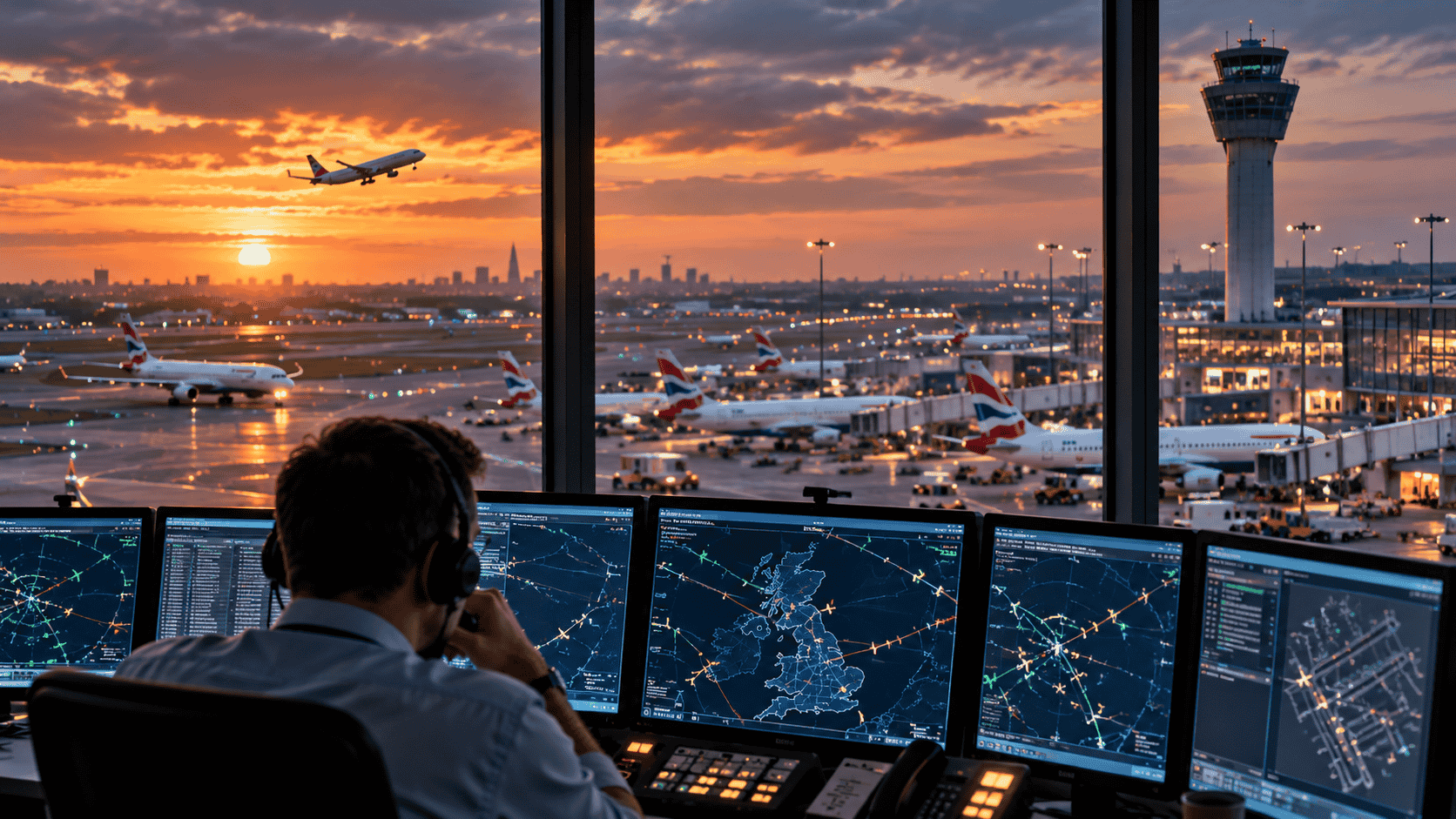
Britain's latest air-traffic-control failure disrupted flights even though the aircraft, airports and runways were still working. The reason lies inside a largely invisible software system that processes hundreds of flight plans every hour. Here is why slowing that computer can slow an entire country's skies.
How Can One Computer Failure Disrupt 1,000 Flights? Inside the Hidden Software Running Air Traffic Control
The aircraft still worked. The runways were open. Controllers were at their desks. Yet flights across Britain and Europe were cancelled or delayed because one of aviation's least visible systems stopped doing its job.
By Aviation & Technology Desk | Wednesday, September 9, 2026
Imagine arriving at Heathrow.
The weather is acceptable.
Your aircraft is sitting at the gate.
The pilots are ready.
The engines work.
The runway is open.
Then the departure board changes.
DELAYED.
Later:
CANCELLED.
The explanation?
A computer system somewhere else in the country has developed a fault.
To a passenger, that can sound ridiculous.
Why should a software problem prevent a perfectly functional aircraft from taking off?
Britain supplied a dramatic answer on September 8.
UK air-traffic-control provider NATS suffered what it described as an issue affecting its flight data processing system.
Heathrow, Gatwick, London City, Stansted, Manchester, Birmingham, Edinburgh and other airports experienced disruption.
NATS said the technical problem had been resolved by 7:34 p.m. British Summer Time and stressed that safety had not been compromised.
But fixing the computer did not instantly fix the airline network.
By then aircraft were in the wrong cities.
Crews were out of position.
Departure slots had disappeared.
Passengers had missed connections.
Airports were carrying a backlog of flights that could not all depart simultaneously.
AP, citing Flightradar24, reported that more than 1,000 flights were cancelled during the disruption, while Reuters—using a different tracker, airport sample and time snapshot—described close to a thousand flights as delayed or cancelled.
Different tracking services can produce different totals.
The important point is the scale.
One failure inside an information system had spread into an international transportation problem.
And to understand why, we need to look inside the hidden digital machinery that makes modern aviation possible.
Air Traffic Control Is Much More Than a Person Watching Radar
Popular culture gives us a simple image of air traffic control.
A controller sits in front of a radar screen.
An aircraft appears as a dot.
The controller speaks to the pilot over the radio:
“Climb to flight level 350.”
“Turn left heading 270.”
“Cleared for approach.”
That work is real.
But underneath the voice communication is an enormous information system.
Before a commercial aircraft flies, its operator submits a flight plan.
That plan contains information such as:
where the aircraft is departing,
where it is going,
the planned route,
airways and waypoints,
aircraft type,
requested altitude,
and other operational information.
Air-traffic-management computers then need to transform this information into something controllers can safely use.
For UK airspace, automated systems process incoming flight-plan information and ensure controllers receive the correct flight data for the aircraft entering, crossing or departing the country's controlled airspace.
The software therefore answers questions such as:
Where will this aircraft enter my airspace?
Which sectors will it cross?
Where is it expected to exit?
Which controller needs its data next?
At busy periods, this is not happening for ten aircraft.
It is happening for hundreds every hour.
In Normal Operation, Computers Can Process More Than 800 Flight Plans an Hour
We know how important automation is because of Britain's previous major NATS failure in August 2023.
NATS' official investigation found that its automated flight-plan subsystem could process more than 800 flight plans per hour at peak levels.
Think about that number.
More than thirteen flight plans every minute.
And those plans are not static.
Aircraft depart late.
Routes change because of weather.
Airlines modify schedules.
Flights cross from one national air-traffic-control system into another.
Controllers need accurate information about what will happen next.
Humans can perform parts of this work manually.
But they cannot realistically reproduce the speed of a large automated flight-processing platform.
This is the first key to understanding Tuesday's disruption:
When automation slows dramatically, aviation capacity has to slow with it.
Not because the aircraft suddenly become unsafe.
Because the number of aircraft the system can safely manage using reduced or fallback processes becomes smaller.
Why Not Just Use Paper?
This is one of the most obvious questions.
Air traffic control existed before modern computers.
Why can't controllers simply write flight plans down?
They can perform manual fallback procedures.
But scale changes everything.
During the 2023 incident, NATS switched to manual flight-plan input when automatic processing stopped.
Its own investigation explained that manual processing at the speed of the automated system would be impractical because it would require a huge number of specially trained people permanently waiting for an extremely rare failure.
In other words:
manual processing is a safety fallback.
It is not a full-capacity replacement.
During that earlier incident, NATS had to reduce traffic dramatically to match the rate at which humans could safely maintain flight data.
At one point, restrictions reduced traffic to only 20 flights per hour through Swanwick-controlled airspace and 10 per hour through Prestwick.
That does not mean Tuesday's 2026 incident followed exactly the same failure mode.
NATS has not yet publicly disclosed a detailed root cause for the latest outage.
But the earlier investigation shows why the loss or degradation of flight-data automation can force controllers to reduce traffic.
The Most Important Word in Air Traffic Control Is “Safe”
Why not keep every scheduled aircraft moving while engineers repair the software?
Because air traffic control is designed to fail safely.
Aviation generally prefers:
delay
over
uncertainty.
If a controller cannot be certain the data describing an aircraft's planned route is correct, the safe response is not to simply increase workload and hope for the best.
It is to reduce the number of aircraft being handled.
NATS' earlier investigation explained that flight-plan systems can deliberately enter protective states rather than risk feeding inaccurate information to controllers.
This gives us the strange situation passengers saw on Tuesday:
the sky was physically usable,
but its digital capacity had fallen.
Think of a motorway.
Imagine all traffic lights, lane-control systems and traffic-management computers suddenly stop communicating.
The road itself still exists.
Cars still work.
But allowing normal traffic volume would create unacceptable risk.
So authorities close lanes and reduce flow.
Air traffic control does something conceptually similar.
What Does a Flight-Processing Computer Actually Do?
Consider a flight from Los Angeles to Paris that crosses British-controlled airspace.
The original flight plan contains a long route composed of:
airways,
coordinates,
waypoints,
and international routing information.
The UK system does not need to control the aircraft from California to France.
It needs to determine the part relevant to the UK network.
An automated system interprets the route and determines things such as:
where the flight enters UK-controlled airspace,
which path it is expected to follow,
which sectors are involved,
and where responsibility passes onward.
Britain's 2023 incident revealed just how complicated this can become.
A highly unusual flight plan contained a combination of attributes, including duplicate waypoint names, that triggered a software exception.
Both primary and backup processing systems ultimately entered maintenance mode rather than risk passing incorrect information to controllers.
That specific bug was fixed afterward.
There is no evidence that Tuesday's 2026 incident had the same cause.
But the old case illustrates an important truth.
Something that looks like a simple route on a passenger map may require surprisingly complicated software logic behind the scenes.
Doesn't Air Traffic Control Have Backup Computers?
Yes.
Critical aviation systems are designed with redundancy.
But “there is a backup” does not mean every possible failure becomes invisible.
A backup can protect against:
hardware failure,
server failure,
power failure,
or other defined problems.
But some failures affect the logic or data used by both primary and secondary systems.
The 2023 NATS incident is a perfect example.
Both the primary and backup subsystems encountered the same problematic condition and entered protective maintenance states.
That does not prove the same happened in September 2026.
The latest root cause remains under investigation.
But it explains why resilience engineering is much harder than simply buying two computers.
If both systems share:
software,
data,
configuration,
or a common dependency,
some faults can affect both.
True resilience requires engineers to think not only about:
“What happens if Server A breaks?”
but:
“What happens if our assumption about how the entire system works turns out to be wrong?”
The Timing Makes the 2026 Incident Especially Interesting
Britain spent years investigating the August 2023 failure.
The Civil Aviation Authority's independent review eventually made 34 recommendations covering NATS, airlines, airports, regulators and government.
Those recommendations included improvements to:
contingency arrangements,
engineering resource management,
major-incident communication,
passenger support,
and regulatory oversight.
In June 2026, the CAA published an addendum confirming closure of the remaining outstanding recommendations from that review.
Then, less than three months later, another technical issue disrupted the system.
That does not automatically mean those recommendations failed.
The new technical fault may be completely different.
No serious conclusion can be reached until NATS publishes the new incident report.
But it explains why airlines reacted so strongly.
Ryanair and Wizz Air both demanded major changes following Tuesday's disruption, while the CAA said it expects a full report from NATS and will consider whether further action is required.
Why Does a Two-Hour Computer Problem Create an All-Day Airline Disaster?
Because airlines do not operate individual flights in isolation.
A commercial aircraft might fly:
London → Amsterdam
then:
Amsterdam → London
then:
London → Madrid
then:
Madrid → London.
The same aircraft may perform several flights in one day.
The pilots and cabin crew may also operate multiple sectors.
Now delay the first flight by three hours.
The aircraft arrives late in Amsterdam.
The second departure becomes late.
The crew approaches legal duty-time limits.
Passengers miss connections.
The aircraft misses the airport slot planned for its return.
The next airport may have a nighttime curfew.
Suddenly an outage that lasted a few hours creates problems long after the computer comes back online.
Reuters aviation analyst John Strickland summarized the problem: Europe's skies operate on tightly timed schedules, so even a relatively short outage can create enormous consequences when many airports are affected simultaneously.
Aircraft and Crews End Up in the Wrong Place
British Airways said Tuesday's disruption left aircraft and crews out of position.
AP reported that BA cancelled or diverted more than 100 flights, while Ryanair said more than 65,000 passengers were affected and that it cancelled more than 50 services.
This is why reopening capacity does not mean every cancelled flight can suddenly operate.
Suppose a Heathrow departure to Dubai needs a particular aircraft.
That aircraft is stuck in Edinburgh.
Or the aircraft arrives but its crew has exceeded maximum working time.
Or the gate needed for it is occupied by another delayed flight.
Or passengers are still being transferred from cancelled connections.
A modern airline is a tightly connected logistics network.
Pull one thread hard enough and the effects appear far away.
Why Can a UK Failure Delay Flights in Other Countries?
Airspace does not end operationally at national borders.
A flight from Amsterdam to New York may cross Britain.
A flight from Dubai to Manchester must enter UK-controlled airspace.
A Paris departure to Edinburgh depends on British capacity later in its journey.
Air-traffic-flow managers do not want hundreds of aircraft taking off elsewhere and then arriving at a bottleneck simultaneously.
So restrictions can be applied before the aircraft leaves its origin airport.
That is why a computer failure in Britain can leave passengers sitting at gates in:
Paris,
Amsterdam,
Dublin,
Dubai,
or elsewhere in Europe.
The delay is sometimes created hundreds or thousands of kilometres away precisely so aircraft do not arrive at congested airspace all at once.
This Is Why You Sometimes Sit on the Ground When the Sky Looks Empty
Passengers understandably become frustrated when told:
“Air traffic control delay.”
They look outside.
Blue sky.
Empty runway.
No obvious problem.
But ATC capacity is not determined by how crowded the visible runway looks.
The bottleneck may be:
a sector of airspace 300 kilometres away,
a controller's workload,
a destination airport,
weather over another region,
or the information system coordinating flights.
Keeping an aircraft on the ground is often the safest and most efficient place to absorb a delay.
Once airborne, an aircraft burns fuel.
It cannot simply park in the sky indefinitely.
Was the September 8 Failure a Cyberattack?
There is currently no evidence publicly establishing that.
NATS described the event as a technical issue affecting its flight data processing system.
It also said safety was not compromised.
Until an investigation identifies the cause, it would be irresponsible to label the outage:
a cyberattack,
sabotage,
or hacking.
Critical infrastructure attracts cyber threats, so investigators naturally consider security as part of modern incident response.
But:
technical failure does not automatically mean cyberattack.
Software bugs,
database failures,
network faults,
hardware problems,
configuration mistakes,
and dependency failures
can all disrupt complex systems.
The correct answer today is:
we do not yet know the detailed cause.
Why Didn't Controllers Lose Aircraft?
This is another important distinction.
A problem in a flight-data processing system is not necessarily the same as:
losing all radar,
losing all radio communication,
or losing control of aircraft already airborne.
NATS specifically said safety was not compromised during Tuesday's incident.
Air traffic control uses multiple systems and procedures.
Controllers can continue managing aircraft already in the air while capacity is reduced and additional traffic is restricted.
The result may be:
delays,
holding,
rerouting,
ground stops,
or cancellations.
That inconvenience is partly the consequence of the system protecting safety.
The 2023 Failure Shows What “Fail Safe” Looks Like
Britain's previous investigation gives us an unusually detailed window into this philosophy.
When automated processing stopped in 2023:
manual data entry began,
existing stored flight information continued to help controllers,
traffic restrictions were introduced,
and those restrictions became progressively tighter as the automated-data buffer aged.
NATS had approximately four hours of stored flight-plan data available to provide engineering teams with time to diagnose problems.
But flight data becomes less reliable as:
airlines change plans,
flights depart late,
routes are modified,
and new aircraft approach UK airspace.
Eventually humans must update more and more information manually.
The workload grows.
So traffic has to shrink.
That is a good example of a system degrading deliberately rather than collapsing chaotically.
Why Not Keep a Thousand People Waiting to Type Flight Plans Manually?
Economics.
NATS' investigation addressed this directly.
Maintaining enough specially trained staff permanently on standby to manually match automatic processing rates above 800 flight plans per hour would be impractical and uneconomic.
And manual flight-plan processing is only one potential failure mode.
A resilient system must prepare for many possibilities.
The engineering challenge is therefore balancing:
redundancy,
cost,
automation,
staffing,
maintenance,
testing,
and recovery time.
You cannot realistically duplicate every component with an entire second workforce and second infrastructure stack.
That is why modern resilience increasingly emphasizes:
rapid detection,
safe degradation,
isolation of faults,
tested recovery,
and clear contingency procedures.
Why Airlines Are So Angry
Airlines bear enormous costs when air traffic control capacity collapses.
They may have to pay for:
hotel rooms,
meals,
replacement flights,
repositioning aircraft,
additional crew,
ground handling,
and disrupted connections.
After the 2023 NATS failure, airline executives estimated that the incident cost the industry more than £100 million in refunds and compensation-related costs.
This week's failure revived those frustrations.
Wizz Air said a provider of critical national infrastructure should not repeatedly bring aviation to a standstill.
Ryanair called for NATS chief executive Martin Rolfe to resign.
Those are airline positions, not independent conclusions.
NATS said it had implemented a fix and apologized for the disruption.
Now the CAA wants the detailed evidence.
What Are Passengers Actually Entitled To?
This is where the technical story becomes practical.
For flights covered by UK passenger-rights law, a cancelled flight generally requires the airline to offer a choice between:
a refund,
rerouting at the earliest opportunity,
or rerouting later at the passenger's convenience, subject to availability.
If a passenger chooses rerouting and must wait, airlines may also be responsible for reasonable:
meals,
refreshments,
hotel accommodation,
and communication,
depending on the circumstances and length of the delay.
However, fixed cash compensation is a separate issue.
The CAA explains that airlines may not owe fixed compensation where disruption results from extraordinary circumstances that could not reasonably have been avoided.
Air-traffic-control management decisions are among the examples that can fall into this category, although each claim is fact-specific.
So:
no cash compensation does not necessarily mean no passenger rights.
Refund, rerouting and care obligations can still matter.
The Smart Passenger Rule: Keep the Receipts
If an airline cannot immediately provide reasonable care and a passenger has to arrange their own:
food,
hotel,
or appropriate alternative transport,
the CAA advises keeping itemised receipts and avoiding excessive spending.
That sounds mundane.
During a major disruption, it can become extremely important.
What Happens Now?
NATS has restored the affected system.
But the technical story is not finished.
The UK Civil Aviation Authority has said it expects NATS to provide a full report on the September 8 incident.
The regulator will then consider whether additional steps are required to secure the reliability of Britain's air-traffic-control system.
The important questions will be:
What exactly failed?
Was the failure hardware, software, database, network or another dependency?
Did backup systems operate as designed?
How quickly was the fault detected?
How quickly was capacity reduced?
Why did recovery take as long as it did?
Were the contingency procedures introduced after 2023 effective?
Could the same failure recur?
And can the architecture be redesigned so a similar event has a smaller operational impact?
Until that report appears, anyone claiming to know the exact technical cause is guessing.
The Hidden Lesson: Modern Aviation Is an Information Network
When we think about aviation infrastructure, we picture:
aircraft,
runways,
terminals,
control towers,
and radar antennas.
But modern aviation depends just as heavily on invisible infrastructure:
databases,
networks,
software,
flight-plan processors,
communication links,
scheduling systems,
and automated coordination.
An Airbus A350 may contain some of the most sophisticated engineering humans have ever built.
But that aircraft still needs permission and information to move safely through crowded airspace.
The physical machine and the digital network are inseparable.
That is the reason one computer problem can inconvenience tens of thousands of people.
The Sky Didn't Break. Its Operating System Slowed Down.
That may be the simplest explanation of what Britain experienced.
Aircraft still flew.
Controllers still worked.
Airports still operated.
But a key component of the digital system coordinating that traffic was impaired.
When aviation's information capacity fell, its physical traffic capacity had to fall with it.
That produced delays.
Those delays displaced aircraft and crews.
Displaced aircraft damaged later schedules.
Later schedules damaged connections.
Connections affected airports beyond Britain.
And within hours, a technical fault had become a network-wide travel crisis.
That is not evidence that air travel is dangerously fragile.
In one sense, it demonstrates the opposite.
Aviation systems are designed to sacrifice punctuality before they sacrifice safety.
Passengers experience that choice as:
CANCELLED.
Engineers experience it as:
the system failed safely.
The unanswered question is whether failures of this scale should be happening as often as they have.
Britain believed it had learned major lessons after 2023.
The CAA closed the remaining recommendations from that review in June 2026.
Now another incident has put resilience back under the microscope.
The latest fault has been fixed.
The harder job begins now:
understanding why it happened—
and ensuring the next software problem does not again become a problem for an entire country's skies.
Frequently Asked Questions
What happened to UK air traffic control on September 8, 2026?
NATS reported a technical issue affecting its flight data processing system. The problem disrupted flights at major British airports before NATS said the system issue was resolved at 7:34 p.m. BST.
How many flights were affected?
AP, citing Flightradar24, reported more than 1,000 cancellations. Reuters reported close to 1,000 delayed or cancelled flights in a different dataset and time snapshot. Totals differ depending on the tracker, airports and measurement period used.
Was Heathrow affected?
Yes. Heathrow experienced cancellations and delays, and arrivals were suspended for the remainder of Tuesday night while the backlog was managed.
What is a flight data processing system?
It is part of the infrastructure that receives, interprets and distributes flight-plan information so controllers know how aircraft are expected to move through controlled airspace.
Why can't air traffic controllers simply work without the computer?
Manual fallback processing exists, but it operates at much lower capacity. NATS' 2023 investigation found that automated processing can exceed 800 flight plans per hour, a rate impractical to reproduce manually.
Does a flight-processing failure mean radar stops working?
Not necessarily. Flight-plan processing, surveillance/radar and radio communications are different parts of the air-traffic-management system. NATS said safety was not compromised during the September 8 event.
Was the latest NATS outage caused by hackers?
There is currently no public evidence establishing a cyberattack. NATS has described it as a technical issue. A detailed root cause has not yet been publicly released.
Didn't NATS already fix its system after the 2023 outage?
NATS and the wider aviation sector implemented changes following the 2023 failure, and the CAA confirmed closure of outstanding recommendations in June 2026. The cause of the new incident has not yet been established, so it should not be assumed to be a repeat of the 2023 bug.
What caused the 2023 NATS failure?
A rare combination of flight-plan attributes, including duplicate waypoint information, exposed a software-logic problem and caused automated flight-plan processing to stop. A specific technical fix was subsequently implemented.
Why do flights remain delayed after the computer is fixed?
Aircraft, crews and passengers may already be in the wrong places. Airports also cannot immediately launch every delayed aircraft at once, so network recovery can take many hours.
Can a UK air traffic control outage delay flights outside the UK?
Yes. Aircraft travelling into or through UK airspace may be held at foreign airports to prevent more traffic from arriving than the reduced system can safely manage.
Do passengers receive compensation after an air traffic control failure?
Fixed cash compensation may not be payable where the cause qualifies as extraordinary circumstances outside an airline's control. However, passengers covered by UK rights can still have entitlements involving refunds, rerouting and care. Each case depends on its circumstances.
What should a stranded passenger do?
Check the airline's instructions, decide carefully between refund and rerouting, and keep itemised receipts for reasonable food, accommodation or alternative arrangements if the airline cannot provide required care directly.
UrduPure Internal Topic Cluster
Primary cluster: Aviation Technology + Critical Infrastructure + Travel
Natural internal-link opportunities:
Direct-to-Cell Satellite Internet: Starlink vs AST SpaceMobile — connect from the discussion of communications infrastructure.
Isar Aerospace Spectrum Reaches Orbit — connect where discussing highly engineered transport systems and safety-critical infrastructure.
The Hidden Cost of AI Data Centers — connect from the broader critical-infrastructure/software-resilience angle.
Future Travel & Culture passenger-rights guide.
Best next cluster articles:
What Actually Happens Inside an Air Traffic Control Tower?
Why Airlines Cannot Simply “Catch Up” After a Major Delay
What Is a Flight Slot—and Why Can Missing One Cancel Your Journey?
Can AI Run Air Traffic Control? What Automation Already Does—and What Humans Still Control
Your Flight Was Cancelled: Refund, Rerouting or Compensation? A Simple UK Passenger Rights Guide
Editorial Note: NATS has confirmed that the September 8, 2026 issue affected its flight data processing system and has been resolved, but a detailed technical root cause has not yet been made public. Explanations of automated and manual flight-plan processing in this article use NATS' published investigation of its separate August 2023 incident to illustrate how this type of infrastructure works; they should not be interpreted as evidence that the two failures had the same cause.
NATS outage 2026, air traffic control computer failure, Heathrow flight cancellations, flight processing system, air traffic control software, UK flight delays, why flights get cancelled
flight tracking, travel insurance, airline compensation, airport technology, aviation software, flight delay services, travel disruption
Air Traffic Control, NATS, Heathrow, Aviation Technology, Flight Delays, Airlines, UK Airports, Travel, Flight Software, Aviation Safety