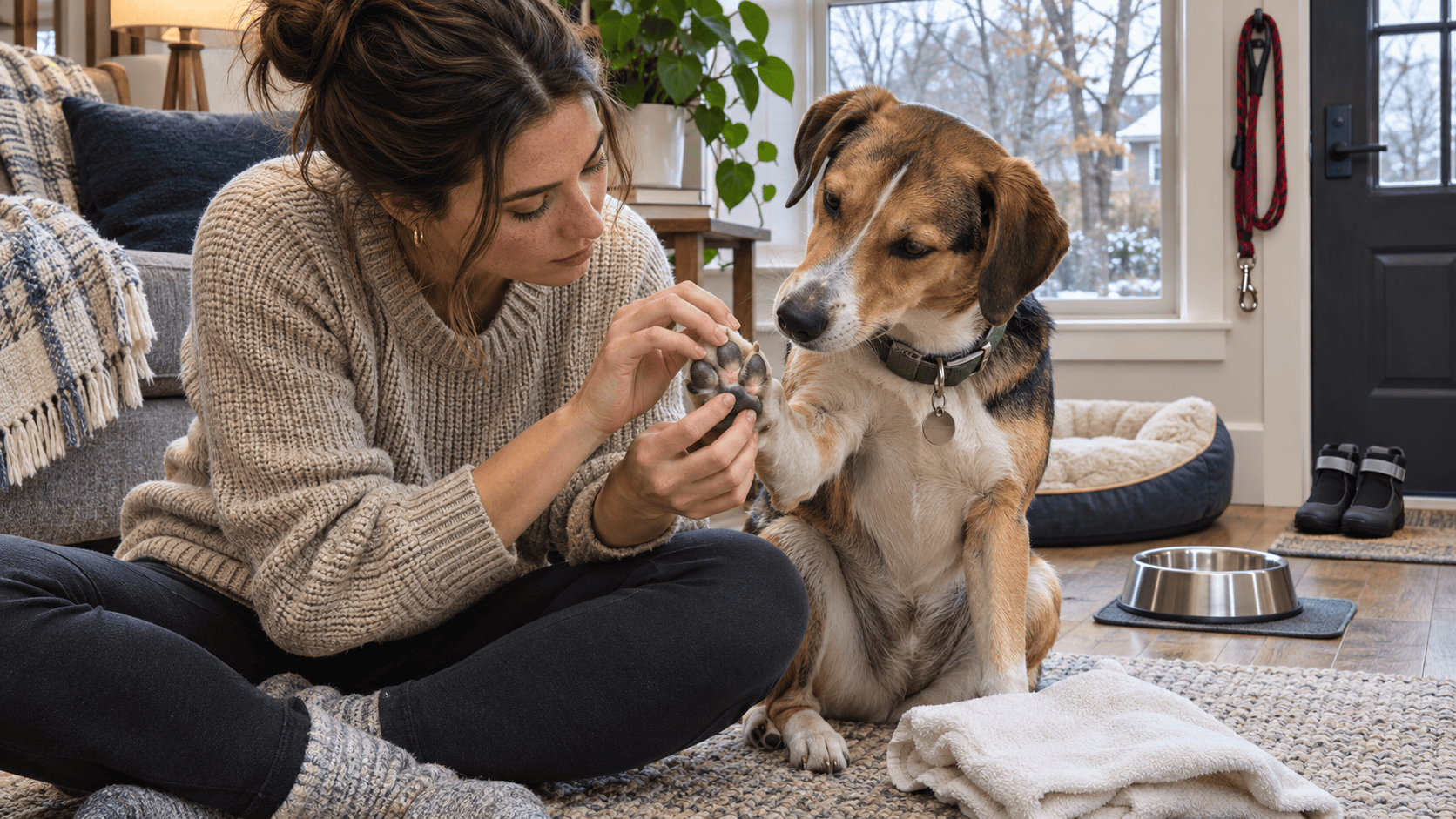
Your dog settles onto the couch and starts licking one paw. A few minutes later, they are still doing it. By bedtime, the fur looks wet and the skin between the toes seems pink. Occasional paw cleaning can be completely normal, but repeated licking or chewing is often a sign that something is itchy, irritated, painful or uncomfortable.
First, Notice Whether It Is One Paw or All Four
This is one of the most useful clues.
A dog repeatedly licking one paw makes a local problem more suspicious.
Think:
a splinter;
thorn;
small cut;
torn nail;
burn;
insect sting;
something caught between the toes;
or pain deeper in the foot.
A dog chewing or licking several paws, especially repeatedly over weeks or during certain seasons, is more suggestive of a broader skin problem such as allergy or infection.
Cornell says dogs with atopic dermatitis commonly lick and chew their feet, while Merck notes that allergic itching often affects the feet, face, ears and abdomen.
The pattern matters.
Start by Looking at the Paw
If your dog suddenly begins obsessing over one foot, inspect it carefully.
Look:
between the toes;
between the paw pads;
around every nail;
and across the pads themselves.
You may find:
a burr;
piece of plant material;
small stone;
gum;
broken nail;
cut;
or swelling.
VCA recommends checking the underside of a suddenly painful paw for obvious material stuck to the foot and advises veterinary care for deep wounds, burns, embedded foreign material or signs of infection.
Do not dig deeply into the paw with tweezers or another tool.
A superficial object may be easy to remove.
A deeply embedded object deserves professional care.
Allergies Are One of the Most Common Explanations
If there is no obvious injury, allergies move much higher on the list.
AAHA says allergic dogs may:
scratch;
lick;
chew;
bite;
or rub their skin.
Commonly affected areas include the:
paws;
face;
belly;
ears;
limbs;
and rear end.
Environmental triggers can include substances such as:
pollen;
plants;
molds;
dust mites;
and flea bites.
Food allergies can cause similar itching in some dogs.
That is why simply looking at the paw does not always tell you the cause.
The irritation can be happening because the immune system is reacting to something elsewhere in the dog's environment or diet.
Seasonal Paw Licking Is a Useful Clue
Does the licking happen every spring?
Every summer?
After grass starts growing?
Or perhaps when fall weeds release pollen?
Cornell says canine atopic dermatitis often has a seasonal component, although some dogs eventually develop year-round symptoms.
AAHA's 2026 guidance also notes that seasonal environmental allergens such as grass and weed pollens can trigger allergic flares.
That means a dog whose feet become itchy every May may have a very different problem from a dog that suddenly chews one paw after a walk.
Keep track of when the licking occurs.
Your veterinarian may find that history extremely useful.
Red or Brown Fur Can Be Evidence of Repeated Licking
Light-colored dogs sometimes develop reddish-brown staining on the fur around their paws.
Cornell notes that repeated licking can produce brown discoloration from saliva staining.
That discoloration tells you the behavior has probably been occurring longer than you realized.
Other signs of chronic irritation can include:
hair loss;
darkened skin;
thickened skin;
odor;
redness;
or recurring infections.
At that point, simply telling the dog to stop licking is unlikely to solve the underlying problem.
Yeast and Bacterial Infections Can Make the Itch Worse
Itching can start the licking.
Then licking damages the skin barrier.
Now bacteria or yeast can take advantage of the irritated skin.
The infection itself creates even more itching.
That creates a cycle:
itch → lick → damaged skin → infection → more itch
Merck says bacterial and fungal infections are common causes of itching and may be accompanied by hair loss, scaling, odor or discharge. It also notes that excessive licking of the feet can occur with yeast or bacterial infections.
If the paws smell unusually strong, look inflamed or develop discharge, a veterinarian should examine them.
Do Not Diagnose “Yeasty Paws” From the Internet Alone
Dog owners frequently encounter social posts claiming that:
brown paws;
a certain smell;
or constant licking
automatically means yeast.
It might.
It might not.
AAHA's allergy guidelines recommend a veterinary skin workup that can include cytology, flea evaluation and skin scrapings rather than diagnosing the cause based only on appearance.
A dog can have:
allergy;
bacterial infection;
yeast;
parasites;
or several problems at once.
The treatments are not interchangeable.
Fleas Can Cause Much More Itching Than You Expect
You do not need to see dozens of fleas for a sensitive dog to become extremely itchy.
Flea allergy is one of the allergic conditions veterinarians consider when investigating itching.
AAHA specifically recommends reviewing parasite prevention during the diagnostic workup of an itchy dog.
Merck similarly lists parasites among the first possibilities veterinarians typically rule out when evaluating pruritus.
If flea prevention has been inconsistent, mention it.
Do not assume:
“I did not see a flea, therefore fleas are impossible.”
Winter Sidewalk Salt Can Irritate Paws
Paw licking can become particularly noticeable during winter.
Dogs walk through:
road salt;
chemical de-icers;
snow;
ice;
and freezing slush.
Then they come indoors and lick their feet.
ASPCA's 2026 winter guidance says rock salt and other de-icing products can irritate dogs' paws, and ingestion during licking can also cause health problems. It recommends wiping or rinsing paws after walks and considering protective booties.
So if paw licking suddenly begins after the first snow or road treatment of the season, consider what your dog just walked through.
Rinse Winter Paws After Walks
You do not need an elaborate paw-cleaning routine.
After walking through salted or chemically treated areas:
rinse or wipe the paws;
clean between the toes;
and dry them thoroughly.
ASPCA specifically recommends washing paws after outdoor exposure to salt and ice-melting chemicals.
Booties can also help protect paws when a dog tolerates them.
The goal is to prevent both:
skin irritation;
and ingestion of de-icer when the dog starts licking.
Hot Pavement Can Cause the Same Behavior in Summer
Winter is not the only season that damages paws.
Hot pavement and sand can injure paw pads.
ASPCA advises avoiding hot surfaces that can cause burns and watching for blisters, loose skin or red ulcerated areas.
If a dog begins licking intensely after a summer walk, inspect the pads.
Paw-pad burns can be painful.
Do not assume the dog suddenly developed allergies on the same day as an extremely hot sidewalk walk.
Context matters.
A Broken Nail Can Cause Constant Licking
Dogs can tear or split nails while:
running;
jumping;
playing;
or catching them on something.
The injury may initially be difficult to notice.
Check every nail, including the dewclaw.
Look for:
bleeding;
a cracked nail;
swelling;
or unusual nail position.
VCA advises veterinary evaluation when a paw injury involves persistent bleeding, significant damage or ongoing pain.
A painful nail can make a dog return to the same paw repeatedly.
Do Not Let Constant Licking Turn a Small Injury Into a Larger One
Dogs lick because the area bothers them.
Unfortunately, persistent licking can keep wounds moist and interfere with healing.
VCA specifically advises preventing dogs from licking open wounds and notes that protective collars are often needed.
If there is an actual wound, stopping access to it can be part of treatment.
But an Elizabethan collar does not diagnose the problem.
It prevents further damage while the underlying cause is addressed.
Could the Dog Simply Be Bored?
Sometimes repetitive licking can have a behavioral component.
A dog may lick during:
boredom;
stress;
anxiety;
or repetitive self-soothing behavior.
But behavior should not be the first explanation for a dog that suddenly begins obsessively licking a paw.
First rule out:
injury;
itching;
infection;
parasites;
and pain.
Calling a painful paw “anxiety” can delay treatment.
Once medical causes have been evaluated, a veterinarian or qualified behavior professional can help determine whether the behavior itself needs attention.
Pain Can Cause Licking Even When the Skin Looks Normal
Dogs do not always lick only where the skin is itchy.
They may lick an area that hurts.
If an older dog repeatedly licks around a foot or leg but the skin appears normal, consider whether discomfort could originate from:
a joint;
muscle;
nail;
or another deeper structure.
Watch for:
limping;
hesitation on stairs;
difficulty rising;
less willingness to walk;
or sensitivity when the limb is touched.
The paw may simply be where the dog focuses attention.
What About Food Allergies?
Food allergy is possible.
It is also frequently self-diagnosed too quickly.
AAHA says food allergy can cause itching that affects areas including the paws, face, belly, ears and limbs, and some dogs may also have gastrointestinal signs.
But changing foods randomly every few weeks can make diagnosis harder.
AAHA's allergy guidelines emphasize a structured diagnostic process because environmental allergy, flea allergy, food allergy and infection can produce overlapping symptoms.
If your veterinarian suspects food allergy, follow the recommended diet trial carefully.
A few days on a new food does not reliably answer the question.
Do Not Put Random Human Creams on the Paw
The internet is full of suggestions involving:
antibiotic ointments;
antifungal creams;
essential oils;
vinegar;
peroxide;
steroid creams;
and other household products.
Do not experiment casually.
Dogs lick their feet.
Anything applied there can potentially be swallowed.
Some products can also irritate already damaged skin or interfere with veterinary testing.
For an injured or inflamed paw, use only treatments your veterinarian considers appropriate for that dog and condition.
When Is Paw Licking an Emergency?
Most paw licking is not an emergency.
But urgent veterinary attention is appropriate when there is:
heavy or persistent bleeding;
a deep wound;
significant swelling;
a serious burn;
a deeply embedded foreign object;
severe pain;
inability to bear weight;
or rapidly worsening infection.
VCA specifically recommends veterinary attention for deep punctures, lacerations, burns, embedded foreign objects and signs of infection such as swelling, redness and pus.
If your dog suddenly cannot use the leg normally, do not wait several days hoping the licking stops.
When Should You Make a Routine Vet Appointment?
Book an examination when the licking:
continues for days;
repeatedly returns;
involves several paws;
causes hair loss;
creates red or thickened skin;
produces odor or discharge;
or is accompanied by recurrent ear problems.
AAHA recommends veterinary assessment when signs suggest allergic disease because ongoing itching can lead to secondary complications.
Chronic paw licking is often much easier to manage once the underlying trigger is identified.
Take a Photo Before You Clean the Paw
This is surprisingly useful.
If the paw looks particularly red or swollen:
take a clear photograph;
then clean it if appropriate.
By the time you reach the veterinary clinic, swelling or redness may look different.
Also record:
which paw is affected;
when licking happens;
whether symptoms are seasonal;
what surfaces the dog recently walked on;
whether food changed;
and whether flea prevention is current.
AAHA emphasizes detailed history—including seasonality, parasite prevention and progression of itching—as an important part of diagnosing allergic skin disease.
Your observations can save diagnostic time.
The Five-Minute Paw Check
When you notice repeated licking, calmly inspect the foot.
Check:
each pad;
between every toe;
the nails;
the top of the paw;
and the surrounding fur.
Ask:
Is there an obvious object?
Is one paw worse than the others?
Is there redness?
Swelling?
Odor?
Discharge?
Bleeding?
A damaged nail?
Does your dog limp?
Did the problem start after walking through snow, salt, grass or hot pavement?
That short examination often helps determine whether you are looking at an immediate local injury or a more persistent dermatologic problem.
So Why Does Your Dog Keep Licking Its Paws?
There is no single answer.
Repeated paw licking can result from:
allergies;
parasites;
bacterial or yeast infection;
winter salt;
hot pavement;
foreign material;
a broken nail;
another injury;
pain;
or sometimes a behavioral problem.
Merck summarizes the larger lesson well: itching is a sign, not a diagnosis, and common causes include parasites, infection and allergies.
So do not focus only on stopping the licking.
Ask why the dog feels the need to lick.
If it is one paw and the behavior began suddenly, inspect carefully for injury or foreign material.
If several paws are involved repeatedly—especially with red skin, ear problems or seasonal flare-ups—allergy becomes more suspicious.
And if the paw is swollen, bleeding, infected or too painful for the dog to walk normally, call the veterinarian.
The licking is often the first visible clue.
The paw itself may tell you what comes next.
dog licking paws, why does my dog lick his paws, dog chewing paws, dog paws red, dog paw allergies, itchy paws dog, dog licking paws allergies, dog paw infection, dog licking one paw, dog paws yeast infection, dog licking paws winter, salt irritating dog paws, dog paw injury, dog paw licking at night
Pet Insurance: What Does It Actually Cover?
Why Are Your Hands Suddenly Dry and Cracking? Cold Weather Is Only Part of the Problem
That “Best By” Date Is Not an Expiration Date. So When Should You Throw Food Away?
Why Are Your Windows Wet Every Morning? What Condensation Is Telling You About Your Home
Pets
Lifestyle
Featured Image Alt Text
Dog owner gently checking between a dog's paw pads after noticing repeated paw licking at home.
Why Does My Dog Keep Licking Its Paws?
Why Does Your Dog Keep Licking Its Paws?
Occasional paw licking is normal. Constant licking can point to allergies, irritation, infection, injury or winter salt. Here’s what to check first.
Your Dog Keeps Licking One Paw. Look Here First.
Your dog has been licking the same paw for twenty minutes.
Allergies?
Maybe.
But first check something much simpler:
Is it one paw—or all four?
One suddenly irritated paw makes a thorn, cut, torn nail or other local problem more suspicious.
Several itchy paws—especially with red skin or recurring ear trouble—can point toward allergies or infection.
And during winter, the problem may be waiting on the sidewalk.
Reader Question
Does your dog lick its paws more during a particular season or after outdoor walks?
Research Notes
AAHA's updated June 2026 allergy guidance says dog allergies can cause frequent scratching, licking, chewing and rubbing. The paws, face, belly, ears, limbs and rear end are common areas of involvement. Environmental, food and flea-related allergies can produce overlapping symptoms.
Cornell says dogs with atopic dermatitis frequently lick and chew their feet. Symptoms can be seasonal and repeated licking may cause hair loss, red skin and brown saliva staining. Secondary skin infections may develop over time.
Merck Veterinary Manual says the most common causes of itching include parasites, infections and allergies. Bacterial and fungal infections may produce hair loss, scaling, odor and discharge in addition to licking or scratching.
ASPCA's January 2026 winter guidance says rock salt and other de-icers can irritate dogs' paws and may cause illness if ingested when dogs lick their feet. ASPCA recommends wiping or rinsing paws after walks and considering protective booties.
VCA recommends veterinary evaluation for paw injuries involving deep wounds, burns, embedded objects, uncontrolled bleeding or signs of infection such as redness, swelling and pus.
Pet Health Note
This article provides general pet-care information and cannot diagnose a dog's paw problem. Persistent licking, significant pain, limping, swelling, bleeding, discharge, burns, deep wounds or suspected infection should be evaluated by a veterinarian.