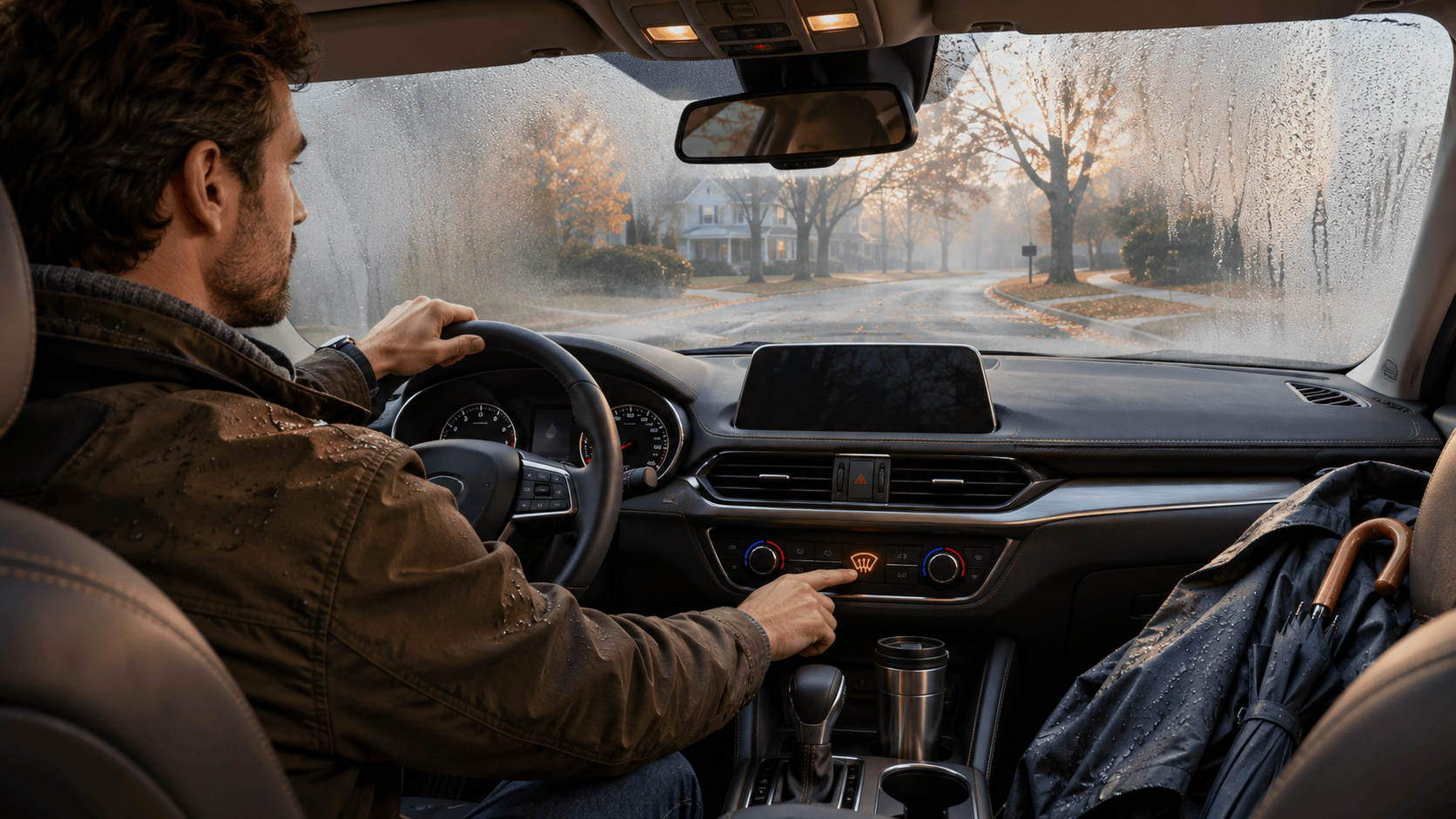
You get into the car on a cold morning, start the engine and within seconds the windshield turns cloudy. You wipe it with your sleeve, visibility improves for a moment—and then the fog comes straight back. The fastest solution is usually not simply blasting hotter air. You need to remove moisture from the cabin, warm the glass and stop recycling the humid air that caused the problem.
Why Does the Windshield Fog Up in the First Place?
The fog is condensation.
Air inside the vehicle contains water vapor from:
your breathing;
wet clothing;
snow on shoes;
rain-soaked carpets;
hot drinks;
and ordinary humidity.
When warm, humid cabin air touches cold windshield glass, the air near the glass cools.
If it cools below its dew point, some of its water vapor condenses into tiny droplets.
Those microscopic droplets scatter light and create the familiar cloudy windshield.
Automotive technical guidance filed with NHTSA describes windshield fogging in essentially the same way: warm cabin air containing moisture is cooled by cold windshield glass until it passes its dew point and condensation forms.
The problem is therefore not merely:
the glass is cold.
It is:
the glass is cold and the air touching it contains too much moisture.
That distinction explains which climate-control settings work fastest.
Press the Windshield Defrost Button First
Modern cars usually have a windshield-defrost or defog setting represented by a curved windshield symbol with arrows pointing upward.
Use it.
This mode directs a large amount of airflow toward the windshield and often toward the front side windows as well.
Many vehicles automatically change several climate settings when you press it.
For example, Toyota's current owner guidance says its windshield defogger can automatically switch the ventilation system toward outside air, while increasing airflow and temperature helps clear the windshield faster.
The button is doing more than pointing warm air at the glass.
It is configuring the climate system for visibility.
Yes, Turn the Air Conditioning On in Winter
This sounds wrong.
It may be 30°F outside.
Why would you want air conditioning?
Because the A/C system does something besides cooling the cabin:
it dehumidifies air.
AAA recommends allowing the air-conditioning system to operate when clearing interior windshield condensation because the system removes moisture from the air before that air reaches the glass.
Toyota similarly says turning on the cooling and dehumidification function helps defog windows effectively and that windows may fog more easily when A/C is switched off.
You can still set the temperature to warm.
Think:
warm + dry air
rather than:
cold air conditioning.
That combination is extremely effective at clearing a cold windshield.
Turn Recirculation Off
This may be the single setting people get wrong most often.
Recirculation closes off much of the outside airflow and keeps cycling cabin air through the HVAC system.
That is useful when:
cooling a hot cabin;
temporarily avoiding outside odors;
or keeping polluted outside air from entering.
It is usually a poor choice when the inside of your windshield is fogging.
Why?
Because the air inside the car is already humid.
Recirculation keeps reusing it.
AAA says recirculation can worsen interior fog because damp cabin air remains inside rather than being replaced with drier outside air.
Toyota's manuals make the same point: windows may fog more easily when recirculated-air mode is used, and windshield defogging should use outside-air mode.
So when the windshield fogs from the inside:
Defrost on.
A/C on.
Fresh/outside air on.
That is the combination to remember.
Turn the Fan Up
Airflow matters.
The more conditioned dry air you move across the windshield, the faster you can change the temperature and moisture conditions at the glass surface.
When rapid clearing is needed, vehicle manufacturers commonly recommend increasing airflow.
Toyota specifically advises turning airflow and temperature up when quick windshield and side-window defogging is needed.
Once the glass is clear, you can reduce the fan speed to something comfortable.
Visibility first.
Quiet cabin second.
Warm Air Helps the Glass Too
The cold windshield is part of the condensation equation.
Warm air flowing over it gradually raises the glass temperature.
As the interior glass surface warms, it becomes less likely to remain below the dew point of the cabin air.
This is why maximum defrost initially can work so well:
dry air removes moisture;
warm air heats the glass;
high fan speed moves more air;
and fresh-air mode replaces humid cabin air.
Several small effects attack the same problem at once.
If the Fog Is Really Bad, Crack a Window
What if your air conditioning is not working?
AAA recommends slightly opening the windows as another way to reduce interior humidity.
That lets humid cabin air escape and replaces some of it with outside air.
You do not need every window completely open in freezing weather.
Even a small opening can sometimes help when several wet people have just climbed into the vehicle.
This is especially useful after:
skiing;
walking through snow;
getting caught in rain;
or loading wet coats into the car.
Do Not Keep Wiping the Windshield With Your Sleeve
Wiping can create temporary visibility.
It does not solve the humidity problem.
It can also leave oils and streaks on the glass.
AAA specifically recommends using the defroster rather than repeatedly wiping interior condensation with clothing because wiping can leave streaks and the fog may simply return.
If you must wipe the windshield while parked, use a clean microfiber cloth.
Then fix the climate conditions that caused the condensation.
A Dirty Windshield Can Fog More Easily
Inside windshields accumulate an invisible film from:
dust;
skin oils;
cleaning residues;
interior materials;
and airborne contaminants.
Moisture can cling to these surfaces, making fog appear more obvious.
Some manufacturer technical guidance recommends keeping the inside of the windshield clean as part of minimizing condensation.
Clean the glass periodically with an automotive glass cleaner and a clean microfiber towel.
Do not wait until a cold rainy night to discover that the inside surface has a greasy film.
Why Does It Get Worse When Several People Enter the Car?
People are moisture generators.
Every passenger exhales warm, humid air.
Now add:
wet jackets;
snow-covered shoes;
damp umbrellas;
and wet floor mats.
A car containing four people can fog dramatically faster than the same car with only the driver.
The HVAC system now has to remove moisture produced by several sources at once.
If a group enters the vehicle on a rainy or snowy evening, consider activating defrost immediately rather than waiting until visibility deteriorates.
Wet Floor Mats Can Keep the Problem Coming Back
Sometimes the windshield fogs every morning even though you are using the controls correctly.
Look down.
If snow or rain has soaked:
carpets;
floor mats;
seats;
or cargo-area materials,
that water slowly evaporates into the cabin.
The vehicle effectively carries its own humidity source.
Remove standing water.
Dry wet mats when practical.
Avoid leaving soaked clothing inside the vehicle overnight.
The less moisture stored in the cabin, the less work the defroster has to do the following morning.
Check the Cabin Air Filter
A heavily restricted cabin air filter can reduce airflow through the ventilation system.
That can make defogging slower.
If airflow from the vents seems weak even at high fan speed, check the maintenance schedule for your vehicle.
The cabin filter may be:
dirty;
blocked with leaves;
or overdue for replacement.
Do not automatically assume a weak defroster means the heater itself has failed.
Air has to reach the glass.
What If the Defroster Barely Gets Warm?
That deserves investigation.
NHTSA recommends testing windshield defrosters before winter begins.
If the engine has reached operating temperature but the defroster still produces little heat, possible causes can include problems involving:
the cooling system;
heater core;
thermostat;
blend doors;
blower system;
or climate-control electronics.
Those require vehicle-specific diagnosis.
If the windshield cannot be kept clear, treat it as a visibility and safety problem rather than merely a comfort problem.
Interior Fog and Exterior Fog Need Different Solutions
Before changing every climate setting, figure out which side of the windshield is wet.
Winter condensation commonly forms on the inside because warm humid cabin air meets cold glass.
But during warm humid weather, condensation can sometimes form on the outside of a windshield that has been chilled by strong air conditioning.
AAA notes that exterior condensation can often be removed simply with the windshield wipers.
That distinction matters.
If the wipers instantly remove the fog, it was outside.
If the wipers do nothing, the condensation is probably inside.
Summer Fog Can Require Almost the Opposite Temperature Strategy
Imagine a hot, humid morning.
Your A/C has made the windshield very cold.
Warm humid air outside contacts the cold exterior glass.
Now condensation forms on the outside.
Blasting even colder air against the windshield may maintain the temperature difference.
AAA suggests adjusting climate conditions so the glass is not excessively cold relative to outside air.
So always determine which side is fogging before deciding what needs to change.
Fog Is Not the Same as Frost or Ice
Condensation inside the windshield is a moisture problem.
Ice on the outside is different.
When the windshield is frozen, use the defroster and a proper ice scraper.
AAA specifically warns drivers not to pour hot or warm water onto a frozen windshield, because the sudden temperature change can damage or crack the glass.
Do not use:
boiling water;
a kitchen knife;
metal tools;
or anything likely to scratch the windshield.
Let the vehicle's defroster gradually warm the glass and use the appropriate scraper.
Clear the Entire Windshield Before Driving
Do not create a tiny viewing slot and start driving.
NHTSA emphasizes maintaining clear visibility through the windshield and recommends ensuring winter wipers, washer fluid and defrosters are functioning before severe weather.
Clear:
the windshield;
side windows;
mirrors;
lights;
and other surfaces necessary for safe visibility.
Driving with a partially obscured windshield is not worth the few minutes saved.
Use Winter Washer Fluid Where Freezing Is Expected
Ordinary washer fluid can freeze under sufficiently cold conditions.
NHTSA recommends using high-quality winter windshield-washer fluid with de-icer in freezing climates.
AAA gives similar advice and recommends flushing summer fluid from the washer lines before severe winter weather arrives.
This matters because dirty winter roads can rapidly coat the windshield with:
salt;
slush;
road spray;
and grime.
A working washer system becomes a visibility tool, not merely a cleaning convenience.
Do Not Drive Until You Can Actually See
This sounds obvious.
People still do it.
You are late for work.
The defroster is slow.
So you drive while leaning forward to see through one clear patch.
Do not.
Visibility is fundamental to driving safely.
A technical climate-control guide filed with NHTSA specifically says drivers should ensure a clear view through the windows before driving.
Give the system another minute.
Clear the glass.
Then go.
Why Does the Fog Sometimes Return While You Are Driving?
Usually because moisture is still building inside the cabin.
Maybe you:
turned off A/C;
switched back to recirculation;
lowered fan speed too far;
or several passengers continued adding humidity.
The windshield glass may also remain cold.
If fog starts returning, restore:
windshield airflow;
fresh air;
and dehumidification.
You do not have to keep maximum defrost running forever.
But you may need some ongoing airflow across the glass during wet weather.
Automatic Climate Control May Handle This for You
Many newer vehicles manage defogging automatically.
Pressing the windshield-defrost button may automatically:
increase fan speed;
activate A/C;
select outside air;
and redirect airflow.
Toyota's current climate-control instructions describe precisely this type of behavior.
If your vehicle has automatic climate control, use the dedicated defrost setting rather than manually fighting every control.
The engineers already built a defogging strategy into the system.
The Fastest Cold-Morning Routine
When interior fog appears, use this sequence:
Press windshield defrost.
Turn A/C on if the vehicle does not do it automatically.
Use fresh outside air, not recirculation.
Increase fan speed.
Use warm air.
Crack a window slightly if humidity remains extreme.
Do not drive until visibility is clear.
That combination removes moisture while warming the windshield.
It fixes the cause instead of merely wiping away the symptom.
So Which Button Clears a Foggy Windshield Fastest?
Start with the button showing the front windshield and upward arrows.
But the real answer is a combination of settings.
For interior winter fog:
Defrost: ON
A/C: ON
Fresh air: ON
Recirculation: OFF
Fan: HIGH initially
Temperature: WARM
AAA says the A/C helps dehumidify cabin air, while outside-air mode helps replace the humid air that recirculation can trap inside.
Vehicle manufacturers give essentially the same guidance. Toyota says A/C dehumidification helps clear windshield fog and warns that recirculated air can make windows fog more easily.
So the next time the windshield turns cloudy, do not keep rubbing circles into it with your sleeve.
Press defrost.
Let the A/C remove moisture.
Bring fresh air into the cabin.
And remember the surprising winter rule:
Sometimes the fastest way to clear a cold windshield is to turn the air conditioning on.
----------------------------------------------------
foggy windshield, windshield fogging inside, how to defog windshield, car windows fogging up, windshield fog in winter, defrost windshield fast, should AC be on to defog windshield, recirculation windshield fog, car defogger settings, foggy car windows, windshield condensation, car windows fog while driving
Your Car Won’t Start on the First Cold Morning. Is the Battery Really Dead?
Why Did Your Tire Pressure Light Come On Overnight? Don’t Ignore It Even If It Goes Away
Can You Plug a Space Heater Into an Extension Cord? Why Fire-Safety Experts Say No
Your Electric Bill Jumped—But You Didn’t Use More Power. What Changed?
Automotive
Lifestyle
Driver using the windshield defrost controls while condensation covers part of the inside of a car windshield on a cold morning.
How to Clear a Foggy Windshield Fast
Your Windshield Keeps Fogging Up. Which Setting Clears It Fastest?
The fastest way to clear interior windshield fog involves defrost, A/C and fresh air—not recirculation. Here’s why the settings work.
Your Windshield Fogged Up. Should the A/C Really Be On?
Cold morning.
The windshield turns completely cloudy.
You turn the heat up.
But one setting matters more than most drivers realize:
Turn the A/C on too.
Even in winter.
It helps remove moisture from cabin air.
Then turn recirculation off and bring fresh outside air in.
That combination can clear the glass much faster than wiping it with your sleeve.
Reader Question
When your windshield fogs up, do you normally use fresh air or leave the car in recirculation mode?
Research Notes
AAA says interior windshield condensation develops when warm humid cabin air contacts cold vehicle glass. For rapid clearing, it recommends windshield defrost, A/C dehumidification and fresh outside air rather than recirculation.
Toyota owner guidance similarly says the A/C cooling/dehumidification function helps defog the windshield effectively and warns that using recirculated-air mode can make windows fog more easily.
NHTSA advises drivers to test windshield defrosters and wipers before winter and keep the washer reservoir filled with appropriate winter fluid in freezing conditions.
AAA advises against pouring warm or hot water over an iced windshield because rapid temperature change can damage the glass. A proper scraper and the vehicle defroster are safer approaches.
Safety Note
Never drive until the windshield, side windows and mirrors provide adequate visibility. Persistent fogging despite normal climate-control operation can indicate an HVAC, airflow or moisture problem that may require inspection.