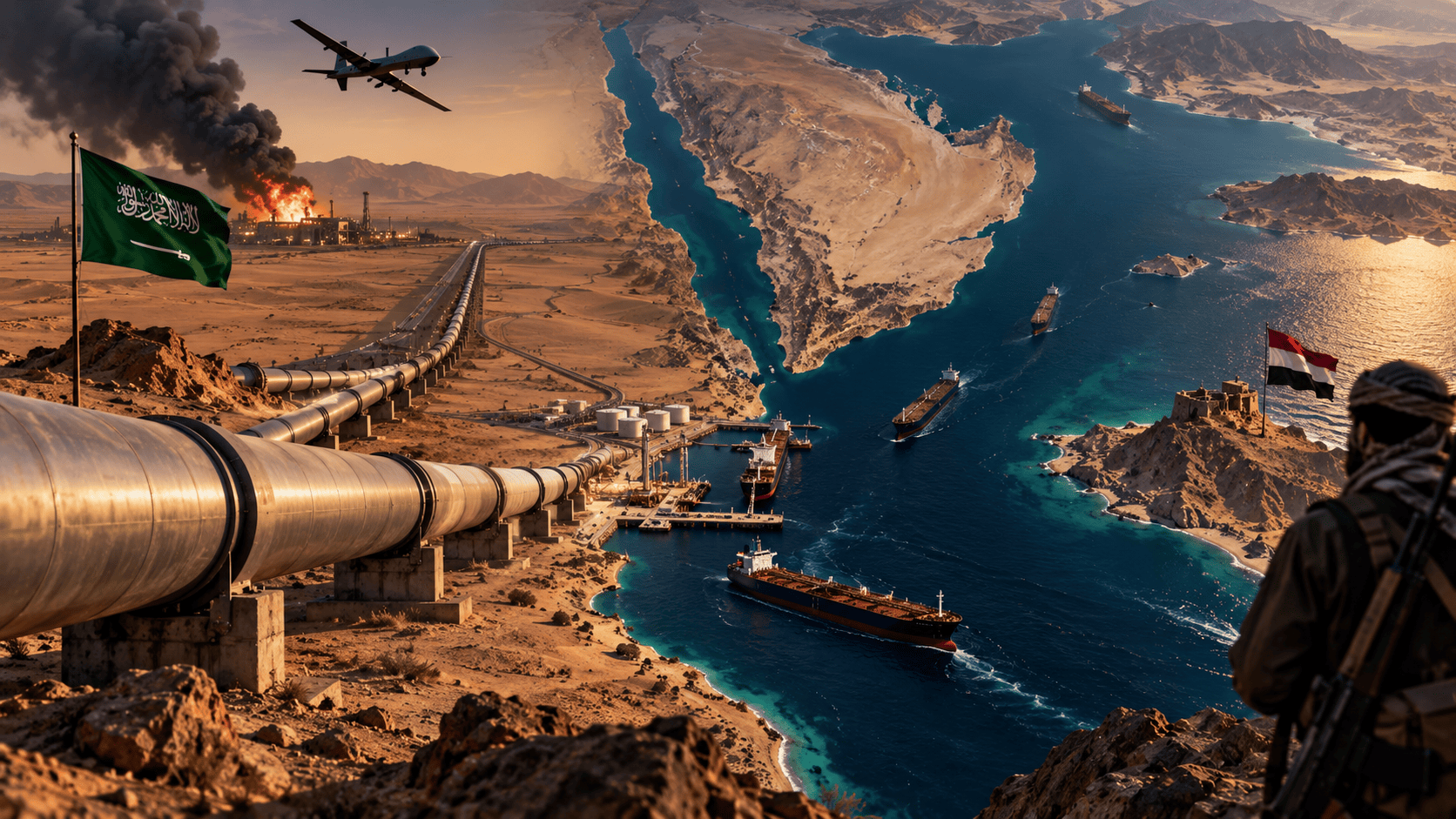
Saudi Arabia's 1,200-kilometre East-West pipeline was built to move Gulf crude to the Red Sea without using the Strait of Hormuz. In 2026 it became more important than ever—then drone attacks forced a shutdown just as Houthi advances threatened shipping near the Red Sea's southern exit. The lesson is bigger than one pipeline: bypassing one chokepoint can simply move the risk somewhere else.
Saudi Arabia Built a Pipeline to Bypass Hormuz—So Why Is Its Oil Still Vulnerable?
The East-West pipeline was designed for exactly the kind of crisis the Gulf is experiencing now: move millions of barrels of Saudi oil across the desert instead of through the Strait of Hormuz. Then drones hit the pipeline itself—while another strategic confrontation moved toward the Red Sea. What happens when the backup route needs a backup?
By Geopolitics & Energy Desk | September 12, 2026
Saudi Arabia spent decades building one of the world's most important pieces of energy insurance.
Instead of placing all of its oil exports on tankers sailing through the narrow Strait of Hormuz, the kingdom built a pipeline more than 1,200 kilometres across the Arabian Peninsula.
Crude could leave the oil-producing east.
Travel over land.
Reach Yanbu on the Red Sea.
And be loaded onto tankers without ever passing through Hormuz.
It was exactly the kind of system an oil superpower needs when one narrow waterway can become the center of a geopolitical crisis.
In 2026, that insurance policy became critical.
Oil traffic through Hormuz collapsed from an average of 21.6 million barrels per day in the fourth quarter of 2025 to only 4.9 million barrels per day in the second quarter of 2026, according to the U.S. Energy Information Administration. Saudi Arabia responded by shifting more crude west through its East-West pipeline.
Then the backup route itself came under attack.
Saudi authorities temporarily shut the East-West pipeline after drone strikes damaged infrastructure in the Riyadh and Medina regions. Saudi Arabia said the drones had originated from Iraqi territory; Iraq subsequently launched an investigation.
At almost the same time, Iran-aligned Houthi forces advanced along Yemen's Red Sea coast and seized Perim, also known as Mayun Island, inside the Bab el-Mandeb Strait—the narrow southern gateway to the Red Sea.
Suddenly the world's oil market was confronting a remarkable problem.
Saudi Arabia had built an escape route around one maritime chokepoint.
But the oil system surrounding that route was now exposed to:
a land-based infrastructure attack
and
a second maritime chokepoint.
That raises the bigger question:
Can an oil-producing country ever truly escape geography?
The Pipeline Was Born From Exactly This Fear
The East-West pipeline is not a new reaction to the current conflict.
Its origins go back more than four decades.
The system—often called Petroline—was developed as Saudi Arabia looked for a second export route linking its eastern oil-producing region to the Red Sea.
The first crude transported across the country was loaded at Yanbu on July 1, 1981. Contemporary Aramco historical material records a first shipment of 1.3 million barrels.
The timing was not accidental.
The Iran-Iraq War had begun in 1980.
The Gulf suddenly looked much less secure.
Tankers and oil infrastructure had become obvious strategic targets.
Saudi Arabia's leaders understood the danger of relying heavily on one maritime exit.
So they built a route across the desert.
What began as strategic redundancy became one of the most valuable pieces of energy infrastructure in the world.
Where Does the East-West Pipeline Actually Go?
The modern pipeline carries crude from the Abqaiq area in eastern Saudi Arabia across the kingdom toward Yanbu on the Red Sea.
EIA lists normal crude capacity at around 5 million barrels per day, with the system temporarily expandable to about 7 million barrels per day after earlier modifications.
That is enormous.
For comparison, total world oil supply in the second quarter of 2026 was roughly 99.7 million barrels per day.
A pipeline capable of moving around five million barrels daily can therefore reroute a quantity equivalent to roughly 5% of global oil supply.
Reuters reports that immediately before the latest shutdown, the line had been transporting around 4–5 million barrels per day.
That explains why an attack on what might otherwise look like one regional pipeline immediately matters to global markets.
What Exactly Is It Bypassing?
The Strait of Hormuz lies between Iran and Oman.
It connects the Persian Gulf to the Gulf of Oman and then the Arabian Sea.
Before the 2026 crisis, approximately 20.9 million barrels per day of petroleum liquids passed through it in the first half of 2025—around one-fifth of global petroleum consumption.
That makes Hormuz one of the world's most consequential pieces of geography.
Saudi Arabia's major eastern export terminals sit inside the Persian Gulf.
Normally, tankers leaving them must pass Hormuz.
But crude loaded into the East-West pipeline goes over land instead.
It reaches the Red Sea without entering the strait.
In pure geographic terms, the system works exactly as intended.
And in 2026, it worked so well that EIA data show oil flows through Bab el-Mandeb increased from 5.4 million barrels per day in late 2025 to 8.1 million in Q2 2026, largely as Saudi Arabia redirected crude westward to Yanbu.
The bypass did not fail.
The crisis simply moved.
Does Saudi Oil From Yanbu Have to Pass Bab el-Mandeb?
Not always.
This is where the geography becomes important.
Yanbu sits on the Red Sea.
A tanker leaving Yanbu has two broad directions.
North toward Europe
It can sail north through the Red Sea toward Egypt and use:
the Suez Canal
or, for some crude flows,
the SUMED pipeline across Egypt.
This route can avoid both Hormuz and Bab el-Mandeb. EIA specifically notes that Saudi Arabia can use the East-West pipeline and Red Sea infrastructure to bypass both chokepoints.
South toward Asia
A tanker sailing from Yanbu toward India, China, Japan, South Korea or other Asian markets would normally travel south through the Red Sea and exit via Bab el-Mandeb.
That is the problem.
Asia has historically been Saudi Arabia's biggest crude market. EIA says around 75% of Saudi crude exports went to Asia in 2023.
So the East-West pipeline removes Hormuz risk—
but for many eastbound cargoes it creates exposure to the Red Sea's southern exit.
The oil has moved around one chokepoint.
It has not escaped the maritime system.
Bab el-Mandeb Literally Means “Gate of Tears”
The name is appropriate.
Bab el-Mandeb separates Yemen from Djibouti and Eritrea.
At its narrowest point, the strait is roughly 18 miles wide.
It connects:
the Red Sea
with
the Gulf of Aden and Arabian Sea.
Anything moving by sea between the Red Sea and Indian Ocean normally passes this gateway.
That includes:
container ships,
oil tankers,
bulk carriers,
and other commercial vessels.
For Europe-to-Asia trade, the normal path is:
Mediterranean → Suez Canal → Red Sea → Bab el-Mandeb → Indian Ocean.
If Bab el-Mandeb becomes too dangerous, ships often divert around the southern tip of Africa.
That means the Cape of Good Hope.
It works.
But it costs more.
The Houthis Have Already Shown How Expensive One Chokepoint Can Become
Houthi attacks on commercial vessels beginning in late 2023 caused many shipping companies to avoid Bab el-Mandeb.
Ships diverted around Africa.
EIA says such rerouting increases:
voyage distance,
fuel consumption,
shipping time,
and freight cost.
That experience transformed Red Sea security from a regional concern into a global supply-chain issue.
In 2026, the geography became even more sensitive because Saudi Arabia was using Red Sea exports more heavily to compensate for disruption at Hormuz.
A route that had once been an alternative became a main pressure-release valve.
Then pressure reached that valve too.
Why Does Perim Island Matter?
Perim, or Mayun, sits directly inside the Bab el-Mandeb Strait.
It is strategically important not because occupying the island automatically closes global shipping.
It doesn't.
But its location provides significant leverage over movement through one of the world's most important maritime corridors.
Reuters reported that Houthi forces took control of the island along with nearby Dhubab, strengthening their position around the chokepoint.
This does not mean Bab el-Mandeb has been completely closed.
In fact, Reuters reported 26 vessel transits through the strait on September 10, close to the recent average.
That distinction is critical.
A chokepoint can become economically dangerous before it physically closes.
Shipowners react to:
missile risk,
drone risk,
insurance premiums,
naval warnings,
crew safety,
possible future blockades,
and uncertainty.
Markets price probabilities.
They do not wait for the final tanker to stop moving.
Then the Pipeline Itself Was Hit
This is what makes the current episode so important.
The East-West system exists partly to reduce dependence on vulnerable sea lanes.
But a pipeline creates its own concentrated infrastructure.
It requires:
pumping stations,
power,
communications,
valves,
control systems,
storage terminals,
and long stretches of physical pipe.
A tanker can change course.
A pipeline cannot.
Its strength is that it avoids the sea.
Its weakness is that everyone knows exactly where it goes.
Drone warfare has made that problem much more serious.
Relatively inexpensive unmanned aircraft can threaten infrastructure far from traditional battlefields.
The latest Saudi attack resulted in the pipeline being shut as authorities assessed and secured the system.
So the 2026 oil crisis now contains three different vulnerabilities:
Hormuz at sea
Petroline on land
Bab el-Mandeb at sea again
That is not one chokepoint.
It is a network of them.
The Pipeline Was Never Designed to Make Saudi Oil Invulnerable
This is the most important correction to the headline.
The East-West pipeline did not fail at its intended purpose.
It successfully provides an alternative to Hormuz.
What 2026 demonstrates is that redundancy is not the same as invulnerability.
Suppose your house has two exits.
If one door becomes blocked, the second saves you.
That is excellent resilience.
But the second door can still have its own risks.
Energy security works the same way.
Saudi Arabia's bypass reduced one catastrophic dependency.
It did not eliminate:
war,
drone attacks,
Red Sea insecurity,
Suez constraints,
shipping costs,
or dependence on ports and pumping stations.
The correct question is therefore not:
“Why didn't the bypass work?”
It is:
“How many independent alternatives are enough?”
Why Can't Saudi Arabia Just Send Everything North Through Suez?
Because capacity, destination and economics matter.
The Suez Canal connects the Red Sea directly to the Mediterranean.
The SUMED pipeline provides another northbound route across Egypt and has capacity of roughly 2.5 million barrels per day.
That makes Yanbu extremely useful for supplying Europe.
But most Saudi crude demand historically comes from Asia.
Shipping crude loaded at Yanbu north through Suez and then around toward Asia would make little geographic sense.
For Asia-bound cargoes, the logical route is south through Bab el-Mandeb.
If that route becomes unsafe, tankers can theoretically travel another direction or be supplied from different terminals, but the logistics become longer, more complicated or capacity-constrained.
This is what economists mean when they talk about a chokepoint premium.
The oil may still exist.
Getting it to the right buyer becomes more expensive.
Can't Tankers Just Sail Around Africa?
Yes.
And many already do during Red Sea disruptions.
A vessel can avoid Bab el-Mandeb and Suez by travelling around the Cape of Good Hope.
That removes chokepoint exposure.
But EIA estimates that diverting voyages around Africa can add substantial time and cost. In some Europe-related routes, avoiding Suez can add around 15 days.
Extra days mean:
more fuel,
more crew time,
fewer voyages per tanker each year,
higher charter rates,
and more working capital tied up in cargo.
Those costs ultimately enter the price of energy.
A bypass is therefore not binary.
The question is not:
Can oil move?
It is:
At what cost, how quickly, and in what volume?
Why Oil Jumped Above $100 Again
The market had already been dealing with severe constraints before the latest attack.
By September 11, Brent crude settled around $104.61 per barrel, while U.S. WTI settled around $100.05. Reuters said oil was headed for a weekly gain of more than 8% amid tighter supply and Middle East disruption.
Markets were pricing several risks simultaneously:
reduced Hormuz traffic,
Saudi infrastructure attacks,
Red Sea shipping threats,
low inventories,
and uncertainty about how quickly disrupted production could return.
That combination matters more than any single attack.
Oil markets can absorb one problem.
They become much more nervous when the alternatives begin failing at the same time.
Saudi Supply Was Already Under Pressure
The International Energy Agency estimated Saudi crude supply at around 6 million barrels per day in August, its lowest level in more than three decades, according to Reuters.
Saudi Arabia reported somewhat different figures to OPEC, illustrating the difference between production, supply and barrels actually reaching markets.
The precise number matters less than the direction:
the kingdom has had difficulty translating its enormous production capability into normal export flows during the regional crisis.
That is a fascinating shift.
For decades, Saudi Arabia's greatest oil-market advantage was its ability to increase production when others could not.
In 2026, the constraint is increasingly not only:
How much can you produce?
It is:
How much can you safely transport?
This Changes the Meaning of Spare Capacity
Oil analysts often talk about Saudi spare production capacity.
Imagine the kingdom can theoretically produce an additional million barrels per day.
That sounds reassuring.
But those barrels only help the world if they can reach customers.
If export routes are constrained, additional underground capacity is less useful.
The 2026 crisis therefore exposes a distinction between:
production capacity
and
deliverable capacity.
You can have oil underground.
You can have refineries.
You can have pipelines.
But the value to the global market exists only when all parts of the chain connect.
Why This Matters So Much for Asia
Asia is the critical part of the story.
China.
India.
Japan.
South Korea.
And other Asian economies consume enormous quantities of Middle Eastern crude.
Saudi Arabia's export system was built around serving those customers efficiently.
When Gulf routes become constrained, Asian refiners must compete for alternative barrels from:
Russia,
West Africa,
the United States,
Latin America,
and elsewhere.
That reshuffles the entire oil market.
A refinery in Asia does not need to buy Saudi oil for a Saudi disruption to affect it.
If enough buyers switch to the same alternatives, those alternatives become more expensive too.
This is how a regional infrastructure attack becomes a global commodity-price event.
And Pakistan Is Not Outside This Story
Pakistan may be geographically closer to the Gulf than Europe, but that does not protect it from global oil-market pricing.
Pakistan imports petroleum and is therefore exposed to changes in:
international crude prices,
refined-product prices,
shipping costs,
insurance,
and the rupee-dollar exchange rate.
A disruption in Saudi exports does not translate mechanically into a particular increase at Pakistani petrol pumps.
Government levies, exchange rates, product benchmarks and pricing periods still matter.
But when Brent, diesel and shipping costs all rise together, the direction of pressure becomes uncomfortable for an import-dependent economy.
There is also a direct reminder of Pakistan's exposure in the current Hormuz crisis.
Reuters reported that a Qatar-linked LNG tanker recently delivered cargo to Pakistan after transiting Hormuz—the first known such delivery since July—showing just how closely Pakistan's energy security remains linked to the same regional waterways.
Could the UAE Become the Safer Alternative?
The United Arab Emirates has its own Hormuz bypass.
Its Abu Dhabi Crude Oil Pipeline carries crude to Fujairah, which sits on the Gulf of Oman outside the Strait of Hormuz.
EIA lists the line's current maximum capacity at roughly 1.8 million barrels per day.
Geographically, that solution is elegant.
Oil reaches open water without entering Hormuz.
And unlike Yanbu, Fujairah does not require Bab el-Mandeb for exports to Asia.
But its capacity is far smaller than the enormous volumes normally moving through Hormuz.
That illustrates the global problem again.
There are alternatives.
There simply are not enough alternatives to replace the entire Gulf export system simultaneously.
Why Not Build More Pipelines?
That is almost certainly one long-term lesson of the crisis.
More pipelines can create:
redundancy,
additional export terminals,
more destination flexibility,
and less dependence on individual waterways.
But pipelines cost billions.
They take years to permit and construct.
They cross politically sensitive land.
They need pumping stations and protection.
And, as Saudi Arabia discovered this week, pipelines themselves become targets.
Energy security therefore cannot mean:
“replace vulnerable tankers with invulnerable pipes.”
It means designing a system where no single failure can stop everything.
That requires:
multiple routes,
multiple ports,
storage,
spare capacity,
security,
rapid repair capability,
and diplomatic stability.
Technology helps.
Geography still wins many arguments.
The Bigger Lesson: Modern Oil Is a Network, Not a Well
Public discussion often treats oil as though the main question is:
Which country has the reserves?
But reserves are only the beginning.
An oil barrel must pass through a chain.
Field.
Processing plant.
Pipeline.
Storage tank.
Export terminal.
Tanker.
Chokepoint.
Import terminal.
Refinery.
Product pipeline.
Petrol station.
Break enough links—
and reserves stop being the relevant number.
That is precisely what the Middle East crisis is demonstrating.
Saudi Arabia remains one of the largest oil-resource holders on Earth.
Yet a damaged pumping system and two contested waterways can still influence the price paid by consumers thousands of kilometres away.
Is Saudi Oil Actually “Trapped”?
No.
That phrase is useful as a headline question, not a literal description.
Saudi Arabia still has export options.
Some Yanbu crude can move north through Suez or SUMED.
Tankers can take longer routes.
Eastern terminals can operate to the extent Hormuz conditions permit.
Inventories can temporarily supply customers.
Infrastructure can be repaired.
The UAE provides another regional bypass.
And global buyers can seek alternative crude.
So the situation is not:
Saudi oil cannot leave the country.
The real issue is:
Saudi Arabia has fewer cheap, high-capacity, low-risk options available simultaneously.
That is enough to move global prices.
The World's Oil System Was Built for Efficiency
For decades, global trade optimized routes around:
distance,
cost,
refinery requirements,
and tanker availability.
A Saudi barrel headed toward Asia normally does not need an elaborate detour.
A Qatari LNG cargo does not normally wait for geopolitical permission to pass Hormuz.
A European importer does not normally wonder whether two separate maritime chokepoints will become contested at once.
The system is efficient because these routes usually work.
But efficiency creates concentration.
Large volumes end up flowing through:
Hormuz,
Bab el-Mandeb,
Suez,
Malacca,
and a handful of other narrow corridors.
The more efficiently the system concentrates traffic, the more consequential those corridors become.
The 2026 Crisis Has Exposed a “Chokepoint Chain”
This may be the most important concept to take away.
We usually talk about individual chokepoints.
Hormuz.
Bab el-Mandeb.
Suez.
But energy actually moves through a chain.
A Saudi barrel might avoid one vulnerable link only to encounter another later.
A pipeline can bypass the sea—
but depend on a coastal export terminal.
A ship can avoid one strait—
but add two weeks around Africa.
A country can build a second route—
but still depend on the same processing facilities at the beginning of the network.
Energy resilience therefore needs to be understood end to end.
Not one map point at a time.
What Happens Next?
There are several indicators worth watching much more closely than dramatic political statements.
1. When does the East-West pipeline return to full operation?
A short precautionary shutdown is very different from prolonged physical damage.
2. Does shipping through Bab el-Mandeb actually decline?
The Houthi seizure of Perim increases risk, but traffic has not stopped completely.
3. Does Hormuz traffic recover?
Reuters reported vessel movements had fallen dramatically from pre-war levels, in some recent periods to single digits per day.
4. What happens to Saudi exports from Yanbu?
This shows whether the kingdom can continue relying on its western outlet.
5. Does Brent remain above $100?
A sustained price matters much more economically than a brief spike.
6. Do insurers or major shipping companies pull back?
Insurance decisions can reduce traffic even without a formal blockade.
These physical indicators tell us more about the energy crisis than rhetoric alone.
Saudi Arabia Solved the Hormuz Problem—But Only Part of It
The East-West pipeline remains an extraordinary strategic asset.
It did what it was designed to do.
When Hormuz became severely constrained, Saudi Arabia could move millions of barrels across its territory and export them from the Red Sea instead.
Without that pipeline, the 2026 Gulf disruption could have been substantially worse.
But the pipeline also demonstrates a fundamental truth about infrastructure.
There is no single machine that makes geography disappear.
The oil still needs:
pumping stations,
power,
ports,
tankers,
safe sea lanes,
and buyers.
Protect one piece.
Another becomes critical.
That is why today's energy crisis is not really a story about a failed bypass.
It is a story about what happens when multiple layers of redundancy come under pressure at the same time.
Saudi Arabia built a road around Hormuz.
That road worked.
Then war reached the road.
And at the other end of it stood another narrow gate.
That is the uncomfortable geography behind today's $100 oil.
Frequently Asked Questions
What is Saudi Arabia's East-West oil pipeline?
The East-West Pipeline, also called Petroline, is a roughly 1,200-kilometre Saudi crude pipeline carrying oil from the kingdom's eastern producing region to Yanbu on the Red Sea. It allows exports to bypass the Strait of Hormuz.
When was the East-West pipeline built?
The project was developed around the beginning of the 1980s. The first crude shipment transported across the system was loaded at Yanbu on July 1, 1981.
How much oil can the Saudi East-West pipeline transport?
EIA describes normal capacity at about 5 million barrels per day, temporarily expandable to approximately 7 million barrels per day.
Why is the East-West pipeline important?
It allows Saudi oil to reach the Red Sea without tankers first passing through the Strait of Hormuz, providing critical redundancy during a Gulf shipping disruption.
Why was the pipeline shut in September 2026?
Saudi Arabia temporarily shut the system after drone attacks hit infrastructure in the Riyadh and Medina regions. Saudi authorities said the drones originated from Iraqi territory, and Iraq launched an investigation.
Is the pipeline permanently closed?
There is no indication that it has been permanently abandoned. The reported shutdown was a security response following the attacks, with assessments and repairs determining the operational timetable.
What is Bab el-Mandeb?
Bab el-Mandeb is the narrow strait connecting the Red Sea with the Gulf of Aden and Arabian Sea, between Yemen and the Horn of Africa. It is roughly 18 miles wide at its narrowest point.
Did the Houthis close Bab el-Mandeb?
No. Houthi forces seized strategically important territory including Perim Island, increasing their ability to threaten shipping, but commercial traffic has continued. Reuters recently recorded 26 vessel movements through the strait in one day.
Can Saudi Arabia bypass both Hormuz and Bab el-Mandeb?
For some westbound exports, yes. Crude can travel through the East-West pipeline to Yanbu and then move north toward Suez or the SUMED pipeline without passing either Hormuz or Bab el-Mandeb.
Why does Bab el-Mandeb still matter to Saudi Arabia?
Saudi oil leaving Yanbu for Asian destinations normally needs to travel south through Bab el-Mandeb, and Asia has historically been Saudi Arabia's largest crude market.
Can ships avoid Bab el-Mandeb?
Yes. Ships can reroute around Africa via the Cape of Good Hope, but this significantly increases voyage length, time and cost.
How much oil normally passes through Hormuz?
EIA says flows averaged roughly 20.9 million barrels per day in the first half of 2025, equivalent to about one-fifth of global petroleum-liquids consumption.
How much oil was passing through Hormuz during the 2026 crisis?
EIA estimates only about 4.9 million barrels per day of crude oil and petroleum liquids transited Hormuz in Q2 2026, down from 21.6 million in Q4 2025.
Why did Bab el-Mandeb oil flows increase in 2026?
EIA says flows rose to around 8.1 million barrels per day in Q2 2026, partly because Saudi Arabia rerouted oil away from Hormuz through its East-West pipeline and Red Sea ports.
What is the UAE alternative to Hormuz?
The UAE operates the Abu Dhabi Crude Oil Pipeline to Fujairah outside Hormuz. EIA lists its maximum capacity at around 1.8 million barrels per day.
Why are oil prices above $100?
Markets are reacting to a combination of reduced Gulf supply, Hormuz disruption, Saudi infrastructure attacks, Red Sea security risks and concerns about how quickly normal export flows can recover. Brent settled at $104.61 on September 11.
Will this automatically increase petrol prices in Pakistan?
Not by a fixed amount. Higher global oil and refined-product prices create upward pressure, but Pakistan's retail prices also depend on exchange rates, taxes, levies, margins and the applicable official pricing period.
Editorial Note: The East-West pipeline should not be described as a failed or useless Hormuz bypass. It has provided Saudi Arabia with major export flexibility during the 2026 disruption. The current crisis instead demonstrates that an alternative route can develop its own vulnerabilities—from physical attacks on pipeline infrastructure to insecurity around Red Sea shipping. Bab el-Mandeb has also not been fully closed at the time of publication; shipping continues despite elevated risk.
crude oil prices, energy security, oil shipping, tanker freight rates, energy market risk, fuel prices, commodity trading, oil infrastructure
Saudi Arabia, Oil Prices, Strait of Hormuz, Bab el-Mandeb, Red Sea, Yanbu, Energy Security, Houthis, Middle East, Crude Oil