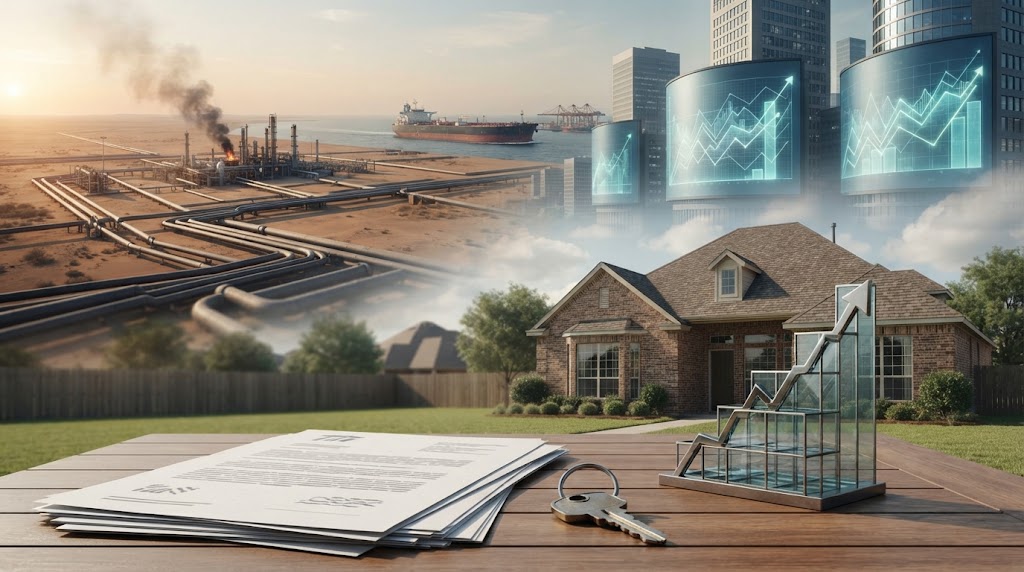
A drone can hit an oil installation in the Middle East and, days later, borrowing costs can rise thousands of kilometres away. The connection is not direct. It travels through fuel prices, inflation expectations, bond markets and central-bank policy.
Updated: September 14, 2026
How Does a Drone Attack in Saudi Arabia End Up Raising Your Mortgage Rate?
Brent crude has climbed above $107 while markets increasingly expect the Federal Reserve to raise interest rates this week. Central banks cannot repair Saudi pipelines or manufacture diesel—so why does an oil shock make money more expensive?
By Business & Finance Desk | September 14, 2026
A drone strikes energy infrastructure in Saudi Arabia.
Oil jumps.
Diesel becomes more expensive.
A delivery company raises its prices.
A supermarket pays more to move food.
A factory pays more for transport and raw materials.
Inflation refuses to fall.
Bond traders demand higher yields.
Then someone trying to buy a house thousands of kilometres away discovers that borrowing money has become more expensive.
At first, that chain sounds absurd.
What does an oil pipeline in Saudi Arabia have to do with a mortgage in Chicago, London—or the cost of financing a business in Pakistan?
There is no pipeline carrying crude oil into a Federal Reserve meeting room.
The Federal Reserve cannot reopen the Strait of Hormuz.
It cannot repair Saudi Arabia's East-West pipeline.
It cannot manufacture diesel.
And raising an interest rate does not create one additional barrel of crude.
Yet financial markets began this Monday with exactly this connection in mind.
Brent crude futures jumped to about $107.51 a barrel after fresh attacks in the Gulf and Saudi Arabia intensified fears over energy supplies. U.S. West Texas Intermediate climbed above $102.
At the same time, traders were pricing roughly an 86% probability that the Federal Reserve will raise its policy rate by a quarter percentage point on Wednesday, September 16.
So how does an oil shock become an interest-rate shock?
The connection travels through one word:
Inflation.
Step One: Oil Does Not Stay at the Petrol Station
When crude oil rises, the most obvious effect appears on fuel prices.
Petrol becomes more expensive.
Diesel becomes more expensive.
Jet fuel becomes more expensive.
But modern economies use petroleum far beyond private cars.
Diesel powers trucks moving food between cities.
It powers agricultural machinery.
Construction equipment.
Some trains.
Ships.
Industrial generators.
Mining machinery.
And much of the freight network that sits invisibly behind everyday shopping.
That is why diesel can matter even more to economy-wide inflation than the petrol price displayed outside a filling station.
On September 10, the average U.S. diesel price passed $6 per gallon for the first time, according to GasBuddy data reported by Reuters. U.S. diesel inventories were also 13% below their five-year average.
A person who never drives a diesel vehicle still pays for diesel indirectly.
It is inside the cost of transporting vegetables.
Delivering parcels.
Moving construction materials.
Harvesting crops.
Supplying factories.
And restocking shops.
The fuel bill arrives before the product reaches the customer.
Step Two: Businesses Try to Pass the Cost Along
Imagine a trucking company whose fuel bill rises 30%.
The company has several choices.
It can accept lower profits.
It can reduce wages or investment.
It can become more efficient.
Or it can charge customers more.
Usually, reality involves some combination of all four.
Now multiply that decision across thousands of businesses.
Food distributors.
Airlines.
Shipping companies.
Construction firms.
Manufacturers.
Retailers.
Farmers.
Courier services.
Suddenly an oil shock is no longer simply an oil price.
It becomes part of the price of almost everything that must be:
made,
moved,
heated,
cooled,
packaged,
or delivered.
The U.S. Producer Price Index illustrates how strongly business costs are already moving. Final-demand producer prices rose 0.4% in August and 5.4% from a year earlier, according to the Bureau of Labor Statistics.
That does not mean oil alone caused the increase.
But it shows why policymakers worry when another energy shock arrives while broader price pressures are already elevated.
Step Three: Consumers Begin Seeing the Shock in Inflation Data
Friday's U.S. inflation report sharpened the concern.
The Consumer Price Index rose 0.4% in August after increasing only 0.1% in July.
Consumer prices were 3.4% higher than a year earlier.
Core inflation—which removes volatile food and energy prices—rose 0.3% during the month, slightly more than economists had expected.
That core number matters.
If only petrol were rising while everything else remained calm, a central bank might be more willing to wait.
Energy prices move up and down.
A temporary spike can reverse without monetary-policy intervention.
But when underlying inflation is also persistent, policymakers have to ask a harder question:
Is the energy shock beginning to spread?
That is where central banks become nervous.
First-Round Inflation Is Not the Biggest Fear
Economists often distinguish between the immediate effect of an energy shock and what happens afterward.
The first round is simple.
Crude rises.
Petrol rises.
Diesel rises.
Air fares may increase.
Utility costs may rise.
Consumers pay more directly.
Central banks cannot do much about this part.
If the cause is a war disrupting oil supply, raising the federal funds rate does not solve the war.
But then comes the second round.
A logistics company increases delivery charges.
A restaurant pays more for transported ingredients.
A manufacturer faces higher freight and plastic costs.
A farmer pays more for diesel and fertilizer.
An airline adds fuel surcharges.
Those businesses then raise prices.
Now the original oil shock has started spreading through the economy.
Then Comes the Part Central Banks Fear Most: Expectations
Suppose people begin to believe inflation will stay high.
Workers may ask for larger wage increases because their purchasing power is falling.
Businesses may raise prices in anticipation of higher wages and future input costs.
Landlords may demand larger rent increases.
Investors may demand higher yields before lending money for ten or thirty years.
The inflation shock begins feeding on expectations about the future.
This is the point where a central bank becomes much more willing to act.
The European Central Bank demonstrated that logic last week.
On September 10, it raised its three key rates by 25 basis points, explicitly saying the Middle East conflict was generating inflation pressure and that inflation was expected to remain above its 2% goal for an extended period.
That is a remarkably clear example.
The ECB cannot solve the energy shock.
It can try to stop the energy shock from becoming permanent inflation.
Why Doesn't the Fed Simply Ignore Oil?
Sometimes it does.
Or, more accurately, it tries to look through temporary energy-price movements.
Suppose oil jumps from $70 to $100 because of a brief disruption.
Two months later, supply returns.
Oil falls back to $70.
A central bank that aggressively raised interest rates during that temporary shock could end up damaging the economy unnecessarily.
Businesses might cancel investment.
Homebuyers might disappear.
Hiring could slow.
Unemployment could rise.
All to fight an inflation source that was already correcting itself.
This is why policymakers care enormously about the duration of a supply shock.
The problem in 2026 is that the Middle East disruption has persisted for months.
And this weekend added new reasons to worry.
Fresh attacks on Saudi Arabia and vessels in the Gulf pushed Brent back above $107, while the Saudi East-West pipeline remained a major source of uncertainty.
The longer expensive energy remains in the system, the greater the chance businesses and households begin treating those prices as normal rather than temporary.
The Fed Was Already Worried About Energy
The Federal Reserve's current target range is 3.50% to 3.75%.
It has held that range since late 2025.
At its July meeting, the Fed kept rates unchanged—but three policymakers voted for an immediate quarter-point increase.
The Fed's July statement explicitly said inflation remained above its 2% objective and noted that supply shocks had increased prices in sectors including energy.
That matters because Wednesday's decision does not arrive out of nowhere.
Pressure has been building.
Hotter August inflation then pushed financial markets sharply toward expecting a hike.
By Monday, traders were assigning about an 86% probability to a quarter-point increase.
The Federal Reserve's official calendar confirms that the two-day meeting begins September 15, with the policy decision and press conference on Wednesday, September 16.
But Higher Interest Rates Still Cannot Create Oil
Correct.
This is the central paradox.
The Fed does not attack the original problem.
It attacks demand elsewhere in the economy.
Higher interest rates make borrowing more expensive.
Businesses become less enthusiastic about opening new factories.
Consumers think twice about financing cars.
Credit-card balances become more painful.
Some homebuyers postpone purchases.
Companies may reduce hiring.
Investors demand more disciplined returns.
Economic activity cools.
That weaker demand puts downward pressure on prices that are not directly controlled by the oil shock.
The central bank is effectively saying:
We cannot make energy cheaper, but we can stop the rest of the economy from becoming hot enough to amplify expensive energy.
That is why interest rates can be used against supply-driven inflation even though they do not fix the supply shortage itself.
Think of the Economy as a Room With Two Heaters
Imagine a room that is already warm.
Then somebody switches on another heater.
That second heater is the oil shock.
The central bank cannot reach its switch.
But it controls the first heater.
So it turns the first heater down.
The room may remain warmer than anyone wants.
But it becomes less likely to overheat completely.
That is roughly what monetary policy is trying to accomplish.
The danger, of course, is turning the other heater down too far.
Then you get a different problem:
recession.
How Does This Reach a Mortgage?
This part is often misunderstood.
The Federal Reserve does not directly set the interest rate on a 30-year mortgage.
It sets a very short-term policy rate.
Mortgage rates are influenced heavily by longer-term financial markets—especially government bond yields, inflation expectations and expectations about where Fed policy will go in the future.
This means mortgage rates can move before the Fed does anything.
Investors are constantly trying to anticipate what inflation and interest rates will look like years ahead.
If they become worried that inflation will stay high, they demand a larger return for lending money long term.
Bond yields rise.
Mortgage funding becomes more expensive.
Mortgage rates can follow.
The U.S. 10-year Treasury yield has recently approached 5%, a level it has rarely sustained for long in almost two decades. Reuters attributes the rise to a mixture of the Middle East war, inflation concerns, strong demand for capital and worries about government borrowing.
So a Saudi pipeline attack does not mechanically raise someone's mortgage.
It changes expectations about:
oil,
inflation,
Fed policy,
and long-term interest rates.
Financial markets then transmit those expectations into borrowing costs.
This Is Why Rates Can Rise Before Wednesday's Fed Meeting
Markets do not wait politely for central banks.
Suppose investors become convinced on Monday that the Fed will raise rates Wednesday.
They begin trading on that expectation immediately.
Bond prices adjust.
Currency markets adjust.
Stocks adjust.
Loan markets respond.
By the time the central bank announces its decision, a substantial part of the financial effect may already have occurred.
That is precisely what has been happening.
Asian share markets fell Monday while oil climbed and expectations for higher U.S. and Japanese rates increased.
Financial markets are essentially voting continuously on what they think central banks will do next.
Credit Cards Feel the Fed More Directly
Mortgages have a complicated relationship with monetary policy.
Credit cards are simpler.
Many variable-rate credit cards are tied, directly or indirectly, to short-term benchmark rates.
When the policy environment moves upward, those borrowing costs can adjust relatively quickly.
A consumer carrying a large balance therefore faces a double squeeze.
First:
food, fuel and other living costs rise.
Then:
the interest charged on borrowed money may increase too.
This is one reason inflation combined with higher interest rates can be so painful for households.
The policy designed to control the rising cost of living can initially make the cost of debt worse.
Car Loans and Business Loans Feel It Too
Vehicle financing is influenced by:
central-bank rates,
bond markets,
bank funding costs,
credit risk,
competition,
and the borrower's creditworthiness.
Business lending is similar.
If banks themselves face higher funding costs—or can earn better returns elsewhere—they may demand more from borrowers.
This matters especially for smaller firms.
A large multinational company may borrow through global bond markets.
A small logistics company may depend on a commercial bank.
Now imagine that company is simultaneously paying:
more for diesel
and
more for borrowing.
Its operating costs rise at both ends.
That is how an energy shock and an interest-rate shock can reinforce one another.
Why Diesel Is the Hidden Inflation Multiplier
Petrol gets more public attention because consumers see the price every time they fill a car.
Diesel is the price embedded inside the rest of the economy.
Reuters reported that U.S. diesel prices have risen almost 60% since the beginning of the Iran conflict, while refinery disruptions in Russia and restrictions on Chinese fuel exports have added further pressure to global supply.
The problem is not only crude oil.
A barrel of crude must be refined into useful fuels.
If refinery capacity becomes constrained, diesel can become extremely expensive even without an equivalent increase in crude.
That is why diesel markets are worth watching separately from Brent.
For inflation, the critical number may not always be the oil price displayed on television.
It may be the fuel cost faced by the truck delivering tomorrow morning's food.
This Is Becoming a Global Interest-Rate Story
The Fed is not operating alone.
The European Central Bank raised rates last week.
The Bank of England decides on Thursday.
The Bank of Japan makes its decision Friday.
Markets expect the Bank of Japan to raise its policy rate from 1% to around 1.25%, which would represent another step away from the ultra-low-rate system that defined Japan for decades.
That makes September unusual.
The same energy shock is influencing monetary-policy debates across several of the world's largest economies at almost the same time.
One region supplies oil.
Another buys it.
Another refines it.
Another transports goods with it.
But inflation travels through the entire network.
Could Central Banks Make the Problem Worse?
Yes.
That is the risk on the other side.
Suppose high oil prices reduce consumers' disposable income.
People already spend less because fuel and electricity cost more.
Businesses already face lower demand.
Then central banks sharply raise rates.
Mortgage payments rise.
Investment slows.
Car purchases fall.
Construction weakens.
The economy can be hit simultaneously by:
higher prices
and
weaker growth.
Economists call the most severe version of this combination stagflation.
It is particularly unpleasant because the obvious solutions pull in opposite directions.
Lower rates could support economic growth but worsen inflation.
Higher rates could fight inflation but further weaken growth.
The art of monetary policy becomes deciding which danger is greater.
Why Policymakers Care About “Second-Round Effects”
The ECB has repeatedly used this concept during the energy shock.
The first round is the direct energy increase.
The second round is everything energy begins influencing.
Wages.
Services.
Restaurant prices.
Freight.
Manufactured goods.
Rent negotiations.
Inflation expectations.
The ECB said in July that it was monitoring both the intensity and duration of the energy shock as well as its indirect and second-round effects.
That is almost the entire current global monetary-policy problem in one sentence.
Central banks do not need to believe they can lower oil prices.
They need to prevent higher oil prices from teaching every other part of the economy to expect permanently higher inflation.
What About Pakistan?
For an oil-importing economy such as Pakistan, the transmission can be especially uncomfortable.
Higher international oil prices can increase the import bill.
That can put pressure on foreign-exchange demand.
A weaker local currency can make imported fuel more expensive in rupee terms.
Transport and electricity costs may then contribute to domestic inflation.
At the same time, higher U.S. and global interest rates can make international financing more expensive and increase the attractiveness of dollar-denominated assets.
That does not mean $107 Brent automatically produces a specific Pakistani petrol price.
Pakistan's retail fuel prices also depend on:
exchange rates,
petroleum levies,
taxes,
dealer and distribution margins,
refined-product benchmarks,
and the official pricing period.
So any exact prediction before an official notification would be speculation.
But the direction of external pressure is clear:
an oil-importing country generally prefers cheaper energy and easier global financial conditions.
Right now, it is getting neither.
Oil Can Even Affect Currencies
Interest-rate expectations influence currencies because investors compare returns available in different countries.
If U.S. rates are expected to remain higher, dollar assets can become more attractive.
If Japan raises rates, the yen may become more attractive.
If the ECB tightens while another central bank does not, the euro may react.
Currency changes then feed back into inflation.
A country with a weakening currency pays more in local money for internationally traded commodities priced in dollars.
Oil therefore creates another loop:
oil → inflation → interest rates → currencies → import prices → inflation again.
This is one reason a prolonged energy crisis is much more dangerous than a one-week price spike.
What Happens If Oil Suddenly Falls?
This is the hopeful side of the mechanism.
Suppose diplomatic progress restores shipping.
The Saudi pipeline returns fully to service.
Hormuz traffic normalizes.
Diesel inventories rebuild.
Brent falls sharply.
Then some inflation pressure can reverse.
Petrol becomes cheaper.
Freight costs moderate.
Businesses face less pressure to raise prices.
Inflation expectations may improve.
Bond yields can fall.
Central banks may decide fewer rate increases are necessary.
That is why markets react so strongly to diplomatic developments.
A ceasefire can become an economic event before a single new barrel physically reaches a refinery.
Expectations move first.
What Should Readers Watch This Week?
The crucial indicators are no longer limited to oil.
Watch Brent and diesel prices, the September 16 Federal Reserve decision, the Fed's updated economic projections, U.S. Treasury yields, the dollar, the Bank of England and Bank of Japan decisions, and any change in Gulf shipping or Saudi pipeline operations.
Those pieces together will show whether markets view the current shock as temporary—or as the beginning of another sustained inflation cycle.
The Fed Cannot Produce Oil. It Can Produce Less Demand.
That is the simplest answer to the entire mystery.
A central bank cannot fix a bombed pipeline.
It cannot command a tanker through a dangerous strait.
It cannot produce diesel from an empty refinery.
Its tool is much less precise.
It can change the price of money.
By making borrowing more expensive, the Fed can slow spending, investment and credit creation across the rest of the economy.
That may reduce the chance that an oil shock becomes generalized inflation.
But it also means people who had nothing to do with the original geopolitical crisis may pay part of the economic price.
A family financing a home.
A business buying new equipment.
A consumer carrying a credit-card balance.
A government refinancing debt.
This is how modern economics connects events that seem to belong to completely different worlds.
A drone hits infrastructure in Saudi Arabia.
Oil rises.
Diesel rises.
Companies raise prices.
Inflation expectations shift.
Bond yields climb.
Central banks respond.
Borrowing becomes more expensive.
And eventually, someone opening a mortgage quote on another continent feels the result.
Oil moves through pipelines.
Inflation moves through almost everything.
Frequently Asked Questions
Why do oil prices cause inflation?
Oil affects petrol and diesel directly, but it also enters transportation, manufacturing, agriculture, aviation, shipping and petrochemical production. Higher energy and freight costs can therefore spread into the prices of many goods and services.
Is Brent crude really above $107?
Brent futures rose to roughly $107.51 per barrel in early Monday trading after fresh attacks on Saudi Arabia and Gulf shipping increased supply concerns.
Is the Federal Reserve expected to raise rates this week?
As of Monday, markets were pricing roughly an 86% probability of a quarter-percentage-point increase at the Fed's September meeting. The decision is scheduled for September 16. That is a market expectation, not a guaranteed outcome.
What is the current Federal Reserve interest rate?
The current federal funds target range is 3.50% to 3.75%.
Why raise rates if expensive oil is a supply problem?
Higher rates cannot increase oil supply. Central banks use them to reduce broader economic demand and to prevent temporary energy inflation from spreading into wages, services, expectations and other prices.
Does the Fed directly control mortgage rates?
No. Mortgage rates are influenced heavily by longer-term bond yields, inflation expectations, financial conditions and expectations about future Fed policy. That is why mortgage rates can move before the Fed changes its policy rate.
Why is diesel particularly important for inflation?
Diesel powers much of the freight, agricultural and heavy-equipment economy. When diesel becomes expensive, higher transport and operating costs can appear in the price of many products. The U.S. national average diesel price recently exceeded $6 per gallon for the first time.
What was the latest U.S. inflation rate?
U.S. consumer prices increased 0.4% in August and 3.4% from a year earlier. Core CPI rose 0.3% during the month.
Did Europe already raise interest rates because of the energy shock?
The European Central Bank raised its three main policy rates by 25 basis points on September 10, explicitly citing inflation pressure associated with the Middle East conflict.
Could high oil prices cause a recession?
They can contribute. Higher energy prices reduce household purchasing power and increase business costs. If central banks also raise rates aggressively, growth can weaken further. Whether this produces a recession depends on the duration and scale of the shock and the broader strength of the economy.
Does expensive oil automatically mean petrol will rise in Pakistan?
No fixed relationship determines the next official retail price. International oil and refined-product prices matter, but Pakistan's domestic price also depends on the rupee-dollar exchange rate, levies, taxes, margins and the government's applicable pricing formula.
oil price inflation, Fed rate hike September 2026, Brent oil $107, why interest rates rise, oil prices mortgage rates, diesel inflation, energy inflation, oil shock economy
Oil Prices, Interest Rates, Federal Reserve, Inflation, Mortgages, Diesel Prices, Saudi Arabia, Strait of Hormuz, Economy, Personal Finance