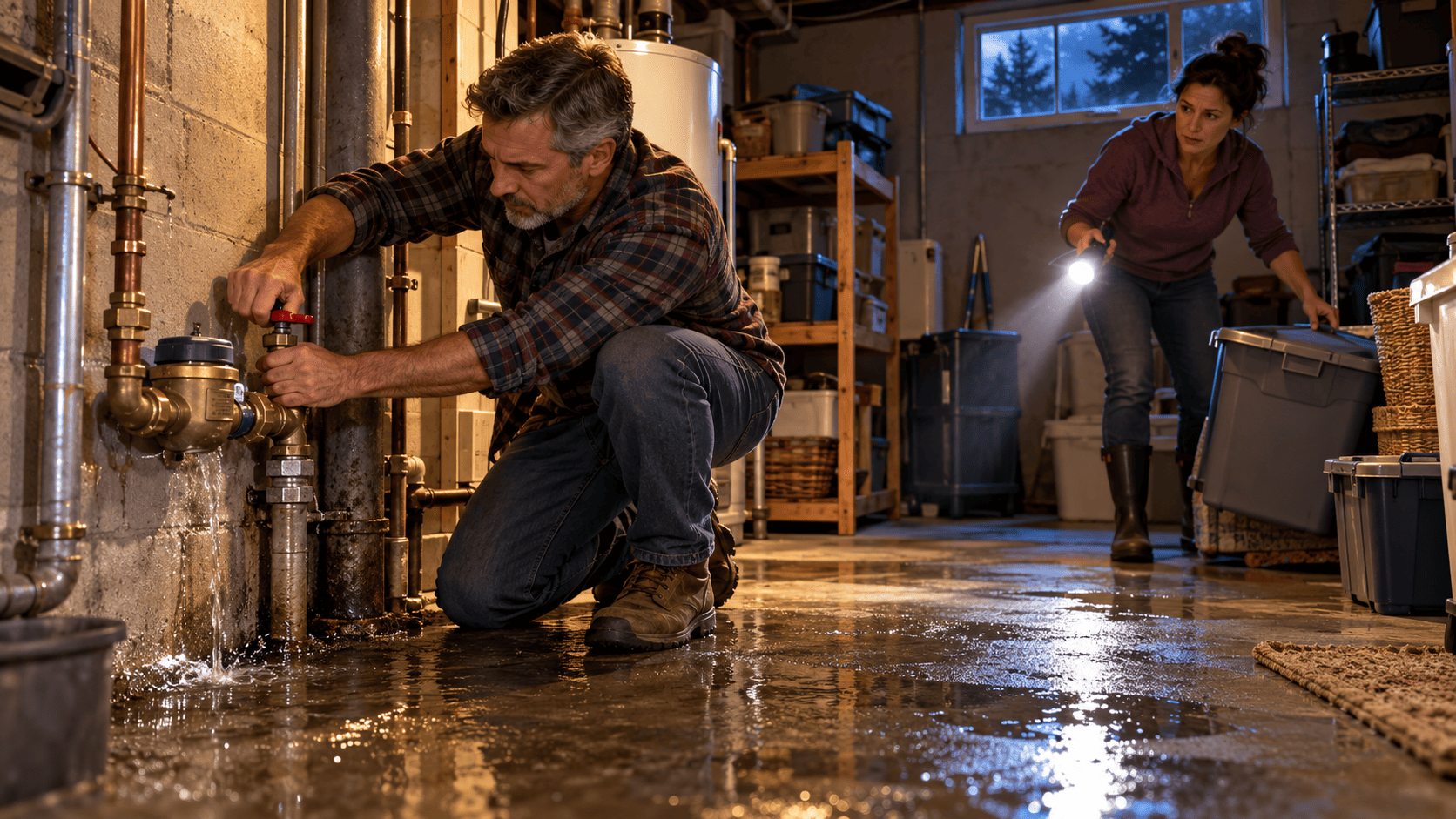
A Pipe Bursts at 2 A.M. What Should You Do Before the Plumber Arrives?
It is 2:13 in the morning. You wake up because something sounds wrong—not an alarm or thunder, but water. You step into the hallway and your sock immediately becomes wet. Water is running beneath a bathroom door, dripping through a ceiling, or spraying from somewhere behind the washing machine.
For the next few minutes, the difference between knowing what to do and simply staring at the disaster can be enormous. A burst pipe does not wait for a plumber, and it does not pause while you search online for instructions.
The first objective is not to repair the pipe. It is to stop the water from making the damage worse. After that comes electrical safety, containing the water, documenting the damage and getting professional help.
The best time to learn that sequence is before you ever need it. But if water is already spreading across the floor, begin here.
Shut Off the Water First
The most important immediate action in most household pipe emergencies is to stop the water supply.
Find the home's main water shutoff valve and close it. The exact location varies by property. It may be near where the main water line enters the house, in a basement, garage or utility room, beside the water meter, or in an exterior service area.
This is why every homeowner should know the answer to one question before an emergency happens: Where is my main water shutoff?
Knowing that can be more useful at 2 a.m. than knowing the plumber's phone number. The plumber may take time to arrive. The water needs to stop now.
Do Not Waste Time Finding the Exact Leak
When water is spreading quickly, it is easy to spend valuable minutes trying to work out exactly which fitting has failed.
Is it behind the toilet? Inside the wall? Beneath the sink?
Water can travel through floors, ceilings and wall cavities. The place where you see water may not be where the failure occurred.
If there is a major uncontrolled supply-line leak and you are unsure of the source, shut off the main water supply first. Diagnosis comes afterward.
What If There Is a Local Shutoff?
Many plumbing fixtures have their own isolation valves. Toilets usually have one, sinks commonly have them, and washing machines normally have separate supply valves.
If you can clearly identify the failed fixture and safely isolate it immediately, using the local valve may allow the rest of the house to retain water service.
But if the source is uncertain or water is escaping rapidly, use the main shutoff. Do not let perfect diagnosis delay damage control.
Water and Electricity Can Become a Dangerous Combination
A plumbing emergency can quickly become an electrical emergency.
Water may reach outlets, extension cords, appliances, light fixtures, wiring or the electrical panel. If electrical equipment is wet, or if you are standing in water, do not touch it.
Do not walk through standing water to reach a breaker panel. Do not operate electrical switches with wet hands. If reaching the electrical panel requires crossing water, keep away and seek qualified assistance.
If water is coming through a ceiling light, fan, smoke detector or another electrical fixture, treat the situation seriously. Do not switch the fixture on or off and do not attempt to remove it while water is present.
Once the Water Is Off, Relieve the Plumbing Pressure
After closing the main water supply, water already inside the plumbing may continue to drain.
Opening appropriate faucets can help relieve pressure and allow remaining water to leave the pipes.
If the failure followed freezing weather, remember that frozen sections may still block parts of the system. If a pipe has actually ruptured, keep the main water supply off until the damaged section has been properly repaired or safely isolated.
Contain the Water Before It Spreads Further
Once the active supply has been stopped, the objective changes from stopping the leak to limiting the damage.
Use buckets, towels, mops and suitable water-extraction equipment where it is electrically safe to do so. Move vulnerable possessions away from the affected area. Lift rugs, move cardboard boxes and protect furniture.
The aim at this stage is not to restore the room perfectly. It is to stop one plumbing failure from becoming damage to flooring, cabinets, ceilings, electrical systems and other parts of the house.
Remember That Water Travels
A burst pipe upstairs can send water underneath flooring, through insulation, along framing and into the ceiling below.
The visible puddle may therefore represent only part of the affected area.
If a ceiling begins to sag, bulge or visibly deform after a leak, do not stand underneath it. Wet building materials can become heavy and unstable.
Take Photos Before Everything Changes
Once people are safe and the active water flow has been controlled, document what happened.
Photograph or record video of the visible source of the leak, standing water, wet walls, ceilings, damaged flooring, furniture and affected belongings.
The scene can change quickly once cleanup begins. Water gets extracted, drywall may be removed, furniture is moved and the damaged plumbing may be cut out.
Documentation can later help when discussing the loss with an insurer, plumber or restoration contractor.
Do not delay urgent damage control just to take photographs. Stop the active problem first, then document the situation as thoroughly as practical.
Call the Plumber With Useful Information
When contacting a plumber, provide more information than simply saying that water is everywhere.
Explain where the leak appears to be, whether the main supply is off, whether water is still flowing, what fixture or pipe appears involved, whether freezing weather preceded the failure and whether ceilings, walls or electrical equipment have become wet.
If the failed component is safely visible, a photograph may also help the plumber understand what equipment or materials could be required.
What Actually Makes a Pipe Burst?
The phrase "burst pipe" describes what happened, but not necessarily why it happened.
Pipes and fittings can fail because of freezing, corrosion, ageing materials, installation problems, abnormal water pressure or mechanical failure.
Understanding the cause matters because simply repairing the broken section may not prevent the same thing from happening elsewhere.
Freezing Is One of the Best-Known Causes
Water expands when it freezes. Plumbing located in unheated or poorly protected areas can therefore become vulnerable during severe cold.
Particularly exposed locations can include garages, crawlspaces, attics, exterior walls, unheated basements and outdoor supply lines.
A frozen pipe may also fail without immediately producing a visible leak. Ice can temporarily block the damaged area. When temperatures rise and the ice begins to melt, water starts flowing again and the rupture suddenly becomes obvious.
That is why some of the worst frozen-pipe leaks become visible after the coldest weather has already passed.
A Frozen Pipe Is Not Necessarily a Burst Pipe
If you turn on a faucet during freezing weather and only a small trickle appears, the pipe may be frozen without yet being ruptured.
Safe thawing methods use gradual heat. Open flames should never be used.
Do not use a blowtorch, propane flame or improvised fire to thaw household plumbing. Apart from the obvious fire risk, concentrated heat can damage pipes and surrounding materials.
Not Every Pipe Failure Happens in Winter
A pipe can also fail in warm weather because of corrosion, ageing fittings, poor installation, abnormal water pressure or other mechanical problems.
In many cases there are warning signs before a major failure.
Watch for unexplained water stains, damp cabinets, bubbling paint, musty odors, corrosion around fittings, dripping sounds, unusually high water bills or areas that repeatedly become damp.
A small leak found early is far easier to manage than the same problem after it has damaged an entire room.
Your Water Meter Can Help Reveal Hidden Leaks
The water meter can sometimes tell you that water is escaping even when you cannot see the leak.
Choose a period when nobody should be using water. Make sure faucets, washing machines, dishwashers and irrigation systems are off and toilets have finished refilling.
Record the water-meter reading. Wait for a period without water use and check it again.
If the meter changes when no water should be flowing, investigate further.
It is effectively a basic whole-house leak detector that many homes already possess.
Smart Leak Detectors Are Becoming More Useful
Modern leak-detection systems generally work in two ways.
Simple moisture sensors detect water when it reaches a particular location. These can be useful beside washing machines, water heaters, sinks and other vulnerable areas.
More advanced flow-monitoring devices watch how water moves through the home's plumbing. Some systems can detect unusual patterns, send a phone alert and even close the main water supply automatically.
That becomes especially valuable when nobody is home.
A pipe that leaks for two minutes is very different from a pipe that leaks for two days.
Know the Manual Shutoff Anyway
Smart technology is useful, but it should not replace basic household knowledge.
Internet connections fail. Batteries die. Electronics malfunction.
Every adult in the home should still know where the manual main water shutoff is and how to use it.
Does Homeowners Insurance Cover a Burst Pipe?
Many homeowners insurance policies provide coverage for resulting damage from sudden and accidental plumbing failures, but exact coverage depends on the policy and circumstances.
There is also an important difference between water released from a household plumbing system and external flooding.
A burst internal pipe and rising floodwater are not necessarily treated as the same type of insurance event.
Coverage may also depend on whether reasonable precautions were taken, particularly in vacant homes or during freezing weather.
When significant damage occurs, review the actual policy and contact the insurer rather than assuming everything will automatically be covered.
The Pipe and the Damage May Be Two Different Questions
Suppose an old pipe corrodes and fails.
The water damages flooring, drywall, cabinets and furniture.
Insurance treatment of the failed pipe itself can differ from treatment of the sudden water damage produced by the failure.
That distinction varies by policy and cause.
This is another reason to document the incident carefully and obtain clear information before beginning non-emergency reconstruction.
Do Not Wait for an Insurance Adjuster While Water Keeps Spreading
If you intend to make an insurance claim, you should still take reasonable steps to stop additional damage.
Turn off the water, protect belongings, remove standing water where safe, arrange necessary emergency repairs and preserve documentation and receipts.
Stopping further damage is usually more important than preserving the exact appearance of the room for an adjuster.
The Plumber May Be Only the First Professional You Need
A plumber repairs the failed water source.
That does not necessarily mean the house is dry.
Water may already have entered drywall, insulation, subflooring, framing, cabinets or flooring.
Depending on the size and duration of the leak, additional work can involve water extraction, structural drying, electrical inspection, flooring repair, drywall replacement or moisture assessment.
The pipe may be repaired in an hour. Moisture hidden inside the building can remain much longer.
Stopping the leak and drying the structure are two different jobs.
What About Mold?
Mold requires moisture, which is why rapid and thorough drying matters after significant water intrusion.
A small leak that is discovered quickly and properly dried is very different from moisture that remains hidden inside a wall for several weeks.
The important questions are how much material became wet, how deeply water penetrated and how long the material remained damp.
The Emergency Repair and Permanent Repair May Be Different
During the emergency, the immediate objective may simply be to isolate the damaged section and restore safe water service.
Afterward, ask why the failure happened.
Was it an isolated fitting?
Do nearby pipes show similar corrosion?
Is the household water pressure too high?
Could freezing occur again?
Are several sections of the same ageing material beginning to deteriorate?
Would insulation, rerouting or broader replacement prevent another failure?
A good repair should explain not only what broke, but also why it broke.
High Water Pressure Can Quietly Stress Plumbing
More water pressure is not always better.
Household plumbing and fixtures are designed to work within appropriate pressure ranges. Excessive or unstable pressure can increase stress on valves, appliance hoses, fittings and supply lines.
If a home repeatedly experiences leaks or failed plumbing components, water pressure may be worth checking rather than continually replacing whichever fitting fails next.
Do Not Forget Washing-Machine Hoses
Some serious household leaks do not begin inside walls. They begin behind appliances.
A washing machine may have pressurized water hoses connected continuously for years. Most homeowners rarely inspect them.
The same principle applies to dishwashers, refrigerators, toilets, sinks and water heaters.
Look occasionally for bulging hoses, corrosion, moisture, damaged fittings or staining.
The best emergency is the one discovered while it is still a suspicious damp patch.
Winter Homes Need a Different Strategy
Homes in freezing climates need seasonal plumbing preparation.
Vulnerable pipes may need insulation. Garage doors should remain closed when water lines run through garage areas. Warm indoor air may need to circulate around plumbing installed inside cabinets against exterior walls.
When a house will be left unattended during cold weather, adequate heating is also important.
A comfortable living room does not guarantee that a pipe inside an uninsulated exterior wall is warm enough.
Insulation Protects More Than the Energy Bill
Most homeowners associate insulation with heating and cooling costs.
It can also help reduce the risk of frozen plumbing.
Attics, garages, crawlspaces, unheated basements and exterior walls often contain water lines exposed to temperatures significantly colder than the main living space.
Improving insulation or protecting vulnerable pipe runs can therefore provide benefits beyond energy efficiency.
Make a Five-Minute Household Emergency Plan
You do not need an elaborate emergency manual. Everyone in the household simply needs to know a few important things.
Know where the main water shutoff is and physically show other adults how to reach it.
Make sure the shutoff actually operates. Discovering that the valve is seized while water is flooding the house is terrible timing.
Know where the electrical panel is, but also know never to cross standing water to reach it.
Keep emergency plumbing contact information somewhere accessible.
Consider simple leak sensors around particularly vulnerable equipment such as washing machines and water heaters.
And know where your home-insurance information is stored.
Your 2 A.M. Priority Order
Protect people first. Do not enter standing water where electricity may be present.
Shut off the water. Use the affected fixture's valve when the source is obvious and easily isolated, or the main supply when it is not.
Treat electricity cautiously. Do not cross water or touch wet electrical equipment.
Contain the remaining water where it is safe to do so.
Photograph the source and affected areas once the immediate danger has been controlled.
Call the plumber and explain whether the water supply has already been isolated.
Contact the insurer when the loss is significant and preserve relevant documentation.
Make sure affected building materials are properly dried. Stopping the leak does not automatically dry the house.
The Most Important Plumbing Tool May Be Knowledge
There are excellent plumbing toolkits filled with pipe wrenches, cutters, fittings and specialized equipment.
But during the first few minutes of a burst-pipe emergency, the most valuable tool may simply be knowing where one valve is located.
The main shutoff.
Turn it. Stop the flow. Stay clear of electrical danger. Then solve the plumbing problem.
When a pipe bursts at 2 a.m., your job is not to become a plumber before sunrise.
Your job is to keep one failed piece of pipe from turning into a failed room.