Your Water Heater Is Making That Noise for
a Reason. Repair It—or Replace It?
Your water heater works quietly for
years—until one evening it starts popping, rumbling or knocking as though
something inside the tank has gone wrong. Sometimes the cause is ordinary
mineral sediment or a replaceable component, but an ageing heater that is
leaking, corroding or repeatedly failing may be warning you that replacement is
approaching.
Start With the Sound
A noisy water heater is not automatically
a dying water heater. Different sounds can point toward very different
problems, including mineral buildup, thermal expansion, water hammer,
heating-element scale, condensation or restrictions in water flow.
That means “my water heater is noisy” is
not yet a diagnosis. The type of noise matters.
Popping and Rumbling: Think Sediment First
Popping, crackling and rumbling are among
the classic water-heater noises. Mineral sediment can accumulate at the bottom
of a storage tank over time, particularly in areas with hard water.
Water can become trapped around or
underneath those deposits while the burner or electric element heats the tank.
That trapped water can become extremely hot and create the strange popping or
rumbling sounds homeowners hear.
So the noise may not mean the tank is
about to fail. It may simply mean years of minerals have collected where efficient
heat transfer is supposed to happen.
Where Does All That Sediment Come From?
Water contains dissolved minerals, and the
amount varies enormously depending on local water quality. As water is
repeatedly heated, some of those minerals can settle inside the tank.
Over months and years, the layer can
become increasingly significant. Hard-water areas can experience this faster.
Sediment accumulation can reduce heating
efficiency, increase recovery time, raise energy use, create popping and
rumbling and contribute to additional wear.
Imagine placing a layer of material
between your heat source and the water you are trying to heat. The heater may
still work, but it has to work harder.
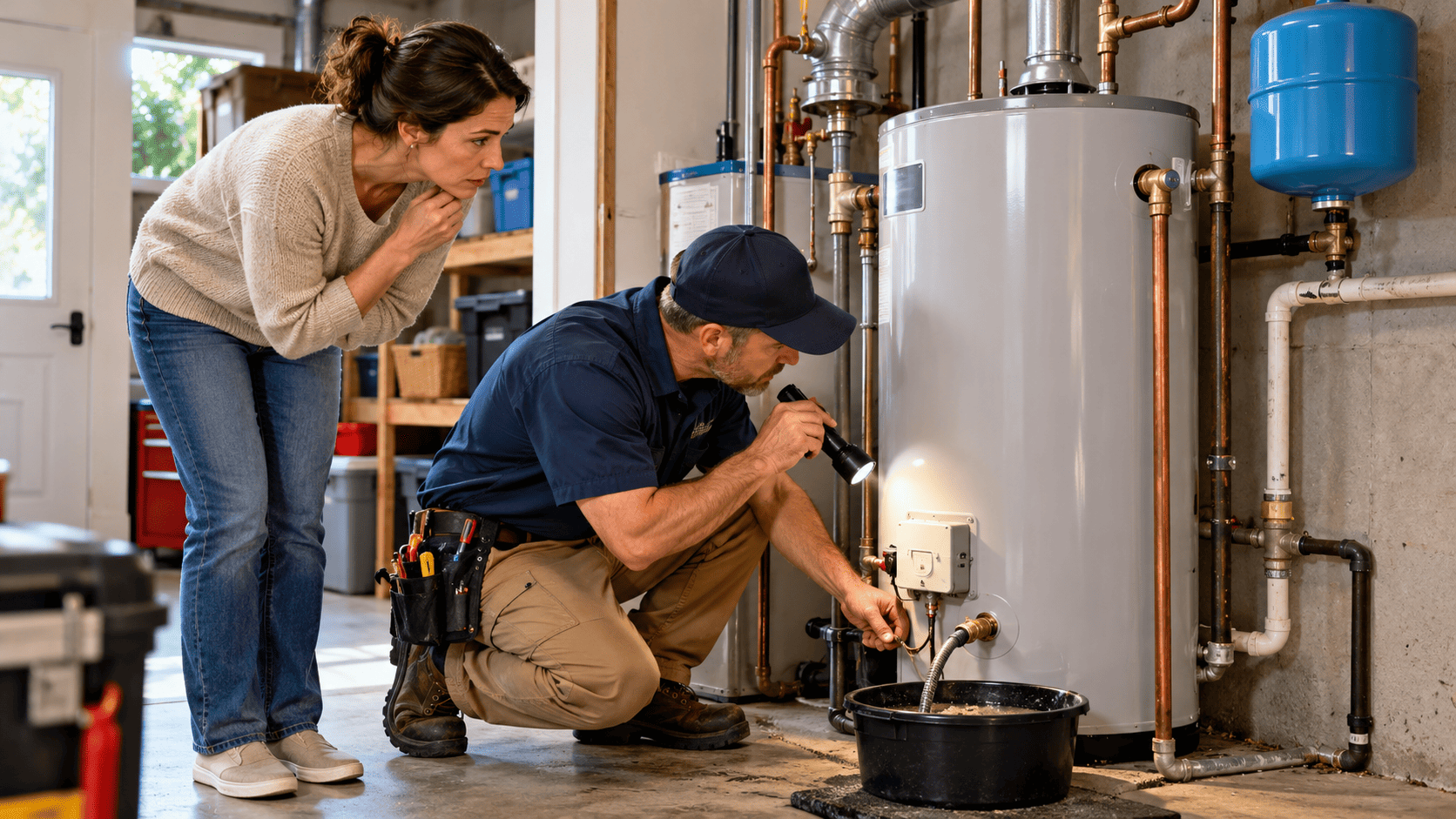
This Is Why Water-Heater Flushing Exists
Tank-type water heaters are commonly
drained and flushed periodically to remove accumulated sediment.
For many households, annual flushing is a
reasonable maintenance interval, although hard-water conditions may justify
more frequent attention.
That does not mean every homeowner should immediately
attach a hose to an old neglected water heater.
A tank that has gone many years without
maintenance may have a deteriorated drain valve, heavy hardened deposits,
corrosion or other complications.
Professional inspection may be sensible,
particularly when the system is old or the homeowner is unfamiliar with safe
shutdown, draining and restart procedures.
Hot water can burn. Electric heaters
involve high-voltage circuits. Gas models involve combustion. Maintenance
should respect all three realities.
Can Flushing Stop the Noise?
Sometimes.
If loose mineral buildup is causing the
noise, removing sediment can reduce rumbling or popping. But flushing cannot
reverse every type of deterioration.
Persistent noise after maintenance may
point toward heavy hardened scale, a deteriorating heating element, tank damage
or another underlying issue.
This creates an important distinction:
sediment that can be removed is mainly a maintenance problem. Damage that years
of sediment have already contributed to may become a repair or replacement
problem.
Crackling or Hissing in an Electric Heater
Electric tank water heaters usually use
heating elements positioned directly in the water.
Mineral scale can accumulate around those
elements. As the element heats, trapped water around the scale can create
crackling, popping or hissing sounds.
A heavily scaled element may also heat
less effectively. Sometimes the element itself eventually fails.
That can create another common symptom:
you still get hot water, but much less than before.
Many electric storage heaters use two
heating elements. If one fails, the heater may still produce some hot water
while recovering much more slowly.
That is very different from a leaking
tank. Heating elements are replaceable components. The tank itself is another
matter.
Banging May Be the Plumbing, Not the Heater
Suppose the loud noise occurs when water
flow suddenly stops and the pipes jump.
That can be water hammer.
Water moving through plumbing has
momentum. When a valve closes rapidly, that moving water abruptly stops and can
create a pressure shock.
The water heater may simply be where the
sound is easiest to hear. The underlying issue may involve the plumbing system.
This is why diagnosing a problem from one
word such as “bang” can be misleading.
Ticking Can Be Expansion
Metal expands when heated. Pipes, fittings
and components can move slightly as temperatures change, creating ticking or
clicking noises.
Sometimes this is harmless. Sometimes it
points to a fitting, heat trap or pipe rubbing against nearby material.
A new or worsening sound still deserves
attention. Machines develop patterns, and when the pattern changes, something
changed.
Sizzling Near a Gas Water Heater Deserves
More Attention
Some sounds are less casual.
Condensation can sometimes drip onto a
burner and create a temporary sizzling sound. But hissing or sizzling around a
gas appliance can also accompany water leakage or combustion-related issues.
This is where homeowners should avoid
turning the problem into a DIY experiment.
Fuel-burning water heaters involve gas,
combustion, ventilation and carbon-monoxide risk.
If a gas heater is behaving unusually,
particularly alongside unusual flames, soot, venting problems or a
carbon-monoxide alarm, professional service is appropriate.
Noise Is Annoying. Water on the Floor Is
More Important.
A noisy tank gets attention. A wet tank
should get more.
First determine where the water is
actually coming from.
A puddle near a heater can come from a
loose plumbing connection, a drain valve, a pressure-relief valve,
condensation, nearby plumbing or the tank itself.
Those situations do not have the same
repair implications.
A fitting may be repairable. A valve can often
be replaced. A leaking tank body is a much larger problem.
Why a Leaking Tank Is Different
A storage water heater is essentially a
large pressure vessel holding many gallons of heated water.
The internal steel tank is protected from
corrosion by several design features. One of the most important is usually the
sacrificial anode rod.
The anode is intentionally made from a
metal that corrodes more readily than the steel tank.
In simple terms, the rod sacrifices itself
so the tank lasts longer.
Eventually, however, that protection can
become depleted.
Once the tank itself corrodes through and
begins leaking, replacing a thermostat or heating element will not restore the
steel wall.
This is why technicians distinguish
between replaceable component failure and tank failure.
The Anode Rod Is the Part Most Homeowners
Never Hear About
Homeowners regularly maintain air filters,
smoke alarms, cars, gutters and garden equipment, yet many never realize their
water heater contains a component designed to slowly destroy itself in order to
protect the tank.
That component is the anode rod.
Periodic inspection can help determine
whether substantial material remains. Replacing a depleted anode at the
appropriate time may extend tank life in some systems.
But access is not always easy. Clearance
can be limited, threads may be extremely tight and the heater may be installed
in an awkward location.
Although the concept is simple, the work
is not always convenient.
Do Not Block the Pressure-Relief Valve
Another extremely important component is
the temperature-and-pressure relief valve, usually called the T&P valve.
Its purpose is safety.
If pressure or temperature inside the tank
becomes excessive, the valve provides a controlled route for discharge.
If the valve is releasing water, the
correct response is to determine why—not to plug the pipe, cap the outlet or
disable the valve because the dripping is annoying.
A safety device is telling you something.
Listen to it.
What About Rust-Colored Hot Water?
Discolored hot water can have several
causes.
Corrosion inside the tank is one
possibility. Anode-rod deterioration can contribute. Household piping may also
be involved.
One useful clue is whether discoloration
appears only from hot taps or from both hot and cold water.
If both are affected, the water supply or
household plumbing may be more likely. If only the hot water is discolored,
attention naturally shifts toward the water-heating system.
The sensible order remains the same:
symptom first, diagnosis second, replacement third.
Running Out of Hot Water Faster Is Another
Clue
Perhaps nothing is leaking and nothing
sounds dramatic, but showers that once stayed comfortably hot now become
lukewarm halfway through.
Potential causes include sediment reducing
effective tank capacity, a failed electric heating element, a thermostat problem,
increased household demand or a heater that was undersized from the beginning.
Do not replace the heater until you know
which problem you actually have.
Repair Makes Sense When the Tank Is Healthy
A relatively young water heater with a
sound tank can often justify repair when the failed component is replaceable.
Examples can include heating elements,
thermostats, ignition components, certain valves or other serviceable controls.
Throwing away the entire appliance because
one replaceable component failed is not automatically economical.
It is similar to replacing an entire car
because the alternator failed.
Sometimes the correct answer really is to
fix the part.
Replacement Starts Making More Sense When
Problems Stack Up
Age alone should not make the decision,
but age plus deterioration changes the calculation.
Consider an older tank with persistent
sediment noise, visible corrosion, repeated repairs, poor hot-water capacity,
rising operating cost and leakage.
At some point, continuing to repair
individual symptoms begins to resemble maintaining a car whose engine,
transmission and electrical system are all deteriorating at once.
Once a conventional storage heater moves
beyond roughly the ten-year range, it becomes sensible to at least begin
thinking about what you would replace it with.
That does not mean the heater has expired.
It means emergency failure is becoming a more important possibility.
Traditional Tank Heaters Often Live Around
a Decade or More
Many conventional storage water heaters
operate somewhere in the range of roughly 10 to 15 years, although actual life
varies considerably.
Water chemistry, maintenance, installation
quality, operating temperature, tank design and how heavily the system is used
all matter.
Some heaters fail earlier. Some last
considerably longer.
Condition matters more than birthday alone.
A twelve-year-old heater in excellent
condition can be a better machine than an eight-year-old unit that has been
neglected in extremely hard water.
Do Not Treat the “50% Rule” as Engineering
Law
You may hear that if repair costs more
than half the price of replacement, you should replace the heater.
It can be a useful rough guide, but
context matters.
A five-year-old premium system needing one
unusual repair is different from a fourteen-year-old heater that has already
failed repeatedly.
Ask how old the heater is, what exactly
failed, what else is deteriorating, how much replacement costs and how much
useful life is realistically expected after the repair.
Those questions are better than blindly
following one percentage.
Emergency Replacement Is Usually the Worst
Time to Shop
Imagine two situations.
In the first, your heater is eleven years
old but still functioning. You have time to research tank versus tankless, gas
versus electric, heat-pump water heaters, installation requirements, warranties
and operating costs. You obtain several quotes and compare your options.
In the second, the tank fails overnight.
There is water across the utility-room floor, nobody can shower and one
contractor can install a replacement today.
Which homeowner has more control over the
decision?
The first one.
This is why planning replacement before
failure can have value even if the existing heater continues working for
another two years.
If Replacement Is Coming, Do Not
Automatically Buy the Same Technology Again
For decades, replacement often meant an
old gas tank was replaced with a new gas tank, or an old electric tank was
replaced with another electric tank.
Today there are more choices.
You may encounter conventional storage
tanks, tankless heaters, heat-pump water heaters, higher-efficiency gas systems
and solar-assisted systems in some regions.
The correct choice depends on energy
source, household size, available space, hot-water demand, climate, utility
pricing and upfront budget.
The day your old heater floods the floor
is a terrible time to research all of this for the first time.
Heat-Pump Water Heaters Deserve Serious
Attention
A heat-pump water heater does something
clever.
Instead of creating all its heat directly
through electric resistance, it moves heat from the surrounding air into the
water.
Think of it as a refrigerator working in
reverse.
Instead of moving heat out of a cold box
and dumping it into the room, the system takes heat from the surrounding air
and moves it into the tank.
That makes it dramatically more efficient
than conventional electric-resistance heating.
For households currently using standard
electric tank heaters, the reduction in electricity consumption can be
substantial.
But Heat-Pump Water Heaters Are Not
Drop-In Magic Everywhere
They need the right environment.
Because they draw heat from surrounding
air, they require appropriate air volume, temperature, drainage, electrical
service and installation clearance.
They also cool and dehumidify the space
around them while operating.
In a warm garage, that may be an
advantage. Inside a small conditioned closet, it can create a more complicated
design question.
High efficiency is useful only when the
equipment is installed in a place where it can operate properly.
Water Heating Is a Bigger Energy Expense
Than Many People Realize
Water heating is one of the major energy
uses in a typical home.
Every shower, dishwasher cycle, warm-water
laundry load and hand wash requires energy to heat water.
That means the replacement decision
affects more than the day you buy the appliance. It affects utility bills for
perhaps another decade or longer.
So the right question is not only, “How
much does this heater cost today?”
It is also, “How much will this heater
cost to own?”
Tankless Is Another Popular Alternative
Tankless systems produce hot water on
demand rather than maintaining a large heated reservoir.
The attraction is obvious: no giant tank,
potential space savings and hot water produced only when needed.
But tankless does not automatically mean
cheaper in every house, nor does it mean unlimited hot water under every
condition.
Installation can require larger gas lines,
different venting, electrical upgrades or other changes.
Hard water can contribute to scale
buildup, and homes with very high simultaneous hot-water demand need careful
sizing.
Tankless systems deserve their own full
article because the decision is more complicated than the marketing slogan
suggests.
Replacement Cost Is More Than the Appliance
A water-heater advertisement may show an
attractive equipment price, but installed cost can include much more.
Potential work may involve removing the
old unit, installing new valves, electrical circuits, venting, gas piping,
expansion tanks, drainage, permits, code updates or other changes required by
the new technology.
This is why written quotes should explain
exactly what is included.
Two contractors can appear to quote the
same appliance while actually proposing very different projects.
Ask for Three Numbers
When deciding between repair and
replacement, ask for three separate figures.
1. Repair
cost — What will it cost to restore the existing heater to proper operation?
2. Like-for-like
replacement — What will it cost to replace the heater with a broadly similar
modern system?
3. Efficiency
upgrade — What would a higher-efficiency alternative cost, and what might
realistically be saved over time?
Now you are comparing choices rather than
simply reacting to a breakdown.
A Water Heater Can Cause Expensive Damage
Without Being an Expensive Appliance
This is one reason proactive replacement
sometimes makes sense.
The heater itself may cost far less than
flooring, drywall, stored possessions, cabinetry, ceilings below or structural
repairs damaged when a tank leaks.
Location changes the risk dramatically.
A failed heater in a garage with a floor
drain is one problem. A failed heater in an upstairs utility closet is another.
The relevant question is therefore not
only, “How likely is the heater to fail?”
It is also, “What happens to my house if
it does?”
Leak Detection Can Buy Time
For heaters installed where leakage could
cause serious damage, homeowners can consider drain pans, water alarms,
automatic leak-detection systems and automatic water shutoff devices where
appropriate.
These devices cannot prevent every
failure, but they may reduce how long water flows unnoticed.
That can be particularly useful when
nobody is home, the heater is upstairs or expensive finishes surround it.
Never Ignore Water Around the Base
A tiny puddle is easy to rationalize.
Maybe somebody spilled something. Maybe it
is condensation. Maybe it will disappear.
Check.
The difference between a dripping
connection and a tank beginning to fail is important enough that guessing is
not worthwhile.
If the source is unclear, have it
inspected.
Gas Water Heaters Need Combustion Safety
Too
With fuel-burning equipment, maintenance
is not only about producing hot water. It is also about safely removing
combustion gases from the home.
Gas systems depend on proper burner
operation, air supply, venting and exhaust.
Unusual soot, combustion odors, flame
behavior, repeated shutdowns or carbon-monoxide alarms require professional
attention.
Working carbon-monoxide detectors are
essential in homes with fuel-burning appliances.
What Should You Do When the Heater Starts
Talking?
Do not panic because it pops, but do not
ignore it either.
Listen to the sound. Look for leakage.
Notice whether hot-water capacity has changed. Check whether recovery is
becoming slower. Know the heater's age and look at its maintenance history.
Then determine whether you are dealing
with maintenance, a replaceable component or evidence of broader tank
deterioration.
That distinction can separate a relatively
small repair from complete replacement.
The Smartest Time to Replace a Water
Heater Is Often Before It Forces You To
Nobody wants to replace an appliance that
still works.
That feels wasteful, and replacing a
healthy heater far too early can indeed waste money.
But waiting for every heater to fail
catastrophically creates the opposite problem.
You lose time, choice, comparison shopping
and the ability to calmly evaluate new technologies.
Planning is therefore different from
replacing.
If your heater is ageing, learn what you
would buy next. Know who you would call. Understand the broad installation
requirements.
Then keep using the existing system while
it remains safe and economical.
The Noise Is Information
Perhaps this is the most useful way to
think about it.
A rumble is information. A pop is
information. A bang is information. A hissing electric element is information.
A puddle is very important information.
Your water heater does not have a
dashboard saying, “Mineral sediment is reducing heat-transfer efficiency.”
So sometimes it communicates physically
through sound, recovery time, water quality, leakage or eventually failure.
The goal is not to become frightened by
every tick.
It is to recognize when a change deserves
attention.
Because the best outcome after hearing a
strange water-heater noise is not discovering that you need a completely new
system.
It is discovering the problem while you
still have time to decide what to do about it.
SEO Keywords
water heater repair, water heater making
noise, water heater replacement, water heater popping noise, water heater
rumbling, water heater leaking, hot water heater repair, water heater sediment,
water heater flush, electric water heater repair, gas water heater repair,
water heater lifespan, heat pump water heater, tankless water heater, water
heater installation
Suggested Internal Links
A Heat Pump Is Basically an Air
Conditioner That Runs Backwards
Your Garage Door Is the Biggest Moving
Machine in Your House
Your AC Is Running but the House Is Still
Hot
Your Roof Can Look Fine—and Still Be
Getting Weaker
Why Home Insurance Costs Are Rising So Fast
Home & Garden
Social Hook
If your water heater suddenly starts
popping or rumbling, it may be heating water around years of mineral sediment
sitting at the bottom of the tank.
Sometimes maintenance solves the problem.
Sometimes years of noise, corrosion, leakage and repeated repairs are telling
you something else: the tank is reaching the point where replacement makes more
sense.
The useful time to figure out which one
you have is before the utility-room floor is wet.
Reader Question
How old is your water heater—and if it
failed tonight, do you already know what you would replace it with?
Research Notes
Manufacturer maintenance guidance commonly
identifies mineral sediment as a major cause of popping and rumbling in storage
water heaters. Scale on electric elements can create crackling or hissing,
while water hammer, thermal expansion and condensation can create different
sounds.
Many manufacturers recommend periodic
flushing of tank water heaters, often annually in typical conditions, with more
frequent maintenance potentially useful where water is particularly hard.
Traditional storage water heaters commonly
enter a replacement-planning stage after roughly a decade of service, although
actual life depends heavily on water chemistry, maintenance, installation and
operating conditions.
Heat-pump water heaters can use
substantially less electricity than conventional electric-resistance tanks
because they move heat from surrounding air rather than generating all heat
directly through resistance elements.
Fuel-burning water heaters should be
professionally serviced when combustion, venting or carbon-monoxide concerns
arise.
Safety note: Water heaters combine hot
water, pressure and either high-voltage electricity or combustible fuel.
Internal electrical, gas, combustion, pressure-relief and major plumbing work
should be performed by appropriately qualified professionals.
Your Water Heater Is Making That Noise for
a Reason. Repair It—or Replace It?
Your water heater works quietly for
years—until one evening it starts popping, rumbling or knocking as though
something inside the tank has gone wrong. Sometimes the cause is ordinary
mineral sediment or a replaceable component, but an ageing heater that is
leaking, corroding or repeatedly failing may be warning you that replacement is
approaching.
Start With the Sound
A noisy water heater is not automatically
a dying water heater. Different sounds can point toward very different
problems, including mineral buildup, thermal expansion, water hammer,
heating-element scale, condensation or restrictions in water flow.
That means “my water heater is noisy” is
not yet a diagnosis. The type of noise matters.
Popping and Rumbling: Think Sediment First
Popping, crackling and rumbling are among
the classic water-heater noises. Mineral sediment can accumulate at the bottom
of a storage tank over time, particularly in areas with hard water.
Water can become trapped around or
underneath those deposits while the burner or electric element heats the tank.
That trapped water can become extremely hot and create the strange popping or
rumbling sounds homeowners hear.
So the noise may not mean the tank is
about to fail. It may simply mean years of minerals have collected where efficient
heat transfer is supposed to happen.
Where Does All That Sediment Come From?
Water contains dissolved minerals, and the
amount varies enormously depending on local water quality. As water is
repeatedly heated, some of those minerals can settle inside the tank.
Over months and years, the layer can
become increasingly significant. Hard-water areas can experience this faster.
Sediment accumulation can reduce heating
efficiency, increase recovery time, raise energy use, create popping and
rumbling and contribute to additional wear.
Imagine placing a layer of material
between your heat source and the water you are trying to heat. The heater may
still work, but it has to work harder.
This Is Why Water-Heater Flushing Exists
Tank-type water heaters are commonly
drained and flushed periodically to remove accumulated sediment.
For many households, annual flushing is a
reasonable maintenance interval, although hard-water conditions may justify
more frequent attention.
That does not mean every homeowner should immediately
attach a hose to an old neglected water heater.
A tank that has gone many years without
maintenance may have a deteriorated drain valve, heavy hardened deposits,
corrosion or other complications.
Professional inspection may be sensible,
particularly when the system is old or the homeowner is unfamiliar with safe
shutdown, draining and restart procedures.
Hot water can burn. Electric heaters
involve high-voltage circuits. Gas models involve combustion. Maintenance
should respect all three realities.
Can Flushing Stop the Noise?
Sometimes.
If loose mineral buildup is causing the
noise, removing sediment can reduce rumbling or popping. But flushing cannot
reverse every type of deterioration.
Persistent noise after maintenance may
point toward heavy hardened scale, a deteriorating heating element, tank damage
or another underlying issue.
This creates an important distinction:
sediment that can be removed is mainly a maintenance problem. Damage that years
of sediment have already contributed to may become a repair or replacement
problem.
Crackling or Hissing in an Electric Heater
Electric tank water heaters usually use
heating elements positioned directly in the water.
Mineral scale can accumulate around those
elements. As the element heats, trapped water around the scale can create
crackling, popping or hissing sounds.
A heavily scaled element may also heat
less effectively. Sometimes the element itself eventually fails.
That can create another common symptom:
you still get hot water, but much less than before.
Many electric storage heaters use two
heating elements. If one fails, the heater may still produce some hot water
while recovering much more slowly.
That is very different from a leaking
tank. Heating elements are replaceable components. The tank itself is another
matter.
Banging May Be the Plumbing, Not the Heater
Suppose the loud noise occurs when water
flow suddenly stops and the pipes jump.
That can be water hammer.
Water moving through plumbing has
momentum. When a valve closes rapidly, that moving water abruptly stops and can
create a pressure shock.
The water heater may simply be where the
sound is easiest to hear. The underlying issue may involve the plumbing system.
This is why diagnosing a problem from one
word such as “bang” can be misleading.
Ticking Can Be Expansion
Metal expands when heated. Pipes, fittings
and components can move slightly as temperatures change, creating ticking or
clicking noises.
Sometimes this is harmless. Sometimes it
points to a fitting, heat trap or pipe rubbing against nearby material.
A new or worsening sound still deserves
attention. Machines develop patterns, and when the pattern changes, something
changed.
Sizzling Near a Gas Water Heater Deserves
More Attention
Some sounds are less casual.
Condensation can sometimes drip onto a
burner and create a temporary sizzling sound. But hissing or sizzling around a
gas appliance can also accompany water leakage or combustion-related issues.
This is where homeowners should avoid
turning the problem into a DIY experiment.
Fuel-burning water heaters involve gas,
combustion, ventilation and carbon-monoxide risk.
If a gas heater is behaving unusually,
particularly alongside unusual flames, soot, venting problems or a
carbon-monoxide alarm, professional service is appropriate.
Noise Is Annoying. Water on the Floor Is
More Important.
A noisy tank gets attention. A wet tank
should get more.
First determine where the water is
actually coming from.
A puddle near a heater can come from a
loose plumbing connection, a drain valve, a pressure-relief valve,
condensation, nearby plumbing or the tank itself.
Those situations do not have the same
repair implications.
A fitting may be repairable. A valve can often
be replaced. A leaking tank body is a much larger problem.
Why a Leaking Tank Is Different
A storage water heater is essentially a
large pressure vessel holding many gallons of heated water.
The internal steel tank is protected from
corrosion by several design features. One of the most important is usually the
sacrificial anode rod.
The anode is intentionally made from a
metal that corrodes more readily than the steel tank.
In simple terms, the rod sacrifices itself
so the tank lasts longer.
Eventually, however, that protection can
become depleted.
Once the tank itself corrodes through and
begins leaking, replacing a thermostat or heating element will not restore the
steel wall.
This is why technicians distinguish
between replaceable component failure and tank failure.
The Anode Rod Is the Part Most Homeowners
Never Hear About
Homeowners regularly maintain air filters,
smoke alarms, cars, gutters and garden equipment, yet many never realize their
water heater contains a component designed to slowly destroy itself in order to
protect the tank.
That component is the anode rod.
Periodic inspection can help determine
whether substantial material remains. Replacing a depleted anode at the
appropriate time may extend tank life in some systems.
But access is not always easy. Clearance
can be limited, threads may be extremely tight and the heater may be installed
in an awkward location.
Although the concept is simple, the work
is not always convenient.
Do Not Block the Pressure-Relief Valve
Another extremely important component is
the temperature-and-pressure relief valve, usually called the T&P valve.
Its purpose is safety.
If pressure or temperature inside the tank
becomes excessive, the valve provides a controlled route for discharge.
If the valve is releasing water, the
correct response is to determine why—not to plug the pipe, cap the outlet or
disable the valve because the dripping is annoying.
A safety device is telling you something.
Listen to it.
What About Rust-Colored Hot Water?
Discolored hot water can have several
causes.
Corrosion inside the tank is one
possibility. Anode-rod deterioration can contribute. Household piping may also
be involved.
One useful clue is whether discoloration
appears only from hot taps or from both hot and cold water.
If both are affected, the water supply or
household plumbing may be more likely. If only the hot water is discolored,
attention naturally shifts toward the water-heating system.
The sensible order remains the same:
symptom first, diagnosis second, replacement third.
Running Out of Hot Water Faster Is Another
Clue
Perhaps nothing is leaking and nothing
sounds dramatic, but showers that once stayed comfortably hot now become
lukewarm halfway through.
Potential causes include sediment reducing
effective tank capacity, a failed electric heating element, a thermostat problem,
increased household demand or a heater that was undersized from the beginning.
Do not replace the heater until you know
which problem you actually have.
Repair Makes Sense When the Tank Is Healthy
A relatively young water heater with a
sound tank can often justify repair when the failed component is replaceable.
Examples can include heating elements,
thermostats, ignition components, certain valves or other serviceable controls.
Throwing away the entire appliance because
one replaceable component failed is not automatically economical.
It is similar to replacing an entire car
because the alternator failed.
Sometimes the correct answer really is to
fix the part.
Replacement Starts Making More Sense When
Problems Stack Up
Age alone should not make the decision,
but age plus deterioration changes the calculation.
Consider an older tank with persistent
sediment noise, visible corrosion, repeated repairs, poor hot-water capacity,
rising operating cost and leakage.
At some point, continuing to repair
individual symptoms begins to resemble maintaining a car whose engine,
transmission and electrical system are all deteriorating at once.
Once a conventional storage heater moves
beyond roughly the ten-year range, it becomes sensible to at least begin
thinking about what you would replace it with.
That does not mean the heater has expired.
It means emergency failure is becoming a more important possibility.
Traditional Tank Heaters Often Live Around
a Decade or More
Many conventional storage water heaters
operate somewhere in the range of roughly 10 to 15 years, although actual life
varies considerably.
Water chemistry, maintenance, installation
quality, operating temperature, tank design and how heavily the system is used
all matter.
Some heaters fail earlier. Some last
considerably longer.
Condition matters more than birthday alone.
A twelve-year-old heater in excellent
condition can be a better machine than an eight-year-old unit that has been
neglected in extremely hard water.
Do Not Treat the “50% Rule” as Engineering
Law
You may hear that if repair costs more
than half the price of replacement, you should replace the heater.
It can be a useful rough guide, but
context matters.
A five-year-old premium system needing one
unusual repair is different from a fourteen-year-old heater that has already
failed repeatedly.
Ask how old the heater is, what exactly
failed, what else is deteriorating, how much replacement costs and how much
useful life is realistically expected after the repair.
Those questions are better than blindly
following one percentage.
Emergency Replacement Is Usually the Worst
Time to Shop
Imagine two situations.
In the first, your heater is eleven years
old but still functioning. You have time to research tank versus tankless, gas
versus electric, heat-pump water heaters, installation requirements, warranties
and operating costs. You obtain several quotes and compare your options.
In the second, the tank fails overnight.
There is water across the utility-room floor, nobody can shower and one
contractor can install a replacement today.
Which homeowner has more control over the
decision?
The first one.
This is why planning replacement before
failure can have value even if the existing heater continues working for
another two years.
If Replacement Is Coming, Do Not
Automatically Buy the Same Technology Again
For decades, replacement often meant an
old gas tank was replaced with a new gas tank, or an old electric tank was
replaced with another electric tank.
Today there are more choices.
You may encounter conventional storage
tanks, tankless heaters, heat-pump water heaters, higher-efficiency gas systems
and solar-assisted systems in some regions.
The correct choice depends on energy
source, household size, available space, hot-water demand, climate, utility
pricing and upfront budget.
The day your old heater floods the floor
is a terrible time to research all of this for the first time.
Heat-Pump Water Heaters Deserve Serious
Attention
A heat-pump water heater does something
clever.
Instead of creating all its heat directly
through electric resistance, it moves heat from the surrounding air into the
water.
Think of it as a refrigerator working in
reverse.
Instead of moving heat out of a cold box
and dumping it into the room, the system takes heat from the surrounding air
and moves it into the tank.
That makes it dramatically more efficient
than conventional electric-resistance heating.
For households currently using standard
electric tank heaters, the reduction in electricity consumption can be
substantial.
But Heat-Pump Water Heaters Are Not
Drop-In Magic Everywhere
They need the right environment.
Because they draw heat from surrounding
air, they require appropriate air volume, temperature, drainage, electrical
service and installation clearance.
They also cool and dehumidify the space
around them while operating.
In a warm garage, that may be an
advantage. Inside a small conditioned closet, it can create a more complicated
design question.
High efficiency is useful only when the
equipment is installed in a place where it can operate properly.
Water Heating Is a Bigger Energy Expense
Than Many People Realize
Water heating is one of the major energy
uses in a typical home.
Every shower, dishwasher cycle, warm-water
laundry load and hand wash requires energy to heat water.
That means the replacement decision
affects more than the day you buy the appliance. It affects utility bills for
perhaps another decade or longer.
So the right question is not only, “How
much does this heater cost today?”
It is also, “How much will this heater
cost to own?”
Tankless Is Another Popular Alternative
Tankless systems produce hot water on
demand rather than maintaining a large heated reservoir.
The attraction is obvious: no giant tank,
potential space savings and hot water produced only when needed.
But tankless does not automatically mean
cheaper in every house, nor does it mean unlimited hot water under every
condition.
Installation can require larger gas lines,
different venting, electrical upgrades or other changes.
Hard water can contribute to scale
buildup, and homes with very high simultaneous hot-water demand need careful
sizing.
Tankless systems deserve their own full
article because the decision is more complicated than the marketing slogan
suggests.
Replacement Cost Is More Than the Appliance
A water-heater advertisement may show an
attractive equipment price, but installed cost can include much more.
Potential work may involve removing the
old unit, installing new valves, electrical circuits, venting, gas piping,
expansion tanks, drainage, permits, code updates or other changes required by
the new technology.
This is why written quotes should explain
exactly what is included.
Two contractors can appear to quote the
same appliance while actually proposing very different projects.
Ask for Three Numbers
When deciding between repair and
replacement, ask for three separate figures.
1. Repair
cost — What will it cost to restore the existing heater to proper operation?
2. Like-for-like
replacement — What will it cost to replace the heater with a broadly similar
modern system?
3. Efficiency
upgrade — What would a higher-efficiency alternative cost, and what might
realistically be saved over time?
Now you are comparing choices rather than
simply reacting to a breakdown.
A Water Heater Can Cause Expensive Damage
Without Being an Expensive Appliance
This is one reason proactive replacement
sometimes makes sense.
The heater itself may cost far less than
flooring, drywall, stored possessions, cabinetry, ceilings below or structural
repairs damaged when a tank leaks.
Location changes the risk dramatically.
A failed heater in a garage with a floor
drain is one problem. A failed heater in an upstairs utility closet is another.
The relevant question is therefore not
only, “How likely is the heater to fail?”
It is also, “What happens to my house if
it does?”
Leak Detection Can Buy Time
For heaters installed where leakage could
cause serious damage, homeowners can consider drain pans, water alarms,
automatic leak-detection systems and automatic water shutoff devices where
appropriate.
These devices cannot prevent every
failure, but they may reduce how long water flows unnoticed.
That can be particularly useful when
nobody is home, the heater is upstairs or expensive finishes surround it.
Never Ignore Water Around the Base
A tiny puddle is easy to rationalize.
Maybe somebody spilled something. Maybe it
is condensation. Maybe it will disappear.
Check.
The difference between a dripping
connection and a tank beginning to fail is important enough that guessing is
not worthwhile.
If the source is unclear, have it
inspected.
Gas Water Heaters Need Combustion Safety
Too
With fuel-burning equipment, maintenance
is not only about producing hot water. It is also about safely removing
combustion gases from the home.
Gas systems depend on proper burner
operation, air supply, venting and exhaust.
Unusual soot, combustion odors, flame
behavior, repeated shutdowns or carbon-monoxide alarms require professional
attention.
Working carbon-monoxide detectors are
essential in homes with fuel-burning appliances.
What Should You Do When the Heater Starts
Talking?
Do not panic because it pops, but do not
ignore it either.
Listen to the sound. Look for leakage.
Notice whether hot-water capacity has changed. Check whether recovery is
becoming slower. Know the heater's age and look at its maintenance history.
Then determine whether you are dealing
with maintenance, a replaceable component or evidence of broader tank
deterioration.
That distinction can separate a relatively
small repair from complete replacement.
The Smartest Time to Replace a Water
Heater Is Often Before It Forces You To
Nobody wants to replace an appliance that
still works.
That feels wasteful, and replacing a
healthy heater far too early can indeed waste money.
But waiting for every heater to fail
catastrophically creates the opposite problem.
You lose time, choice, comparison shopping
and the ability to calmly evaluate new technologies.
Planning is therefore different from
replacing.
If your heater is ageing, learn what you
would buy next. Know who you would call. Understand the broad installation
requirements.
Then keep using the existing system while
it remains safe and economical.
The Noise Is Information
Perhaps this is the most useful way to
think about it.
A rumble is information. A pop is
information. A bang is information. A hissing electric element is information.
A puddle is very important information.
Your water heater does not have a
dashboard saying, “Mineral sediment is reducing heat-transfer efficiency.”
So sometimes it communicates physically
through sound, recovery time, water quality, leakage or eventually failure.
The goal is not to become frightened by
every tick.
It is to recognize when a change deserves
attention.
Because the best outcome after hearing a
strange water-heater noise is not discovering that you need a completely new
system.
It is discovering the problem while you
still have time to decide what to do about it.
SEO Keywords
water heater repair, water heater making
noise, water heater replacement, water heater popping noise, water heater
rumbling, water heater leaking, hot water heater repair, water heater sediment,
water heater flush, electric water heater repair, gas water heater repair,
water heater lifespan, heat pump water heater, tankless water heater, water
heater installation
Suggested Internal Links
A Heat Pump Is Basically an Air
Conditioner That Runs Backwards
Your Garage Door Is the Biggest Moving
Machine in Your House
Your AC Is Running but the House Is Still
Hot
Your Roof Can Look Fine—and Still Be
Getting Weaker
Why Home Insurance Costs Are Rising So Fast
Home & Garden
Social Hook
If your water heater suddenly starts
popping or rumbling, it may be heating water around years of mineral sediment
sitting at the bottom of the tank.
Sometimes maintenance solves the problem.
Sometimes years of noise, corrosion, leakage and repeated repairs are telling
you something else: the tank is reaching the point where replacement makes more
sense.
The useful time to figure out which one
you have is before the utility-room floor is wet.
Reader Question
How old is your water heater—and if it
failed tonight, do you already know what you would replace it with?
Research Notes
Manufacturer maintenance guidance commonly
identifies mineral sediment as a major cause of popping and rumbling in storage
water heaters. Scale on electric elements can create crackling or hissing,
while water hammer, thermal expansion and condensation can create different
sounds.
Many manufacturers recommend periodic
flushing of tank water heaters, often annually in typical conditions, with more
frequent maintenance potentially useful where water is particularly hard.
Traditional storage water heaters commonly
enter a replacement-planning stage after roughly a decade of service, although
actual life depends heavily on water chemistry, maintenance, installation and
operating conditions.
Heat-pump water heaters can use
substantially less electricity than conventional electric-resistance tanks
because they move heat from surrounding air rather than generating all heat
directly through resistance elements.
Fuel-burning water heaters should be
professionally serviced when combustion, venting or carbon-monoxide concerns
arise.
Safety note: Water heaters combine hot
water, pressure and either high-voltage electricity or combustible fuel.
Internal electrical, gas, combustion, pressure-relief and major plumbing work
should be performed by appropriately qualified professionals.