The first cold night arrives, your furnace starts, warm air comes from the vents—and then you remember that the machine downstairs is 16 years old. Replacing a furnace that still works can feel wasteful, but waiting until it fails on the coldest night of winter can be expensive too. The smartest decision usually has less to do with age alone than with efficiency, repair history, safety, installation quality and what the rest of your house is doing with the heat.
Fifteen Years Is a Warning Light, Not an Expiration Date
There is no universal birthday when a furnace suddenly becomes financially irrational.
ENERGY STAR says homeowners should consider replacing a furnace or boiler once it is more than 15 years old, particularly when other warning signs are present.
The word “consider” matters.
A 16-year-old furnace that has been maintained, heats the home comfortably and has required few repairs is a different financial proposition from a 16-year-old system that breaks every winter and sends energy bills climbing.
Age should start the conversation.
It should not automatically end it.
The Real Question Is: What Does Another Year Cost You?
Imagine two furnaces.
The first is old but dependable. It receives regular maintenance, the house heats evenly and the owner has spent very little on repairs.
The second is the same age, but the blower has failed, the ignition system has been repaired twice, one bedroom never gets warm and another expensive component may be next.
On paper, both furnaces are 15 years old.
Financially, they are completely different machines.
The useful decision is not simply:
“How old is my furnace?”
It is:
“What will keeping this furnace probably cost compared with replacing it?”
That includes fuel, repairs, reliability and the consequences of an emergency failure.
Do Not Replace a Furnace Just to Chase a Lower Gas Bill
Efficiency matters, but efficiency savings alone do not always justify replacing working equipment early.
Furnace efficiency is commonly expressed as AFUE—Annual Fuel Utilization Efficiency.
An 80% AFUE furnace is rated to convert roughly 80% of the fuel energy it consumes into useful heat over the heating season. The remainder is lost, largely through exhaust and other system losses.
A 97% AFUE furnace wastes much less fuel at the appliance itself.
That sounds like an enormous difference.
But it does not mean your total household heating bill automatically falls by 17 percentage points.
The actual savings depend on climate, fuel price, thermostat settings, house insulation, duct leakage, equipment sizing and how much heating you use.
Efficiency is one piece of the house.
Not the whole house.
A Simple Example Shows Why the Math Matters
Suppose an older furnace has an 80% AFUE rating and a possible replacement is rated at 97%.
To deliver the same amount of heat, the higher-efficiency appliance theoretically requires substantially less fuel.
That can create meaningful savings in a cold climate with a long heating season.
But imagine the furnace replacement costs thousands of dollars and the household's annual heating-fuel bill is relatively modest.
Even a significant percentage reduction in fuel consumption may take years to recover the installation cost.
Now consider a large cold-climate home with an inefficient furnace, high fuel use and plans to remain in the property for many years.
The economics become much more attractive.
This is why percentage efficiency alone does not tell you whether replacement “pays.”
You need dollars.
Calculate the Payback Before You Buy
A simple first-pass calculation can help.
Estimate how much you currently spend each year on furnace fuel.
Estimate how much fuel a proposed replacement could reasonably save.
Then compare the expected annual savings with the additional installed cost of the higher-efficiency option.
For example, if one upgrade costs $3,000 more and realistically saves $300 per year, the simple payback is around 10 years.
That does not automatically make the upgrade good or bad.
It simply tells you how long the energy savings may take to recover the additional investment.
Also remember that simple payback ignores financing costs, future energy prices, repairs, resale timing and the value you place on comfort and reliability.
The Furnace May Not Be the Reason Your Heating Bill Is High
This is one of the most important mistakes homeowners make.
The furnace gets blamed because it is the machine burning the fuel.
But the house may be losing the heat almost as quickly as the furnace produces it.
ENERGY STAR recommends addressing major air leaks and duct problems before investing in new heating and cooling equipment because these can be the real source of high energy use and poor comfort.
A highly efficient new furnace connected to badly leaking ducts is still heating places you do not live.
An attic.
A crawlspace.
A garage.
A wall cavity.
Replacing the furnace without fixing those losses can produce a much smaller improvement than expected.
This Is Why the Air-Duct Question Matters
Your furnace and duct system operate as one heating network.
If supply ducts leak, heated air may escape before it reaches the rooms.
If return ducts leak, the system may draw cold or dirty air from attics, crawlspaces or other unwanted locations.
If ducts are poorly insulated, heat can disappear while the air travels through unconditioned spaces.
That means a homeowner considering furnace replacement should ask for more than an equipment quote.
Ask whether the duct system has been inspected too.
Sometimes the cheapest “new furnace” is the furnace you already own after the rest of the system is repaired.
An Oversized New Furnace Can Be an Expensive Mistake
Bigger does not automatically mean better.
Heating equipment should be sized according to the actual heating requirements of the home.
ENERGY STAR recommends that contractors use a Manual J load calculation to determine the heating and cooling capacity a house requires.
DOE building-science guidance warns that rule-of-thumb sizing often leads to oversized equipment, which can increase upfront cost and cause excessive on-off cycling that hurts comfort and efficiency.
So if your old furnace says 100,000 BTU on the label, do not assume the new one should automatically be 100,000 BTU too.
The original furnace may have been oversized.
The home may also have changed since it was installed.
Maybe insulation was added.
Windows were replaced.
Air leaks were sealed.
Rooms were remodeled.
The correct replacement starts with today's heating load—not yesterday's equipment label.
Installation Can Erase the Efficiency You Paid For
A premium furnace is only as good as the system around it.
ENERGY STAR says improper installation of heating and cooling equipment can reduce efficiency by as much as 30%.
That is a remarkable number.
A homeowner can spend extra money on high-efficiency equipment and then lose a substantial portion of the benefit through poor sizing, bad airflow, leaking ducts or incorrect installation.
This is why contractor quality may matter as much as the brand printed on the furnace.
The lowest equipment quote is not necessarily the lowest-cost heating system over its life.
Frequent Repairs Change the Equation Fast
One repair does not make an old furnace obsolete.
A relatively inexpensive igniter, sensor, switch or other serviceable component may justify repair—especially if the furnace has otherwise been reliable.
But repeated failures are different.
Imagine spending $500 this winter.
Then $700 next winter.
Then facing another major repair the following year.
At some point, you are no longer preserving a dependable furnace.
You are financing the decline of an unreliable one.
ENERGY STAR specifically identifies frequent repairs combined with rising energy bills as a reason to consider replacement.
Repair history therefore matters as much as chronological age.
The Cost of Failure Depends on When It Happens
A furnace rarely checks your calendar before breaking.
Emergency failure during mild autumn weather is inconvenient.
Emergency failure during a severe cold spell can become urgent.
That changes your bargaining position.
You may have less time to:
compare contractors;
research equipment;
check load calculations;
evaluate furnace versus heat-pump options;
review warranties;
or wait for the model you actually want.
The contractor who can install tomorrow suddenly has an enormous advantage.
Planning replacement before failure does not necessarily mean replacing the furnace immediately.
It means deciding what you would do if it failed.
That knowledge has value.
Comfort Problems Can Point to the Furnace—or Something Else
Some rooms are hot.
Others stay cold.
The furnace runs constantly.
Or it turns on and off over and over.
These symptoms deserve investigation, but they do not automatically prove the furnace needs replacement.
ENERGY STAR notes that uneven temperatures can result from equipment problems, duct issues or inadequate insulation.
A furnace salesperson sees a furnace.
An insulation contractor sees insulation.
A duct contractor sees ductwork.
The homeowner needs someone to evaluate the entire heating system.
That is particularly important before spending thousands on new equipment.
Short Cycling Deserves Attention
A furnace that repeatedly starts and stops after very short runs may be short cycling.
Possible causes range from simple problems to more complicated ones.
A dirty filter can restrict airflow.
Controls or sensors may be involved.
The furnace may be overheating.
Or the equipment may simply be too large for the home's heating load.
Short cycling can increase wear and reduce comfort.
But again, diagnosis should come before replacement.
Do not replace an entire furnace because somebody skipped the inexpensive possibilities.
Rising Bills Are a Clue, Not a Diagnosis
Suppose your heating bill is suddenly 25% higher.
That does not automatically mean your furnace lost 25% of its efficiency.
Weather may have been colder.
Fuel prices may have changed.
The thermostat schedule may have changed.
More people may be home.
A duct may have disconnected.
The filter may be clogged.
The house may have developed new air leaks.
This is why comparing utility bills requires context.
Whenever possible, compare fuel consumption—not only the dollar amount.
If the utility price rose substantially, the furnace may be using the same amount of fuel while the bill climbs anyway.
The 2026 Tax-Credit Reality Has Changed
U.S. homeowners need to be careful with older furnace-replacement articles.
The federal Energy Efficient Home Improvement Credit under Section 25C applied to qualifying improvements placed in service through December 31, 2025.
The IRS states that the credit is not available for property placed in service after that date.
That means a 2026 furnace purchase should not be financially justified using an outdated assumption that the previous federal credit is still available.
Local utility, state or other rebate programs may still exist and can vary substantially by location.
Check current programs before buying.
Do not rely on an old blog post, contractor page or calculator that has not been updated.
ENERGY STAR Furnace Requirements Also Changed in 2026
ENERGY STAR's current Version 5.0 furnace specification took effect on July 31, 2026.
Under the current criteria, qualifying gas furnaces must achieve at least 97% AFUE in the U.S. North and at least 95% AFUE in the U.S. South. Qualifying oil furnaces must reach at least 87% AFUE.
That is useful context when comparing equipment.
But the logo still does not answer the central question:
Will this particular furnace save enough money in this particular house to justify the installed cost?
Efficiency ratings help you compare machines.
They cannot evaluate your building.
The Cheapest Furnace Can Become Expensive Over Time
Upfront price matters.
But a heating system may remain in the home for many years.
A less efficient model can therefore cost more in fuel over time, while a very high-efficiency model may cost more initially than its energy savings can justify.
This creates a middle ground.
The financially sensible choice is often not:
“Buy the cheapest furnace.”
Nor is it automatically:
“Buy the highest AFUE available.”
Instead, compare the installed price difference with realistic operating savings over the years you expect to own the home.
That last part matters enormously.
How Long Will You Stay in the House?
A ten-year energy payback makes very different sense depending on your plans.
If you expect to remain in the home for 15 years, you may personally experience much of the benefit.
If you expect to move in two years, you may not.
A more efficient, newer HVAC system can influence how buyers perceive a home, but homeowners should be cautious about assuming they will recover every upgrade dollar through resale.
The strongest financial case still comes from benefits you can reasonably expect to use.
Safety Can Override the Payback Calculation
There are circumstances where this should stop being an energy-efficiency discussion.
Fuel-burning furnaces produce combustion gases.
A malfunctioning appliance, blocked vent or other problem can create carbon-monoxide risk.
The U.S. Consumer Product Safety Commission recommends annual professional inspection of fuel-burning heating systems, including furnaces, chimneys, flues and vents.
CPSC also advises homes to have working carbon-monoxide alarms and says an alarming CO detector should never be ignored.
If a qualified technician identifies a serious combustion or venting hazard, the question is not simply whether replacement produces an attractive payback.
Safety comes first.
A Furnace Replacement Is Also a Chance to Rethink the Furnace
This is where the decision becomes more interesting.
If the furnace needs replacing anyway, you do not necessarily have to replace it with another version of the same technology.
A modern heat pump can provide both heating and cooling.
ENERGY STAR specifically recommends considering an air-source heat pump when replacing traditional HVAC equipment and notes that cold-climate models are designed to operate at low outdoor temperatures.
Whether a heat pump makes financial sense depends on climate, electricity prices, gas or oil prices, home design, existing ductwork and the equipment being replaced.
This is not a universal “heat pump always wins” calculation.
But furnace replacement is the moment when the comparison becomes worth doing.
You Can Also Keep the Furnace and Add a Heat Pump
There is another option many homeowners overlook.
If the furnace is relatively new but the central air conditioner needs replacing, ENERGY STAR suggests considering a heat pump paired with the existing furnace.
This creates a dual-fuel system.
The heat pump can handle heating and cooling when conditions make sense, while the furnace remains available as another heating source.
That can be more attractive than throwing away a perfectly serviceable furnace simply because another component of the HVAC system reached the end of its life.
Do the House Improvements Before Choosing the Furnace Size
Imagine sealing major air leaks, improving attic insulation and repairing leaky ducts after installing the furnace.
The home's heating requirement may now be much smaller.
But you already purchased equipment sized for the old, inefficient house.
A better sequence is often:
improve obvious building-envelope problems;
repair major duct leakage;
calculate the home's heating load;
then size replacement equipment.
This can sometimes allow a smaller furnace to heat the house comfortably.
Smaller equipment may also cost less.
Efficiency is not only about buying a better machine.
It is about reducing how much work the machine has to do.
Ask for More Than One Replacement Quote
A useful furnace quote should contain enough information for you to compare actual systems.
Ask contractors to specify:
equipment model;
AFUE rating;
heating capacity;
whether a Manual J load calculation will be performed;
venting changes;
duct modifications;
thermostat requirements;
electrical work;
condensate drainage for condensing furnaces;
labor warranty;
equipment warranty;
removal of old equipment;
and total installed price.
Two quotes for “a new furnace” may describe completely different jobs.
Compare systems, not just totals.
Beware the Furnace That Is Sized From Square Footage Alone
Square footage matters.
But it is not enough.
Two 2,000-square-foot homes can have dramatically different heating requirements.
One may have excellent insulation, modern windows and tight construction.
The other may leak air through an uninsulated attic, old windows and poorly sealed walls.
Climate matters too.
So does orientation, construction, ceiling height and many other factors.
If a replacement furnace is selected solely because:
“Your house is 2,000 square feet, so you need this size,”
ask how the actual heating load was calculated.
The Cheapest Repair Can Be Expensive If It Buys Only a Month
Repairing an old furnace is not wasteful when the repair restores dependable service.
But consider the probability of what comes next.
A $350 repair on a healthy system could be excellent value.
A $1,500 repair on a very old furnace with several other deteriorating components may be different.
There is no magic percentage that applies to every house.
The decision becomes stronger when several factors stack together:
advanced age;
frequent failures;
a costly current repair;
poor efficiency;
comfort problems;
and plans to stay in the home.
One factor rarely decides the case.
Several together often do.
The Best Time to Shop Is Before the Furnace Becomes an Emergency
This may be the biggest financial advantage available to homeowners with ageing equipment.
You do not have to replace the furnace today.
But you can obtain estimates today.
You can learn your home's heating load.
You can inspect the ducts.
You can compare high-efficiency furnaces and heat pumps.
You can find local rebates.
You can identify contractors you trust.
You can decide what you would buy.
Then, if the old furnace continues running reliably, you can keep using it.
Planning costs much less than panic.
So When Does Replacing a Working Furnace Actually Save Money?
Replacement becomes more financially compelling when the furnace is older, increasingly unreliable, inefficient, expensive to repair and responsible for high fuel use—and when you expect to remain in the home long enough to benefit.
Keeping the existing furnace often makes more sense when it remains safe, reliable and inexpensive to operate and when the projected energy savings from replacement are small relative to the installed cost.
But do not evaluate the furnace in isolation.
Check the house.
Check the ducts.
Check the insulation.
Check the load calculation.
Check the current fuel prices.
Check your expected years of ownership.
And in 2026, check incentive information carefully because the previous U.S. federal Section 25C home-efficiency credit ended for property placed in service after December 31, 2025.
A furnace that still works is not automatically worth replacing.
But a furnace does not have to stop working before replacement becomes the smarter financial decision.
The sweet spot is finding that moment before an ageing machine makes the decision for you.
___________________________________________
when to replace furnace, furnace replacement, furnace repair or replace, old furnace replacement, furnace efficiency, high efficiency furnace, furnace replacement cost, furnace energy savings, AFUE rating, 15 year old furnace, furnace keeps breaking, heating bill high, heat pump vs furnace, furnace replacement 2026, HVAC replacement
Do You Really Need Air-Duct Cleaning? What the Evidence Says
A Heat Pump Is Basically an Air Conditioner That Runs Backwards
Your AC Is Running but the House Is Still Hot
Your Garage Door Is the Biggest Moving Machine in Your House
Your Water Heater Is Making That Noise for a Reason
Your Roof Can Look Fine—and Still Be Getting Weaker
Home & Garden
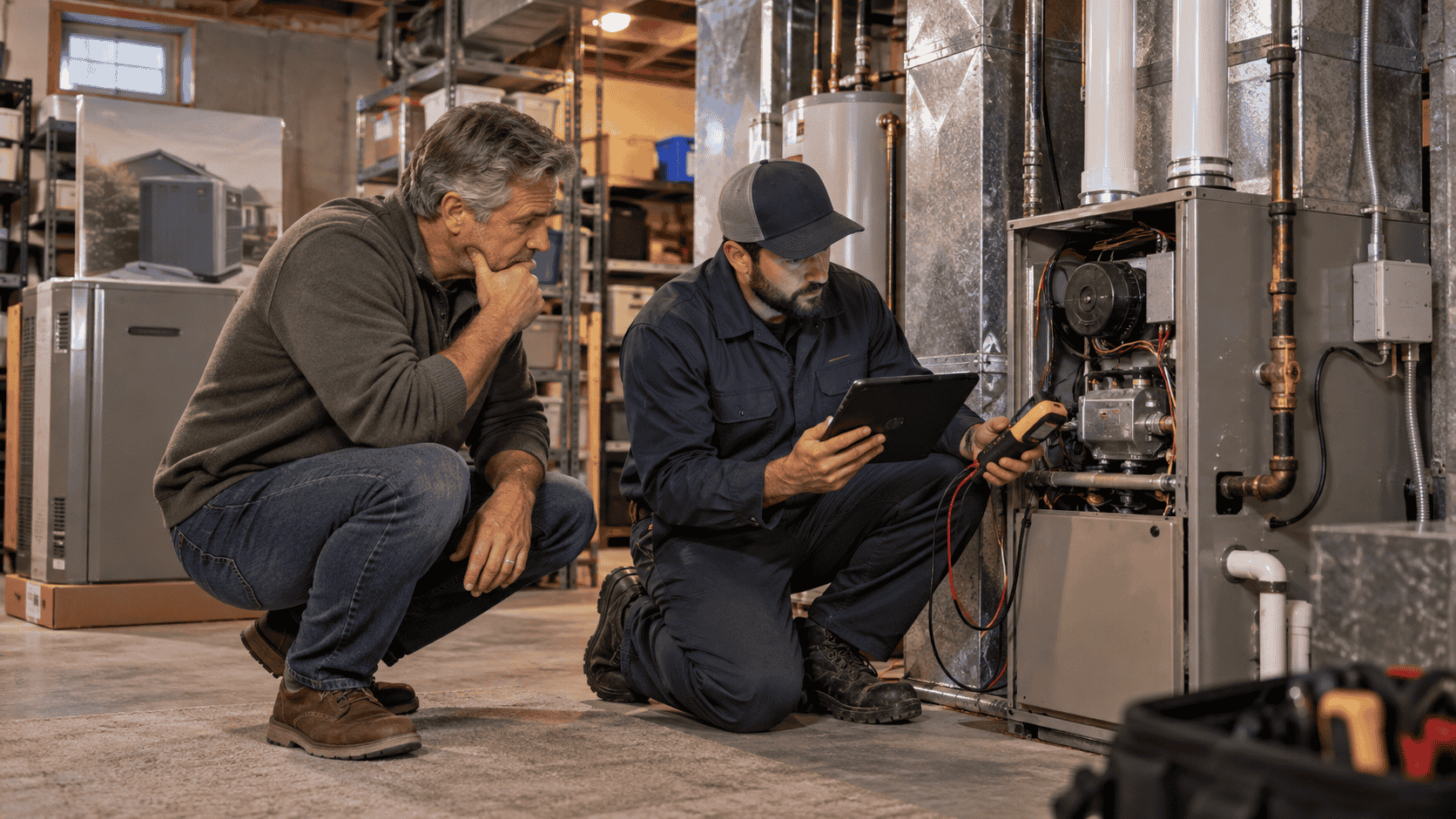
Homeowner and HVAC technician inspecting an older residential furnace while discussing whether repair or replacement makes financial sense.
When Should You Replace an Old Furnace?
Your Furnace Still Works. When Does Replacing It Save Money?
An old furnace can keep running for years—but that does not always make it cheaper to keep. Here’s how to know when repair or replacement makes financial sense.
Your Furnace Still Works. Should You Replace It Anyway?
Your furnace is 16 years old.
It still heats the house.
So replacing it now would be wasting money… right?
Not necessarily.
Age alone is a poor reason to replace a furnace—but rising fuel use, repeated repairs, bad ductwork and emergency-failure risk can completely change the math.
And there is one important 2026 change many older furnace guides still get wrong.
Reader Question
How old is your furnace—and would you repair it one more time or replace it if it failed this winter?
Research Notes
ENERGY STAR says homeowners should consider furnace or boiler replacement when equipment is more than 15 years old, particularly when it requires frequent repairs or energy bills are rising. ENERGY STAR also notes that uneven temperatures can result from equipment, duct or insulation problems rather than automatically requiring furnace replacement.
ENERGY STAR recommends addressing major house and duct air leaks before investing in new heating and cooling equipment and says improper HVAC installation can reduce system efficiency by as much as 30%.
ENERGY STAR and DOE building-science guidance recommend proper HVAC sizing based on load calculations such as ACCA Manual J rather than simple rules of thumb. Oversizing can increase cost, cause short cycling and reduce comfort.
ENERGY STAR Furnace Specification Version 5.0 became effective July 31, 2026. Current ENERGY STAR criteria require gas furnaces to achieve at least 97% AFUE in the U.S. North and 95% in the U.S. South; oil furnaces require at least 87% AFUE.
The IRS states that the Energy Efficient Home Improvement Credit under Section 25C is unavailable for qualifying property placed in service after December 31, 2025. Homeowners in 2026 should therefore verify current state, local and utility incentives rather than assuming the previous federal credit remains available.
CPSC recommends annual professional inspection of fuel-burning heating equipment and working carbon-monoxide alarms because furnaces and other combustion appliances can create dangerous CO exposure when improperly installed, maintained or vented.
Safety Note
Fuel-burning furnaces involve combustion, gas or oil, high temperatures, electricity and potentially dangerous carbon monoxide. Combustion, venting, gas-line and internal furnace repairs should be performed by appropriately qualified professionals. Never ignore a carbon-monoxide alarm.
furnace replacement, furnace repair or replace, old furnace, furnace efficiency, furnace replacement cost, high-efficiency furnace, AFUE rating, furnace energy savings, furnace lifespan, heat pump vs furnace
Furnace Replacement, HVAC, Home Heating, Energy Efficiency, Furnace Repair, Home Maintenance, Heating Costs, Heat Pumps, Home Improvement